

Quick Summary: Python enables advanced NLP analysis for semantic SEO through libraries like spaCy, NLTK, and Hugging Face Transformers. These tools extract entities, analyze search intent, cluster keywords semantically, and optimize content for topical relevance beyond traditional keyword matching. Automating these tasks with Python scripts helps sites achieve topical authority and better rankings in modern search algorithms.
Search engines evolved beyond simple keyword matching years ago. They now parse meaning, understand context, and evaluaфte topical depth. Traditional SEO tactics don’t cut it anymore.
Python changed everything for content optimization. Natural language processing libraries decode how search algorithms interpret content semantics. And the barrier to entry? Lower than most people think.
Processing raw text intelligently requires more than pattern matching. Words that look different often mean similar things. The same words in different orders convey completely different meanings. According to spaCy’s documentation, solving these problems effectively requires adding linguistic knowledge to raw character analysis.
This guide breaks down exactly how Python NLP libraries transform semantic SEO workflows. No fluff, no invented stats. Just practical implementation strategies backed by real library documentation.
Understanding NLP and Semantic SEO Fundamentals
Natural language processing teaches machines to understand human language. Semantic SEO applies that understanding to create content that matches search intent and topical expectations.
Here’s the thing though—search engines don’t just match keywords anymore. They parse entities, relationships, and context. A page about “Python programming” should naturally discuss related concepts like variables, functions, and libraries. Missing those semantic connections signals incomplete coverage.
How Search Engines Process Language Semantically
Modern search algorithms use transformer models to understand query meaning. BERT, developed by Google AI Language in 2018, serves as a foundation for solving 11+ of the most common NLP tasks including sentiment analysis and named entity recognition.
The bidirectional methodology matters. BERT analyzes context from both directions around each word, similar to how humans fill in blanks in sentences by reading surrounding text. According to Hugging Face documentation, DistilBERT offers a lighter version that runs 60% faster while maintaining over 95% of BERT’s performance.
Search engines apply these models to both queries and content. They extract entities, understand relationships, and evaluate whether content comprehensively covers a topic.
Why Traditional Keyword Research Falls Short
Keyword density optimization made sense when algorithms counted word frequency. Not anymore.
Real talk: stuffing target keywords throughout content actively hurts rankings now. Search algorithms detect unnatural language patterns. They prioritize content that covers semantic fields naturally.
A semantic approach identifies concept clusters. For a topic like “machine learning,” related terms include neural networks, training data, algorithms, and model validation. Python NLP tools extract these relationships automatically.
Use NLP for Better SEO
Using Python for NLP and semantic SEO is just one piece of a broader strategy, and LENGREO helps integrate these techniques into complete SEO frameworks that drive results. Success depends on how well content matches search intent.
- keyword clustering and intent mapping
- semantic content optimization
- scalable SEO frameworks
If you want to turn data into rankings, contact LENGREO to get started.
Essential Python Libraries for NLP and Semantic SEO
Three library ecosystems dominate Python NLP: NLTK for foundational tasks, spaCy for production pipelines, and Hugging Face Transformers for state-of-the-art models.
Each serves different use cases. Choosing the right tool depends on specific analysis needs.
NLTK: The Foundation
The Natural Language Toolkit provides comprehensive access to linguistic algorithms. It’s designed for learning NLP concepts and prototyping solutions.
Installation requires a single command:
pip install nltk
NLTK excels at text preprocessing, tokenization, and basic linguistic analysis. The learning curve starts gentle, making it accessible for those new to NLP. However, processing speed lags behind modern alternatives.
Best applications for SEO include text cleaning, stopword removal, and basic frequency analysis. The extensive documentation and educational resources make NLTK ideal for understanding NLP fundamentals before moving to production tools.
spaCy: Production-Ready Processing
According to spaCy’s official documentation, spaCy is a free, open-source library for advanced Natural Language Processing in Python. It’s built for real-world applications where performance matters.
Installation follows a two-step process:
pip install spacy
python -m spacy download en_core_web_sm
The architecture prioritizes speed. Like many NLP libraries, spaCy encodes all strings to hash values, reducing memory usage and improving efficiency. To get readable string representations of attributes, add an underscore to the attribute name.
Processing a document creates a Doc object containing tokens, entities, and syntactic relationships:
import spacy
nlp = spacy.load(‘en_core_web_sm’)
text = ‘Microsoft bought Activision for $68.7 billion on January 18’
doc = nlp(text)
for ent in doc.ents:
print(ent.text, ent.label_)
This script identifies “Microsoft” and “Activision” as organizations, “$68.7 billion” as money, and “January 18” as a date. Marketers using spaCy in Python report 25-35% faster content optimization cycles through automated synonym generation and semantic field analysis.
Hugging Face Transformers: State-of-the-Art Models
The Transformers library provides access to pre-trained models like BERT, GPT, and specialized variants. These models understand context at levels traditional algorithms can’t match.
Installation:
pip install transformers
Transformer models excel at understanding search intent, generating semantically similar phrases, and analyzing content depth. The computational requirements run higher than spaCy, but the semantic understanding quality justifies the cost for critical analyses.
For semantic search applications, transformer-based embeddings capture meaning more effectively than traditional word vectors. This enables better content gap analysis and intent matching.
| Library | Installation | Best For | Learning Curve | SEO Applications |
|---|---|---|---|---|
| NLTK | pip install nltk | Learning fundamentals | Beginner-friendly | Text preprocessing, frequency analysis |
| spaCy | pip install spacy | Production pipelines | Moderate | Entity extraction, dependency parsing |
| Transformers | pip install transformers | Advanced semantics | Advanced | Intent analysis, semantic similarity |
Named Entity Recognition for Content Optimization
Named Entity Recognition (NER) identifies and classifies entities mentioned in text. Search engines use similar techniques to understand what content discusses.
Entities include people, organizations, locations, dates, products, and more. Comprehensive entity coverage signals topical authority.
Extracting Entities with spaCy
spaCy’s pre-trained models identify entities out of the box. The process takes just a few lines of code:
import spacy
from spacy import displacy
nlp = spacy.load(‘en_core_web_sm’)
text = ‘Apple announced the iPhone 15 in Cupertino on September 12, 2023’
doc = nlp(text)
for ent in doc.ents:
print(f'{ent.text}: {ent.label_}’)
This identifies Apple as an organization, iPhone 15 as a product, Cupertino as a location, and the date. Analyzing competitor content reveals which entities they cover and which gaps exist.
Building Entity Coverage Maps
Topical authority requires mentioning relevant entities naturally. Python scripts can analyze top-ranking pages and extract entity frequency patterns.
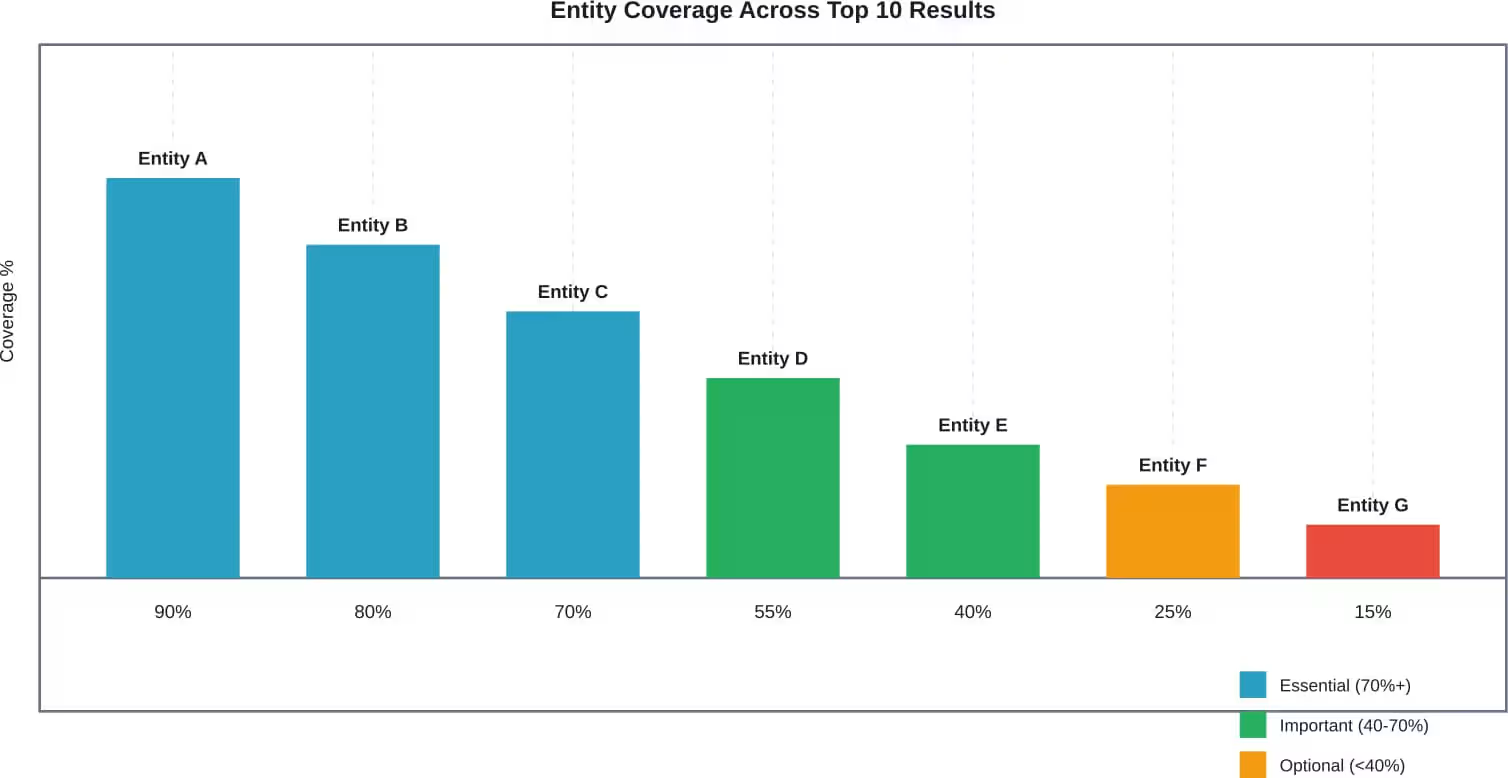
The approach works like this: scrape top 10 results for a target query, extract entities from each, count entity frequency across results, and identify entities present in 70%+ of top results.
Entities appearing in most top results represent expected topical coverage. Content missing these entities likely appears incomplete to search algorithms. Adding them naturally—without forcing mentions—strengthens semantic relevance.
Semantic Keyword Clustering with Python
Keyword clustering groups related search terms based on semantic similarity rather than just word overlap. This reveals how searchers think about topics and how content should be structured.
Traditional clustering looked at shared words. Semantic clustering analyzes meaning. “Best smartphones” and “top mobile phones” contain no shared words but express identical intent.
TF-IDF Based Clustering
Term Frequency-Inverse Document Frequency measures word importance across documents. Words appearing frequently in one document but rarely across others score high.
The technique works for initial keyword grouping:
from sklearn.feature_extraction.text import TfidfVectorizer
from sklearn.cluster import KMeans
keywords = [‘python tutorial’, ‘learn python’, ‘python guide’,
‘machine learning basics’, ‘ML introduction’, ‘start with ML’]
vectorizer = TfidfVectorizer()
X = vectorizer.fit_transform(keywords)
kmeans = KMeans(n_clusters=2)
kmeans.fit(X)
print(kmeans.labels_)
This groups keywords into clusters. The first three keywords cluster together (Python learning), while the last three group separately (machine learning introduction).
Advanced Semantic Clustering with Embeddings
Transformer-based embeddings capture semantic similarity more accurately. They understand that “automobile” and “car” mean the same thing despite different characters.
The Sentence Transformers library simplifies this:
from sentence_transformers import SentenceTransformer
from sklearn.cluster import AgglomerativeClustering
model = SentenceTransformer(‘all-MiniLM-L6-v2’)
keywords = [‘best laptops 2026’, ‘top notebooks this year’,
‘laptop buying guide’, ‘how to choose a computer’]
embeddings = model.encode(keywords)
clustering = AgglomerativeClustering(n_clusters=2)
labels = clustering.fit_predict(embeddings)
This method groups semantically similar queries even when they use completely different wording. Product comparison queries cluster separately from how-to guides.
Building Content Hubs from Clusters
Once keywords cluster semantically, structure content accordingly. Each cluster becomes a content hub with a pillar page and supporting articles.
Clusters reveal search intent patterns. Informational queries group together. Commercial intent terms form separate clusters. This informs content type selection and internal linking architecture.
Analyzing Search Intent with NLP
Search intent determines what type of content satisfies a query. Python NLP tools classify intent automatically by analyzing query patterns and top-ranking content.
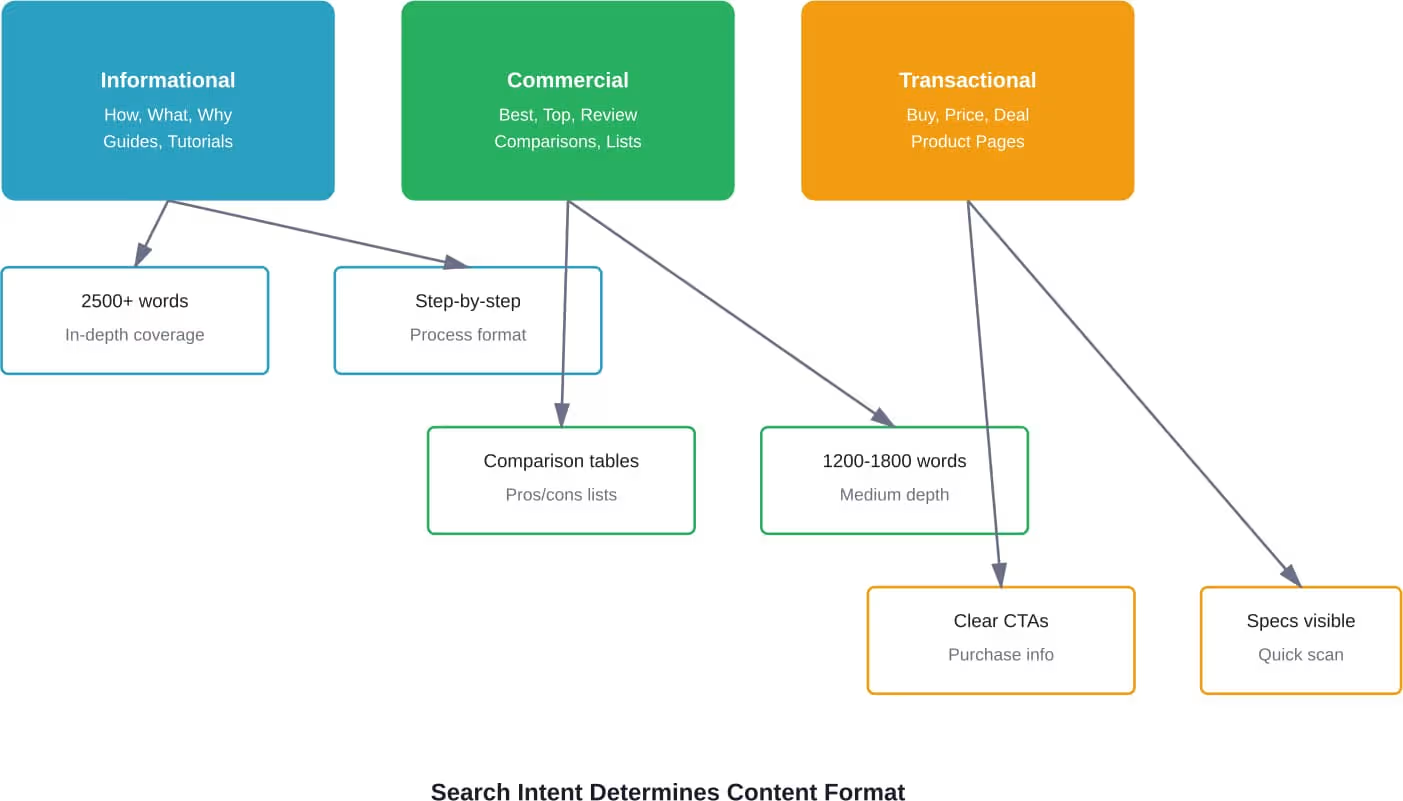
Four primary intent types exist: informational (learning), navigational (finding specific sites), commercial (researching products), and transactional (ready to buy).
Intent Classification Through Query Analysis
Query structure reveals intent. Questions starting with “how,” “what,” or “why” signal informational intent. Phrases containing “best,” “top,” or “review” indicate commercial research intent.
A simple classifier uses pattern matching:
import re
def classify_intent(query):
query_lower = query.lower()
informational_patterns = [r’^how’, r’^what’, r’^why’, r’^when’, r’guide’, r’tutorial’]
commercial_patterns = [r’best’, r’top’, r’review’, r’compare’, r’vs’]
transactional_patterns = [r’buy’, r’purchase’, r’price’, r’cheap’, r’deal’]
for pattern in transactional_patterns:
if re.search(pattern, query_lower):
return ‘Transactional’
for pattern in commercial_patterns:
if re.search(pattern, query_lower):
return ‘Commercial’
for pattern in informational_patterns:
if re.search(pattern, query_lower):
return ‘Informational’
return ‘Navigational’
print(classify_intent(‘how to learn python’)) # Informational
print(classify_intent(‘best python courses’)) # Commercial
SERP Content Analysis for Intent Validation
Top-ranking content types validate intent classification. If all top results are listicles, the query expects comparison content. If tutorials dominate, instructional content performs best.
Automated SERP analysis extracts patterns:
- Count question marks in titles (FAQ-style content)
- Identify list indicators (numbered steps, bullet points)
- Detect product mentions and prices (commercial content)
- Measure average content length (depth expectations)
Matching content format to dominant SERP patterns improves ranking potential. A detailed tutorial won’t rank for a query where searchers expect quick product comparisons.
Content Gap Analysis with Python
Content gaps represent topics competitors cover that your site misses. Identifying and filling these gaps builds topical authority and captures additional search traffic.
Manual gap analysis takes hours. Python automates the process in minutes.
Scraping Competitor Content Structures
Analyzing competitor headings reveals their topical coverage. Beautiful Soup extracts heading structures efficiently:
from bs4 import BeautifulSoup
import requests
url = ‘https://competitor.com/target-article’
response = requests.get(url)
soup = BeautifulSoup(response.content, ‘html.parser’)
headings = []
for heading in soup.find_all([‘h2’, ‘h3’]):
headings.append(heading.get_text().strip())
for h in headings:
print(h)
Run this against multiple top-ranking pages. Extract all H2 and H3 headings. Compare their topics to your existing content.
Finding Missing Topical Coverage
Once competitor headings are collected, identify common topics absent from your content. Topics appearing in 60%+ of top results but missing from your pages represent clear gaps.
A frequency analysis script counts heading topic occurrence:
from collections import Counter
import re
all_competitor_headings = [
# Headings from competitor 1
[‘Introduction’, ‘Setup Guide’, ‘Advanced Techniques’, ‘Common Errors’],
# Headings from competitor 2
[‘Getting Started’, ‘Setup Guide’, ‘Troubleshooting’, ‘Best Practices’],
# Headings from competitor 3
[‘Overview’, ‘Installation’, ‘Advanced Techniques’, ‘Common Errors’]
]
flat_headings = [h for sublist in all_competitor_headings for h in sublist]
heading_counts = Counter(flat_headings)
for heading, count in heading_counts.most_common():
percentage = (count / len(all_competitor_headings)) * 100
print(f'{heading}: {count} occurrences ({percentage:.0f}%)’)
Headings appearing frequently across competitors but missing from your content should be added. This doesn’t mean copying their structure—it means ensuring comprehensive coverage of expected subtopics.
Optimizing Content Readability and Structure
Readability affects both user engagement and search rankings. Python tools measure readability objectively and identify improvement opportunities.
Search engines consider dwell time and engagement signals. Hard-to-read content drives visitors away quickly, sending negative ranking signals.
Calculating Readability Scores
The textstat library computes standard readability metrics:
import textstat
text = ”’Your content goes here. This can be a full article
or just a section you want to analyze for readability.”’
flesch_reading_ease = textstat.flesch_reading_ease(text)
flesch_kincaid_grade = textstat.flesch_kincaid_grade(text)
print(f’Flesch Reading Ease: {flesch_reading_ease}’)
print(f’Grade Level: {flesch_kincaid_grade}’)
Flesch Reading Ease scores above 60 indicate accessible content. Scores below 30 suggest difficult reading that may lose audiences. Flesch-Kincaid Grade Level shows the US school grade needed to understand the text.
For most web content, aim for grades 8-10. Technical topics may justify higher levels, but even complex subjects benefit from clear writing.
Sentence Length and Complexity Analysis
Average sentence length impacts readability. Very long sentences tire readers. Too many short sentences feel choppy.
spaCy analyzes sentence structure:
import spacy
nlp = spacy.load(‘en_core_web_sm’)
text = ”’Your article text here.”’
doc = nlp(text)
sentence_lengths = [len(sent) for sent in doc.sents]
average_length = sum(sentence_lengths) / len(sentence_lengths)
print(f’Average sentence length: {average_length:.1f} words’)
print(f’Longest sentence: {max(sentence_lengths)} words’)
print(f’Shortest sentence: {min(sentence_lengths)} words’)
Aim for average sentence lengths between 15-20 words. Mix shorter punchy sentences with longer detailed ones. Sentences exceeding 35-40 words often confuse readers and should be split.
Building Automated SEO Content Analysis Tools
Combining NLP techniques into unified analysis tools automates repetitive optimization tasks. A single script can extract entities, classify intent, measure readability, and identify gaps.
Creating a Content Audit Script
A comprehensive audit script analyzes existing content at scale:
import spacy
import textstat
from collections import Counter
nlp = spacy.load(‘en_core_web_sm’)
def analyze_content(text):
doc = nlp(text)
# Entity extraction
entities = [(ent.text, ent.label_) for ent in doc.ents]
entity_counts = Counter([label for _, label in entities])
# Readability
readability = textstat.flesch_reading_ease(text)
grade_level = textstat.flesch_kincaid_grade(text)
# Structure
sentence_count = len(list(doc.sents))
word_count = len([token for token in doc if not token.is_punct])
return {
‘word_count’: word_count,
‘sentence_count’: sentence_count,
‘readability_score’: readability,
‘grade_level’: grade_level,
‘entity_counts’: dict(entity_counts),
‘unique_entities’: len(set([text for text, _ in entities]))
}
# Use on content
results = analyze_content(your_article_text)
print(results)
This provides actionable metrics: word count, sentence count, readability scores, entity diversity, and entity type distribution. Run it across all site content to identify underperforming pages.
Competitor Comparison Dashboard
Analyzing competitor content alongside your own reveals relative strengths and weaknesses. A comparison script processes multiple URLs:
import requests
from bs4 import BeautifulSoup
def scrape_and_analyze(url):
response = requests.get(url)
soup = BeautifulSoup(response.content, ‘html.parser’)
# Extract main content (adjust selector for target sites)
content = soup.find(‘article’).get_text()
return analyze_content(content)
competitor_urls = [
‘https://competitor1.com/article’,
‘https://competitor2.com/article’
]
for url in competitor_urls:
print(f’\nAnalyzing: {url}’)
results = scrape_and_analyze(url)
print(f”Words: {results[‘word_count’]}”)
print(f”Readability: {results[‘readability_score’]:.1f}”)
print(f”Entities: {results[‘unique_entities’]}”)
Compare your metrics to competitor averages. If competitors average 2,500 words and yours contains 1,200, expanding content depth may improve rankings. If they mention 25 unique entities and yours covers 12, increasing topical breadth could help.
| Metric | Your Content | Competitor Avg | Action Needed |
|---|---|---|---|
| Word Count | 1,850 | 2,600 | Expand coverage |
| Readability Score | 58 | 65 | Simplify language |
| Unique Entities | 14 | 22 | Add relevant entities |
| Average Sentence Length | 24 words | 18 words | Shorten sentences |
| Headings (H2+H3) | 8 | 13 | Improve structure |
Leveraging Transformers for Semantic Search
Transformer models revolutionized semantic understanding. They power modern search engines and enable advanced content optimization techniques.
According to research on semantic search, transformer-based approaches significantly outperform traditional lexical methods for information retrieval tasks.
Generating Semantic Embeddings
Embeddings convert text into numerical vectors that capture meaning. Semantically similar texts produce similar vectors, even with different wording.
Sentence Transformers generates these embeddings:
from sentence_transformers import SentenceTransformer, util
model = SentenceTransformer(‘all-MiniLM-L6-v2’)
sentences = [
‘Python is a programming language’,
‘Python is used for coding’,
‘Snakes are reptiles’
]
embeddings = model.encode(sentences)
# Calculate similarity between first and other sentences
similarity_1_2 = util.cos_sim(embeddings[0], embeddings[1])
similarity_1_3 = util.cos_sim(embeddings[0], embeddings[2])
print(f’Similarity (1-2): {similarity_1_2.item():.3f}’)
print(f’Similarity (1-3): {similarity_1_3.item():.3f}’)
The first two sentences show high similarity despite different words. The third sentence scores low similarity—correctly identifying different semantic meaning.
Finding Semantically Related Content
Embeddings identify related articles for internal linking. Convert all site articles to embeddings, then find pieces with high semantic similarity.
This reveals natural linking opportunities that strengthen topical clusters:
articles = [
{‘title’: ‘Python Basics’, ‘text’: ‘Introduction to Python programming…’},
{‘title’: ‘Advanced Python’, ‘text’: ‘Advanced Python techniques…’},
{‘title’: ‘JavaScript Guide’, ‘text’: ‘Learning JavaScript fundamentals…’}
]
embeddings = model.encode([a[‘text’] for a in articles])
# Find articles similar to first one
target_embedding = embeddings[0]
similarities = [util.cos_sim(target_embedding, emb).item() for emb in embeddings[1:]]
for i, sim in enumerate(similarities, 1):
print(f”{articles[i][‘title’]}: {sim:.3f}”)
Articles with similarity scores above 0.6-0.7 make strong internal link candidates. This builds semantic content clusters that demonstrate topical expertise to search engines.
Local SEO Enhancement with NLP
Location-based searches require specific semantic optimization. Python NLP extracts location entities and ensures proper geographic context.
Extracting Geographic Entities
spaCy identifies location mentions automatically:
import spacy
nlp = spacy.load(‘en_core_web_sm’)
text = ‘Visit our offices in Seattle, Portland, and San Francisco’
doc = nlp(text)
locations = [ent.text for ent in doc.ents if ent.label_ == ‘GPE’]
print(f’Locations mentioned: {locations}’)
GPE (Geo-Political Entity) captures cities, states, and countries. FAC captures facilities and buildings.
For local SEO, ensure location entities appear naturally throughout content. Service pages should mention served cities, neighborhoods, and regional landmarks.
Analyzing Local Search Intent
Local queries often include implicit location intent without explicit location words. “Coffee shops” implies “coffee shops near me.”
Analyzing SERPs for queries reveals when search engines apply local intent:
- Map packs in results indicate local intent
- Business listings dominate rankings
- Results vary by searcher location
Content targeting these queries needs strong local signals: address mentions, service area descriptions, and locally relevant entities.
Monitoring Semantic Rankings and Performance
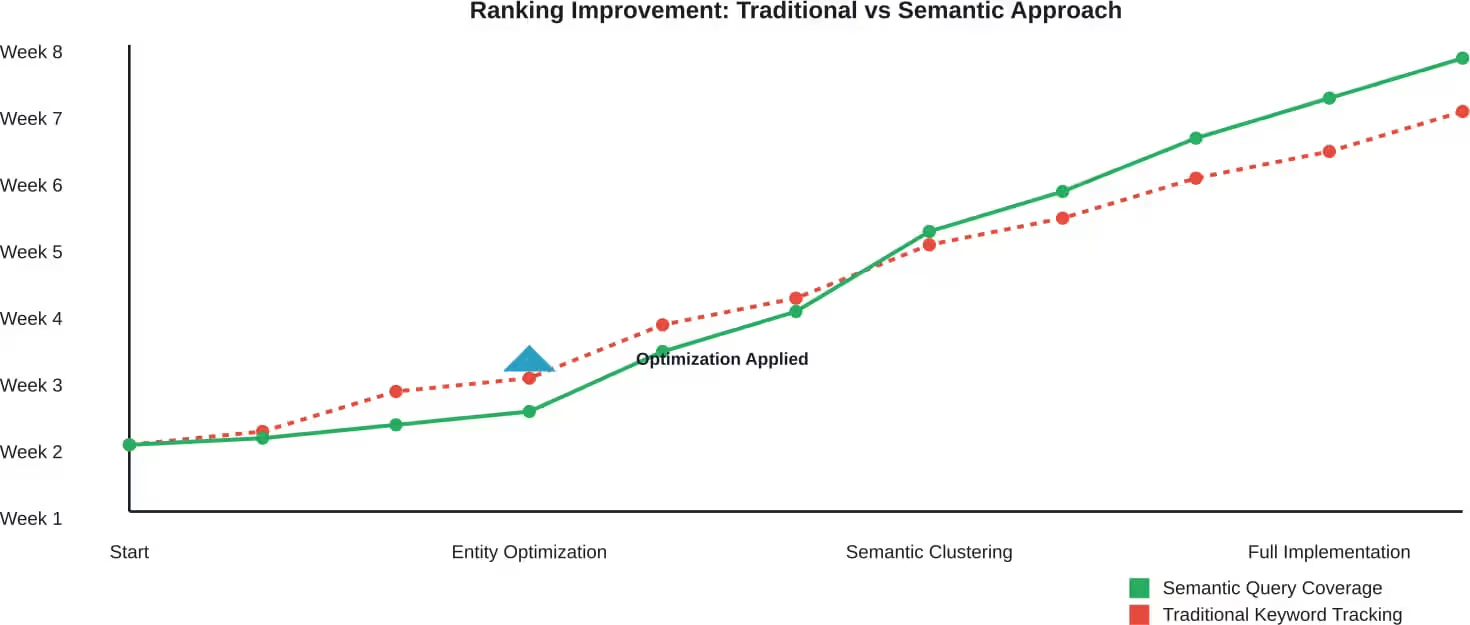
Tracking semantic SEO success requires different metrics than traditional keyword tracking. Monitor topical authority signals, entity visibility, and semantic traffic growth.
Entity-Based Rank Tracking
Instead of tracking individual keywords, monitor how well content ranks for entity-related queries. If targeting the “Python programming” entity, track rankings for:
- Core entity queries (“Python programming”)
- Related entity queries (“Python tutorials,” “Python libraries”)
- Long-tail semantic variations
Improved entity association drives traffic across multiple related queries, not just target keywords.
Content Performance Analysis
Compare content metrics before and after semantic optimization:
- Average time on page (engagement improvement)
- Pages per session (internal link effectiveness)
- Bounce rate (relevance matching)
- Impressions for related queries (topical authority expansion)
Semantic optimization typically increases traffic breadth—the number of different queries driving visits—rather than just volume.
Common Python NLP SEO Workflows
Effective implementation combines multiple techniques into repeatable workflows. These processes turn isolated scripts into systematic optimization approaches.
New Content Creation Workflow
Before writing new content:
- Scrape top 10 ranking pages for target query
- Extract entities from all pages using spaCy
- Identify common entities (70%+ presence)
- Cluster related keywords semantically
- Analyze SERP content structure (headings, format)
- Determine dominant search intent
- Calculate average content length and readability
Create content that matches format expectations, covers expected entities, and addresses identified intent. This data-driven approach reduces guesswork.
Existing Content Optimization Workflow
For underperforming existing content:
- Run readability analysis (identify sentences to simplify)
- Extract current entity coverage
- Compare to competitor entity coverage
- Identify missing entities from top results
- Check semantic similarity to top-ranking content
- Find internal linking opportunities via embeddings
- Update content with gaps filled
This systematic approach ensures optimization addresses actual deficiencies rather than making random changes.
Implementation Best Practices and Considerations
Successful Python NLP implementation requires balancing automation with editorial judgment. Scripts provide data-driven insights, but content quality ultimately depends on human expertise.
Data Quality Matters
Automated analysis quality depends entirely on input data quality. Scraping competitor content requires accurate content extraction—excluding navigation, ads, and footers. Many sites structure content differently, requiring customized extraction logic.
Test scripts on small samples before running at scale. Verify entity extraction accuracy manually. Check that readability calculations reflect actual reading difficulty. Bad input data produces misleading analysis.
Don’t Over-Optimize
NLP tools reveal optimization opportunities, but cramming every identified entity into content creates unnatural writing. Prioritize the most relevant entities and topics. Not every semantic gap requires filling.
Search engines detect over-optimization patterns. Content stuffed with entities for manipulation purposes performs poorly. Natural coverage of genuinely relevant concepts works better than forced mentions.
Combine Automated Analysis with Human Judgment
Python scripts identify what topics competitors cover and which entities they mention. Human editors determine how to address those topics naturally and whether they actually matter for the target audience.
Automated readability scores provide guidance, but context matters. Technical content for expert audiences legitimately uses complex language. Simplification isn’t always appropriate.
Keep Models Updated
NLP libraries and models update frequently. spaCy releases new versions with improved accuracy. Transformers adds new pre-trained models regularly. Periodically updating dependencies ensures access to improvements.
Model updates may change output slightly. Test updated versions before deploying to production workflows to understand any behavioral changes.
Moving Forward with Python NLP for SEO
The semantic web continues evolving. Search algorithms grow more sophisticated at understanding context and evaluating expertise. Python NLP tools provide the analytical capabilities needed to keep pace.
Start with simple implementations. Extract entities from top-ranking content. Calculate readability for existing pages. Build from there as comfort with the tools grows.
The competitive advantage comes from consistent application, not perfect scripts. Sites that systematically apply semantic analysis to content planning and optimization compound advantages over time.
Search engines reward comprehensive, well-structured content that demonstrates topical expertise. Python NLP automates finding what comprehensive coverage looks like for any topic. The rest is execution.
Implementation doesn’t require data science teams or complex infrastructure. The libraries discussed run on any computer. A few hundred lines of Python code can transform content workflows.
The semantic future of search is already here. Tools that seemed cutting-edge a few years ago are now table stakes. Sites that master these techniques establish topical authority that traditional keyword tactics can’t match.
Start building your Python NLP toolkit today. Extract those entities. Cluster those keywords. Analyze that content structure. The data will show you exactly what comprehensive topical coverage looks like.