


Quick Summary: Modern lenders need diverse marketing strategies to stand out in 2026’s competitive landscape. This guide covers proven digital and traditional marketing tactics—from social media and video content to community partnerships and referral programs—that help mortgage lenders, private lenders, and loan officers generate quality leads while maintaining compliance with federal regulations.
The lending industry has changed dramatically over the past few years. Competition intensified, digital channels exploded, and borrowers became more sophisticated in how they research and choose lenders. Traditional marketing approaches don’t cut it anymore.
Lenders who thrive in 2026 combine digital marketing savvy with relationship-building fundamentals. They show up where borrowers are looking, provide genuine value before asking for business, and create systems that turn one-time clients into referral engines.
Here’s the thing though—marketing for lenders isn’t about trying every tactic under the sun. It’s about selecting strategies that fit your market, your strengths, and your compliance requirements, then executing them consistently.
Build Your Digital Foundation First
Before launching campaigns or creating content, lenders need a solid digital infrastructure. This foundation determines whether every other marketing effort succeeds or fails.
Create or Refresh Your Website
A professional website serves as the hub for all marketing activities. Borrowers research lenders online before making contact, and a dated or confusing website kills conversions immediately.
The site should load quickly, work flawlessly on mobile devices, and make it obvious what services are offered. Include clear calls-to-action on every page—phone numbers, contact forms, and pre-qualification tools.
Most importantly, the website needs content that answers common borrower questions. Rate information, loan type explanations, and qualification requirements should be easy to find. Adding a mortgage calculator or similar tool gives visitors a reason to stay longer.
Complete and Optimize Your Google Business Profile
When potential borrowers search for lenders in their area, Google Business Profile listings appear prominently in results. Claiming and optimizing this free profile can generate substantial local leads.
Fill out every section completely—business hours, service area, loan types offered, and contact information. Add high-quality photos of the office and team. The description should include relevant keywords naturally while explaining what makes this lender different.
Regular updates matter too. Post weekly content like market updates, new loan products, or client success stories. Respond to every review, positive or negative, to demonstrate engagement and professionalism.
Establish Email Signature Branding
Every email sent represents a marketing opportunity. A professional email signature should include name, title, company, phone number, and website link at minimum.
But lenders can push this further. Add a professional headshot, social media icons, and a rotating call-to-action banner. That banner might promote current rates, highlight a blog post, or encourage referrals. Since loan officers send dozens of emails daily, these small touches accumulate significant visibility over time.
Organize Lending Marketing System With Lengreo
Lenders need marketing that clearly explains products, eligibility, and application steps while generating actionable inquiries. Lengreo integrates website development, SEO, paid ads, content, lead generation, appointment setting, and tracking into one connected system.
This makes it easier to reach qualified borrowers and measure campaign performance.
Need More Qualified Loan Leads?
Lengreo can help with:
- refining service, product, and contact pages
- setting up SEO and paid traffic campaigns
- tracking applications, calls, and lead sources
- supporting content and lead generation workflows
👉 Contact Lengreo to discuss your marketing setup.
Content Marketing Strategies That Build Trust
Content marketing positions lenders as knowledgeable experts while providing genuine value to potential borrowers. This approach builds trust before a sales conversation ever happens.
Launch a Consistent Blog
Regular blog posts improve search engine rankings while demonstrating expertise. The key word is “regular”—sporadic posting doesn’t work. Aim for at least two quality posts monthly.
Topics should address real questions borrowers ask. First-time homebuyer guides, explanation of loan types, credit score improvement tips, and local market analyses all work well. Write for actual humans, not search engines, but include relevant keywords naturally.
Each post should include a clear next step—contact the lender for personalized advice, download a buyer’s guide, or schedule a consultation. Content without conversion opportunities wastes effort.
Create Video Content
Industry reports indicate that 86% of marketers use video as a marketing tool, with the same percentage believing video successfully generates leads. Online video continues to dominate web traffic in 2026.
Lenders don’t need expensive equipment or professional editing. Smartphone videos work fine for most content. The focus should be on value—market updates, loan process explanations, tips for home buyers, or answers to frequently asked questions.
Short-form video performs particularly well on social platforms. A 60-second explanation of rate locks or closing costs reaches more people than a five-page article on the same topic. Post these consistently across social channels, the website, and email campaigns.
Go Live on Social Platforms
Live video creates authentic connection and urgency. Facebook Live, Instagram Live, and LinkedIn Live all offer opportunities to engage with potential borrowers in real time.
Host weekly or monthly live sessions covering topics like current market conditions, new loan programs, or Q&A sessions where viewers ask questions about the lending process. The informal nature of live video makes lenders more approachable while demonstrating expertise.
Promote live sessions in advance through email and social posts, then repurpose the recorded video afterward. One live session becomes multiple pieces of content.
Social Media Marketing for Lenders
Social media offers direct access to potential borrowers, referral partners, and past clients. But different platforms serve different purposes for lenders.
Develop a LinkedIn Presence
LinkedIn works exceptionally well for connecting with real estate agents, financial advisors, and other referral sources. It’s also where many professionals research business partners, including lenders.
Create a complete professional profile with a quality headshot, detailed work history, and certifications. Join local real estate and business groups. Share industry news, market insights, and helpful content regularly—at least three times weekly.
Engage authentically with others’ content. Comment thoughtfully on posts from real estate agents, CPAs, and other professionals in the lending ecosystem. These interactions build relationships that lead to referrals.
Post Consistently Across Platforms
Consistency matters more than volume. Posting daily for two weeks then disappearing for a month accomplishes nothing. Better to post twice weekly on a predictable schedule.
Content should mix education, market updates, personal touches, and community involvement. Share rate trends, explain loan programs, highlight local events, and occasionally post team photos or personal milestones. This variety keeps feeds interesting while building personal connection.
According to FTC guidance on endorsements and advertising, any material connections must be disclosed clearly. When sharing client testimonials or working with influencers, transparency about the relationship is legally required and builds trust.
Create Platform-Specific Content
Each social platform has its own culture and content preferences. Facebook users engage with longer posts and community content. Instagram demands visual appeal and stories. LinkedIn prefers professional insights and industry news.
Adapt content for each platform rather than posting identical material everywhere. A market analysis might be a detailed LinkedIn article, an infographic on Instagram, and a live video discussion on Facebook.
Building a Referral Engine
Most lending business comes through referrals—from real estate agents, past clients, or professional networks. Smart marketing prioritizes and nurtures these relationships.
Develop Real Estate Agent Partnerships
Real estate agents represent the most valuable referral source for most lenders. Building strong agent relationships requires consistent effort and genuine value.
Attend local real estate events, open houses, and continuing education sessions. Offer to co-host events—sponsor an agent’s client appreciation event or host a homebuyer seminar together. Provide agents with market data, pre-qualification letters within hours, and exceptional communication throughout the loan process.
Community discussions consistently emphasize that face-to-face interaction matters most. Coffee meetings, lunch-and-learns at brokerages, and joint marketing events build stronger relationships than digital outreach alone.
Create an “Everything We Offer” Sheet
Referral partners often don’t know the full range of loan products available. A simple one-page overview listing every loan type offered—conventional, FHA, VA, USDA, jumbo, renovation loans, portfolio products—helps partners match clients appropriately.
Include this sheet in agent presentations, email it to CPAs and financial advisors, and keep copies in the office. When someone thinks they have a borrower who won’t qualify for conventional financing, they’ll check the sheet and remember those portfolio options.
Implement a Past Client Nurture System
Past clients represent the most underutilized marketing asset most lenders have. These people already trust the lender, have positive experiences, and know others who might need loans.
Send monthly value-add emails—home maintenance tips, market updates, refinance opportunities, or local event information. Mail birthday cards, home anniversary cards, or holiday greetings. Check in quarterly by phone just to see how they’re doing, without pushing for business.
This consistent contact keeps the lender top-of-mind when past clients’ friends mention house hunting. It also generates refinance opportunities when rates shift or equity builds.
Local Community Marketing
Lenders are local businesses serving specific communities. Local visibility builds trust and generates leads that national online lenders can’t access.
Sponsor and Attend Local Events
Community sponsorships put the lender’s name in front of local residents while supporting worthwhile causes. Youth sports teams, charity runs, school fundraisers, and community festivals all offer sponsorship opportunities at various price points.
But sponsorship alone isn’t enough. Attend these events personally. Set up a booth, hand out information, and talk with attendees. The face-to-face connections matter more than the banner.
Teach Financial Education Classes
Offering free financial education positions lenders as community resources rather than just salespeople. First-time homebuyer classes, credit improvement workshops, or personal finance seminars provide genuine value while building trust.
Partner with libraries, community centers, or churches to host these sessions. Promote them through social media, local newspapers, and partner organizations. Attendees become warm leads who already view the lender as a helpful expert.
Join Local Business Organizations
Chambers of commerce, BNI chapters, and other business networking groups create opportunities to meet potential referral partners. Attorneys, CPAs, financial advisors, and real estate agents all attend these meetings.
Participate actively rather than just showing up. Volunteer for committees, sponsor events, and give presentations when appropriate. The goal is building genuine relationships, not collecting business cards.
Paid Advertising Strategies
Organic marketing builds sustainable lead flow, but paid advertising can accelerate results when executed strategically.
Google Ads for Local Intent
Search advertising captures people actively looking for lenders. Someone searching “mortgage lender near me” or “best mortgage rates in [city]” has immediate intent.
Focus campaigns on local geographic areas and specific loan types. Broad national campaigns waste budget competing against huge online lenders. Tight geographic targeting and specific landing pages convert better.
Landing pages must match the ad promise exactly. An ad about VA loans should land on a VA loan page, not the homepage. Include clear contact forms, phone numbers, and next-step instructions.
Facebook and Instagram Lead Ads
Social media advertising works differently than search ads. People aren’t actively looking for lenders, so interruption-based ads need compelling hooks.
Lead ads allow users to submit information without leaving the platform, reducing friction significantly. Offer something valuable in exchange—a first-time buyer guide, rate quote, or pre-qualification.
Target specific audiences based on demographics, life events, and behaviors. New movers, recently engaged people, and those who’ve shown interest in real estate all make sense for lender campaigns.
Purchase Mortgage Leads Strategically
Lead generation companies sell mortgage leads, but quality varies dramatically. Some leads are exclusive and fresh; others have been sold to a dozen lenders and are weeks old.
If purchasing leads, start small to test quality. Track conversion rates meticulously. Aged mortgage leads—older leads sold at lower prices—can work for patient lenders with strong follow-up systems, but they require different expectations than fresh exclusive leads.
Real talk: most successful lenders generate more business through organic marketing and referrals than through purchased leads. Leads should supplement, not replace, relationship marketing.
Email Marketing That Works
Email remains one of the highest-ROI marketing channels when done correctly. The key is providing value consistently, not just sending rate sheets.
Segment Email Lists Appropriately
Different audiences need different content. Past clients want refinance opportunities and home maintenance tips. Real estate agents need market data and process updates. Prospective buyers want educational content and qualification information.
Segment lists by audience type and customize content accordingly. A one-size-fits-all email blast converts poorly compared to targeted, relevant messages.
Provide Value in Every Email
Nobody wants another rate sheet email. Provide actionable information—market trend analysis, policy changes that affect buyers, home maintenance checklists, local event roundups, or answers to common questions.
Include one clear call-to-action per email. Too many options overwhelm recipients and reduce click-through rates. Make it obvious what action the reader should take next.
Maintain Consistent Contact
Monthly emails keep lenders top-of-mind without overwhelming recipients. More frequent emails work for some audiences—weekly market updates for real estate agents, for example—but most contacts appreciate monthly rhythm.
Consistency matters more than frequency. Monthly emails sent reliably build stronger awareness than sporadic campaigns with no predictable schedule.
Compliance Considerations in Lender Marketing
Lenders face stricter regulatory oversight than most industries. Marketing must comply with various federal and state regulations or face significant penalties.
Truth in Lending and Regulation Z
Federal Reserve regulations govern how lenders advertise rates and terms. Any advertisement that mentions specific rates must include additional disclosures—APR, payment amounts, and terms.
While the Credit Practices Rule has no dollar cutoff unlike Regulation Z’s $25,000 threshold for certain requirements, lenders should consult compliance officers before launching rate-based advertising to ensure all necessary disclosures appear correctly.
Fair Lending Laws
Marketing materials and targeting cannot discriminate based on protected classes. Fair Housing Act requirements apply to mortgage marketing just as they do to lending decisions themselves.
Review advertising targeting and messaging to ensure nothing suggests preference or discrimination based on race, religion, national origin, familial status, or other protected characteristics.
Endorsement and Testimonial Guidelines
The FTC’s endorsement guides apply to lender marketing. When using client testimonials or working with influencers, material connections must be disclosed. Even small incentives—the FTC specifically mentions that compensation as minimal as a one-dollar-off coupon requires disclosure.
According to FTC guidance, disclosure requirements apply regardless of format—written reviews, video testimonials, or social media posts all require clear disclosure of any material relationship between the endorser and the lender.
| Marketing Channel | Startup Cost | Time to Results | Best For |
|---|---|---|---|
| Social Media Organic | Free | 2-4 months | Brand building, community engagement |
| Google Business Profile | Free | 1-2 months | Local search visibility |
| Content Marketing | Low | 3-6 months | SEO, authority building |
| Real Estate Partnerships | Low | 1-3 months | Consistent referral flow |
| Email Marketing | Low | 1-2 months | Nurturing past clients |
| Google Ads | Medium-High | Immediate | Capturing active shoppers |
| Community Sponsorships | Medium | 3-6 months | Local brand recognition |
Marketing Tools and Technology
The right technology stack makes marketing more efficient and measurable. Lenders don’t need dozens of tools, but a few strategic investments pay dividends.
CRM Systems
Customer relationship management systems track every interaction with prospects, clients, and referral partners. They automate follow-up, segment contacts, and ensure nobody falls through the cracks.
CRMs designed specifically for mortgage lenders include features like automated drip campaigns for different loan stages, real estate agent relationship management, and compliance-friendly communication tracking.
Design Tools for Non-Designers
Professional-looking graphics matter on social media and in marketing materials. Tools like Canva offer templates specifically for financial services, making it easy to create branded content without graphic design skills.
Subscriptions cost around $12.99 monthly for full access to template libraries, stock photos, and brand kit features that maintain consistency across all marketing materials. Upload brand colors, fonts, and logos once, then every design automatically matches brand standards.
Email Marketing Platforms
Dedicated email platforms provide templates, automation, list segmentation, and analytics that personal email accounts can’t match. They also maintain better deliverability rates and comply with CAN-SPAM requirements automatically.
Look for platforms with mortgage-specific templates and the ability to segment lists by client type, loan status, and engagement level. Automation features should handle birthday emails, loan anniversary messages, and nurture sequences without manual intervention.
Measuring Marketing Effectiveness
Marketing without measurement wastes resources. Track specific metrics to understand what’s working and what isn’t.
Lead Source Tracking
Ask every new lead how they heard about the lender. Track this information consistently in the CRM. Over time, patterns emerge showing which marketing activities generate the most and best leads.
Some sources produce volume but low conversion rates. Others generate fewer leads but higher quality. Both metrics matter when allocating marketing budget and effort.
Cost Per Acquisition
Calculate the total cost of each marketing channel divided by closed loans from that source. A networking group with $500 annual dues that generates two closings costs $250 per acquisition. Google Ads spending $2,000 monthly that produces six closings costs approximately $333 per acquisition.
Compare these costs against loan revenue to determine ROI. Some high-cost channels make sense if they produce high-value loans.
Referral Partner Productivity
Track which real estate agents, CPAs, and other referral partners actually send business. The 80/20 rule usually applies—80% of referrals come from 20% of partners.
Focus relationship-building efforts on productive partners and those showing strong potential. Not every referral relationship deserves equal time investment.
Common Marketing Mistakes to Avoid
Understanding what doesn’t work saves time and money. These mistakes appear repeatedly among struggling lenders.
Inconsistent Execution
The biggest marketing mistake is inconsistency. Starting a blog and abandoning it after three posts. Posting on social media for a month then going silent for six weeks. Attending networking events sporadically.
Marketing requires sustained effort over time. Results compound. The lender who shows up consistently for a year builds dramatically more awareness than one who tries harder but quits after two months.
No Clear Differentiation
Generic marketing that could apply to any lender wastes opportunities. “Great rates and service” describes every lender in existence. Find something specific and different—specialization in a loan type, expertise with a particular buyer type, unique process advantages, or exceptional communication standards.
Differentiation becomes the foundation for all messaging. It gives referral partners and borrowers a reason to choose this lender over dozens of alternatives.
Ignoring Past Clients
Most lenders spend enormous effort acquiring new clients while ignoring the gold mine sitting in their database. Past clients who had positive experiences will refer friends and return for future loans—if they remember the lender exists.
A simple monthly email to past clients costs almost nothing and generates steady referral and refinance business. This might be the highest-ROI marketing activity available.
Getting Started With Marketing
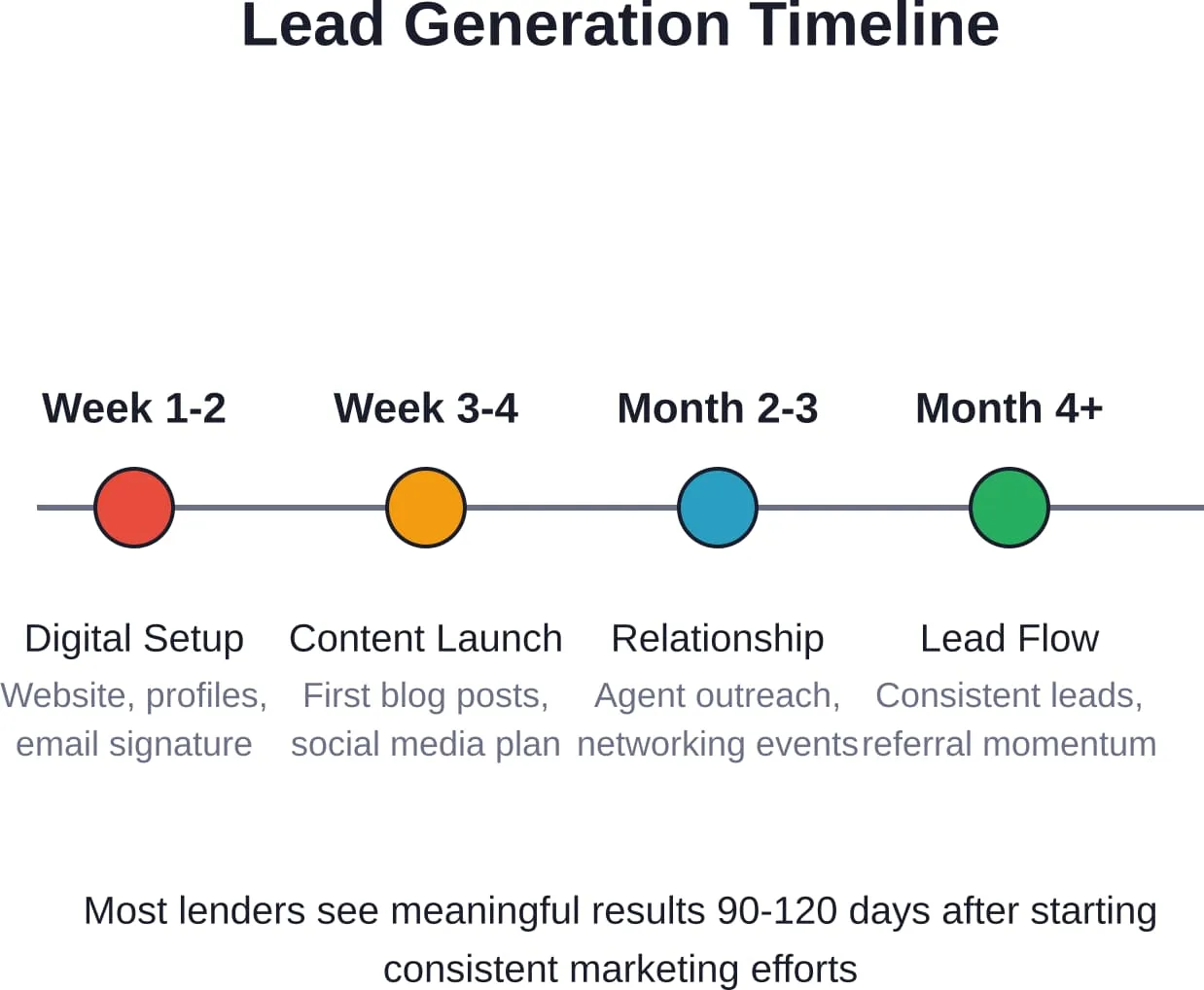
Comprehensive marketing plans can feel overwhelming. The solution is sequential implementation rather than trying everything simultaneously.
- Start with digital foundation elements—website updates, Google Business Profile optimization, email signature, and basic social profiles. These provide infrastructure for everything else.
- Next, choose one content marketing channel and commit to it for 90 days minimum. Pick blogging, video, or social media and execute consistently. Add other channels only after establishing rhythm with the first.
- Simultaneously, begin systematic relationship building with real estate agents and past clients. These high-value activities should happen weekly regardless of what else is going on.
- Layer in paid advertising only after organic channels are functioning. Ads amplify existing marketing efforts but shouldn’t replace relationship marketing fundamentals.
The timeline is longer than most lenders prefer. Meaningful results typically appear 90-120 days after starting consistent marketing efforts. But those results compound over time, creating sustainable lead flow that doesn’t depend on purchased leads or unpredictable market conditions.
Final Thoughts
Marketing for lenders isn’t about tricks or hacks. It’s about showing up consistently, providing genuine value, building real relationships, and earning trust over time.
The lenders who thrive combine modern digital marketing with old-school relationship fundamentals. They create helpful content, maintain visibility on social platforms, nurture past clients systematically, and invest time building referral partnerships face-to-face.
Start with one or two strategies that fit your strengths and market. Execute them consistently for at least 90 days before evaluating results or adding new tactics. Marketing success comes from sustained effort, not from trying everything simultaneously.
Track what works in your specific market. Implement systems that make marketing activities sustainable rather than sporadic. And remember—the best marketing investment is often exceptional service that turns every client into a referral source.
Ready to transform your lending business? Choose three strategies from this guide and commit to implementing them consistently for the next 90 days. Document your lead sources, track your results, and adjust based on what the data shows. The lenders who take action today will dominate their markets tomorrow.