


Quick Summary: Digital transformation in insurance represents a fundamental shift from legacy systems to AI-driven, cloud-based platforms that enhance customer experience, automate claims processing, and enable data-driven risk assessment. According to recent industry surveys, 74% of insurers prioritized digital transformation in 2025, with 96% of insurance CEOs acknowledging that COVID-19 accelerated their digital initiatives. Successful implementation requires strategic visioning, robust change management, and organizational commitment to overcome integration challenges and regulatory complexities.
The insurance industry isn’t what it used to be. Gone are the days when paper forms and face-to-face meetings dominated every transaction. Today’s insurers face mounting pressure from multiple directions: customers demanding seamless digital experiences, emerging technologies reshaping operational capabilities, and competitive threats from agile insurtech startups.
But here’s the thing—digital transformation in insurance isn’t primarily a technology challenge. It’s fundamentally about organizational change, strategic vision, and getting people to embrace new ways of working. The technology exists. The real question is whether insurance companies can successfully implement it.
In 2025, 74% of insurers made digital transformation their top priority. That’s not surprising when you consider that 96% of insurance CEOs reported the pandemic accelerated their digitization efforts. The momentum has never been stronger.
Understanding Digital Transformation in the Insurance Sector
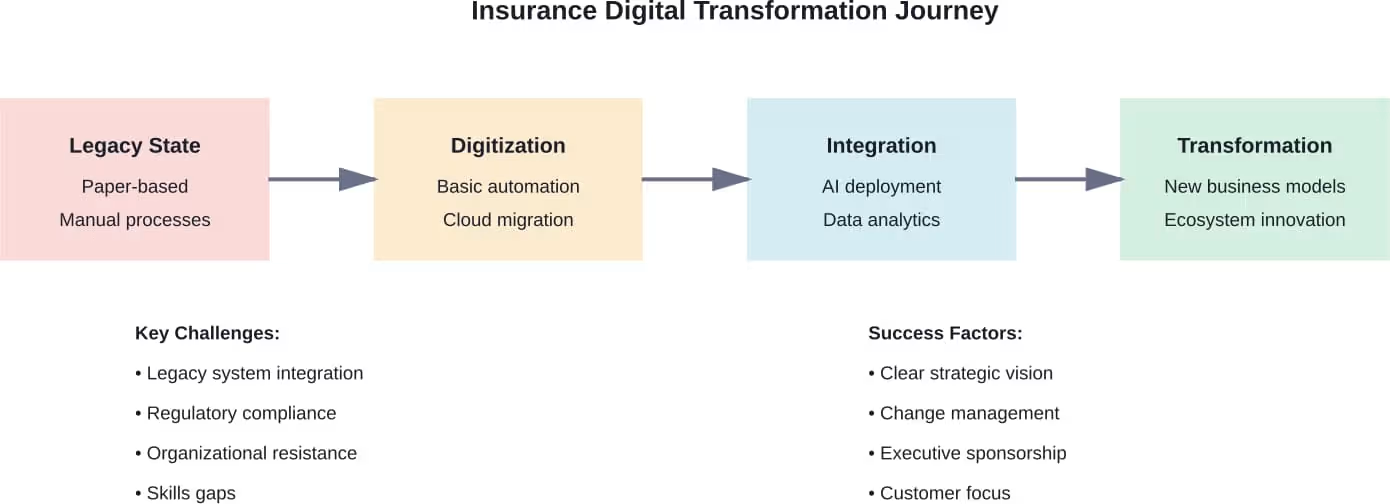
Digital transformation in insurance extends far beyond simply digitizing existing processes. It represents a comprehensive reimagining of core products, customer service models, operational processes, and entire business strategies.
Traditional insurance operations relied heavily on manual underwriting, paper-based claims processing, and in-person customer interactions. The digital transformation journey replaces these legacy approaches with cloud platforms, artificial intelligence, big data analytics, and automation technologies that fundamentally change how insurers compete and deliver value.
Over the next three years, AI and data analytics alone are expected to dramatically reshape insurance operations. But technology adoption represents just one component of a much broader organizational shift.
What Makes Insurance Transformation Different
Insurance companies operate under unique constraints that complicate digital transformation efforts. Regulatory compliance requirements vary significantly across jurisdictions, creating complex implementation challenges. Legacy systems often contain decades of historical data that can’t simply be abandoned or easily migrated.
The academic research on visioning in insurance transformation reveals something interesting: digital transformation destination becomes much easier when a clear vision is communicated throughout the organization. Without strategic clarity, transformation initiatives fragment into disconnected technology projects that fail to deliver meaningful business outcomes.
Transform Insurance Processes With LENGREO
Digital transformation in insurance involves automating workflows, improving customer journeys, and adapting to changing market expectations. At the same time, companies need a reliable way to generate high quality leads.
LENGREO supports insurance companies with marketing strategies focused on lead generation and revenue growth.
Services include:
- SEO and content marketing
- outreach campaigns and appointment setting
- paid acquisition and campaign management
- demand generation and funnel optimization
If you want to support digital transformation with consistent pipeline growth, get a free consultation with LENGREO.
AI and Automation Leading the Charge
Artificial intelligence has moved from experimental technology to mainstream operational tool across the insurance industry. According to the National Association of Insurance Commissioners (NAIC), 84% of health insurers report they currently utilize artificial intelligence and machine learning (AI/ML) in some capacity.
The NAIC’s Artificial Intelligence and Machine Learning (AI/ML) Survey Report, announced on May 20, 2025, explored key areas including the extent of AI/ML adoption, the involvement of third-party developers, the structure of AI governance frameworks, and how these frameworks align with the NAIC’s AI Principles and Model Bulletin. The findings reveal widespread implementation across claims resolution, customer service, and underwriting processes.
Claims Processing Transformation
Global insurers increasingly turn to digital solutions to address significant claims resolution challenges. Supply chain disruptions, rising inflation, and geopolitical tensions have complicated the ability to process claims efficiently, according to Gallagher Bassett research.
In response to these challenges, a majority (54%) of insurers have focused on implementing digital claims processing, which streamlines the claims process and reduces reliance on physical documentation. AI chatbots, data analytics platforms, and automated decision-making tools now handle routine claims that previously required extensive manual review.
Hurricane Helene demonstrated both the scale of insurance challenges and the potential for innovation. The event was estimated to be a $50 billion event, with an estimated 95% of losses going uninsured, according to Majesco. These catastrophic events highlight the urgent need for more accessible, efficient insurance models enabled by digital transformation.
Customer Experience Innovation
New digital engagement models attract and educate customers in ways traditional insurance marketing never could. Interactive tools, personalized recommendations, and seamless omnichannel experiences have become baseline expectations rather than competitive differentiators.
Customers now expect insurance interactions to match the convenience they experience with other digital services. Mobile apps for policy management, instant claims updates, chatbot support for routine questions, and AI-driven policy recommendations represent just the starting point.
Strategic Implementation Considerations
Technology capabilities matter less than implementation strategy. Insurance companies that rush into digital transformation without proper planning often end up with fragmented systems, frustrated employees, and disappointed customers.
| Implementation Phase | Key Activities | Common Pitfalls |
|---|---|---|
| Assessment | Evaluate current capabilities, identify gaps, define vision | Underestimating legacy system complexity |
| Planning | Develop roadmap, secure resources, establish governance | Lack of executive sponsorship |
| Pilot | Test solutions, gather feedback, refine approaches | Choosing overly ambitious pilot scope |
| Scaling | Deploy across organization, manage change, measure results | Insufficient change management support |
| Optimization | Continuous improvement, capability building, innovation | Declaring victory too early |
The Role of IT Sourcing
According to discussions between executives from TCS and Swiss Re published in MIT Sloan Management Review, IT sourcing strategy plays a crucial role in insurance digital transformation success. The rapidly changing technology landscape requires insurers to carefully balance build-versus-buy decisions and partner selection.
Some capabilities make sense to develop internally, particularly those involving proprietary data or unique competitive advantages. Other functions benefit from specialized third-party solutions that bring proven capabilities and continuous innovation.
Change Management as the Cornerstone
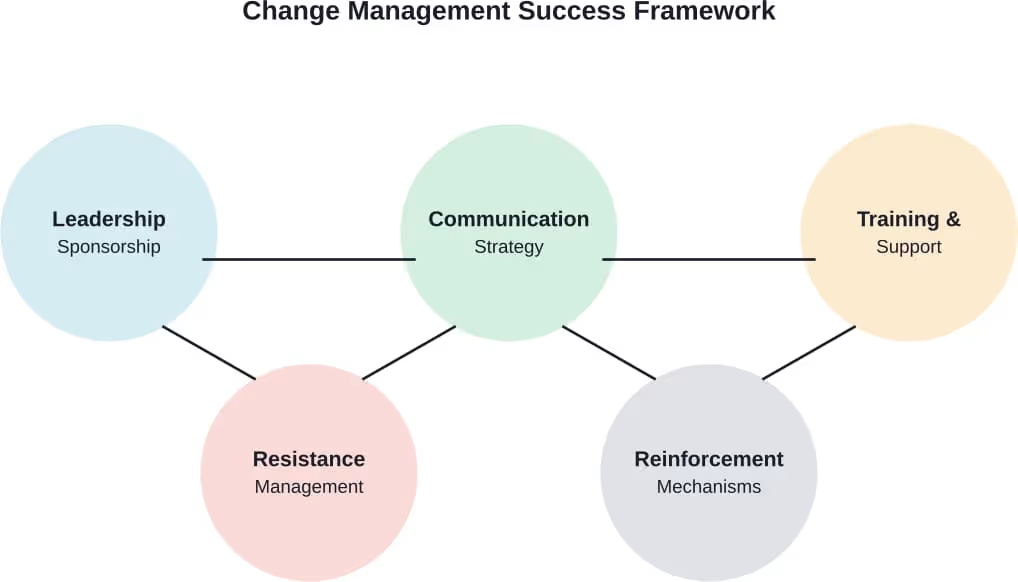
Here’s what many insurers get wrong: they treat digital transformation as a technology project when it’s actually an organizational change initiative that happens to involve technology.
Research consistently shows that technology implementations fail not because the technology doesn’t work, but because people resist adopting it. Employees comfortable with existing processes see new systems as threats. Customers accustomed to traditional service channels resist switching to digital alternatives.
Successful insurance transformation requires structured change management that addresses both the technical and human dimensions of transformation. Clear communication, adequate training, visible leadership support, and mechanisms for feedback all contribute to adoption success.
Emerging Technology Trends Reshaping Insurance
The landscape of risk itself is undergoing dramatic transformation, becoming increasingly complex, frequent, and unpredictable. This new reality demands fundamental shifts in how insurers approach risk assessment and management, according to Majesco’s white paper on trends shaping insurance in 2025.
Insurance operational costs are rising, growth remains limited, and profitability challenges have become more pronounced. These issues underscore that current operational models can’t sustain future business requirements.
Cloud Platform Migration
Cloud computing provides the foundational infrastructure for modern insurance operations. Scalability, cost efficiency, and rapid deployment capabilities make cloud platforms essential for insurers seeking operational agility.
Legacy on-premises systems can’t match the flexibility cloud environments provide. Product launches that previously required months of infrastructure preparation now happen in weeks. Capacity scales automatically to handle claim surges after major events.
Data Analytics and Predictive Modeling
Big data analytics transforms how insurers understand and price risk. Telematics data from connected vehicles, IoT sensors in commercial properties, and health monitoring devices generate unprecedented visibility into risk factors.
Predictive models built on this data enable more accurate underwriting, personalized pricing, and proactive risk prevention. Insurers can identify potential claims before they occur and intervene with recommendations or alerts.
Ecosystem Innovation and Partnerships
Insurance increasingly operates as part of broader digital ecosystems rather than standalone products. Connected ecosystems that integrate insurers with distribution partners, service providers, and technology platforms create new value propositions.
Group insurance carriers particularly benefit from ecosystem strategies that connect employers, employees, benefits administrators, and healthcare providers through unified digital experiences.
Navigating Implementation Challenges
Real talk: digital transformation in insurance is hard. The barriers are substantial and the risks of failure are real.
Legacy systems contain decades of policy data, claims history, and customer information that can’t simply be discarded. Integration between old and new systems creates technical complexity that requires careful architecture planning and skilled implementation.
Regulatory requirements add another layer of complexity. Insurance remains one of the most heavily regulated industries, with rules varying significantly across states and countries. Digital solutions must maintain compliance while delivering innovation.
| Challenge Category | Specific Issues | Mitigation Strategies |
|---|---|---|
| Technical | Legacy system integration, data quality, security | API-first architecture, data governance, zero-trust security |
| Organizational | Resistance to change, skills gaps, culture | Change management, training, leadership alignment |
| Regulatory | Compliance requirements, data privacy, reporting | Compliance-by-design, regular audits, legal partnership |
| Financial | Investment requirements, ROI uncertainty, budget constraints | Phased implementation, clear metrics, business case validation |
Skills and Capability Gaps
Insurance companies built their workforces around traditional operational models. Digital transformation requires new capabilities in data science, AI development, cloud architecture, and digital product management.
Building these capabilities requires a combination of hiring, training existing employees, and partnering with specialized providers. The talent competition is fierce, particularly for AI and data science expertise.
Looking Ahead: The Future of Insurance
Current U.S. economic conditions present mixed signals for insurance transformation. Despite strong growth drivers like innovation investments and federal deregulation efforts, challenges from legal system abuse trends and AI uncertainty cloud the 2026 outlook according to Chubb’s CEO.
Tariff policies, particularly those targeting materials essential for property repairs after insured events, complicate risk assessment and prediction. Court rulings on these policies will shape future operational strategies.
But the transformation trajectory remains clear. Insurance will continue its evolution toward more digital, data-driven, customer-centric models. The companies that successfully navigate this transition will gain significant competitive advantages.
Artificial intelligence governance will mature as regulators develop clearer frameworks and industry best practices emerge. Privacy considerations will remain paramount, requiring insurers to balance data utilization with customer protection.
The insurance digital ecosystem will expand, creating new partnership opportunities and business models. Embedded insurance—where coverage integrates seamlessly into other purchases and services—represents just one example of ecosystem innovation.
Conclusion: The Imperative for Action
Digital transformation in insurance has moved beyond optional strategic initiative to business imperative. Customer expectations, competitive pressures, operational challenges, and emerging risk complexities all demand fundamental changes in how insurance companies operate.
The technology exists. The business case is clear. What separates successful transformations from failed initiatives is execution—combining strategic vision, robust change management, appropriate technology selection, and sustained organizational commitment.
Insurers that delay transformation risk competitive disadvantage as more agile competitors and insurtech disruptors capture market share. But rushed implementations without proper planning create their own problems: fragmented systems, frustrated employees, and disappointed customers.
The path forward requires balanced approaches that acknowledge both the urgency of transformation and the complexity of execution. Start with clear strategic vision. Invest in change management as heavily as technology. Build capabilities systematically. Measure results rigorously. And maintain the organizational commitment required to see transformation through to meaningful business outcomes.
The future of insurance is digital. The question isn’t whether to transform, but how quickly and effectively companies can navigate the journey.