

INTRODUCTION
The business managed primarily air and sea shipments, alongside selected vehicle shipments. Its operations involved many interconnected details: order data, cargo information, shipment routes, lifecycle stages, customer updates, and related operational decisions.
As the team grew, the limitations of the third-party platform became increasingly visible. Generic workflows created unnecessary workarounds, important information was harder to control in one place, and the existing system could not be adapted closely enough to the client’s internal processes.
The client decided to replace it with a custom platform built around its own operational logic.
*This case study has been anonymised under an NDA. The company name, logo, and branding shown in the screenshots are representative only and do not identify the client. The project scope, timeline, and results remain accurate.
THE CHALLENGE
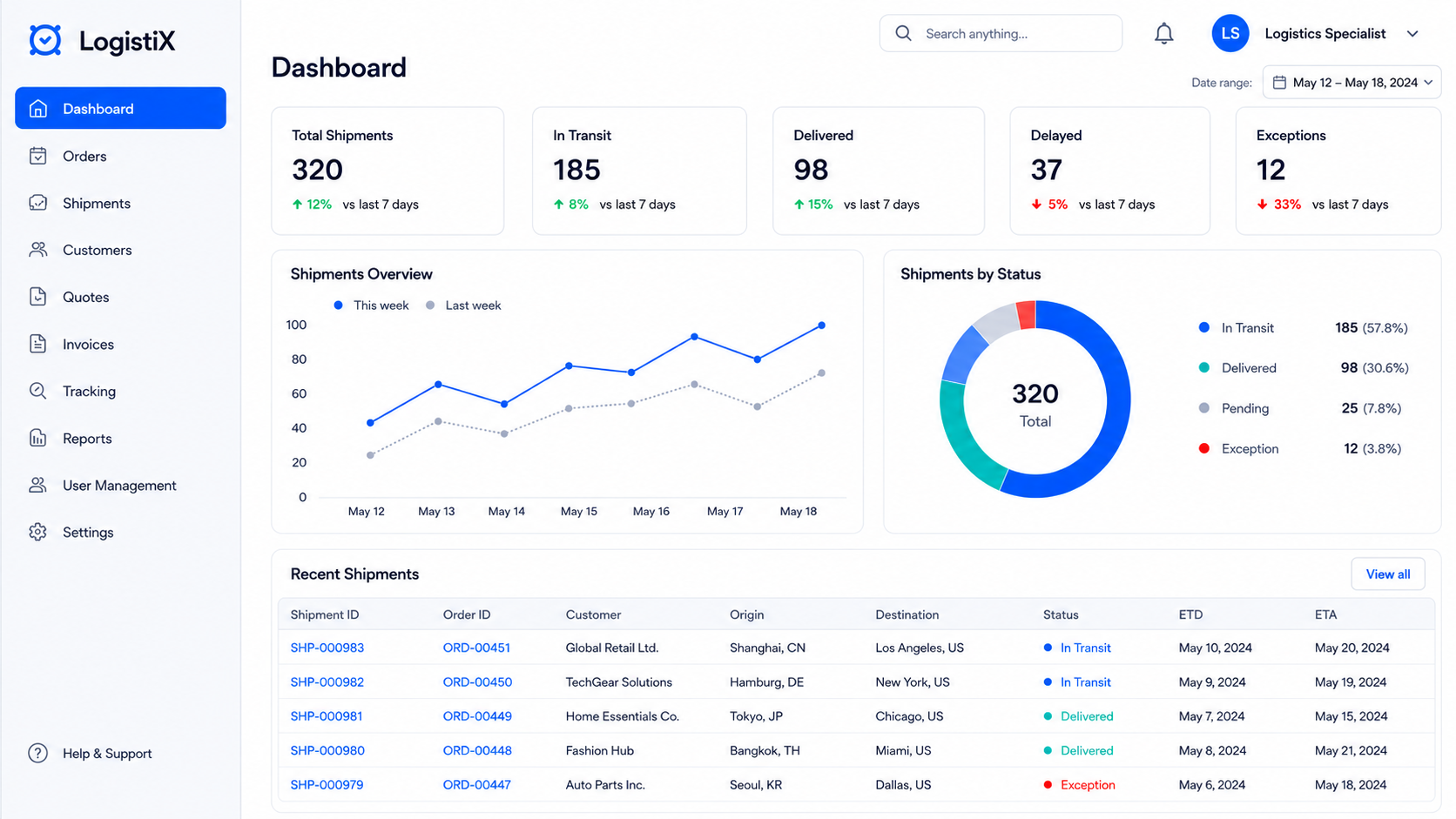
*Representative reconstruction of the Logistics Operations Dashboard. Original interface protected under NDA.
The main challenge was not simply to build another logistics dashboard. It was to translate complex, real-world operations into a system that was structured enough to prevent mistakes, while remaining intuitive for logistics specialists who needed to move quickly.
One of the highest-priority areas was shipment and order creation. This involved a dense, spreadsheet-style flow with many related fields, dependencies, and operational details. The interface needed to make complex data manageable without oversimplifying the underlying business logic.
The platform also needed to give specialists a clearer way to:
- create and manage shipment orders;
- monitor shipment progress and exceptions;
- keep key tracking information visible;
- communicate with customers without losing the operational context;
- receive and manage notifications;
- work with selected external delivery-service integrations.
The goal was to replace a generic third-party tool with a platform that supported the client’s actual workflow rather than forcing the team to adapt around software limitations.
Our Role and Approach
The client already had an internal product owner and designer defining the broader product direction and user experience. LenGreo joined as the technical delivery partner, working closely with both roles to turn requirements into a stable, production-ready platform.
Our role included sprint planning, technical clarification, front-end and back-end development, QA, and release preparation. The delivery team consisted of a technical lead, front-end developer, back-end developer, project manager, and QA specialist.
We worked in focused sprints, aligning functionality and priorities with the product owner and designer before implementation. This approach helped us resolve complex workflow details early, keep the product aligned with real user needs, and ensure every delivered feature matched the agreed requirements.
Throughout the project, QA was integrated into the delivery process to validate functionality, identify edge cases, and support a stable release.
What We Built
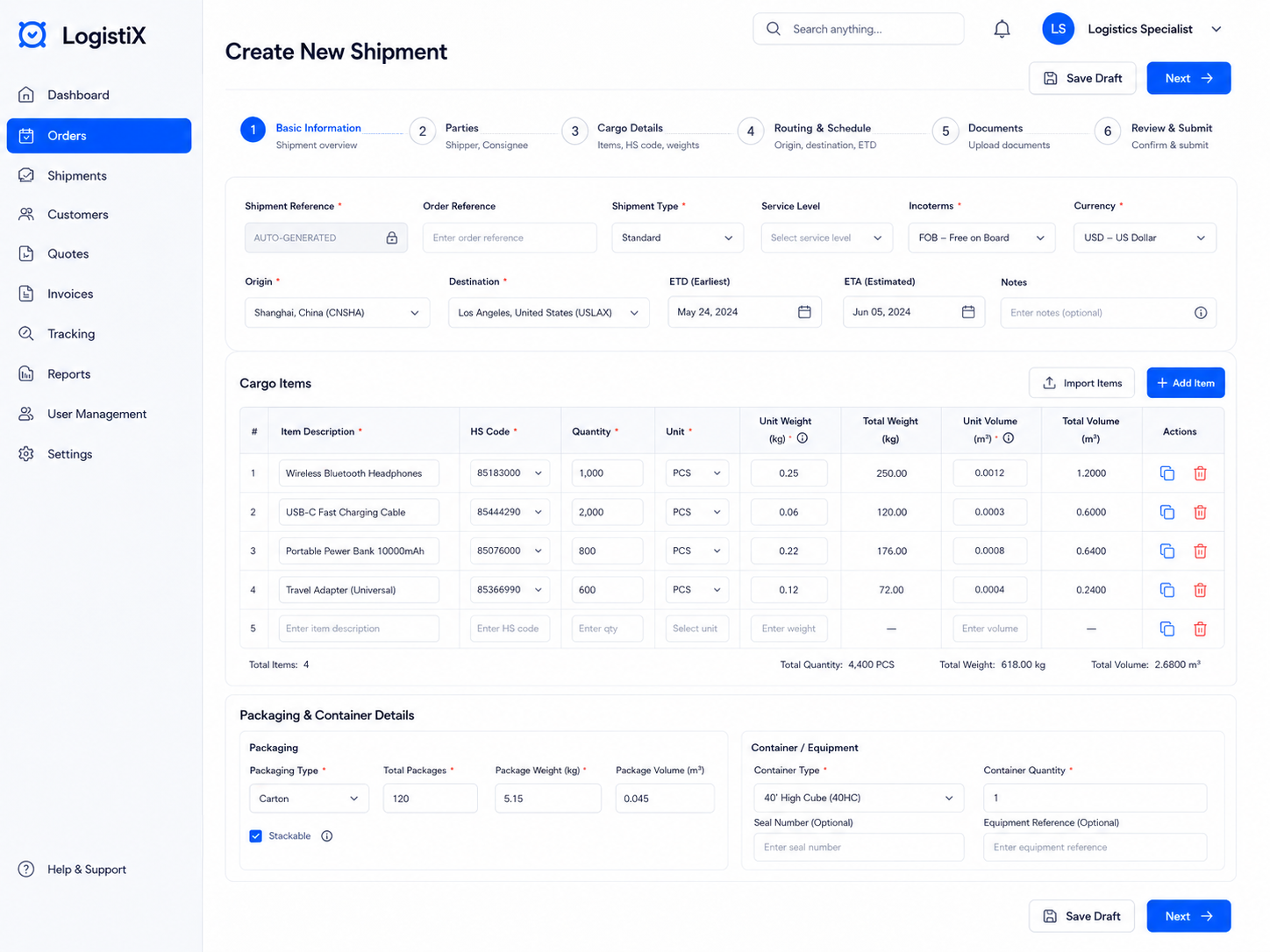
*Representative reconstruction of the Shipment Creation Flow. Original interface protected under NDA.
A central operations dashboard
We created a dashboard that gave logistics specialists a clear operational overview of shipment activity, current statuses, delayed or exceptional cases, and recent updates.
Instead of searching through disconnected records, the team could quickly understand what required attention and navigate directly to the relevant shipment or order.
A structured shipment and order creation flow
A major part of the work focused on building a more practical way to create and manage complex shipments.
The flow was designed to handle interconnected shipment, cargo, routing, and container information in a structured format. It gave users the flexibility needed for detailed logistics operations while reducing the friction of working through a dense data-entry process.
Shipment lifecycle management and customer communication
We built a dedicated shipment workspace where specialists could track a shipment from confirmation through delivery, review tracking events, update statuses, and communicate with customers in context.
Bringing lifecycle visibility and customer communication together reduced the need to switch between tools or reconstruct the history of a shipment manually.
Notifications and external integrations
The platform also supported operational notifications and selected external delivery-service integrations, helping the team keep shipment information current and communicate important updates efficiently.
Shipment Lifecycle Management & Built-In Communication
We created a dedicated shipment workspace where logistics specialists could track every order from confirmation through delivery, review status updates, and manage key operational details in one place.
The platform also included built-in chat functionality, allowing the logistics and sales teams to communicate with clients directly within the relevant order or shipment context. This kept conversations, updates, and operational decisions connected to the shipment instead of scattered across separate tools.
The Outcome
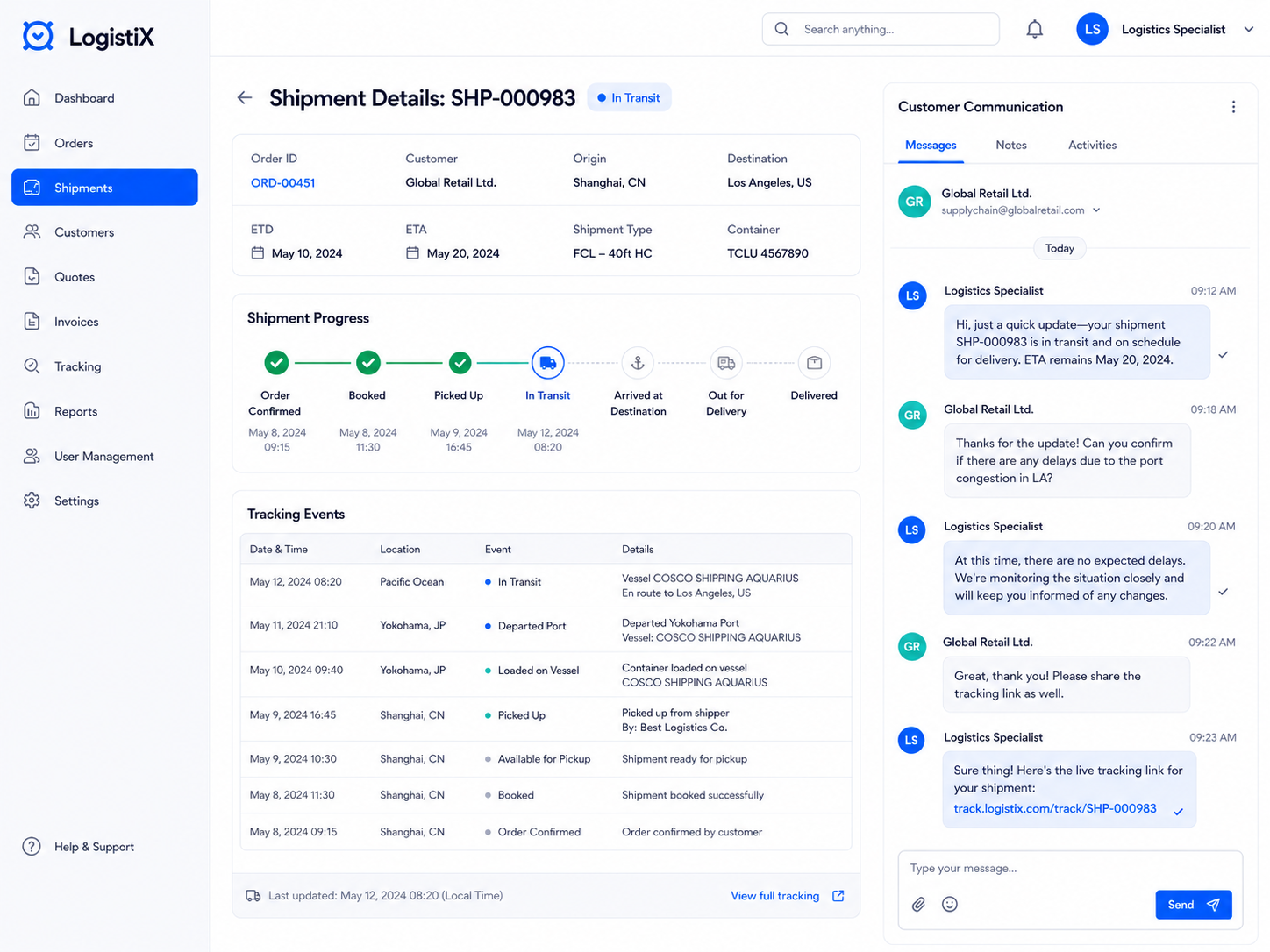
*Representative reconstruction of Shipment Lifecycle Management. Original interface protected under NDA.
Within four months, the platform was released to real users and introduced through a phased onboarding process. Over time, it fully replaced the third-party system the client had previously relied on.
The result was a custom operational workspace that reflected the company’s own processes instead of the limitations of generic logistics software.
The new platform gave the team:
- one place to create, manage, and track shipments;
- a clearer view of shipment status, progress, and exceptions;
- a more structured approach to complex order creation;
- customer communication connected directly to the relevant shipment;
- a scalable technical foundation for future operational workflows and integrations.
For LenGreo, the project demonstrates more than logistics expertise. It shows how we approach complex custom software: by working closely with product stakeholders, understanding the real operational logic behind the interface, and delivering systems that are practical for the people who use them every day.