

Somehow, the email is still standing.
Despite all the noise about TikTok ads, DMs, and AI chatbots, email keeps doing what it does best: starting real conversations, delivering ROI, and quietly powering some of the most effective marketing programs on the planet.
But let’s be honest – email marketing today isn’t about dumping another newsletter into the abyss and hoping for the best. If you’re still sending the same email to every person on your list, you’re probably wasting time and money.
This guide isn’t about old tricks or recycled tactics. It’s a deep dive into what actually works now. We’re talking about smart segmentation, timing that respects your reader’s life, AI that helps (not hinders), and strategies built for behavior, not guesswork.
What Is an Email Marketing Strategy and Why It’s Worth Having One
An email marketing strategy is your roadmap for using email to support real business goals. It’s not just about writing a few newsletters or setting up an automated flow. It’s about knowing who you’re talking to, what you want them to do, and how to guide them there – step by step.
Without a strategy, email becomes a guessing game. You end up sending the same thing to everyone, at random times, and hoping something sticks. That’s how you get low open rates, unsubscribes, or just silence. A good strategy changes that. Whether you’re focused on lead generation, customer retention, or boosting eCommerce sales, it keeps your emails focused and effective, so you’re not just sending, you’re converting.
What Email Strategy Looks Like in Practice
At Lengreo, email is more than just a communication channel – it’s a key part of how we generate demand and build pipelines for our clients. From early-stage outreach to appointment setting, we use structured, data-informed email campaigns to connect with decision-makers across sectors like SaaS, cybersecurity, biotech, and more.
What drives our results is a combination of precision targeting and consistent optimization. We don’t rely on mass mailers or one-size-fits-all templates. Instead, every campaign is backed by research, aligned with business goals, and fine-tuned through performance metrics like open rates, replies, and conversions. In practice, that means sending fewer but more relevant emails – ones that speak directly to the recipient’s context and intent.
Modern Email Marketing Strategies That Actually Work
The following strategies aren’t hypothetical. They’re built on what real brands are doing today to turn their email channel into a real growth driver. Whether you’re just getting started or cleaning up a bloated system, there’s something here you can use right away. Let’s dig in.
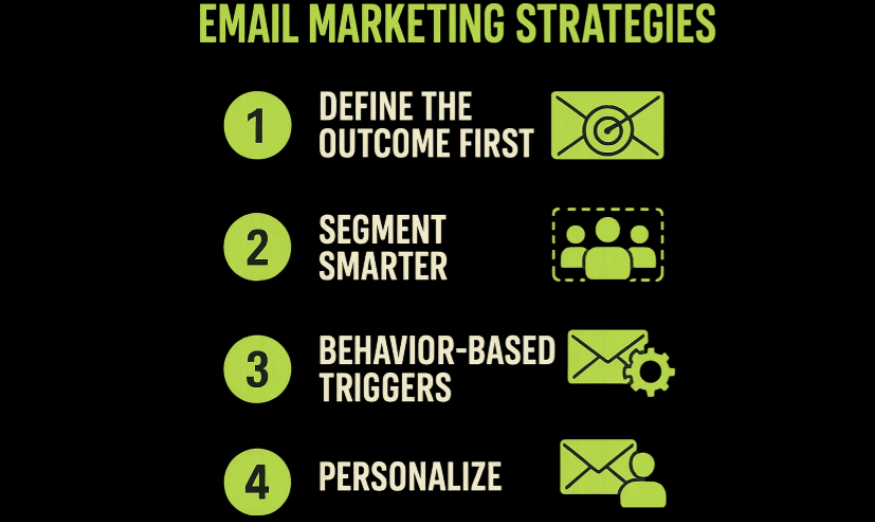
Strategy №1. Define the Outcome First
Before you touch a subject line or layout, you need to be clear about what you’re aiming for. A lot of marketers jump straight to tactics – automations, A/B tests, scheduling – without thinking about the point of the campaign.
Good email campaigns are guided by specific, measurable goals. For example:
- Grow your active subscriber base by 15% in three months.
- Increase average open rate from 18% to 25%.
- Recover 20% of abandoned carts.
- Reactivate 10% of dormant users.
Without a clear goal, you’re guessing. Start with the outcome, then build backward.
Strategy №2. Segment Smarter and Keep It Useful
Segmentation has been part of email strategy for years, yet many brands still either skip it entirely or overcomplicate it into oblivion. At its core, segmentation is about creating smaller, more meaningful groups within your audience so your emails land with more relevance. The key is to tie your segments to real behavior or needs – not just surface-level data like age or geography.
Think about where someone is in their journey: are they a first-time buyer, a regular customer, someone who browsed your site but never clicked “buy,” or maybe a subscriber who hasn’t opened an email in months? These are the kinds of differences that should shape your messaging.
You don’t need dozens of groups to start – just a few clear distinctions based on what people have done (or haven’t done) can make a huge difference. The goal isn’t complexity. It’s usefulness. Build messaging around the actual context of your audience, and you’ll likely see engagement go up without having to send more emails.
Strategy №3. Use Behavior-Based Triggers, Not Just Schedules
Some of the most effective emails aren’t planned in advance – they’re triggered by what a person just did (or didn’t do).
For example:
- Viewed a product? Send a follow-up with reviews.
- Started checkout but didn’t finish? Remind them with a cart email.
- Just signed up? Hit them with a welcome series, not a one-off hello.
Behavioral emails perform better because they feel timely. They’re tied to intent. And they don’t interrupt – they assist.
Trigger ideas:
- Browse or cart abandonment.
- Back-in-stock or price-drop alerts.
- Refill or reorder nudges.
- Anniversary or usage milestones.
The goal is to show up at just the right moment, without being annoying.
Strategy №4. Personalize Beyond the First Name
“Hi [First Name]” is not personalization. It’s a placeholder.
Real personalization is about sending the right content to the right person, at the right time, based on real signals: what they’ve bought, what they’ve looked at, where they are in their journey.
Practical ways to personalize:
- Recommend products based on browsing or purchase history.
- Adjust send time based on when they usually open emails.
- Use dynamic content blocks to show different items to different people.
- Include location-based offers or messaging.
The key is to add relevance without being creepy. Don’t show people that you’re watching; show them that you’re listening.
Strategy №5. Clean Your List Like It’s Your Job
Too often, email lists get treated like trophies – the bigger, the better. But if half of those contacts are outdated, disengaged, or bouncing, you’re not doing yourself any favors. In fact, hanging on to a bloated list can drag down your sender reputation and make it harder for even your best emails to land in the inbox.
That’s why cleaning your list should be a regular habit, not a once-a-year panic move. Start by cutting the obvious dead weight – addresses that hard bounce or clearly no longer exist.
It’s also smart to give people choices instead of forcing a hard unsubscribe. Letting subscribers opt down – like choosing monthly updates over weekly – can keep more people around, without annoying them.
In the end, it’s not about hoarding contacts. It’s about making sure your list is full of people who still want to hear from you. Ten thousand engaged readers will outperform a hundred thousand ghosts every single time.
Strategy №6. Optimize for Mobile (Because That’s Where They’re Reading)
Most email opens now happen on phones. If your email isn’t mobile-first, it’s probably underperforming and frustrating your readers.
Keep in mind:
- Subject lines should be short and specific (ideally under 40 characters), so they don’t get cut off on mobile.
- CTAs need to be tappable – use clear, well-spaced buttons instead of small links buried in text.
- Stick to a clean, scannable layout. Use headers, bullet points, and white space to make it easy on the eyes.
- Always test your emails across devices and email clients – something that looks perfect on desktop might break on mobile.
- Don’t forget alt text for images, especially if your email relies on visuals to get the point across.
Think of your email like a mobile landing page. Would you stay and read it if you saw it on your phone?
Strategy №7. Use AI and Automation to Scale Without Losing Relevance
AI isn’t just tech-speak anymore – it’s quietly powering a lot of what happens behind the scenes in modern email marketing. And when it’s used with intention, not hype, it becomes a serious asset. It doesn’t invent your strategy for you, but it can take the repetitive, manual parts and make them faster, smarter, and way more scalable.
Think about how long it used to take to test different subject lines, or guess when to send emails. Now, AI can help fine-tune send times based on actual user behavior. It can personalize product recommendations without writing dozens of variations by hand. Even segmentation can become more fluid, adapting as people take new actions or drop off.
The best part? You don’t have to sacrifice relevance to move fast. Automation, when thoughtfully applied, actually helps keep your messaging timely and targeted. The trick is making sure the human side still leads – AI just sharpens the execution.

Strategy №8. Test What Matters (Not Just What’s Easy)
A/B testing is a great tool, when you use it with intent. Don’t just test for the sake of it. Focus on elements that can move the needle.
Test things like:
- Tone and length of the message.
- Button placement or format.
- Personalization vs. no personalization.
- Send times (especially by region or timezone).
- Layout type: plain text vs. image-heavy.
Track the results over time, not just one-off campaigns. And always consider how different segments react differently.
Strategy №9. Don’t Ignore Inactive Users
Inactive subscribers aren’t a lost cause. Just because someone hasn’t opened your emails lately doesn’t mean they’re gone for good. People get busy, inboxes get crowded, and sometimes all it takes is the right moment or the right message to get them re-engaged.
That’s why it’s worth having a proper reactivation approach. A friendly check-in, a small incentive, or even a quick survey asking what’s changed can spark interest again. The key is to make it personal and respectful – not a guilt trip, but a reminder that they can still get value from staying connected. It also helps to give them options, like adjusting how often they hear from you, instead of forcing a binary unsubscribe.
Strategy №10. Respect the Customer Journey
Too often, email is only used for acquisition or promotion. But some of the most valuable email content comes after the purchase.
Think about:
- Onboarding emails that help users succeed with your product.
- Post-purchase check-ins or usage tips.
- Requests for feedback or reviews.
- Loyalty program invitations.
- Win-back campaigns based on inactivity.
Every stage is a chance to provide value. If your email strategy stops at “Thanks for buying,” you’re missing opportunities to deepen the relationship.
What You Can Actually Gain from a Solid Email Strategy
First, there’s consistency. A good email strategy keeps your brand present without being overbearing. You’re no longer guessing when or what to send – your campaigns follow a plan tied to real stages in your customer’s journey.
Then comes relevance. With personalization and segmentation in place, your emails stop feeling like digital flyers and start reading like tailored messages. Open rates go up, unsubscribes drop, and people actually reply.
You’ll likely see better lead nurturing, too. Especially for longer sales cycles, email becomes a pressure-free way to stay in touch. You’re not hard selling – you’re staying top of mind until the moment is right.
Final Takeaway: Strategy Over Tactics
Email marketing still works, but only when it’s done with a strategy. One that listens before it speaks. One that serves the customer instead of interrupting them. One that uses data, not just hunches.
If you’re willing to move past templates, batch-blasts, and vanity metrics, there’s real value waiting in your list.
Build your emails around how people actually behave. Segment with purpose. Personalize without overdoing it. Automate what you can. Clean your list, test what matters, and respect the full lifecycle.