

Franchise marketing sits at the intersection of centralized brand governance and decentralized local execution. The model demands consistency across dozens or hundreds of locations while allowing each outlet to compete effectively in its own market. Success depends on clear division of responsibilities, shared tools, and ongoing measurement rather than on one-size-fits-all campaigns.
Why These Strategies Are Non-Negotiable in 2025-2026
76-80% of consumers check Google before visiting. Weak local presence equals instant loss.
- Duplicate pages and generic sites kill rankings.
- Unoptimized ads waste budget on wrong traffic.
- Inconsistent branding destroys trust network-wide.
- Poor review management costs 20-30% of revenue.
No co-funding or transparency equals low franchisee buy-in and slow growth.
How We at Lengreo Approach Franchise Marketing Strategies
At Lengreo we see every marketing engagement as a strategic challenge that starts with clarity and structure. Before launching campaigns, we work with clients to define their core value proposition, target audience, and messaging – ensuring that all channels operate under a unified direction. This alignment becomes the foundation for SEO, paid advertising, outbound outreach, and content initiatives, so every activity reinforces the same story and drives measurable results.
Our team relies on data from CRM systems, market research, LinkedIn insights, and performance analytics to refine targeting and segmentation. This helps us tailor messages to specific buyer groups, improve relevance, and reduce acquisition costs. For clients in tech, SaaS, professional services, and other B2B verticals, this structured approach consistently leads to higher-quality opportunities and more predictable pipelines.
Once the strategic layer is in place, we execute and optimize campaigns across channels – improving visibility through SEO, generating demand via paid search and social, and supporting sales teams with personalized outreach workflows. We treat ourselves as an extension of the client’s team, iterating based on real metrics and continuously refining what works.
This disciplined, data-driven framework is the main reason our clients see sustainable improvements in lead quality, lower cost per acquisition, and stronger overall marketing performance.
10 Core Franchise Marketing Strategies for 2025-2026
Master these 10, and you create a flywheel: stronger locations, higher revenue, happier owners, faster expansion. Ignore them, and the franchise system itself is at risk in a mobile-first, review-driven world.
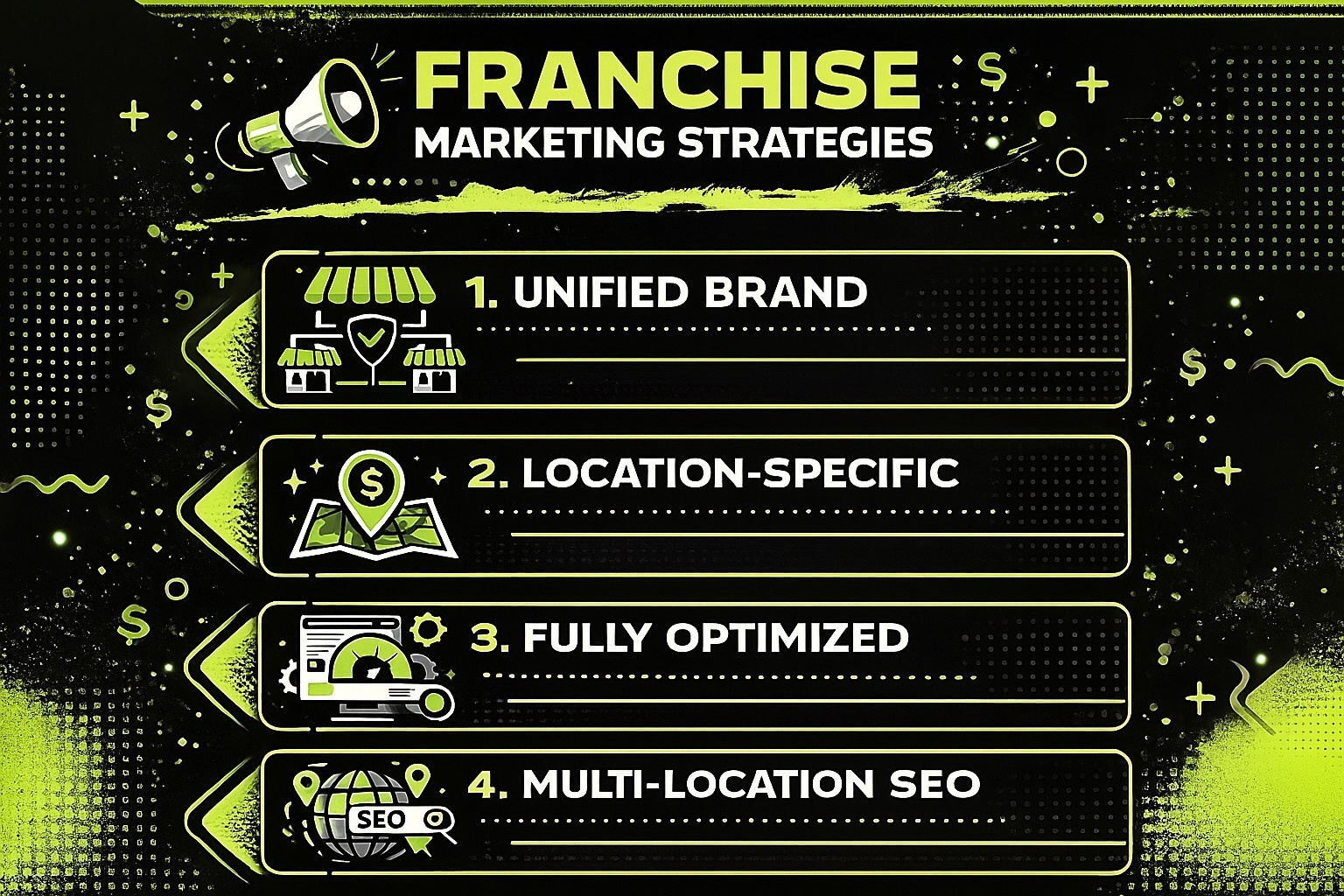
1. Unified Brand with Local Flexibility
Enforce a strict brand book (logo, colors, tone of voice, templates) while allowing franchisees to add local promotions, team photos, and city-specific messaging.
This combination protects brand equity and builds instant recognition nationally, yet gives each location the human touch that makes customers feel they’re dealing with a neighbor, not a corporation.
2. Dedicated Location-Specific Landing Pages
One unique page per location with NAP, real photos of the branch, local reviews, embedded Google Map, location-based keywords, and strong CTAs. No duplicate content ever.
Google filters out duplicate pages to avoid showing redundant results, but there is no domain-wide penalty.
3. Fully Optimized
Separate verified GBP for every location: 10–15 fresh photos monthly, 2–3 posts per week, review responses within 24 hours, accurate categories and attributes.
An active, complete GBP often drives a third to half of total foot traffic and phone calls. It’s the new storefront: customers decide whether to visit before they ever reach your website.
4. Multi-Location Local SEO
- City-specific keywords in titles, H1s, and content
- Proper Schema markup (Organization + LocalBusiness) for each site
- 100+ consistent local citations per location
- Local backlinks from regional media, chambers of commerce, and sponsorships
5. Geo-Targeted Paid Ads at Scale
Run separate Google Ads & Meta campaigns for each location with city names in headlines, location-specific offers, and direct links to the matching landing page.
Geo-fencing + local landing pages routinely slashes cost-per-acquisition compared to national campaigns and delivers immediate, measurable revenue while SEO matures.
6. Centralized Social Media Guidelines + Local Posts
Provide corporate templates and a content calendar, but let franchisees post community events, staff highlights, and real-time local engagement.
Customers trust “real” local content far more than corporate posts.
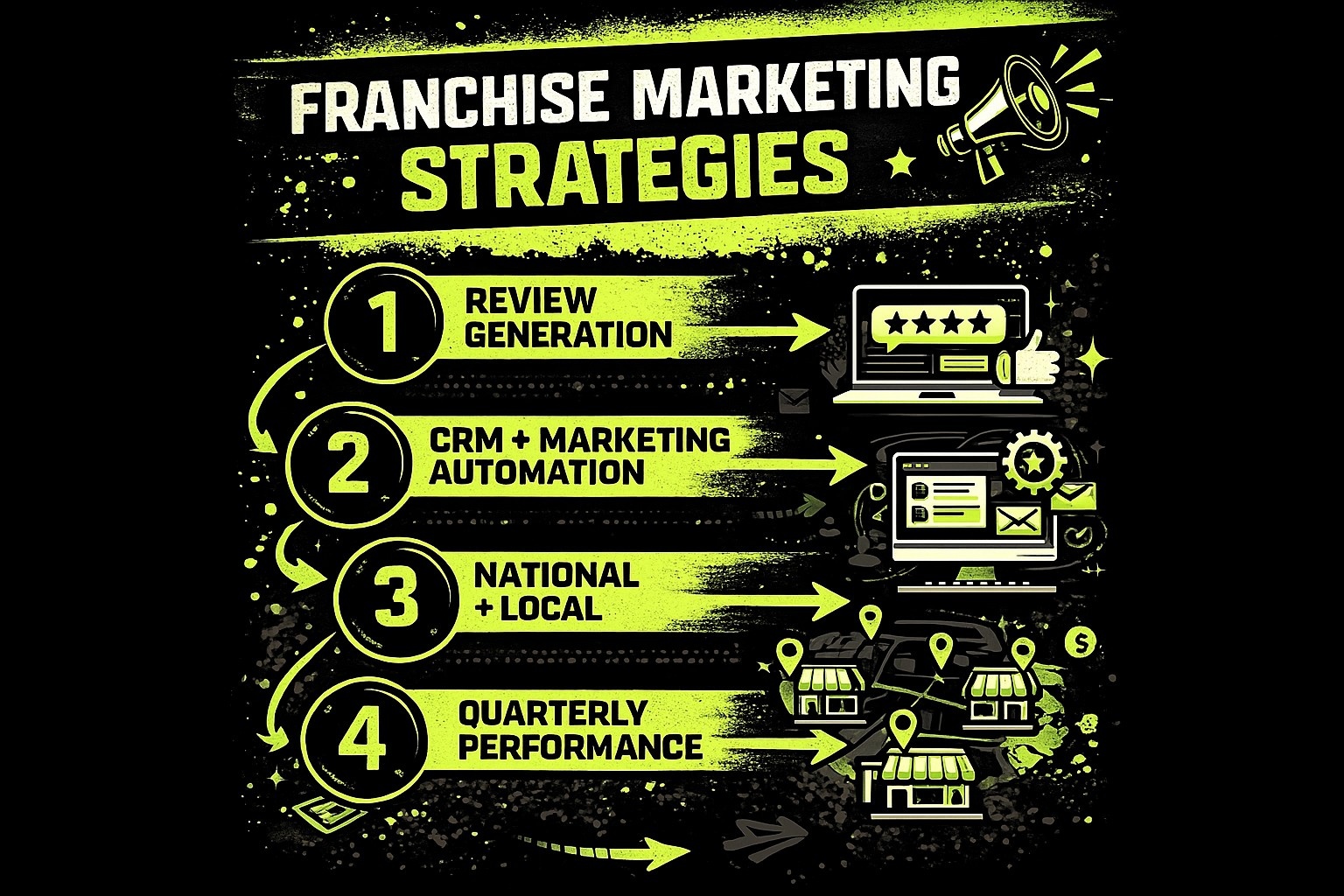
7. Automated Review Generation & Reputation Management
Post-service SMS/email review requests, centralized dashboard for monitoring, and trained responses to every review (positive or negative).
Each additional star on Google can lift revenue significantly. Systematic requests + fast responses quickly build hundreds of new reviews and push locations to the top of local search results.
8. Shared CRM + Marketing Automation
Single CRM with location-based tagging, automated lead nurturing, personalized email/SMS sequences, and pre-built templates for every franchisee.
This eliminates dropped leads, ensures every customer receives consistent follow-up regardless of location, and frees franchisees to focus on operations instead of chasing spreadsheets.
9. Co-Funded National + Local Marketing Fund
National brand campaigns paid 100 % by franchisor; local digital boosts (Google LSA, Meta, SEO) co-funded (e.g., 50/50 or tiered) to align incentives.
Co-funding turns franchisees from passive recipients into active partners, dramatically increases local spend execution, and typically doubles marketing ROI per location.
10. Quarterly Performance Dashboards & Franchisee Scorecards
Transparent KPI tracking (traffic, leads, conversions, ROI per location) shared with every franchisee so everyone knows exactly what works and where to improve.
When franchisees see their own numbers in black and white, adoption of corporate initiatives jumps dramatically, creating true system-wide momentum.
Conclusion
Master these ten strategies and you create a true flywheel: stronger local performance drives higher revenue per location, happier franchisees become your best recruiters, and the entire system scales faster with lower risk. Ignore them, and even the strongest franchise concept will lose ground in today’s mobile-first, review-driven, hyper-local world.