

Experiential marketing has shifted from optional activation to a core component of brand strategy. Companies now use live and digital interactions to create direct customer connections that traditional advertising cannot replicate. This article examines the strategies that consistently deliver measurable impact, drawn from established campaigns and execution frameworks.
Why Experiential Marketing Strategies Actually Matter
Standard advertising fights for fractions of a second of attention in overcrowded feeds. Experiential strategies flip the equation: instead of interrupting people, they invite them into a controlled moment where the brand has full focus, often for minutes or hours. That shift from passive exposure to active participation is the main reason recall rates and purchase intent jump dramatically compared to traditional channels.
The second reason is trust. When customers touch, try, or co-create something themselves, they no longer rely on marketing claims; they form their own opinion through direct evidence. In an era where 88% of consumers say authenticity matters when deciding which brands to support, giving them first-hand proof beats any polished ad.
Finally, these strategies generate owned first-party data that most digital channels can no longer deliver reliably. Every interaction, dwell time, choice, and shared photo becomes a measurable signal that feeds segmentation, retargeting, and future campaign planning. In short, well-executed experiential work is one of the few remaining ways to build genuine preference while collecting clean, attributable data at the same time.
Partnering with Lengreo for Experiential Marketing Execution
At Lengreo, we operate as a full digital marketing and tech partner for B2B companies, helping them build predictable pipelines and measurable growth through a blend of strategy, lead generation, SEO, PPC, and content-driven visibility. Our team works as an extension of the client’s business, aligning positioning, messaging, and channel mix to create a unified system that consistently attracts and converts high-value buyers. This approach has helped our clients significantly improve performance – from increasing annual client acquisition for a US software development company by 400%, to generating dozens of qualified opportunities for architecture, IT, sports tech, and event technology providers, reducing cost per lead multiple times, and boosting conversion rates across key markets.
We combine deep expertise in outreach, search, paid advertising, website development, and content marketing to ensure every stage of the funnel is covered – from targeted prospecting to demand generation and retention optimization. Rather than offering generic packages, we audit the current setup, identify the most scalable levers, and execute with precision across channels. With founders Serhii Steshenko and Max Mykhal leading the process, clients work not with a typical agency, but with a committed partner focused on long-term, data-driven growth.
Top Experiential Marketing Strategies That Deliver Real Business Impact
Experiential marketing has evolved into a disciplined mix of physical presence, digital extension, and measurable participation. The strategies below are the ones that consistently show up in campaigns that actually move awareness, consideration, and revenue – not just Instagram likes.
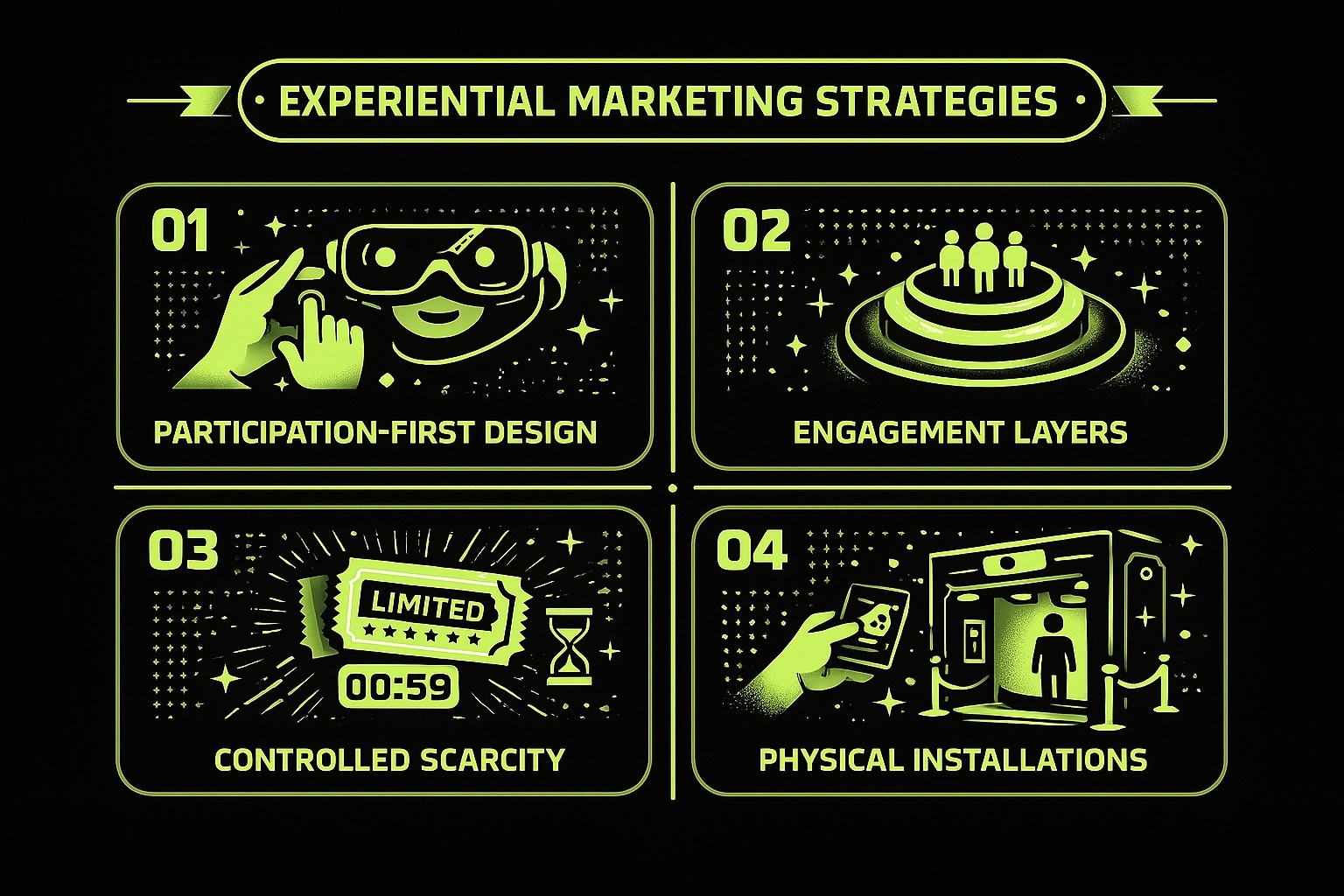
1. Participation-First Design
Shift the entire brief from “what do we want to show” to “what does the customer want to do”. The strongest activations start by solving a genuine friction point: trying before buying, visualizing fit, understanding complex features, or simply having a story worth telling. When the utility is clear, emotional connection and sharing follow automatically.
2. Progressive Engagement Layers
Never offer just one thing to do. Build light, medium, and deep participation loops:
- Light: scan a code, step on a floor trigger, take a quick photo
- Medium: customize an item, play a 30-second game, answer three preference questions
- Deep: create content, register for follow-up, join a private community People self-select how far they want to go, and conversion rates rise dramatically at each deeper layer.
3. Controlled Scarcity and Exclusivity
Limited-time windows, city-only tours, invite-only sessions, or “only available this weekend” editions still trigger FOMO more effectively than any paid campaign. The scarcity has to feel earned – early access for loyalty members, first 100 scans, tonight-only prize – so participants become advocates instead of feeling manipulated.
4. Multi-Sensory Physical Installations
Engage more than just sight and sound. Texture, scent, temperature changes, and taste (when relevant) create memory anchors that single-sense ads can’t match. A subtle scent trigger or tactile surface often becomes the detail people remember and mention months later.
5. Seamless Social Media Activations
Stop begging for shares. Instead, hand people content that is instantly post-worthy:
- Real-time AR overlays or GIF booths that drop finished files straight to camera roll
- Live hashtag walls showing posts appear in seconds
- Staff-seeded photos sent via AirDrop or text
- Exclusive filters, frames, or stickers unlocked only inside the activation zone
- Instant-win contests with on-site fulfillment
When the output is flattering, useful, or exclusive, posting happens organically.
6. Hybrid Physical-Digital Continuity
The experience must travel home in the participant’s pocket. Common take-home assets that work:
- Personalized recap videos compiled from their journey
- AR experiences that live on after the event
- Custom playlists, digital certificates, or downloadable assets generated on-site
- Discount codes tied to the exact item they customized
These assets extend dwell time from hours to days and turn attendees into micro-influencers.
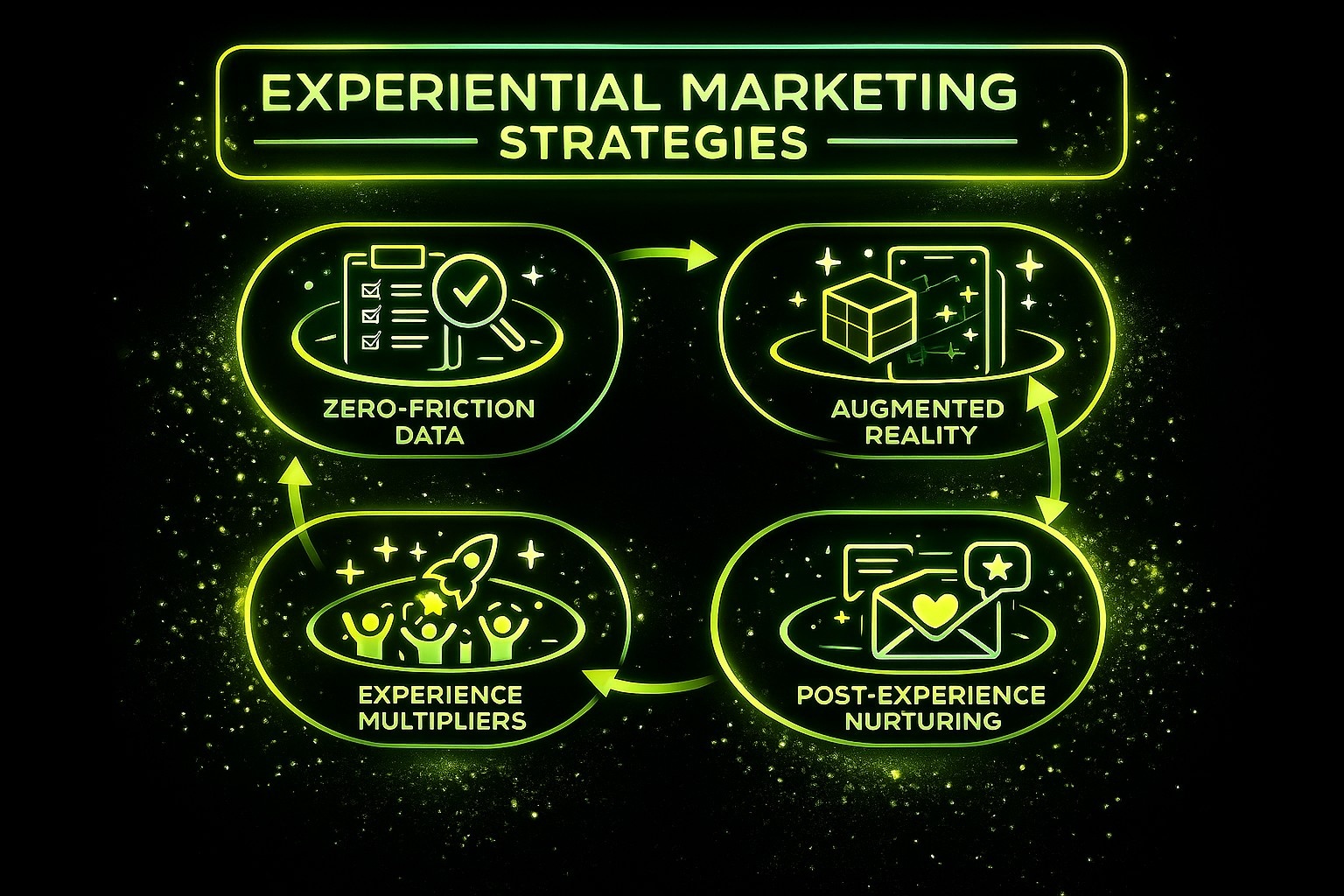
7. Zero-Friction Data Capture
Replace paper forms with one-tap solutions: QR to pre-filled opt-ins, NFC wristbands, facial recognition for photo booths, or simple “text your email to this number” stations. The easier the capture, the richer and cleaner your first-party data becomes.
8. Augmented Reality as Utility Layer
AR works when it removes purchase barriers rather than existing for spectacle:
- Marker-based product visualization on packaging or posters
- In-store virtual try-on for clothes, makeup, or furniture placement
- Location-based discovery that guides foot traffic to stores or pop-ups
- Gamified scavenger hunts with real rewards
Load times under five seconds and clear value in the first ten seconds separate successes from abandoned scans.
9. Staff as Experience Multipliers
Well-briefed, empowered staff outperform any tech installation for emotional connection. Give them playbooks, real-time decision authority, and simple tools (tablets showing customer history, ability to issue instant upgrades). Visitors remember how a human made them feel far longer than how clever the installation looked.
10. Immediate Post-Experience Nurturing
The hottest moment in the funnel is the 30 minutes after someone leaves. Automated but personalized follow-up – thank-you with their created asset + soft next step – routinely converts at rates no other channel touches.
Combine any four or five of these strategies and the activation stops being an expense line and becomes a genuine growth engine. The brands winning in 2025 aren’t the ones with the biggest production budgets; they’re the ones who treat every participant touchpoint as a deliberate step toward measurable business outcomes.
Conclusion
Experiential marketing is no longer about creating the loudest or flashiest moment. It’s about building deliberate, layered experiences where every interaction – from the first scan to the follow-up message days later – serves a clear business purpose. The strategies that actually deliver are the ones that respect participant time, remove real friction, and turn passive visitors into active advocates who carry the brand story forward on their own terms. When done right, these activations don’t just generate impressions; they create preference, first-party data, and revenue that traditional channels can no longer match.