


Search engines are remarkably sophisticated, but they still struggle with one fundamental challenge: understanding context. A page about “apple pie” could be about baking, a restaurant menu item, or even a tech-related metaphor. Without clear signals, search engines make educated guesses about what content means.
That’s where structured data comes in. It’s essentially a translator between your website content and search engines, providing explicit clues about what information means and how it relates to other elements on your page.
And the results speak for themselves. According to Google Search Central, Rakuten found that users spend 1.5x more time on pages that implemented structured data than on non-structured data pages, and have a 3.6x higher interaction rate on AMP pages with search features vs non-feature AMP pages. Nestlé has measured pages that show as rich results in search have an 82% higher click through rate than non-rich result pages.
What Exactly Is Structured Data?
Structured data is a standardized format for providing information about a page and classifying its content. Think of it as metadata that describes what’s on your page in a language search engines can parse with precision.
When someone publishes a recipe online, humans can easily identify the ingredients list, cooking time, and nutritional information just by looking at the page layout. Search engines, however, see HTML code. Without structured data, they must infer meaning from visual presentation and surrounding text—an imperfect process at best.
Structured data markup solves this by explicitly labeling each content element. Instead of letting Google guess which paragraph contains cooking time, the markup declares: “This is the cooking time: 45 minutes.” The search engine no longer needs to interpret; it knows.
The Machine-Readable Web
The web was originally built for humans to read. Structured data transforms it into something machines can understand with the same clarity. This shift matters because search engines increasingly rely on understanding semantic relationships between content elements, not just matching keywords.
When structured data tells Google that a page contains a product with a specific price, availability status, and customer rating, the search engine can confidently display that information directly in search results. This creates those enhanced listings called rich results—the search features that show star ratings, pricing, cooking times, event dates, and other details right on the results page.
Understanding Schema.org: The Universal Vocabulary
In 2011, Google, Microsoft, Yahoo, and Yandex collaborated to create Schema.org, a unified vocabulary for structured data markup. This collaboration standardized how websites could communicate with search engines, ending years of competing formats and inconsistent implementations.
Schema.org isn’t owned by any single company. It’s a community-driven project that maintains schemas—essentially templates or blueprints—for describing different types of content. The vocabulary has grown substantially since its launch and currently consists of 827 Types, 1,528 Properties, 14 Datatypes, 94 Enumerations, and 522 Enumeration members, according to Schema.org.
These schemas cover an extensive range of content categories:
- Creative works: Articles, books, movies, music, recipes, reviews
- Organizations and places: Businesses, schools, restaurants, landmarks
- Events: Concerts, conferences, festivals, sports events
- Products and offers: Physical goods, services, pricing, availability
- People: Authors, artists, professionals
- Actions: Interactions users can take on web pages
As of 2024, over 45 million web domains markup their web pages with over 450 billion Schema.org objects, making it the de facto standard for structured data implementation across the web.
The Hierarchy Model
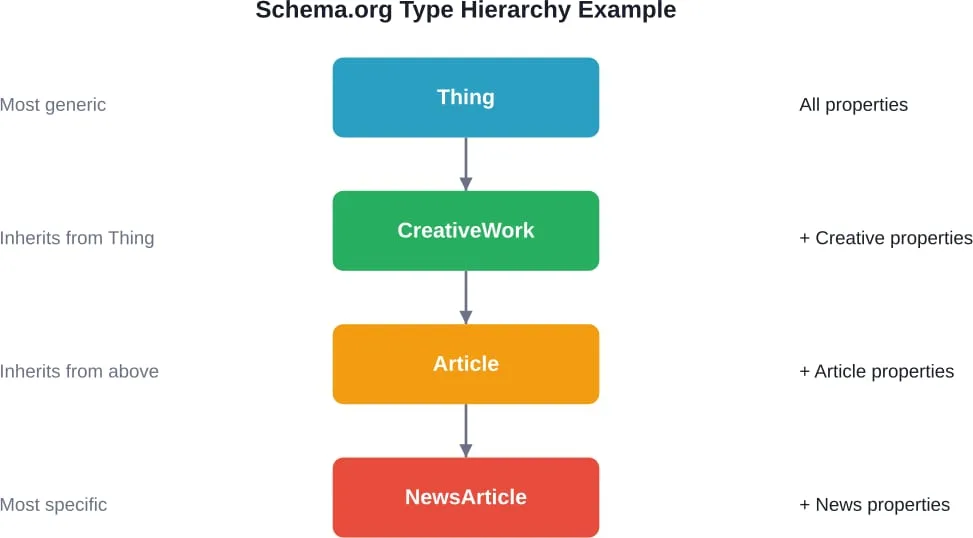
Schema.org organizes types in a hierarchy. At the top sits “Thing,” the most generic type. Everything descends from Thing, becoming progressively more specific. For example: Thing > CreativeWork > Article > NewsArticle.
This hierarchical structure means schemas inherit properties from their parent types. A NewsArticle automatically includes all properties available to Article, CreativeWork, and Thing, plus its own specific properties. This inheritance model keeps the vocabulary organized while allowing detailed specificity when needed.
Why Structured Data Matters for SEO
Search engines don’t require structured data to index or rank pages. Sites without any markup can still perform well in search results. So why bother?
The answer lies in visibility, context, and competitive advantage.
Enhanced Search Visibility Through Rich Results
Rich results are the primary reason most websites implement structured data. These enhanced search listings display additional information beyond the standard blue link and meta description.
They can show:
- Star ratings and review counts
- Product prices and availability
- Recipe cooking times and calorie counts
- Event dates and locations
- FAQ accordion content
- Video thumbnails and duration
- Breadcrumb navigation paths
These enhanced listings occupy more visual space on the results page and draw more attention than standard results. Studies have shown that rich snippets can improve CTR by anywhere from 5%–30%, according to Moz research. That’s not a minor optimization—it’s a substantial competitive advantage.
But here’s what’s important: not all structured data automatically qualifies for rich results. Google selectively displays enhanced features based on content quality, markup accuracy, and relevance to the search query. The markup creates eligibility, not entitlement.
Improved Semantic Understanding
Beyond rich results, structured data helps search engines understand content relationships and context. This semantic understanding influences how search engines categorize content, determine relevance for queries, and connect related information across different pages.
When a recipe page includes structured data identifying the author, search engines can connect that recipe to other content by the same author. When product pages mark up brand information, search engines can aggregate all products from that brand. This interconnected understanding creates what’s sometimes called the “knowledge graph”—the web of relationships between entities that powers modern search.
Real-World Performance Impact
The data supporting structured data implementation goes beyond theoretical benefits. According to Moz industry research, one established national retail brand saw schema implementation contribute to a 50% increase in organic conversions within just one month. Schema improvements drove a 230% increase in organic conversion value within six months for the same client.
These aren’t isolated cases. The consistent pattern across implementations shows that structured data delivers measurable results when implemented correctly.
Common Structured Data Formats
Schema.org defines what to markup (the vocabulary), but it doesn’t specify how to encode that markup in your HTML. Three formats have emerged as the primary options:
JSON-LD (Recommended)
JSON-LD stands for JavaScript Object Notation for Linked Data. It’s Google’s recommended format and the most widely adopted approach for new implementations.
JSON-LD lives in a script tag, typically placed in the page head or body section. The markup exists separately from visible page content, making it easy to add, edit, or remove without touching the HTML that users see.
Here’s what a basic JSON-LD implementation looks like for an article:
| <script type=”application/ld+json”> { “@context”: “https://schema.org”, “@type”: “Article”, “headline”: “What Is Structured Data SEO?”, “author”: { “@type”: “Person”, “name”: “Jane Smith” }, “datePublished”: “2026-02-25”, “image”: “https://example.com/image.jpg” } </script> |
The format is clean, readable, and doesn’t interfere with page rendering or user experience. Because it’s separate from visible content, developers can manage structured data independently from design changes.
Microdata
Microdata embeds schema markup directly into HTML tags as additional attributes. It interweaves with the visible content, using attributes like itemscope, itemtype, and itemprop to define schema properties.
While still supported, microdata has fallen out of favor because it’s harder to maintain. Changes to page layout require updating the markup, and it’s more difficult to validate without specialized tools.
RDFa
RDFa (Resource Description Framework in Attributes) is another embedded format that adds semantic annotations through HTML attributes. It’s more flexible than microdata but also more complex to implement correctly.
RDFa sees limited use in general SEO contexts but remains relevant in specific industries and contexts where more sophisticated semantic relationships need expression.
| Format | Placement | Ease of Use | Google’s Recommendation | Best For |
|---|---|---|---|---|
| JSON-LD | Separate script block | Easy to implement and maintain | Recommended | Most websites and new implementations |
| Microdata | Embedded in HTML | Moderate complexity | Supported | Legacy systems with existing microdata |
| RDFa | Embedded in HTML | Complex | Supported | Specialized semantic applications |
Types of Structured Data Most Valuable for SEO
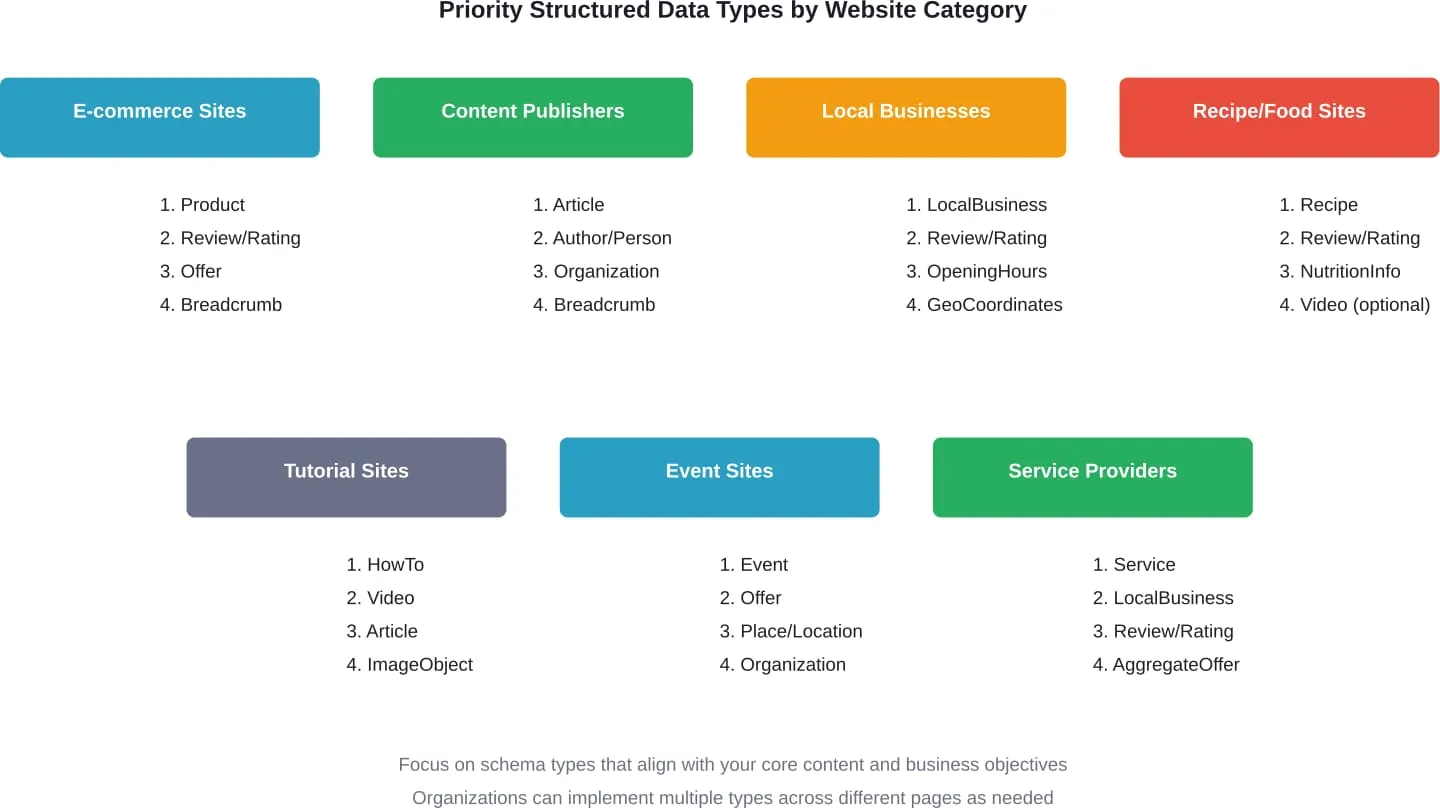
Schema.org includes hundreds of types, but most websites benefit from focusing on a core set of schemas that align with their content and business model.
Article Schema
Article schema applies to blog posts, news articles, opinion pieces, and similar content. It helps search engines identify authorship, publication dates, featured images, and article sections.
News sites, blogs, and content publishers should prioritize Article schema (or its more specific variants like NewsArticle, BlogPosting, or ScholarlyArticle). This markup supports features like the Top Stories carousel and article snippets in search results.
Product Schema
E-commerce sites rely heavily on Product schema to mark up items for sale. This schema includes properties for name, image, description, SKU, brand, price, availability, and customer reviews.
Product markup enables shopping-related rich results that display pricing, availability, and ratings directly in search. For online retailers, this markup isn’t optional—it’s essential for competing in product search.
Local Business Schema
Brick-and-mortar businesses and service providers benefit from LocalBusiness schema (and its many specific subtypes like Restaurant, Store, or ProfessionalService). This markup includes business hours, location, contact information, and service areas.
Local Business schema supports the knowledge panel that appears for business searches and helps with local pack rankings in Google Maps results.
FAQ Schema
FAQ schema markup creates expandable question-and-answer sections directly in search results. When someone searches for a question your FAQ answers, Google can display that specific Q&A pair right on the results page.
However, Google has restricted FAQ rich results to authoritative government and health websites in recent years. While other sites can still implement FAQ schema for semantic understanding, they shouldn’t expect rich result display.
HowTo Schema
Tutorial and instructional content benefits from HowTo schema, which structures step-by-step processes with individual steps, images, and estimated completion times.
HowTo rich results can display in search with images for each step, making tutorial content highly visible and appealing to users looking for instructions.
Video Schema
Pages with video content should implement VideoObject schema to provide search engines with information about the video’s title, description, thumbnail, upload date, and duration.
Video schema supports video carousels in search results and can display video previews directly on the search page, increasing visibility for video content.
Breadcrumb Schema
Breadcrumb markup doesn’t create dramatic visual enhancements, but it helps search engines understand site hierarchy and can replace the URL display in search results with a more user-friendly breadcrumb trail.
How to Implement Structured Data on Your Website
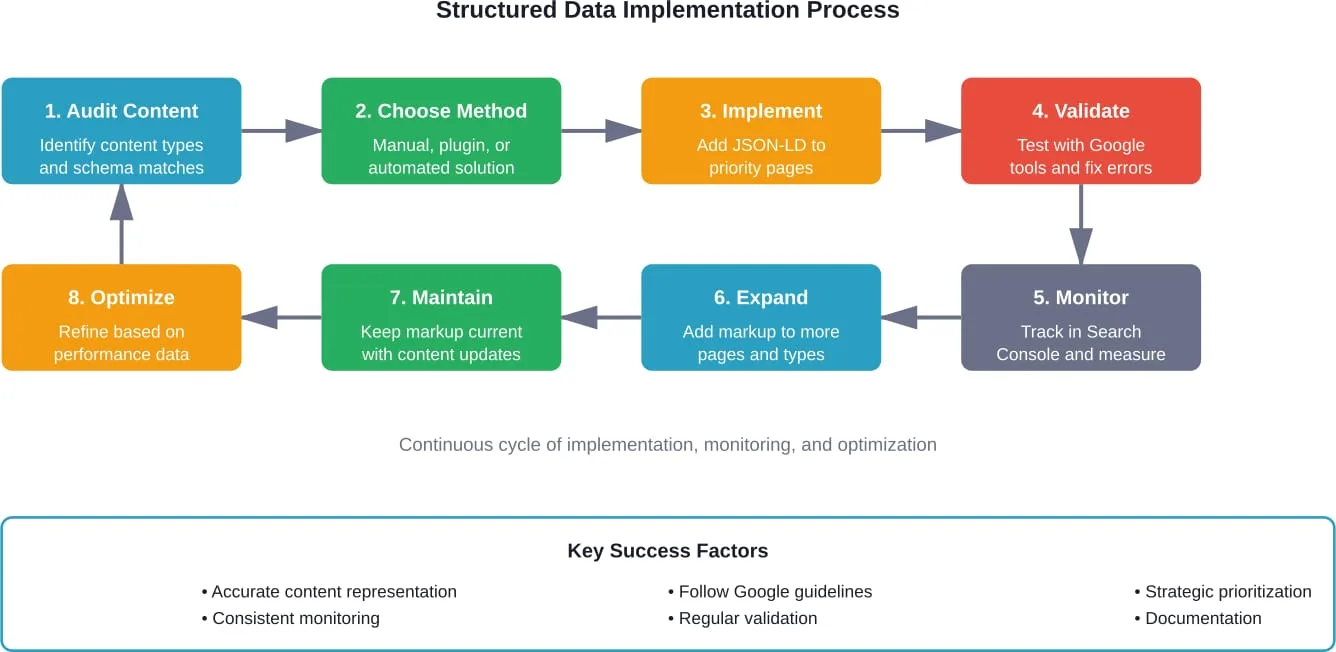
Implementation approaches range from manual coding to automated plugin solutions, depending on technical capability and platform constraints.
Manual Implementation
For developers comfortable with HTML and JSON, manual implementation offers complete control.
This approach involves:
- Identifying which schema types match your content
- Consulting Schema.org documentation for required and recommended properties
- Writing JSON-LD code that accurately describes your content
- Adding the script block to your page template or individual pages
- Testing the implementation with validation tools
Manual implementation works well for custom-built websites and situations requiring precise control over markup details.
WordPress Plugins
WordPress users can leverage plugins that automate much of the structured data process. Popular options include Yoast SEO, Rank Math, Schema Pro, and All in One Schema Rich Snippets.
These plugins typically provide settings interfaces where users can configure schema types without writing code. The plugins then automatically generate and insert the appropriate JSON-LD based on content type, custom fields, and plugin settings.
Plugin-based implementations trade some flexibility for ease of use. They work well for sites where standard schema types cover most needs and technical resources are limited.
Google Tag Manager
Some organizations deploy structured data through Google Tag Manager, which allows adding and modifying markup without changing website code. This approach suits situations where direct code access is restricted or where marketing teams need to manage markup independently.
Tag Manager implementations require setting up custom HTML tags that contain the JSON-LD code, then configuring triggers to fire those tags on appropriate pages.
Platform-Specific Solutions
E-commerce platforms like Shopify, WooCommerce, and BigCommerce often include built-in structured data or offer specialized apps for schema implementation. These solutions understand the platform’s data structure and can automatically generate Product, Review, and Offer markup based on product information already in the system.
Testing and Validating Structured Data
Implementing markup is only half the process. Validation ensures the code is error-free and eligible for rich results.
Google Rich Results Test
Google’s Rich Results Test checks whether a page’s structured data qualifies for specific rich result features. It identifies errors, warnings, and valid items while showing a preview of how the page might appear in search results.
This tool focuses specifically on markup types that can trigger rich results, so it won’t validate all schema types—only those Google actively uses for search features.
Schema Markup Validator
Schema.org provides its own validator that checks markup against the full vocabulary specification. This tool is more comprehensive than Google’s Rich Results Test because it validates all schema types, not just those eligible for rich features.
Use this validator to verify technical correctness even when rich results aren’t the primary goal.
Google Search Console
After implementing structured data, Google Search Console’s Enhancement reports show which pages include specific markup types, any errors Google encountered, and performance data for pages with rich results.
These reports provide ongoing monitoring and alert site owners when Google detects new errors or issues with existing markup.
Common Structured Data Mistakes to Avoid
Structured data implementation seems straightforward, but several common errors can prevent markup from working correctly or even trigger manual actions from Google.
Marking Up Content Not Visible to Users
Google’s structured data guidelines prohibit marking up content that users can’t see on the page. The markup should describe visible content, not inject additional information that exists only for search engines.
For example, marking up a 5-star rating when no rating appears on the page violates guidelines. The structured data should accurately reflect what users experience.
Misusing Review Markup
Review and rating markup frequently gets misapplied.
Common violations include:
- Marking up promotional content as reviews
- Creating self-reviews (businesses reviewing themselves)
- Using fake or incentivized reviews
- Marking up reviews about multiple items on a single page
Google actively monitors review markup for manipulation and can issue manual actions for violations.
Duplicate or Conflicting Markup
Multiple sources can sometimes add structured data to the same page—a theme might include basic markup, a plugin adds more, and custom code adds additional schemas. This can create duplicate or conflicting information.
Audit your pages to ensure markup isn’t redundantly describing the same content or providing conflicting values for the same properties.
Missing Required Properties
Each schema type has required properties that must be present for the markup to be valid. Product schema requires name, image, and either offers or review, for example.
Check Schema.org documentation or use validation tools to verify all required properties are present.
Incorrect Data Types
Properties expect specific data types—dates should be formatted properly, prices need currency codes, and URLs must be complete. Improper formatting can invalidate markup even when the underlying information is correct.
Structured Data Beyond Rich Results
While rich results generate the most attention, structured data serves broader purposes in modern SEO and web technology.
Voice Search and Digital Assistants
Voice assistants like Google Assistant, Alexa, and Siri rely on structured data to answer spoken queries. When someone asks about business hours, event times, or recipe ingredients, assistants pull information from pages with appropriate markup.
As voice search continues growing, structured data becomes increasingly important for appearing in voice query results.
Knowledge Graph Integration
Google’s Knowledge Graph aggregates information about entities—people, places, things, and concepts—from across the web. Structured data helps Google understand relationships between entities and can contribute to Knowledge Graph panels.
Consistent structured data about organizations, people, and their relationships helps build more complete entity profiles in the Knowledge Graph.
Future-Proofing for AI Search
As search engines incorporate more AI and machine learning, understanding semantic relationships becomes even more critical. Structured data provides explicit semantic information that AI systems can use to better understand content context and relationships.
With generative AI search experiences emerging, structured data may influence how content gets selected and presented in AI-generated answers.
Structured Data Strategy and Best Practices
Effective structured data implementation requires strategic thinking beyond just adding markup to pages.
Start with Your Most Important Pages
Don’t attempt to mark up every page simultaneously. Prioritize:
- Pages that drive the most traffic or conversions
- Content types with clear schema matches (products, articles, events)
- Pages where rich results would provide competitive advantage
Build out structured data coverage gradually, validating and monitoring results as you expand implementation.
Maintain Accuracy and Consistency
Structured data should always accurately reflect page content. When content changes, markup must update accordingly. Outdated pricing, discontinued products, or past events with inaccurate dates create poor user experiences and can violate Google’s guidelines.
Establish processes for keeping markup synchronized with content changes, particularly for dynamic content like pricing and availability.
Document Your Implementation
Create documentation that maps which schema types are used where, how they’re implemented (plugin, manual code, Tag Manager), and what properties are included. This documentation helps when troubleshooting issues, training team members, or auditing markup comprehensiveness.
Monitor Performance
Track metrics that indicate structured data impact:
- Rich result impressions and clicks in Search Console
- Click-through rates for pages with rich results vs. standard listings
- Overall organic traffic trends after implementation
- Conversion rates for traffic from rich results
These metrics help quantify the ROI of structured data efforts and guide future optimization priorities.
Stay Current with Google’s Guidelines
Google regularly updates its structured data guidelines, adds support for new schema types, and modifies how existing markup displays in search. Subscribe to Google Search Central blog updates and periodically review official documentation to stay informed about changes.
Scaling Performance with Lengreo
While understanding the mechanics of Schema.org is vital for any modern digital strategy, the technical execution and ongoing maintenance of these schemas can be a significant undertaking for growing businesses. Our team at Lengreo specializes in bridging the gap between technical SEO requirements and high-level business growth. We integrate structured data audits and optimizations directly into our comprehensive SEO and content strategies to ensure our clients aren’t just visible, but are dominating their respective search landscapes with high-impact rich results.
The data confirms that semantic clarity leads to higher engagement, and we have seen this translate into remarkable real-world outcomes. By aligning technical precision with market-driven strategy, we’ve successfully boosted conversion rates by over 53% for our IT sector partners and significantly reduced cost-per-lead for international tech firms. Whether you are looking to implement JSON-LD for a complex e-commerce catalog or optimize your local business presence, we provide the expertise needed to turn structured data into a sustainable competitive advantage.
The Future of Structured Data in SEO
Structured data’s importance continues growing as search experiences evolve beyond traditional blue links. Several trends point to expanding relevance:
AI and Generative Search
As AI-powered search experiences like Google’s Search Generative Experience and other AI chatbots become more prevalent, structured data may influence how content gets selected and cited in AI-generated responses. These systems need reliable, structured information sources, and pages with clear schema markup provide exactly that.
Multimodal Search
Search increasingly spans voice, visual, and traditional text queries. Structured data helps search engines understand content across these different modalities, ensuring pages can surface for voice questions, image searches, and visual discovery tools.
Entity-Based Search
Google’s shift toward entity-based understanding rather than keyword matching makes structured data more valuable. Markup explicitly defines entities and their relationships, aligning with how modern search engines conceptualize information.
The organizations and websites that implement comprehensive, accurate structured data today position themselves advantageously for whatever search innovations emerge tomorrow.
Getting Started with Structured Data SEO
Structured data implementation might seem technical, but the fundamentals are accessible to anyone willing to learn the basics.
Start by identifying one high-value content type on your site—your most popular product category, your blog articles, or your service pages. Research which schema type matches that content, then implement markup on just a few pages initially. Validate the implementation, monitor results for a few weeks, and gradually expand coverage based on what works.
The structured data landscape continues evolving, but the core principle remains constant: providing search engines with explicit, accurate information about your content creates opportunities for enhanced visibility and better user experiences.
As search becomes more sophisticated and AI-driven, the websites that speak search engines’ semantic language through structured data will maintain competitive advantages over those that rely solely on traditional optimization techniques.
Take the time to understand structured data fundamentals, implement markup strategically on your most important pages, and monitor the results. The initial investment in learning and implementation pays dividends through improved search visibility, higher click-through rates, and better positioning for the future of search.