


Quick Summary: Website development for banks encompasses creating secure, accessible, and user-friendly digital platforms that meet regulatory compliance while delivering seamless customer experiences. Modern banking websites integrate advanced security protocols, mobile responsiveness, and intuitive navigation to support online account management, loan applications, and financial services. Successful bank web development balances aesthetic design with robust functionality, ensuring trust and efficiency for both retail and commercial banking customers.
Banking websites serve as the digital front door to financial institutions. They’re where first impressions form, where trust gets established, and where customers increasingly conduct their financial business.
But here’s the thing—developing a website for a bank isn’t like building one for a retail shop or a blog. The stakes are different. Security vulnerabilities can cost millions. Poor user experience drives customers to competitors. Non-compliance with regulations brings federal scrutiny.
The financial technology landscape has grown dramatically, with fintech companies transforming how customers expect to interact with their banks online. That shift puts pressure on traditional banking institutions to modernize their digital presence.
This guide covers what actually matters in bank website development—from security standards that keep the OCC satisfied to design principles that convert visitors into customers.
Why Banking Website Development Requires Specialized Expertise
Financial institutions face unique requirements that don’t apply to most other industries. Regulatory compliance alone creates a complex web of standards.
The Office of the Comptroller of the Currency (OCC) issues detailed bulletins outlining expectations for protecting non-public information on digital platforms. These aren’t suggestions. Banks must implement specific security provisions designed to protect customer data from unauthorized disclosure.
The Federal Reserve Board establishes interagency guidelines for information security standards that state member banks must follow. These guidelines cover everything from authentication protocols to access controls for financial institution services and systems.
Real talk: ignoring these requirements isn’t an option. The regulatory framework exists because banking websites handle sensitive financial data, account credentials, and personally identifiable information that attackers constantly target.
Security Standards That Actually Matter
According to NIST’s Cybersecurity Framework, organizations must understand and improve their management of cybersecurity risk through structured approaches. For banks, this translates to specific technical implementations.
NIST has published cybersecurity considerations specifically for open banking implementations (IR 8389), recognizing that modern financial platforms increasingly rely on API integrations and third-party services. These create new attack surfaces that didn’t exist with legacy banking systems.
OWASP (Open Web Application Security Project) maintains multiple resources directly applicable to banking website development. Their SecureBank project provides a developer training environment showing how common vulnerabilities appear in financial applications—and how to prevent them.
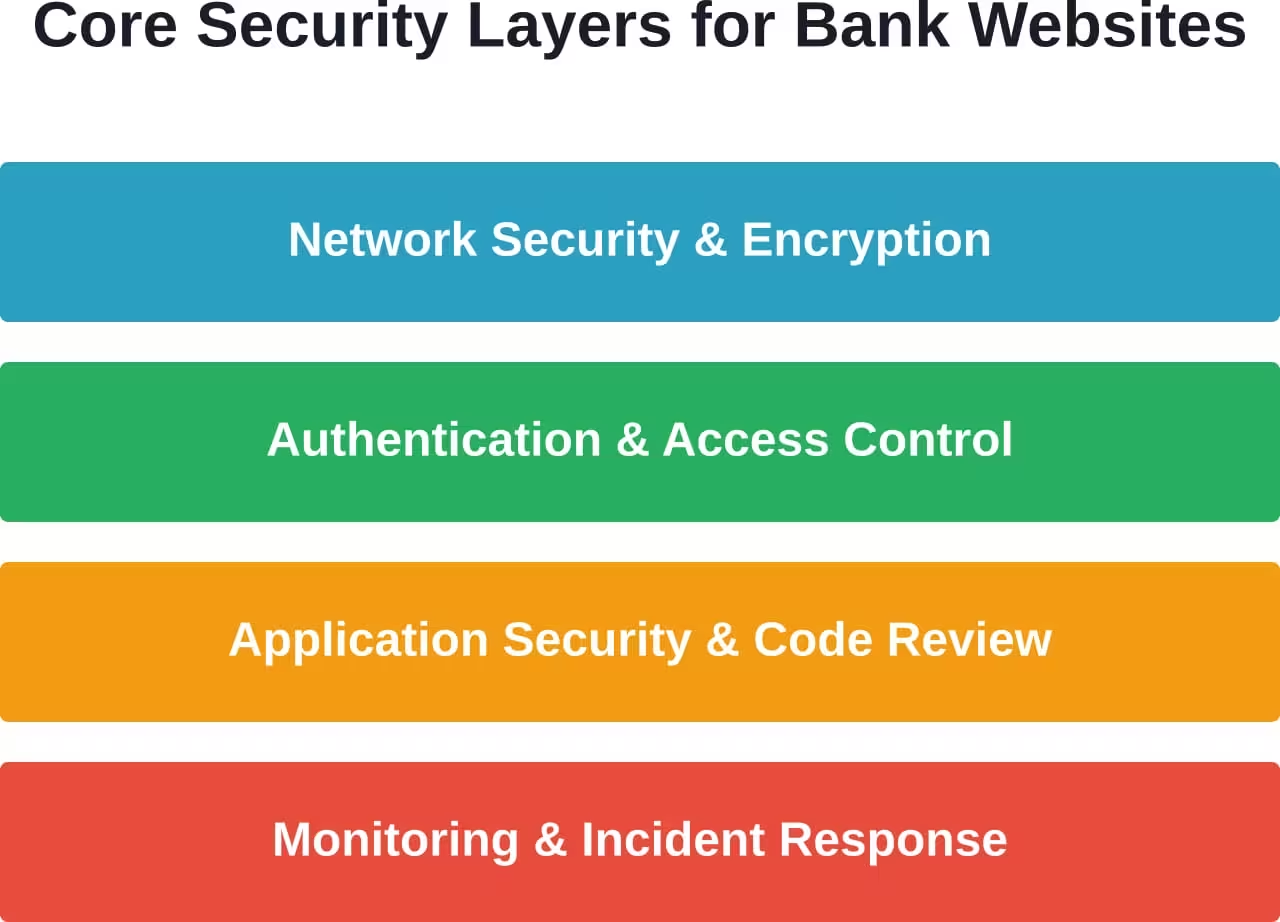
The OWASP API Security Project identifies vulnerabilities specific to application programming interfaces—critical because modern banking websites rely heavily on APIs for everything from account balance lookups to payment processing. APIs expose application logic and sensitive data, making them prime targets.
Client-side security presents distinct challenges. The OWASP Top 10 Client-Side Security Risks document addresses threats that occur in customers’ browsers rather than on bank servers. Third-party JavaScript libraries, browser extensions, and cross-site scripting attacks all operate in this space.
Credential Stuffing and Automated Threats
OWASP research on credential stuffing reveals why banks face constant login attacks. Attackers inject stolen username-password pairs into website login forms, attempting to access customer accounts fraudulently. Since many people reuse passwords across multiple sites, credentials exposed in one breach often work on banking sites.
The OWASP Automated Threats to Web Applications project catalogs scenarios where software automation causes divergence from accepted behavior. These aren’t traditional vulnerabilities in code—they’re attacks that exploit normal website functionality through automation.
Banks must implement rate limiting, CAPTCHA challenges, device fingerprinting, and behavioral analysis to detect and block these automated attacks without frustrating legitimate customers.
Build a Banking Website With the Expertise It Requires
Banking websites can’t be built on guesswork. When security, compliance, and functionality all matter, mistakes at the planning stage usually turn into serious problems after launch. Lengreo approaches website development through a defined process that starts with analysis and moves step by step to launch and support. This helps avoid gaps in requirements, misalignment in design, and issues that typically appear when complex projects are rushed or poorly structured.
Follow a Clear Development Process That Reduces Risk and Delays
Lengreo structures website projects to keep development controlled and predictable:
- Discovery, business analysis, and research to define requirements and goals
- Prototyping and design with iterative reviews and adjustments
- Front-end and back-end development delivered in controlled stages
- Quality assurance before launch with short-term post-launch support
👉 Contact Lengreo to build a banking website with a clear process, proper structure, and reliable delivery.
Design Best Practices That Drive Engagement
Security and compliance form the foundation, but design determines whether customers actually use the website. Banking website design must balance multiple competing priorities.
Navigation should be intuitive. Customers need to find account opening forms, loan applications, branch locations, and customer service contacts without hunting through nested menus. Clear information architecture reduces bounce rates and improves conversion.
Research shows that 80% of users interact with their bank through more than one channel. The website experience must integrate seamlessly with mobile apps, ATMs, phone banking, and in-branch services. Disconnected channels create frustration and erode trust.
Mobile Responsiveness Is Non-Negotiable
Mobile devices account for the majority of banking website traffic for most institutions. Responsive design that adapts to different screen sizes isn’t optional—it’s fundamental to serving customers effectively.
But wait. Responsive design for banks requires more than just flexible layouts. Touch targets must be large enough for accurate tapping. Forms must work with mobile keyboards and autofill. Account numbers and routing numbers need to display in readable formats on small screens.
Payment interfaces deserve special attention. Entering card numbers, selecting accounts, and confirming transactions must work flawlessly on mobile devices where most transactions now occur.
Accessibility Compliance Protects Everyone
Website accessibility compliance isn’t just about avoiding lawsuits—though that’s certainly a consideration. Accessible design makes banking websites usable for customers with visual, auditory, motor, or cognitive impairments.
The Web Content Accessibility Guidelines (WCAG) provide technical standards for accessible web development. Banks should target WCAG 2.1 Level AA compliance at minimum, addressing issues like color contrast, keyboard navigation, screen reader compatibility, and alternative text for images.
Accessible design also improves usability for everyone. Clear headings help all users scan content. Proper form labels reduce errors. High contrast text remains readable in bright sunlight.
| Design Element | Banking Best Practice | Why It Matters |
|---|---|---|
| Navigation | Flat hierarchy with max 3 clicks to any page | Reduces friction in finding services and information |
| Forms | Inline validation with clear error messages | Decreases abandonment on account opening and applications |
| Search | Prominent search with autocomplete and filters | Helps customers quickly locate specific products or answers |
| CTAs | High-contrast buttons with action-oriented text | Increases conversion on key actions like account opening |
| Content | Plain language with financial jargon defined | Builds understanding and confidence in banking decisions |
Performance and Hosting Considerations
Page load speed directly impacts both user experience and search engine rankings. Banking websites often include complex functionality that can slow performance if not optimized properly.
Image optimization reduces file sizes without sacrificing visual quality. JavaScript and CSS files should be minified and compressed. Critical rendering path optimization ensures above-the-fold content loads quickly while less essential resources load progressively.
Content Delivery Networks (CDNs) distribute static assets across geographically distributed servers, reducing latency for customers regardless of location. For banks with regional or national presence, CDNs significantly improve performance.
Hosting Requirements for Financial Institutions
Secure hosting infrastructure matters as much as the website code itself. Banks need hosting environments that provide robust security controls, regular backups, disaster recovery capabilities, and compliance certifications.
Dedicated hosting or private cloud environments offer better security isolation than shared hosting. The Federal Financial Institutions Examination Council (FFIEC) provides guidance on third-party risk management that applies to hosting providers.
Uptime requirements for banking websites typically exceed 99.9%. Customers expect access to online banking at any time. Redundant systems, load balancing, and failover mechanisms prevent outages from disrupting service.
Content Strategy for Banking Websites
Content serves multiple purposes on banking websites. It educates customers about products and services. It answers common questions to reduce call center volume. It builds trust through transparency and expertise.
Product pages need clear explanations of features, rates, fees, and requirements. Avoid burying important details in fine print—transparency builds confidence. Comparison tools help customers evaluate options like checking accounts or mortgage products.
Educational content addresses customer questions about financial topics. Articles about budgeting, saving strategies, or understanding credit scores position the bank as a helpful resource beyond just selling products.
Branch and ATM locators must work accurately with current information. Nothing frustrates customers like driving to a branch that’s closed or no longer exists based on outdated website data.
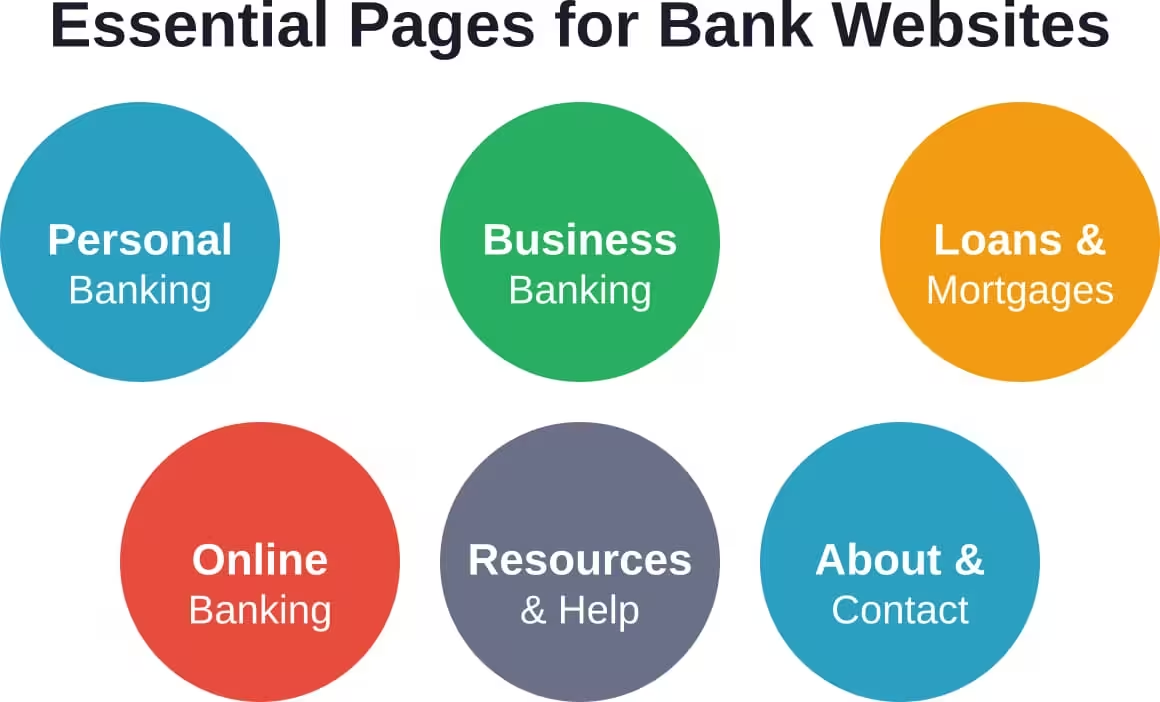
Integration with Banking Systems
Modern banking websites don’t exist in isolation. They must integrate with core banking systems, customer relationship management platforms, marketing automation tools, and third-party services.
Account opening workflows connect to systems that verify identity, check credit, and establish new accounts in core banking platforms. These integrations must work reliably while maintaining security and compliance.
Online banking functionality requires real-time or near-real-time connections to account data. Customers expect to see current balances, recent transactions, and accurate information about their accounts.
Marketing teams need tools to manage website content without developer involvement for every change. Content management systems designed for financial institutions provide appropriate workflows and approval processes.
Digital Transformation in Banking
The broader context of banking website development involves digital transformation across the financial services industry. Academic research on fintech’s impact on banking notes that fintech continues reshaping the banking sector’s financial landscape, creating challenges for executives trying to stay current.
Traditional banks compete not just with other banks but with fintech startups offering specialized services—mobile payment apps, online-only banks, peer-to-peer lending platforms, and robo-advisors. Websites serve as key battlegrounds in this competition.
Digital payment innovations demonstrate how quickly customer expectations evolve. Mobile money services and real-time payment systems have transformed financial services delivery globally. That’s the transformative potential of well-executed financial technology.
MIT research on digital strategy emphasizes experimentation and customer engagement over traditional strategic analysis and big bets. Digital business strategies rely on continuous streams of business experiments and customer interaction to identify what solutions customers actually want.
Balancing Innovation and Stability
Banks face tension between innovation and stability. Customers expect modern features and convenience. But they also expect their bank to be reliable, secure, and trustworthy.
Website development must navigate this tension. New features should undergo thorough testing and security review before deployment. But development cycles can’t be so slow that competitors gain significant advantages.
Agile development methodologies adapted for banking contexts allow iterative improvement while maintaining necessary controls. DevSecOps practices integrate security testing throughout development rather than treating it as a final gate.
| Development Approach | Best For | Typical Timeline |
|---|---|---|
| Complete redesign | Outdated sites needing fundamental updates | 6-12 months |
| Phased modernization | Large institutions with complex legacy systems | 12-24 months |
| Continuous improvement | Maintained sites needing ongoing optimization | Ongoing sprints |
| Feature additions | Specific capability gaps or new products | 2-4 months per feature |
Measuring Success for Banking Websites
Analytics performance measurement for banking websites requires specific metrics beyond standard web analytics. Conversion rates matter—how many visitors open accounts, submit loan applications, or sign up for credit cards.
Task completion rates reveal whether customers can successfully accomplish common goals like finding branch hours, downloading tax documents, or understanding product terms. High abandonment rates on specific pages signal usability problems.
Customer satisfaction scores from post-visit surveys provide qualitative feedback on website experience. Net Promoter Score (NPS) measures whether customers would recommend the bank to others.
Security metrics track attempted attacks, successful authentications, and security incident response times. These don’t directly measure customer satisfaction but indicate how well security controls perform.
Building Banking Websites That Work
Website development for banks demands expertise spanning security, compliance, design, and financial services operations. The technical requirements exceed typical business websites. The stakes of getting it wrong—data breaches, regulatory penalties, customer trust erosion—create little margin for error.
But done well, banking websites become powerful assets. They reduce operational costs by enabling self-service. They attract new customers through compelling digital experiences. They strengthen relationships by providing convenient access to financial services.
The banking industry continues evolving rapidly. Digital expectations keep rising. Competitive pressures from fintech companies intensify. Banks that invest in professional website development position themselves to thrive in this changing landscape.
Whether starting a complete redesign or planning incremental improvements, prioritize security, compliance, and customer needs in that order. Beautiful design and advanced features matter only if they’re built on a secure, compliant foundation that actually serves customer goals.
Ready to improve your bank’s digital presence? Start by auditing your current website against the security standards and design best practices outlined here. Identify gaps and prioritize improvements based on risk and customer impact.