

Quick Summary: Marketing virtual events requires a strategic mix of tactics: leverage email campaigns with SMS follow-ups (98% open rate), create compelling video content (59% of executives agree that if both text and video are available on the same topic, they are more likely to engage with video), optimize landing pages, engage speakers as co-promoters, use targeted social media advertising, and focus on audience-centric content. Measuring engagement metrics, registration conversion rates, and post-event ROI ensures continuous improvement.
Virtual events aren’t going anywhere. Industry data shows that 92% of event organizers have shifted to virtual events in 2021, and the momentum hasn’t slowed—over 93% of companies will host virtual events in 2026 and beyond.
But here’s the problem: creating a stellar virtual event means nothing if nobody shows up.
The difference between an empty (virtual) room and a packed, engaged audience comes down to marketing strategy. Not just any strategy—one that understands the unique challenges of virtual attendance, audience fatigue, and the increasingly crowded online event space.
This guide breaks down 14 actionable marketing ideas for virtual events, backed by real data from authoritative sources. No fluff. Just tactics that drive registrations, boost attendance, and create measurable results.
What Makes Virtual Event Marketing Different in 2026
Virtual event marketing isn’t simply taking traditional event promotion online. The dynamics have fundamentally shifted.
Attendance barriers are lower—attendees don’t need travel budgets or time off—but commitment barriers are higher. Clicking “register” takes seconds, but actually showing up competes with every other tab open on someone’s browser.
Forrester research emphasizes that technology supports virtual event experiences but is ineffective without a solid strategy and set of customer experience goals.
2022 saw a precipitous increase in event costs, with the average cost per attendee around 25% higher compared to 2019. Virtual events offer cost relief, but they demand different promotional approaches: shorter promotion cycles, more touchpoints, and content that proves value upfront.
Optimize Your Marketing With Lengreo
Virtual event companies need marketing that clearly explains event services, registration processes, and platforms. Lengreo helps connect website development, SEO, paid ads, content, lead generation, appointment setting, and tracking into a cohesive system, making it easier to convert potential attendees into registrants.
Need More Registrations?
Lengreo can help with:
- improving service, registration, and contact pages
- setting up SEO and paid traffic campaigns
- tracking forms, calls, and registration sources
- supporting content and lead generation workflows
👉 Contact Lengreo to discuss your marketing setup.
Build an Audience-Centric Content Strategy
Start with what attendees actually want—not what the organization wants to present.
Forrester research emphasizes that delivering compelling B2B event content requires a disciplined, audience-centric approach. Leaders must build organizational alignment around a key theme that connects to business objectives, then use this theme to craft a narrative feeding into all content aspects.
Forrester research shows 62% of B2B buyers list event presentations among their top five preferred content formats, and 59% list vendor-supplied event materials.
What does this mean practically?
Survey target attendees before building the agenda. Ask what challenges keep them up at night. Shape sessions around solving those specific problems, then communicate those solutions in every promotional message.
When marketing materials focus on attendee outcomes rather than speaker credentials or company achievements, registration rates improve. Frame every email subject line, social post, and landing page headline around audience benefit.
Optimize Landing Pages for Maximum Conversion
The landing page sits at the center of virtual event promotion. Every tactic—email, social media, paid ads—drives traffic here. If it doesn’t convert, nothing else matters.
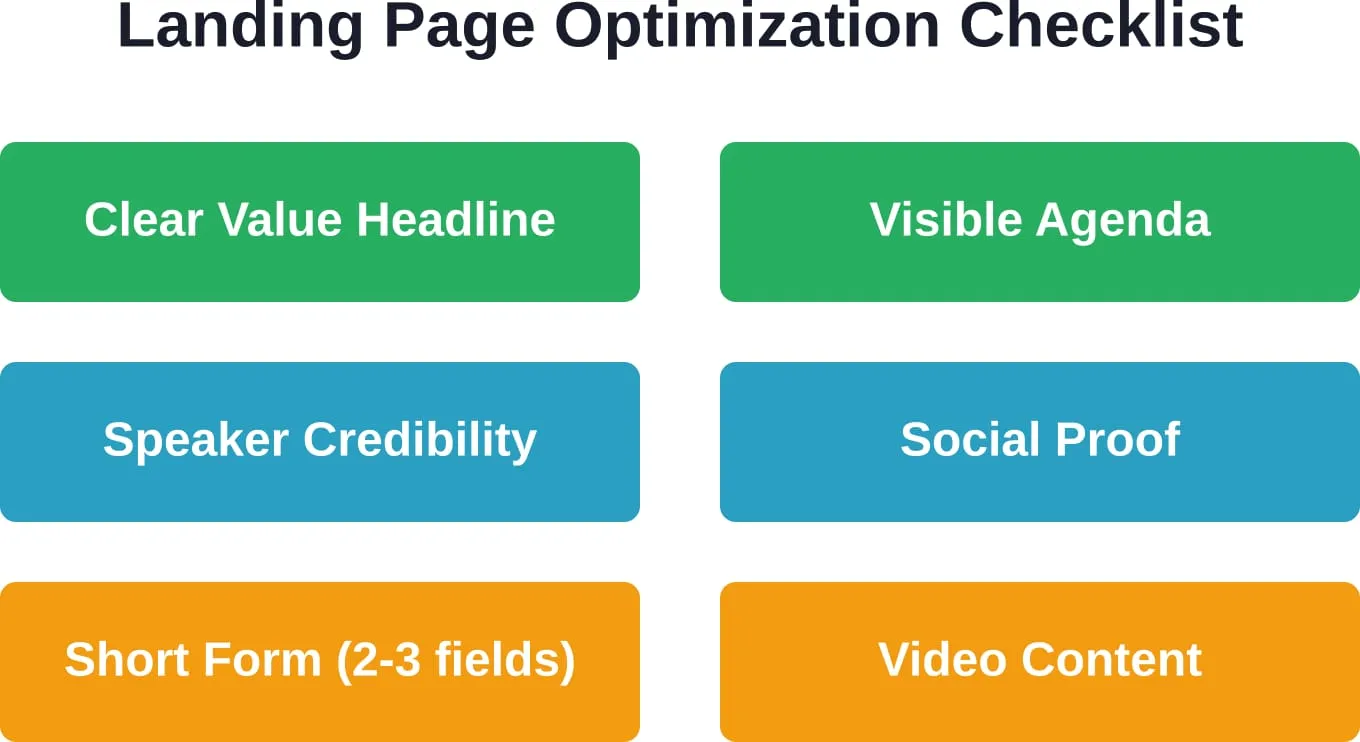
- Effective landing pages share common elements: a compelling headline stating the core benefit, a clear agenda showing time investment, speaker credibility indicators, social proof (past attendee numbers or testimonials), and a frictionless registration form.
- Keep forms short. Name and email suffice for top-of-funnel events. Every additional field reduces conversion rates. For events requiring more qualification, use progressive profiling—collect basic info first, gather details later.
- Video performs exceptionally well on landing pages. According to available data, 59% of executives agree that if both text and video are available on the same topic, they are more likely to engage with video. A 60-90 second video featuring a key speaker or highlighting session value can significantly boost registration completion rates.
- Test different versions. Small changes—button color, headline phrasing, form placement—can swing conversion rates by 20-30 percent. Set up A/B tests at least two weeks before the main promotional push to identify winners.
Leverage Email Marketing With Strategic Segmentation
Email remains the workhorse of event promotion. But generic blast emails don’t cut it anymore.
Segment audiences based on past behavior, industry, role, or engagement level. Craft different messages for each segment. A C-level executive cares about strategic insights; a practitioner wants tactical takeaways. Tailor subject lines and body copy accordingly.
Timing matters enormously. For virtual events, the promotion window typically runs shorter than in-person equivalents. Start promotional emails 3-4 weeks out for smaller events, 6-8 weeks for major conferences.
Send a sequence, not a single message. A proven cadence: announcement email (4 weeks out), speaker spotlight (3 weeks), early-bird deadline reminder (2 weeks), content preview (1 week), final reminder (2 days before), and day-of logistics email.
Track open rates, click-through rates, and registration conversion by email. Identify which messages perform best, then double down on those angles for future campaigns.
Amplify Email With SMS Follow-Ups
Text message marketing delivers remarkable results. According to MPI, text messages achieve a 98% open rate and 19% click-through rate—dramatically outperforming email across both metrics.
Use SMS strategically, not excessively. Reserve texts for high-priority messages: registration confirmation, last-chance reminders 24 hours before the event, day-of login links, and mid-event engagement prompts.
Keep messages brief and action-oriented. Include a clear link and state the value proposition in under 160 characters. SMS should complement email, not replace it—use texts to reach registrants who haven’t opened recent emails.
Turn Speakers Into Co-Promoters
Speakers bring their own audiences. Activate them.
When confirming speakers, send a promotion toolkit: pre-written social posts, graphics sized for different platforms, email copy they can adapt, and a unique tracking link to measure their promotional impact.
Make it effortless. Speakers are busy; they’ll promote if doing so requires minimal effort. Provide ready-to-use assets they can post with one click.
Incentivize participation. Recognize top promoters publicly, offer bonus speaking opportunities, or create a leaderboard showing which speakers drove the most registrations. Friendly competition works.
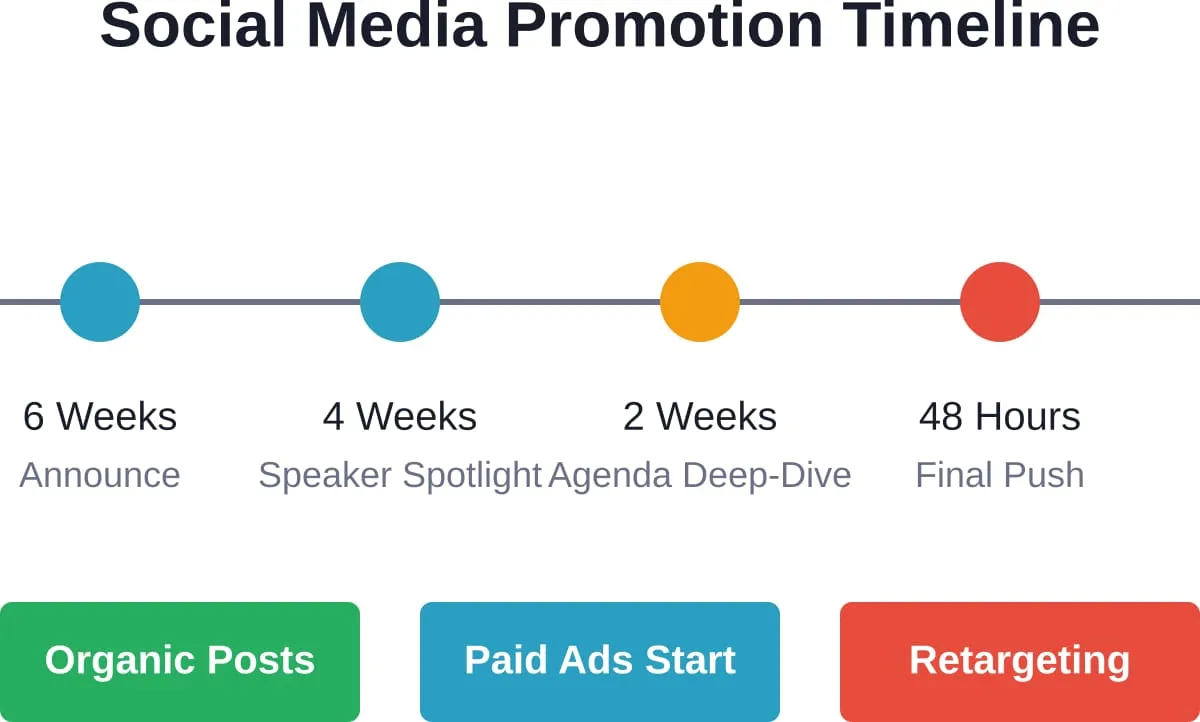
Schedule speaker promotion at intervals. Request one post when they’re announced (4-6 weeks out), another mid-promotion cycle (2-3 weeks out), and a final push in the last 48 hours.
Harness Social Media Advertising With Precision Targeting
Organic social reach continues declining. Paid social advertising fills the gap.
LinkedIn excels for B2B virtual events. Target by job title, company size, industry, and even specific companies. Start with small test budgets across multiple audience segments, identify which segments deliver the lowest cost-per-registration, then scale spending toward winners.
Facebook and Instagram work well for consumer-focused or broad professional development events. Use lookalike audiences based on past attendee lists to find similar prospects.
Create platform-specific ad creative. LinkedIn performs best with professional imagery and value-focused copy. Instagram needs visually striking graphics or short video clips. Test multiple ad variations simultaneously to identify top performers.
Retarget website visitors who viewed the landing page but didn’t register. These warm prospects need just one more nudge—show them ads highlighting testimonials, session details they didn’t see, or a countdown to the event.
Organic Social Tactics That Still Work
Even without ad spend, social channels drive awareness and engagement.
Create an event hashtag and use it consistently across all posts. Encourage speakers and partners to use it too. This aggregates conversation and makes the event discoverable.
Share behind-the-scenes content: speaker preparation clips, agenda sneak peeks, team planning sessions. Humanizing the event builds connection and interest.
Post countdown graphics in the final week. Visual reminders create urgency: “5 days until we explore [hot topic]—have you registered?”
Go live on platform-native video. A 10-minute Q&A with a headline speaker or a quick preview of what attendees will learn generates authentic engagement algorithms favor.
Create Compelling Video Content
Video outperforms static content consistently. The earlier statistic bears repeating: 59% of executives agree that if both text and video are available on the same topic, they are more likely to engage with video.
- Produce multiple video assets throughout the promotion cycle. A 90-second event overview video works for the landing page. Speaker introduction videos (15-30 seconds each) populate social feeds. Session teaser clips generate curiosity about specific content.
- Keep production quality professional but not overly polished. Authentic, conversational videos often outperform high-production corporate pieces. Smartphone footage with good lighting and clear audio suffices.
- Add captions to every video. Most social video plays without sound initially; captions ensure the message lands even when users can’t listen.
- Repurpose video content aggressively. Extract quotes as graphics. Transcribe insights into blog posts. Turn key moments into GIFs for email or social media.
Partner With Complementary Organizations
Strategic partnerships multiply reach without multiplying budget.
Identify organizations serving the same audience without directly competing. For a marketing automation event, partner with CRM vendors, analytics platforms, or professional marketing associations.
Structure win-win arrangements. Offer partners complimentary registrations for their members, co-branding on promotional materials, or speaking slots in exchange for promotion to their audience.
Provide partners with the same promotion toolkit used for speakers. Make co-promotion as easy as possible—pre-written emails, social posts, and graphics ready to deploy.
Track registration sources carefully. Understand which partnerships drive meaningful attendance, then prioritize those relationships for future events.
Implement Strategic Remarketing Campaigns
Most website visitors don’t register on the first visit. Remarketing brings them back.
- Install tracking pixels on the event landing page. Build remarketing audiences of visitors who didn’t complete registration, then show them targeted ads across Google Display Network, Facebook, LinkedIn, or other platforms.
- Customize remarketing messages based on behavior. Visitors who viewed the agenda but didn’t register might need social proof—show them testimonials or attendee numbers. Those who started registration but abandoned the form might need urgency—highlight limited seats or the approaching deadline.
- Set frequency caps to avoid ad fatigue. Showing the same person the same ad 20 times daily annoys rather than persuades. Limit exposure to 3-5 impressions per person per day.
- Exclude people who already registered. Nothing frustrates registrants more than seeing ads for an event they’ve already committed to attending.
Develop a Pre-Event Content Series
Content marketing builds anticipation and establishes authority.
Publish a series of blog posts, articles, or videos addressing topics the event will cover in depth. Each piece should provide standalone value while positioning the event as the next logical step for deeper learning.
Guest posts on industry publications extend reach. Pitch editors articles related to event themes, include a brief event mention and link in the author bio.
Host pre-event webinars on subtopics. A 30-minute webinar four weeks before the main event attracts interested prospects, demonstrates content quality, and converts attendees into event registrants.
Create downloadable resources: checklists, templates, guides, or reports. Gate these with a registration form that includes an option to also register for the upcoming event.
Optimize for Search and Discoverability
Ensuring your event can be easily found is essential. People search for events, topics, and solutions, so optimizing for discoverability increases registrations and engagement.
Organize Event Landing Pages
Include relevant keywords such as “virtual event,” the event topic, industry terms, and format descriptors in page titles, headers, and body copy to improve search visibility.
List Events on Discovery Platforms
Create listings on Eventbrite, Meetup, professional association calendars, and industry-specific directories. Each listing provides another pathway for potential attendees to find and register.
Leverage Speaker Networks
Encourage speakers to add the event to their personal websites, LinkedIn profiles, and speaker pages. These backlinks not only improve search rankings but also tap into each speaker’s audience.
Submit to Newsletters and Industry Roundups
Send event details to relevant newsletters and trade publication roundups. Many professional communities curate upcoming event lists, providing exposure to highly targeted audiences.
Measure What Matters
Marketing without measurement wastes resources. Track metrics that actually indicate success.
Registration conversion rate reveals landing page and promotion effectiveness. Calculate it by dividing registrations by landing page visitors. Well-executed campaigns often achieve conversion rates in the 15-25% range.
Source attribution shows which channels deliver. Tag all promotional links with UTM parameters to track which emails, social posts, ads, or partners drive the most registrations.
Registration-to-attendance rate measures actual engagement. Virtual events typically see 40-60% of registrants attend live, though actual rates vary significantly. Below 40% suggests promotion attracted wrong-fit attendees or messaging misset expectations.
Engagement metrics during the event—poll participation, chat activity, session attendance duration—indicate content quality and relevance. These inform future event topics and formats.
Post-event surveys capture attendee satisfaction and gather testimonials for promoting future events. Ask specific questions: What was most valuable? What could improve? Would you attend again?
| Metric | What It Measures | Typical Benchmark | How to Improve |
|---|---|---|---|
| Landing Page Conversion Rate | Percentage of visitors who register | 15-25% | Optimize headline, reduce form fields, add video |
| Email Open Rate | Percentage of recipients who open promotional emails | 20-30% | Improve subject lines, segment audiences, test send times |
| Registration-to-Attendance | Percentage of registrants who attend | 40-60% | Send reminders, set expectations, create urgency |
| Cost Per Registration | Total promotional spend divided by registrations | Varies by industry | Focus budget on highest-converting channels |
| Engagement Rate | Active participation during event | 30-50% interact | Use polls, Q&A, chat prompts, interactive elements |
Common Virtual Event Marketing Mistakes to Avoid
Even experienced marketers stumble. Avoid these pitfalls.
- Starting promotion too late is a common challenge. Virtual events typically benefit from adequate lead time—3-4 weeks for smaller sessions, 6-8 weeks for major conferences. Last-minute promotion rarely fills the house.
- Neglecting mobile optimization kills conversions. Over 50% of email opens and web traffic come from mobile devices. Landing pages that don’t render properly on smartphones lose half their potential registrants.
- Overcomplicating registration creates unnecessary friction. Long forms, multiple pages, or required fields beyond basics significantly reduce completion rates. Collect only what’s essential initially.
- Forgetting to promote to existing registrants wastes opportunities. Send reminders helping registrants mark calendars, prepare questions, and understand what to expect. This dramatically improves show rates.
- Ignoring time zones frustrates international audiences. Clearly state time zones on all promotional materials and the landing page. Better yet, use tools that automatically display event time in each visitor’s local zone.
Don’t Let Perfect Become the Enemy of Good
Waiting for flawless messaging, perfect graphics, or ideal timing delays launch and shrinks the promotion window.
Ship promotion with solid fundamentals—clear value proposition, functioning registration, reliable event platform—then iterate based on performance data. Early registrants often become the best promoters through word-of-mouth and social sharing.
Post-Event Marketing: Keep the Momentum Going
Event marketing doesn’t end when the virtual event concludes. Smart marketers extend value and nurture relationships post-event.
Send recordings to registrants who couldn’t attend within 24 hours. This delivers promised value and often converts no-shows into engaged audience members for future events.
Share highlight reels on social media. Create short clips of key moments, powerful quotes, or surprising insights. Tag speakers and attendees who participated actively.
Publish post-event content: blog recaps, key takeaway lists, speaker interview articles, or infographics summarizing main points. This content serves multiple purposes—providing ongoing value, improving SEO, and promoting future events.
Segment attendees by engagement level for follow-up. Highly engaged participants might be candidates for premium content, one-on-one consultations, or early-bird access to the next event. Less-engaged attendees might need different content to re-engage them.
Forrester research notes that events represent unique opportunities to capture formally presented and spontaneous content, turning it into a wealth of useful marketing assets. Buyers list event presentations and vendor-supplied event materials among preferred content formats—repurposing event content extends ROI significantly.
Final Thoughts: Make Virtual Event Marketing a Continuous Process
Virtual event marketing isn’t a one-and-done campaign. The most successful programs treat each event as part of an ongoing engagement strategy.
Every event generates data: which messages resonated, which channels converted, what content attendees valued most, where promotion fell short. Document these insights and apply them to the next event. Marketing effectiveness compounds when each campaign builds on previous learnings.
MPI’s Event Marketing Strategist certificate program emphasizes that brands use in-person, digital, and hybrid events to connect to customers, and these events represent absolute goldmines of customer data that often go unnoticed due to a lack of event marketing strategies. Meeting brand goals and objectives through events—regardless of platform—requires understanding what works specifically for the audience being served.
The tactics outlined here provide a framework, not a rigid formula. Test different approaches. Measure results rigorously. Double down on what works. Cut what doesn’t.
Virtual events aren’t disappearing—they’re evolving. Marketing strategies must evolve with them. Start with these 14 proven ideas, adapt them to specific audiences and objectives, and refine based on performance data.
The difference between an empty virtual room and a packed, engaged audience comes down to strategic, data-informed marketing executed with consistency and creativity.