


YouTube SEO gets talked about a lot, but rarely explained well. Some people still treat it like old-school Google SEO with video tags swapped in. Others assume it’s all luck, trends, and viral magic. The truth sits somewhere in the middle.
YouTube SEO is about helping the platform understand who your video is for and why it deserves attention. That means aligning content with real search intent, earning clicks, and keeping people watching long enough to signal value. Keywords still play a role, but they no longer do the heavy lifting on their own.
If YouTube is where people go to learn, compare, and decide, then SEO is what determines whether your video shows up, or gets buried.
YouTube Is Not Just a Video Platform
To understand YouTube SEO, you first need to stop thinking of YouTube as “just” a social network or a hosting site. It is one of the largest search engines in the world, used daily for learning, comparison, and decision-making.
People search YouTube for:
- How to do something
- Reviews before buying
- Explanations they do not want to read
- Visual answers that feel more trustworthy than text
This shift matters. When users treat YouTube like a search engine, optimization becomes less about gaming the system and more about meeting intent. The platform rewards videos that solve a problem clearly and keep viewers engaged long enough to prove it.
What YouTube SEO Actually Means
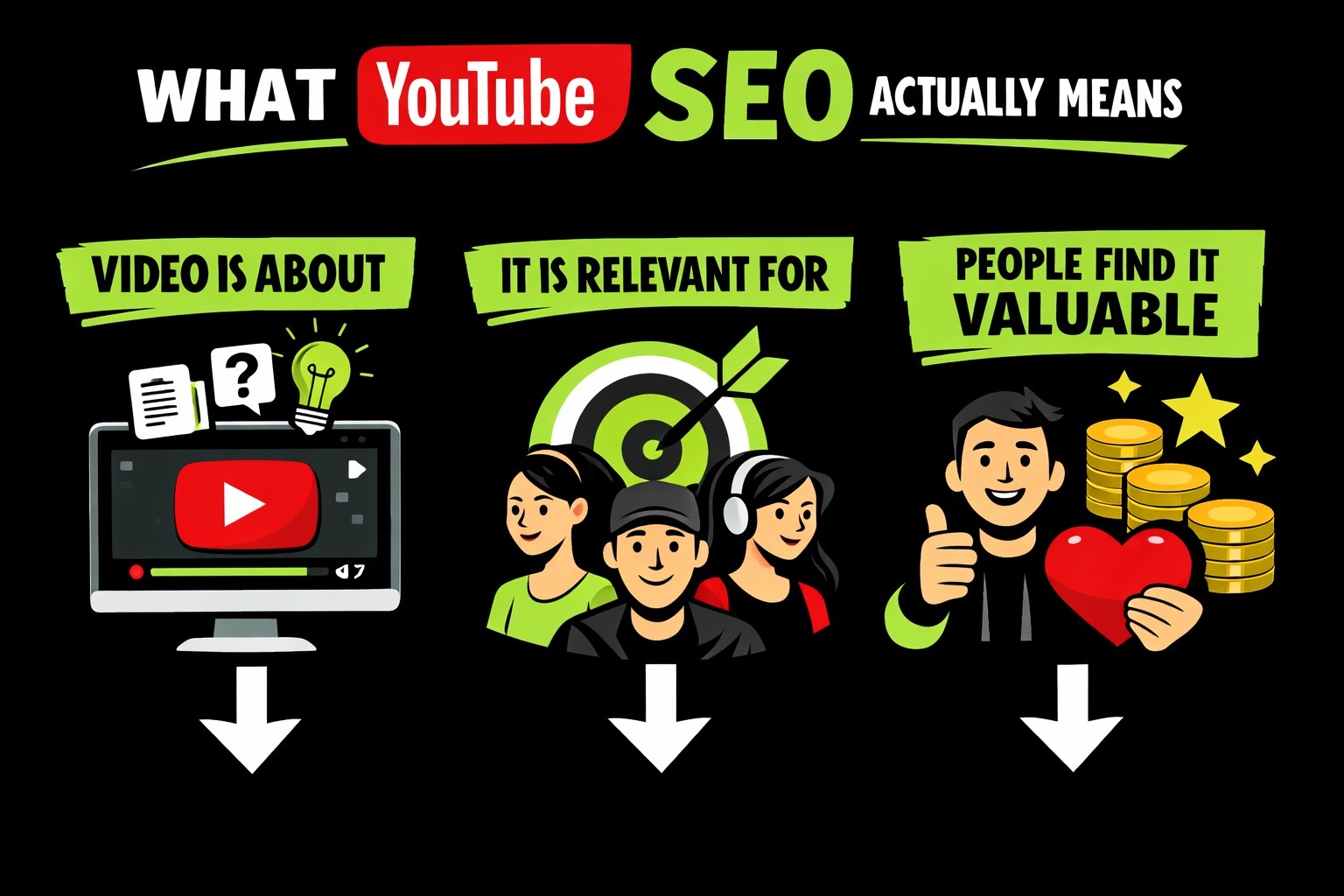
At its core, YouTube SEO is the practice of helping YouTube understand:
- What your video is about
- Who it is relevant for
- Whether people find it valuable once they click
Unlike traditional website SEO, YouTube cannot “read” your video content directly. It relies on signals around the video to make decisions. These include text-based inputs like titles and descriptions, but also behavioral data like watch time and interaction.
If your video attracts clicks but people leave after 20 seconds, optimization stops working. If people watch, comment, or continue to another video, YouTube takes that as a strong signal of relevance.
How Lengreo Turns YouTube SEO Into a Growth Channel
At Lengreo, we don’t treat YouTube SEO as a standalone tactic or a box to tick. For us, it’s part of a broader growth system where search visibility, content quality, and lead generation are tightly connected. A video that ranks but brings the wrong audience is not a win. What matters is reaching people who are already looking for answers and guiding them toward a real business outcome.
We build YouTube SEO strategies the same way we approach SEO as a whole: starting with intent, not assumptions. That means digging into what your audience is actually searching for, how competitors are positioning their content, and where the gaps are. From there, we shape video topics, titles, descriptions, and content structure so they earn clicks and hold attention. Engagement is not an accident. It’s designed.
What makes our work different is that we never isolate performance from results. We look beyond views and rankings to see how YouTube contributes to organic traffic, lead quality, and conversion paths. Whether we’re supporting a SaaS brand, a tech company, or a highly competitive B2B niche, the goal stays the same: consistent visibility that translates into real growth. That’s why our SEO work is tied to measurable outcomes, not vanity metrics.
Why Keywords Still Matter, But Not the Way They Used To
Keywords Set Context, Not Rankings
Keywords are not dead on YouTube, but they are no longer the main driver of visibility. Think of them as context, not fuel. Titles, descriptions, captions, and transcripts help YouTube understand what your video is about and who it might be relevant for. Without that context, even a strong video struggles to find its place.
Engagement Decides What Gets Promoted
What keywords no longer do is guarantee ranking. A perfectly optimized title or description cannot save a video that people do not watch. YouTube pays far more attention to what happens after the click. Watch time, retention, and interaction ultimately decide whether a video keeps getting surfaced or quietly fades out.
Clarity Beats Keyword Density
The practical takeaway is simple: write for clarity, not density. If a human can quickly understand what the video delivers and why it matters, the algorithm usually can too. Over-optimization only gets in the way. Clear language, accurate framing, and honest expectations outperform keyword-heavy descriptions every time.
Audience Intent Is the Real Foundation
One of the biggest mistakes creators make is treating all views as equal. They are not.
Someone searching “how to edit YouTube Shorts” has a very different expectation than someone browsing casually through suggested videos. YouTube SEO works best when your content matches the reason someone clicked in the first place.
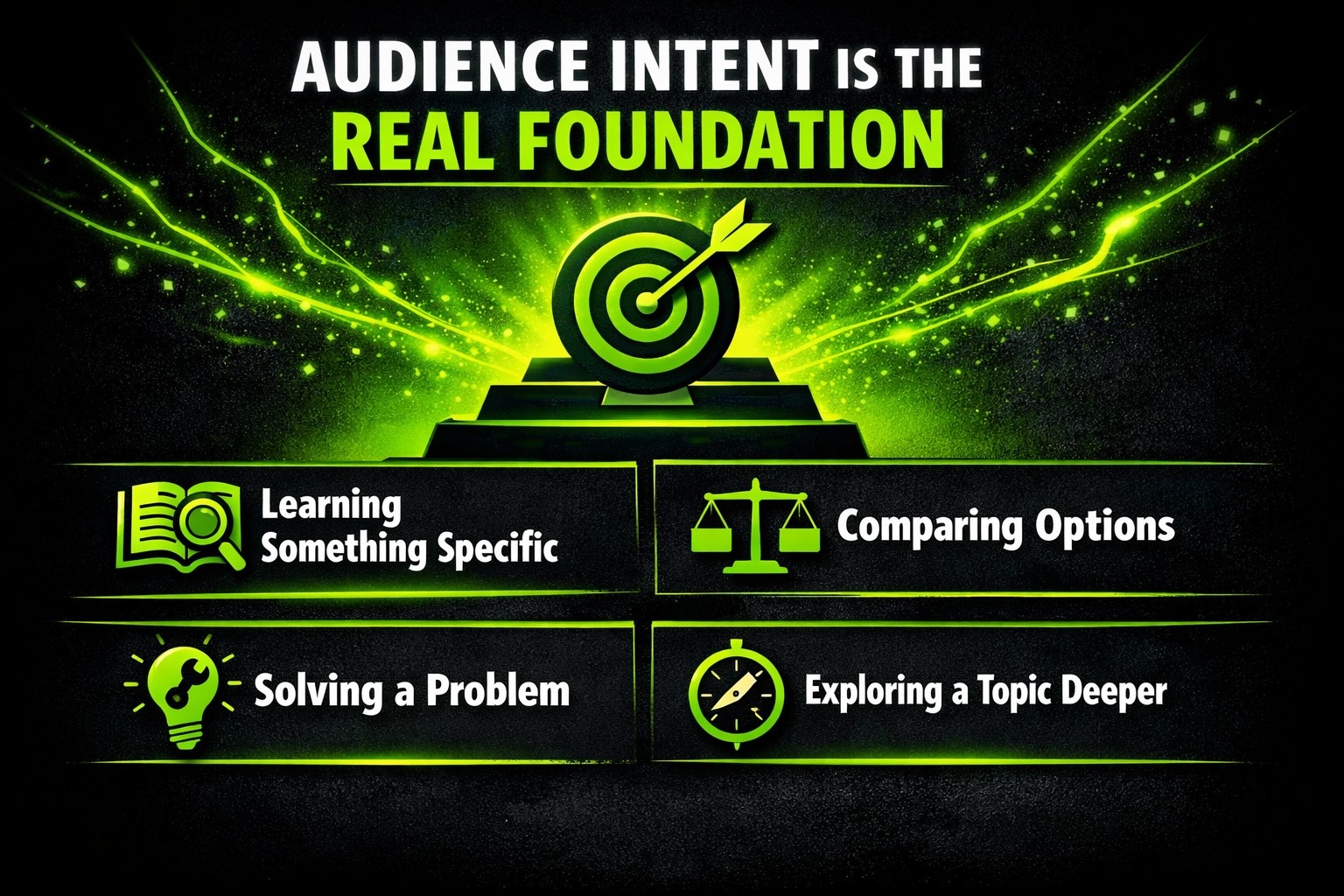
Intent typically falls into a few categories:
- Learning something specific
- Comparing options
- Solving a problem
- Exploring a topic deeper
Videos that align tightly with intent tend to earn better retention. Better retention leads to stronger signals. Stronger signals lead to more exposure. This loop is the backbone of YouTube SEO.
Search Is Only One Part of Discovery
Ranking in YouTube search is useful, but it is not where most views come from. In practice, the majority of traffic comes from suggested videos, browse and homepage feeds, and Shorts discovery. These surfaces expose content to viewers who are not actively searching but are open to watching something relevant.
Discovery in these areas relies far less on keywords and far more on engagement patterns. If a video keeps people watching and naturally leads them to another piece of content, YouTube has a clear reason to push it further. Momentum matters more than metadata.
This is why YouTube SEO cannot be separated from content quality and structure. The platform rewards videos that hold attention and create viewing sessions, not just those that match a query.
Click-Through Rate Sets the First Gate
Before YouTube can measure watch time or engagement, someone has to click. That makes click-through rate one of the most underestimated parts of YouTube SEO. If a video never earns the click, nothing else has a chance to work.
Titles Shape Expectations
Titles should set a clear expectation without overpromising. Viewers click when they understand what they will get and why it is useful to them. Vague phrasing or exaggerated claims might drive curiosity once, but they rarely lead to long-term performance. Clear, honest titles attract the right audience, which improves both CTR and retention.
Thumbnails Confirm the Decision
Thumbnails do not need to be flashy to perform well, but they do need to stand out at small sizes, especially on mobile screens. A strong thumbnail supports the title by visually reinforcing the value of the video. High-performing thumbnails do not trick people into clicking. They confirm that clicking is worth their time.
What Really Drives Visibility on YouTube
YouTube SEO goes far beyond keywords and metadata. Once a video is live, the platform shifts its focus to behavior. What people do after they click matters more than almost anything else.
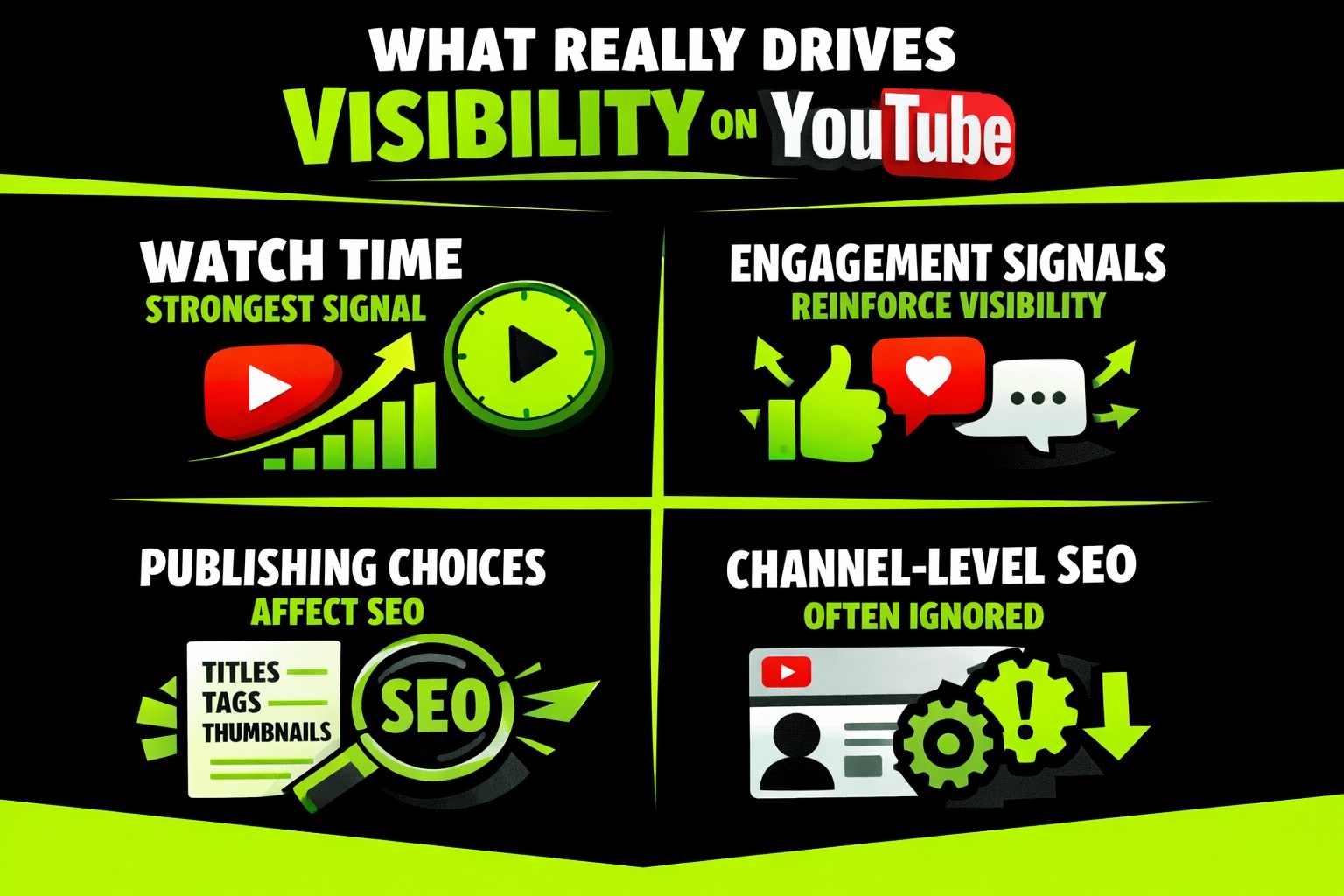
Watch Time Is the Strongest Signal
Once someone clicks, YouTube pays close attention to how long they stay. Watch time and audience retention are the clearest indicators that a video delivered real value. A video that holds attention tells the platform it deserves wider distribution.
Why the Opening Seconds Matter
The first moments set expectations. If the introduction drifts, overexplains, or delays the point, viewers leave. When a video clearly sets direction and delivers on its promise early, retention improves naturally. This early engagement often determines whether YouTube keeps testing the video with new audiences.
Structure Beats Length
YouTube SEO is not about stretching videos unnecessarily. Longer videos only perform well when they stay focused and paced correctly. Clear structure, logical progression, and respect for the viewer’s time consistently outperform bloated content across search, suggested videos, and browse feeds.
Engagement Signals Reinforce Visibility
Likes, comments, shares, and subscriptions are not vanity metrics. They act as confirmation signals that support what watch time already shows.
Interaction Signals Relevance
When viewers interact with a video, YouTube interprets that behavior as relevance. Comments are especially valuable because they indicate the content sparked thought, disagreement, or curiosity. That feedback helps the system decide where else the video might belong.
Authentic Engagement Wins
Simple prompts can help encourage interaction, but forced engagement rarely works. People comment, like, or subscribe when they feel understood or helped, not when they are pushed to act. Videos that genuinely answer questions tend to earn interaction naturally.
Publishing Choices Affect SEO More Than Most Realize
A surprising amount of YouTube SEO is lost at the publishing stage, long before performance data even comes into play.
Metadata Helps the Algorithm Move Faster
Clear titles, readable descriptions, timestamps, and transcripts make it easier for YouTube to process and categorize your video quickly. Chapters improve navigation for viewers and allow specific sections of a video to surface independently in search results.
Descriptions Are Context, Not Filler
Descriptions are not there to pad word count. They provide context to both users and search engines. When written properly, they explain what the video covers, who it is for, and why it matters, without repeating the title in different words.
Channel-Level SEO Is Often Ignored
Optimizing individual videos is important, but YouTube also evaluates channels as a whole when deciding what to recommend.
Consistency Builds Trust With the Algorithm
Consistency in topic, tone, and publishing patterns helps YouTube understand what your channel represents. When the platform clearly understands your niche, it can recommend your videos with more confidence to the right audience.
Playlists Reinforce Topical Authority
Playlists play a quiet but important role in YouTube SEO. They increase session time by guiding viewers through related content and encourage longer viewing sessions. From an SEO perspective, they help reinforce topical authority and strengthen your channel’s overall relevance.
Analytics Turn SEO Into a System
YouTube SEO improves fastest when analytics guide decisions instead of assumptions. Retention graphs show exactly where attention drops, which moments work, and which ones lose viewers. Traffic source data reveals how people actually find your content, whether through search, suggested videos, or external links. Click-through metrics make it clear which titles and thumbnails earn interest and which ones get ignored.
The goal is not to chase metrics for their own sake. What matters is pattern recognition. When certain topics, formats, or openings consistently outperform others, those signals become your SEO strategy. Over time, analytics turn YouTube SEO from guesswork into a repeatable system that improves with every upload.
Shorts and Long-Form Work Together
Short-form video has changed how discovery works, but it has not replaced long-form content. Shorts are often the first touchpoint, helping new viewers find your channel quickly. Long-form videos are where trust builds, questions get answered fully, and watch time compounds.
From an SEO perspective, Shorts act as entry points. When they perform well, they increase the likelihood that YouTube recommends your longer videos to the same audience. This creates a natural bridge between fast discovery and deeper engagement. The same optimization principles apply in both formats: clear hooks, strong pacing, and relevance still decide what gets watched and shared.
Google and YouTube SEO Are Connected
YouTube does not operate in a vacuum. Videos regularly appear in Google search results, especially for queries where a visual explanation is the most helpful format.
Video Is Often the Best Answer
Google surfaces YouTube videos most often when written content alone would not fully answer the question. Tutorials, walkthroughs, comparisons, and explanations tend to benefit the most from this crossover visibility.
Clear Context Improves Cross-Platform Visibility
Titles, descriptions, and transcripts influence how well videos perform outside YouTube. When YouTube understands your content clearly, Google often does too. This shared understanding allows a single video to capture visibility across both platforms.
This connection is why YouTube SEO should not be treated in isolation. Well-optimized videos can support broader search presence and reinforce discoverability beyond YouTube itself.
Common Myths That Get in the Way
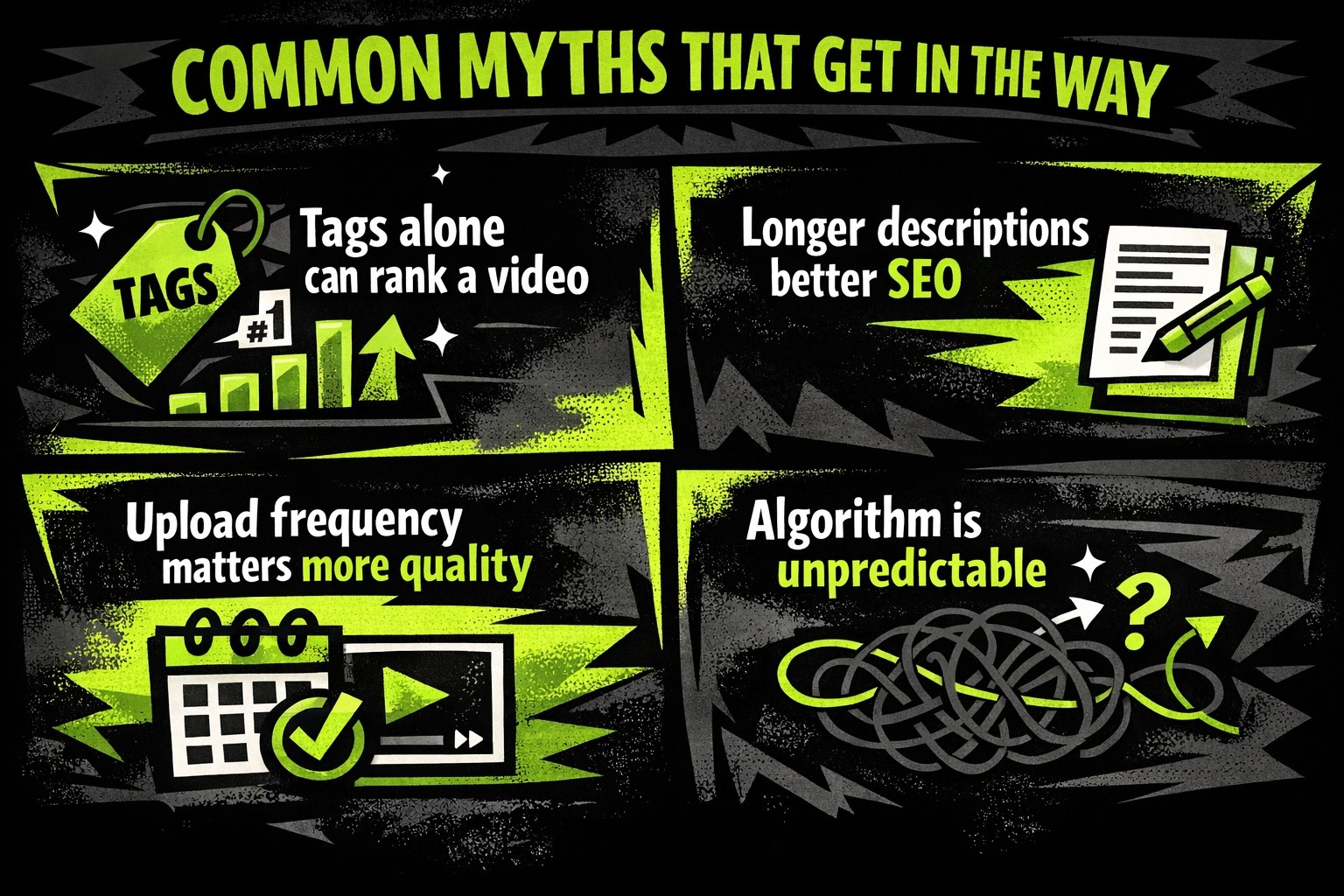
There are a few ideas about YouTube SEO that refuse to die, even though they don’t hold up in real-world performance.
- Tags alone can rank a video. Tags help YouTube understand context, especially early on, but they don’t carry rankings by themselves. If viewers don’t click or watch, no amount of tagging will push a video forward.
- Longer descriptions automatically mean better SEO. Length does not equal usefulness. A clear, well-structured description that explains what the video covers will outperform a 500-word block of filler every time. YouTube looks for relevance and clarity, not word count.
- Upload frequency matters more than quality. Consistency helps, but quality still sets the ceiling. Publishing often only works when the content holds attention. Frequent uploads with poor retention train the algorithm to stop recommending your channel.
- The algorithm is unpredictable and random. It may feel that way from the outside, but the system responds to patterns. When videos earn clicks, keep people watching, and lead to more viewing sessions, YouTube reliably rewards them with wider distribution.
None of these myths survive contact with actual data. YouTube favors clarity, relevance, and engagement over mechanical optimization. When those elements are in place, growth stops feeling accidental and starts becoming repeatable.
What YouTube SEO Really Comes Down To
YouTube SEO is not a trick or a loophole. It is a feedback system.
When you understand what people are searching for, present it clearly, and deliver value that holds attention, the platform responds. Titles and keywords help the system find your video. Engagement tells it whether to keep showing it.
The strongest YouTube SEO strategies feel boring on the surface because they rely on fundamentals. But those fundamentals compound over time.
If your videos consistently answer real questions and respect the viewer’s time, optimization stops being something you “do” and becomes something that happens naturally.
Conclusion
YouTube SEO is often treated like a technical puzzle, but in practice, it behaves more like a feedback loop. When videos are clear, relevant, and genuinely useful, people respond. When people respond, the platform does too. That relationship is far more important than any single optimization trick.
Keywords, titles, and metadata still matter, but they only open the door. What happens after the click determines whether a video keeps getting surfaced or quietly fades out. Watch time, engagement, and viewing sessions are the signals that turn one good upload into sustained visibility.
If there’s one thing to take away, it’s this: YouTube SEO works best when it is built around people, not the algorithm. Create content that answers real questions, respect attention, and use data to refine what already works. Do that consistently, and growth stops feeling random and starts becoming predictable.