An SEO audit is a systematic evaluation of a website’s overall health from a search engine optimization perspective. It examines how well the site aligns with search engine guidelines and identifies factors that affect its visibility in organic search results.
The process reviews multiple layers of the site, including technical setup, content quality, user experience, and external signals. The goal is to uncover issues that limit performance and highlight opportunities for improvement. A proper audit provides a clear picture of current strengths and weaknesses, serving as the foundation for any meaningful optimization strategy.
Why SEO Audits Matter
Regular audits help maintain and improve search engine positions in an environment where algorithms evolve constantly. Sites that ignore underlying problems often see gradual declines in traffic, even if surface-level content appears solid.
Audits reveal hidden technical errors, content gaps, and structural flaws that search engines penalize. Addressing these issues leads to better crawlability, higher relevance signals, and improved user satisfaction, all of which contribute to stronger rankings over time.
Without periodic checks, sites risk accumulating problems that compound and become harder to fix. An audit establishes priorities and prevents wasted effort on tactics that cannot succeed due to unresolved foundational issues.
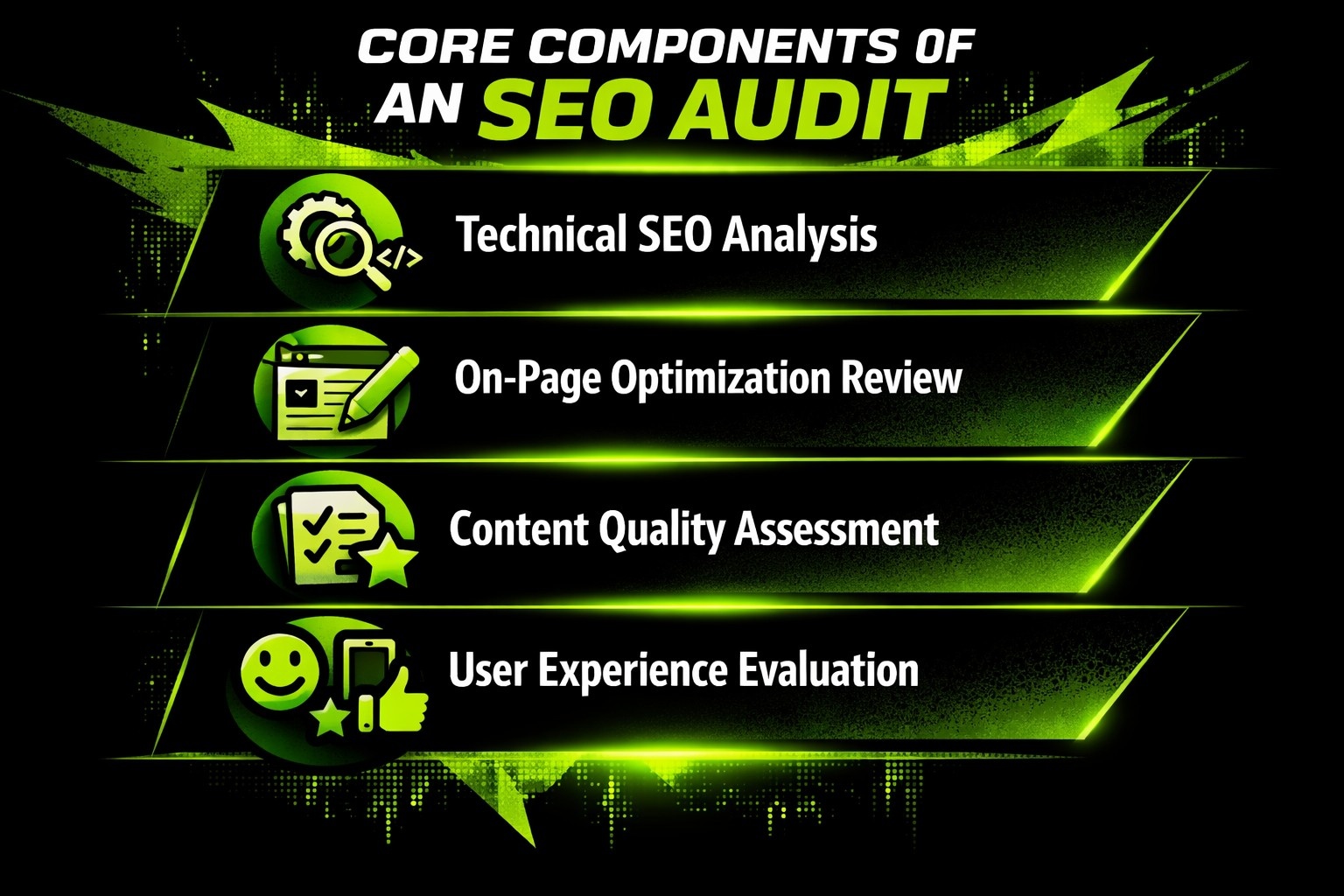
Core Components of an SEO Audit
A comprehensive audit covers several interconnected areas. Each component focuses on specific aspects of site performance and search engine interaction.
Technical SEO Analysis
Technical SEO forms the backbone of any audit. It ensures search engines can access, crawl, and interpret the site correctly.
Key elements include site architecture, URL structure, indexation status, and server configuration. Auditors examine robots.txt files, XML sitemaps, redirect chains, and status codes to confirm proper crawler access.
Page speed and mobile optimization receive close attention, as these directly influence core ranking factors. JavaScript rendering, canonical tags, and structured data implementation are also reviewed for accuracy and effectiveness.
On-Page Optimization Review
On-page elements determine how well individual pages communicate relevance to search engines and users.
This section analyzes title tags, meta descriptions, header hierarchy, and keyword integration within content. Internal linking patterns and anchor text distribution are evaluated to assess how authority flows through the site.
Image optimization, alt attributes, and schema markup fall under this category as well. The focus remains on ensuring each page supports targeted search queries while maintaining natural readability.
Content Quality Assessment
Content evaluation goes beyond keyword presence to examine depth, relevance, and authority.
Auditors check for thin pages, duplicate content across the site, and outdated material that no longer serves user intent. Structure, readability, and alignment with search queries are measured against current standards.
The review identifies gaps where new content could capture additional traffic or better satisfy existing queries. It also flags pages that dilute overall site quality through lack of substance or poor organization.
User Experience Evaluation
User experience has become a critical ranking signal. Audits now include detailed analysis of navigation, mobile responsiveness, and interaction patterns.
Core Web Vitals metrics provide objective data on loading performance, interactivity, and visual stability. Site hierarchy, breadcrumb implementation, and overall usability are assessed for clarity and efficiency.
Poor user experience often leads to high bounce rates and low dwell time, both of which send negative signals to search engines.
Off-Page Factors and Backlink Profile
External signals remain a major influence on search rankings. The audit examines the quantity, quality, and diversity of inbound links.
Link sources are evaluated for authority, relevance, and potential toxicity. Anchor text distribution and linking patterns are analyzed for natural appearance.
Competitor backlink profiles may be reviewed to identify realistic opportunities and benchmark current standing.
Why We Start Almost Every Project with an SEO Audit
At Lengreo, we see an SEO audit as more than just a technical checklist – it’s like a full health checkup for your online presence. We dive deep into how search engines actually view and crawl your site: spotting indexing issues, duplicate content traps, crawl budget waste, slow page speeds, broken redirects, mobile usability problems, and all the little things that quietly kill rankings. Then we layer on the strategic side – keyword gaps versus what your competitors are ranking for, backlink profile quality (good links vs toxic ones), on-page optimization levels, content performance, and user experience signals. The goal isn’t a fancy report full of red flags; it’s to pinpoint exactly what’s holding back your organic traffic and where the quickest, highest-impact wins are hiding.
That’s exactly why website audits & optimizations sit at the heart of our SEO services. Every audit we run is custom – we start by really understanding your business goals, your audience, and what success actually looks like for you, instead of throwing generic templates at the problem. When it’s done, you don’t just get a list of fixes; you get a clear, prioritized roadmap: what needs immediate attention, what can wait, and where putting in extra effort will move the needle most. We’ve watched SaaS companies, biotech firms, and service providers double or triple their organic leads after acting on these insights, often while cutting paid acquisition costs dramatically. If your site hasn’t had a proper look under the hood in a while, let’s chat – more often than not, that’s where the real growth starts.
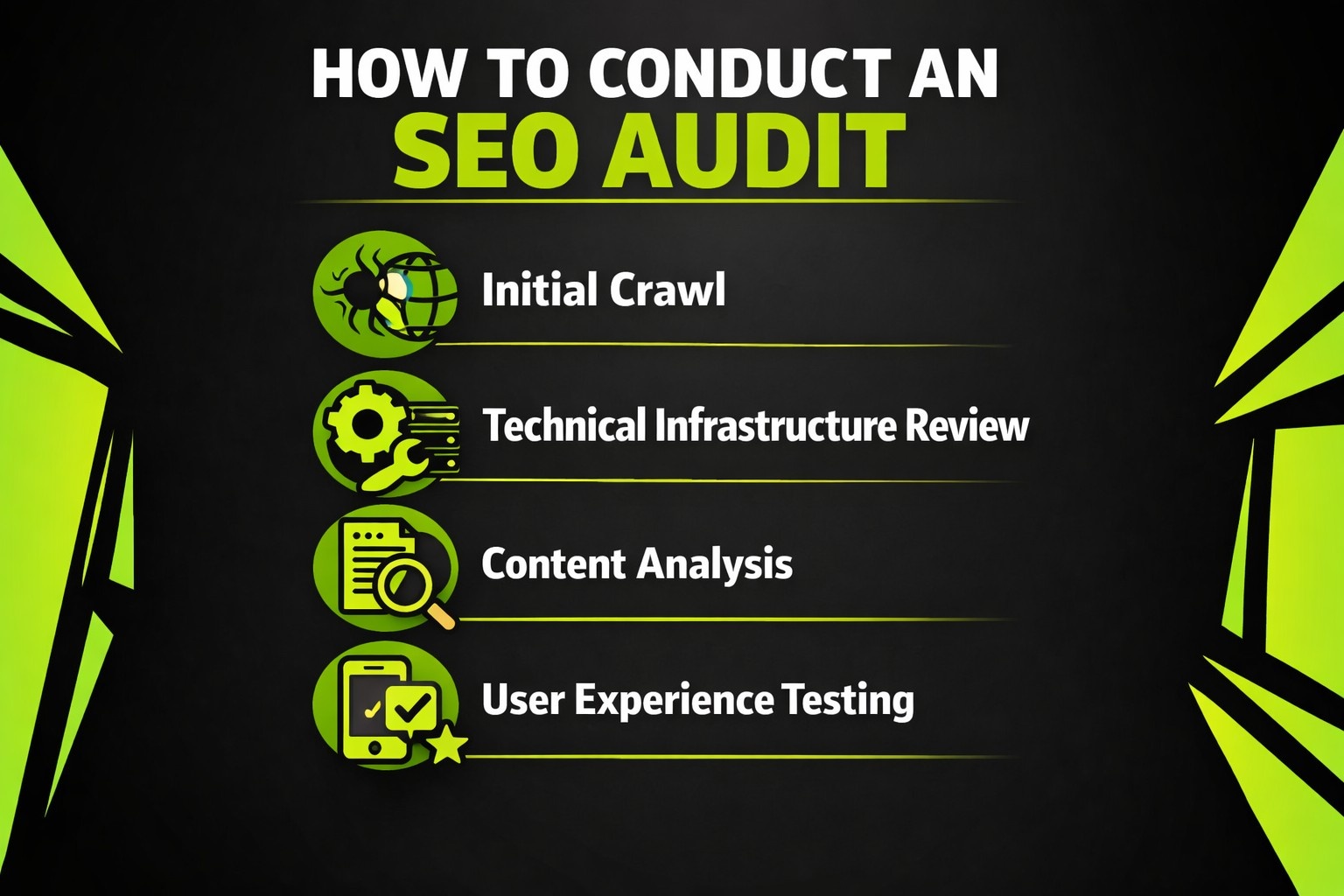
How to Conduct an SEO Audit: Step-by-Step Process
Executing an audit requires a structured approach to ensure thorough coverage without missing critical areas.
№1: Initial Crawl and Indexing Check
The process begins with a full site crawl using specialized tools. This simulates search engine behavior and reveals accessibility issues.
Blocked resources, broken links, redirect loops, and orphan pages surface during this phase. Indexation status is verified against actual search results to confirm proper coverage.
№2: Technical Infrastructure Review
Server response times, HTTPS implementation, and XML sitemap validity are examined in detail. Render-blocking resources and inefficient code receive particular scrutiny.
Mobile-friendliness testing ensures consistent experience across devices. International setups are checked for correct hreflang implementation and geographic targeting.
№3: On-Page and Content Analysis
Each page undergoes review for optimization quality and content effectiveness. Title and description uniqueness, header logic, and keyword integration are verified.
Content depth is measured against top-ranking competitors for similar queries. Duplicate or near-duplicate pages are identified and consolidation recommendations prepared.
№4: Performance and User Experience Testing
Real-user and lab data provide insight into actual loading behavior. Largest Contentful Paint, Cumulative Layout Shift, and interaction delays are benchmarked against accepted thresholds.
Navigation flow and information architecture are mapped to identify friction points. Accessibility standards are reviewed for compliance and improvement potential.
№5: Backlink and External Signals Assessment
Link profile tools reveal the current state of external authority. Toxic or irrelevant links are flagged for disavowal or removal.
Natural link patterns are compared against industry norms. Opportunities for legitimate link acquisition are noted based on competitor analysis.
Tools for Performing SEO Audits
Several established tools support different phases of the audit process.
- Crawling software for site mapping and technical discovery
- Analytics platforms for traffic and behavior patterns
- Search console data for indexing and error reports
- Backlink analysis tools for external profile evaluation
- Performance testing utilities for speed and vitality metrics
Combining free and paid options provides comprehensive coverage without unnecessary overlap.
Interpreting Results and Building Action Plans
Audit completion marks the transition from diagnosis to implementation. Findings must be prioritized based on potential impact and implementation complexity.
High-priority technical blockers receive immediate attention. Content gaps affecting major traffic sources follow closely. Lower-impact items are scheduled for phased resolution.
Clear documentation of issues, recommended fixes, and expected outcomes ensures smooth execution across teams.
Industry-Specific Audit Considerations
Different site types present unique challenges that require tailored attention.
E-Commerce Platforms
Product catalog structure, faceted navigation, and pagination handling demand specific focus. Seasonal content updates and inventory-related duplicates need regular monitoring.
E-commerce audits must prioritize optimization for AI Overviews, zero-click searches, and generative features, where product pages are frequently cited without driving direct clicks. Key checks include robust Product + Offer + Review + AggregateRating schema implementation, strong E-E-A-T signals via UGC like crawlable reviews and Q&A, fast Core Web Vitals (especially LCP under 2.5s on image-heavy pages), and strategies to combat traffic loss through rich multimedia (videos, 360° views) and conversational content that aligns with AI-driven queries.
Local Business Sites
Consistency across directory listings and location-specific pages affects local pack visibility. Review management and schema implementation play larger roles.
By the end of 2025, local audits extend beyond traditional map pack factors to include visibility in Google AI Mode, AI Overviews, and emerging LLM platforms. Essential elements involve real-time NAP consistency and attribute accuracy across Google Business Profile (including photos, Q&A, responses to reviews, and hours), full LocalBusiness + AggregateRating + ServiceArea schema, monitoring for duplicate listings in new aggregators, and tracking citations/mentions in AI responses to strengthen entity authority and trust signals in hyper-localized, personalized search results.
B2B and Service Sites
Longer content pieces supporting complex buyer journeys require deeper topical coverage. Gated assets and lead capture integration influence optimization strategy.
In 2026, B2B audits shift heavily toward Answer Engine Optimization (AEO) alongside traditional SEO, focusing on topical authority, passage-level relevance, and citation in AI tools like Google AI Mode, Gemini, and ChatGPT. Critical areas include deep content clusters with pillar pages, semantic consistency and entity-rich structures, E-E-A-T reinforcement through credentials and industry mentions, proper handling of gated content (noindex on post-login pages while optimizing public assets), internal linking for buyer journey flow, and monitoring AI visibility to ensure expert materials are selected as authoritative answers in complex, multi-step queries.
Conclusion
A thorough SEO audit provides the diagnostic foundation for sustained search performance improvement. It identifies current limitations while revealing realistic paths forward. Regular audits keep sites aligned with evolving search engine expectations and maintain competitive positioning in organic results.