If you’ve spent any time around digital marketing, you’ve probably heard SEO and SEM used interchangeably – sometimes even by people who should know better. They sound similar, they both deal with search engines, and they’re often bundled into the same conversations. But they’re not the same thing, and treating them as equals can lead to the wrong strategy from day one.
SEO and SEM solve different problems, move at different speeds, and demand different levels of investment. One is about earning visibility over time. The other is about buying attention when you need it. Understanding where each fits, and where it doesn’t, is the difference between building sustainable growth and just chasing short-term spikes.
Let’s break down what SEO and SEM actually are, in plain language, and how they’re meant to work in the real world.
Understanding Search as a System, Not a Channel
Before separating SEO and SEM, it helps to understand how search engines themselves work at a high level.
Search engines organize the web by crawling pages, indexing content, and ranking results based on relevance, trust, and usefulness. When someone searches, the results page is divided into two core areas:
- Paid placements, clearly labeled as sponsored
- Organic results, ranked based on algorithmic evaluation
Both appear on the same page. Both compete for attention. And both are part of what most people casually call “search marketing.”
This is where confusion starts. SEO and SEM operate inside the same ecosystem, but they influence different parts of it in different ways.
What SEO Is Really About
Search engine optimization is the practice of improving a website so it earns visibility in organic search results. No payment is made to the search engine for placement. Instead, rankings are earned by aligning with how search engines evaluate quality and relevance.
At its core, SEO is not a trick or a growth hack. It is a long-term investment in making a website useful, discoverable, and trustworthy.
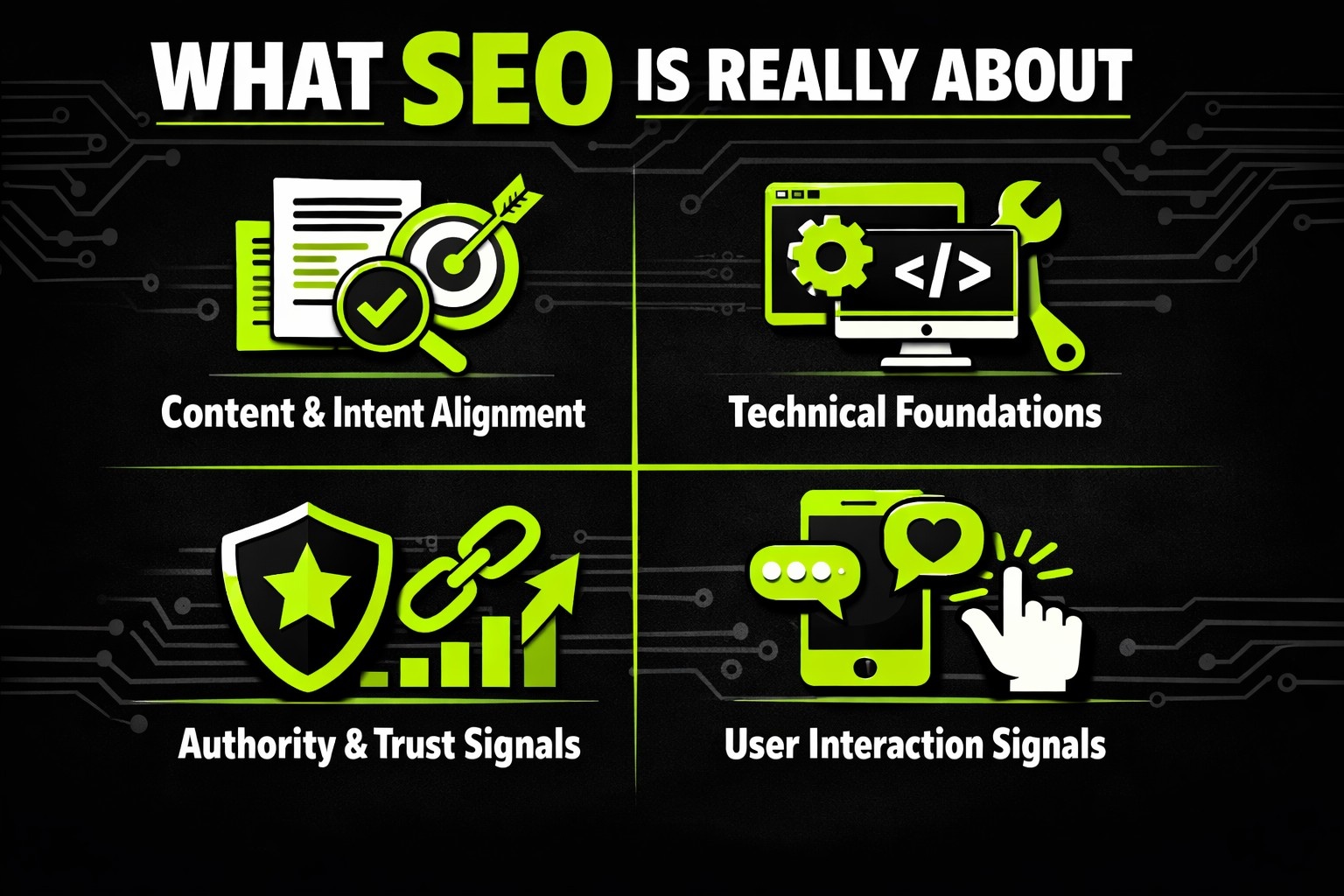
SEO work usually falls into four interconnected areas.
Content and Intent Alignment
Search engines are built to satisfy intent, not keywords in isolation. Modern SEO starts by understanding what someone is actually trying to accomplish when they search.
A query like “best CRM for startups” signals comparison and decision-making. A query like “what is customer relationship management” signals education. Treating both the same leads to poor results.
Good SEO content matches format, depth, and tone to intent. Sometimes that means long-form explanations. Sometimes it means concise answers. The common thread is relevance.
Technical Foundations
Even the best content fails if search engines cannot access it properly.
Technical SEO ensures that pages can be crawled, indexed, and rendered efficiently. This includes site structure, internal linking, page speed, mobile usability, and clean URLs. None of these are glamorous, but all of them matter.
Technical issues rarely destroy rankings overnight. Instead, they quietly cap growth. Fixing them often unlocks performance that content alone could not achieve.
Authority and Trust Signals
Search engines use external signals to assess credibility. The most well-known of these is backlinks, links from other websites pointing to yours.
Not all links are equal. A few relevant, earned links from trusted sites carry more weight than hundreds of low-quality mentions. Authority is built slowly, through content that deserves to be referenced and promoted.
Other trust signals include brand mentions, consistency of information, and user behavior patterns over time.
User Interaction Signals
How users behave on a page provides feedback to search engines. If people click a result and immediately leave, that sends a signal. If they stay, scroll, and engage, that sends another.
SEO does not mean manipulating users. It means designing pages that answer questions clearly, load quickly, and feel worth reading. Search engines increasingly reward that.
What SEM Actually Includes
Search engine marketing is a broader term. It refers to all tactics used to gain visibility in search engine results pages, including both organic and paid methods.
In practice, SEM is most often associated with paid search advertising, especially pay-per-click campaigns through platforms like Google Ads or Bing Ads. But it is important to be precise: SEO is part of SEM. Paid search is another part.
When people say “SEM,” they usually mean paid search. This article uses that common interpretation while keeping the broader definition in mind.
Paid Search and Immediate Visibility
Paid search allows advertisers to bid on keywords. When someone searches for those terms, ads can appear above or alongside organic results.
Unlike SEO, paid visibility does not require earning trust over time. Placement is influenced by bidding strategy, ad relevance, and landing page quality.
The biggest advantage of SEM through paid search is speed. Campaigns can be launched quickly. Traffic can start flowing the same day. This makes SEM valuable in situations where timing matters.
Control and Precision
Paid search offers a level of control SEO cannot match. Advertisers can:
- Choose exactly which queries trigger ads
- Target specific locations, devices, and audiences
- Control daily and monthly spend
- Test messaging rapidly
This makes SEM useful for promotions, product launches, and validating demand.
That control comes with a tradeoff. When spending stops, visibility disappears.
Cost Structure and Reality
SEM is not inherently expensive or cheap. It depends entirely on competition and intent. High-intent keywords in competitive industries can cost significant amounts per click. Informational or niche queries may cost very little.
What matters is not cost per click in isolation, but cost per outcome. A campaign that appears expensive may be profitable if conversion rates and lifetime value justify it.
The risk with SEM is not overspending. It is spending without a clear feedback loop.
SEO and SEM Compared Through Real Constraints
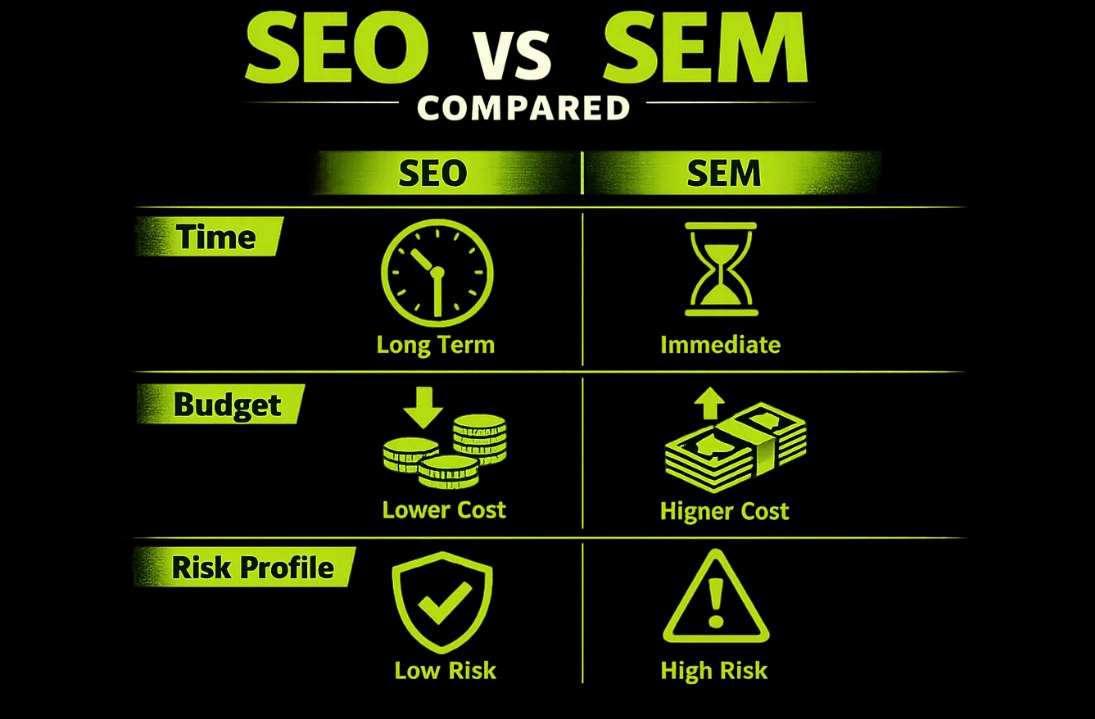
The easiest way to understand the difference between SEO and SEM is not through definitions, but through constraints.
Time
SEO compounds slowly. It takes months to show meaningful results, especially for new sites or competitive markets. But once momentum builds, results tend to be durable.
SEM produces immediate visibility. Results can appear within hours. But they last only as long as campaigns are active.
Neither is better. They solve different timing problems.
Budget
SEO requires upfront investment in strategy, content, and infrastructure. There is no per-click fee, but there are real costs in labor, tools, and expertise.
SEM requires continuous spend. Traffic is predictable, but only while funding continues.
SEO favors patience. SEM favors liquidity.
Risk Profile
SEO risk is primarily opportunity cost. Poor execution wastes time, not ad budget. Mistakes can be corrected without ongoing fees.
SEM risk is financial. Poor targeting or weak landing pages can burn budget quickly.
Smart teams manage both risks intentionally.
How Lengreo Builds SEO and SEM Strategies That Actually Perform
At Lengreo, we don’t treat SEO and SEM as abstract marketing concepts or isolated services. We look at them as tools that need to work under real constraints: budget limits, competitive pressure, internal resources, and business goals that do not wait forever. Every strategy we build starts with that reality, not with a predefined package.
We use SEO to create long-term leverage. That means building search visibility that compounds over time, lowers acquisition costs, and supports the entire funnel, not just traffic numbers. But we are also realistic about timelines. When speed matters, or when a business needs validation before committing to a long-term play, SEM becomes part of the equation. Paid search lets us test messaging, measure demand, and generate qualified leads while organic growth is taking shape.
What matters most to us is alignment. SEO and SEM are planned together, not run in parallel silos. Data from paid campaigns informs content and keyword priorities. Organic performance shapes where paid spend makes sense and where it does not. The goal is not more traffic for the sake of it, but predictable growth that makes sense commercially. If you want to see how this thinking translates into real execution, we share our work, insights, and results openly on LinkedIn and Instagram, where the focus stays on outcomes, not buzzwords.
Choosing Between SEO and SEM Based on Real Business Needs
SEO and SEM are often treated as opposites, but in practice they solve different problems. The right choice depends less on preference and more on timing, budget, and how people buy what you offer.
When SEO Is the Smarter Focus
SEO makes sense when a business can invest in long-term efficiency rather than immediate traffic. Results take time, but once momentum builds, acquisition costs tend to drop and performance becomes more stable.
It works especially well when a product or service needs explanation. In those cases, content plays a real role in the buying process, helping people research, compare, and build confidence before converting. Over time, strong organic visibility also signals credibility. That trust carries into paid ads, social channels, and email, improving performance across the board.
SEO is a strong fit for industries where education drives decisions. SaaS, professional services, and complex B2B offerings often benefit the most, because visibility is earned through relevance and expertise, not just spend.
When SEM Makes More Sense
SEM is the better option when speed matters. Paid search allows you to generate traffic quickly, test messaging, and respond to demand without waiting months for rankings to develop.
It is particularly effective for time-sensitive offers, launches, or campaigns tied to specific moments. SEM also works well when search demand already exists and there is room in the budget to test and optimize. With the right landing pages, paid traffic can turn into qualified leads fast.
SEM should not be seen as a replacement for SEO. It is a tool for speed and validation. Used intentionally, it supports growth while longer-term organic efforts take shape.
Why SEO and SEM Work Best Together
The most effective search strategies rarely choose one exclusively.
SEO builds a foundation. SEM fills gaps, accelerates testing, and captures demand while organic growth matures.
Paid search data can inform SEO content strategy. SEO insights can improve paid landing pages. Together, they create feedback loops that neither can produce alone.
The mistake is treating them as isolated tactics managed in silos.
Common Misunderstandings That Hold Teams Back
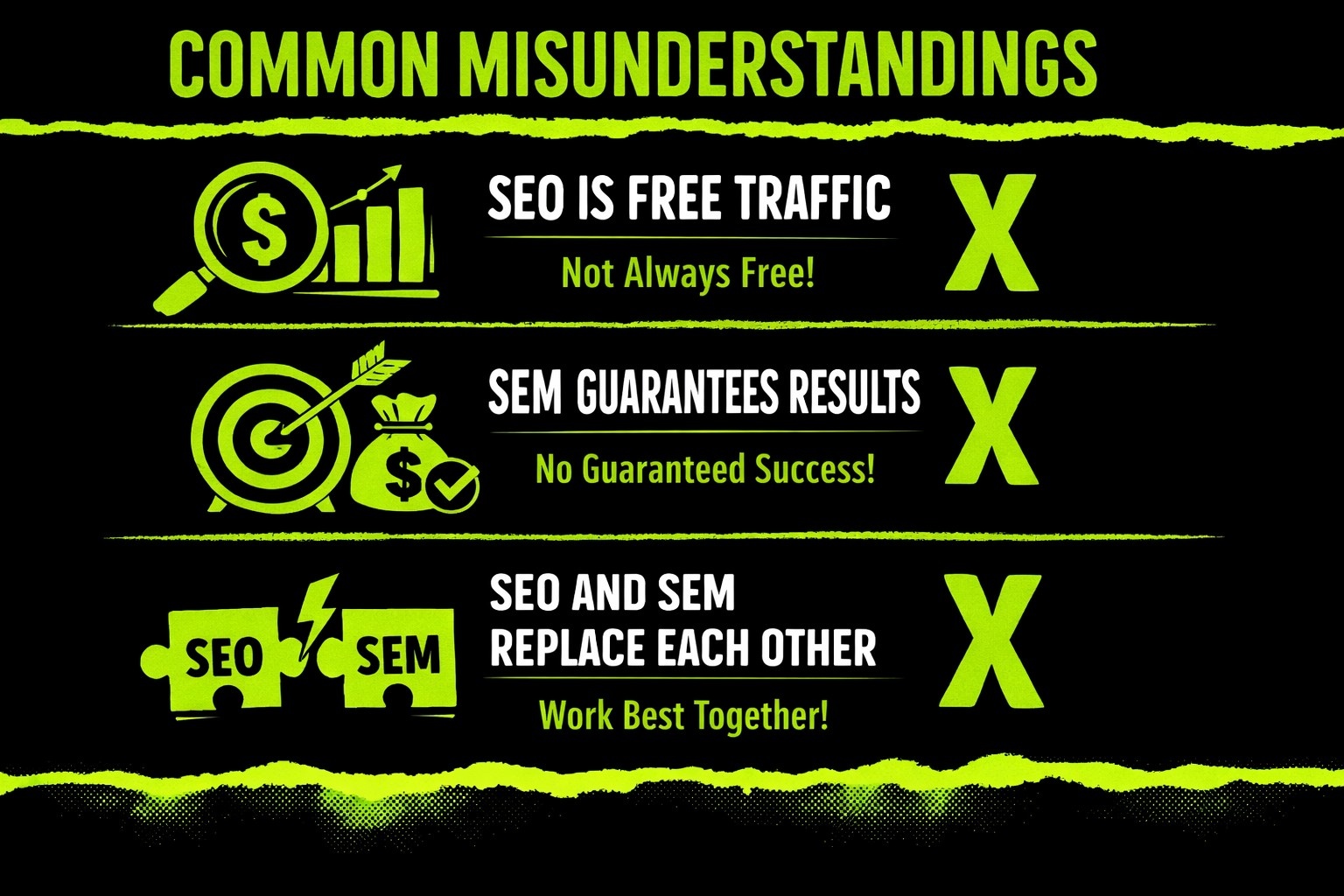
Several myths still surround SEO and SEM, and they tend to derail strategy early.
- SEO is free traffic. SEO does not charge per click, but it is not free. The cost shifts from media spend to execution, time, and expertise. Content, technical work, and ongoing optimization all require real investment.
- SEM guarantees results. Paid visibility does not fix weak positioning, poor messaging, or unclear offers. Without strong landing pages and a clear value proposition, SEM can burn budget quickly.
- SEO and SEM replace each other. They do not. SEO and SEM solve different problems. Treating one as a substitute for the other usually leads to gaps in visibility and wasted effort.
Final Thoughts
SEO and SEM are not trends. They are responses to how people search for information and make decisions.
SEO rewards clarity, consistency, and patience. SEM rewards precision, testing, and timing. Both punish shortcuts.
Understanding the difference is not about choosing sides. It is about building a search strategy that fits reality, not theory.
When done well, SEO and SEM stop feeling like tactics and start functioning like infrastructure. And that is where real growth begins.