


Every online store faces the same fundamental challenge: getting discovered by people who are ready to buy. While paid advertising can bring quick results, it’s also expensive and stops working the moment the budget runs out. That’s where ecommerce SEO becomes essential.
According to research by Backlinko, the first result on Google’s search engine results page receives 27.6% of all clicks. Even more striking, only 0.63% of searchers click on websites listed on page two of search results. These numbers highlight a harsh reality—if an online store doesn’t rank on the first page for relevant keywords, it’s essentially invisible to potential customers.
But what exactly is ecommerce SEO, and how does it differ from standard search engine optimization? This guide breaks down everything needed to understand and implement effective ecommerce SEO strategies.
Understanding Ecommerce SEO Fundamentals
Ecommerce SEO is the strategic process of optimizing an online store to improve its visibility in search engine results. The goal is straightforward: when someone searches for products that a store sells, that store should appear prominently in the results.
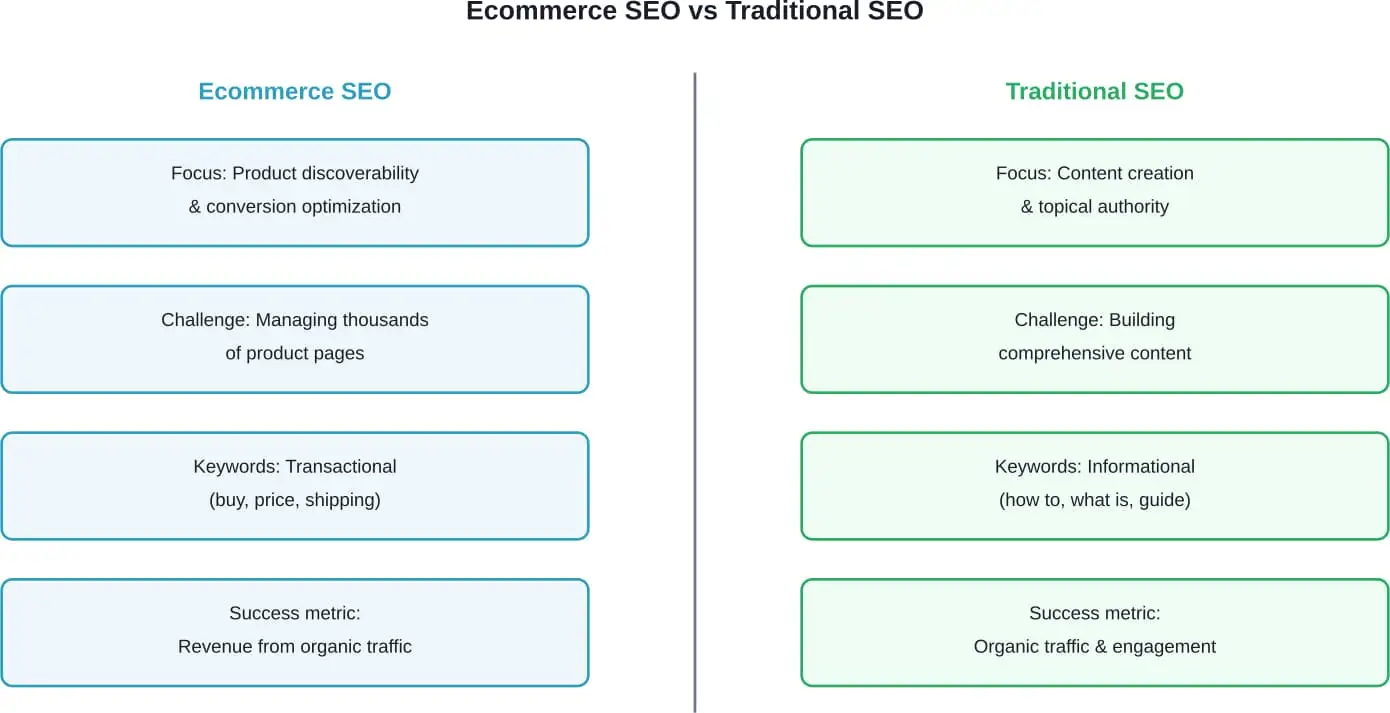
Unlike traditional SEO for informational websites or blogs, ecommerce SEO deals with unique challenges. Online stores typically have hundreds or thousands of product pages, complex site structures with multiple categories and filters, and the constant need to balance user experience with search engine crawlability.
How Search Engines Evaluate Ecommerce Sites
Google and other search engines use sophisticated algorithms to determine which online stores deserve top rankings. According to Google Search Central, the search engine looks at multiple factors when evaluating ecommerce websites.
Search engines crawl product pages and category pages, analyze site structure, evaluate page speed and mobile responsiveness, assess the quality of product descriptions, and examine how other websites link to the store. They also consider user engagement signals like bounce rate and time on site.
The structured data that online stores add to their pages plays a crucial role too. Google’s documentation notes that Rakuten users spend 1.5 times more time on pages with structured data than pages without, while interaction rates on AMP pages with structured data are 3.6 times higher than AMP pages without. Nestlé achieved an 82% higher click-through rate on pages displayed as rich search results versus pages without structured markup.
Why Ecommerce SEO Differs from Traditional SEO
Standard SEO focuses primarily on content creation and establishing topical authority. Ecommerce SEO requires that foundation but adds layers of complexity.
First, product pages are inherently transactional rather than informational. The keyword intent is different—people searching for “wireless headphones” want to buy, not read a 2,000-word article about audio technology.
Second, ecommerce sites must manage technical challenges like duplicate content from similar products, pagination across category pages with hundreds of items, and dynamic URLs generated by filters and sorting options.
Third, conversion optimization becomes inseparable from SEO. Ranking high means nothing if visitors don’t convert into customers. Product page optimization must balance search engine requirements with persuasive copywriting and clear calls to action.
The Business Case for Ecommerce SEO
Some online store owners question whether SEO is worth the investment compared to paid advertising channels. The data tells a compelling story.
Research shows that 98% of people use a search engine every month, with Google users performing more than 16.4 billion searches daily. This represents an enormous pool of potential customers actively looking for products.
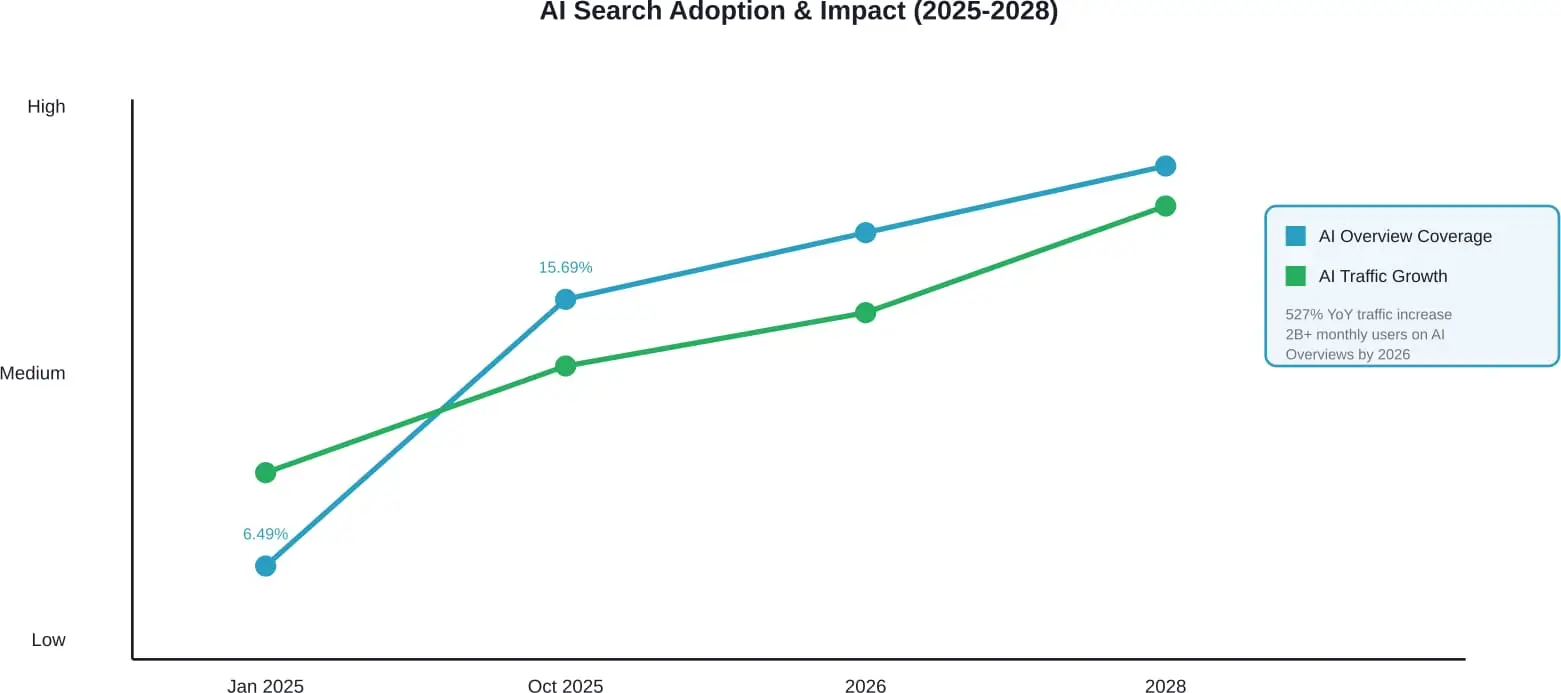
The challenge? Competition for visibility has intensified. According to Semrush research, AI Overviews appeared for 6.49% of keywords in January 2025, peaked at nearly 25% in July 2025, then declined to 15.69% by November 2025. The search landscape continues evolving rapidly, making strategic SEO more important than ever.
Long-Term Value Versus Paid Advertising
Paid search and social media ads deliver immediate traffic, but they’re essentially renting attention. The moment ad spend stops, traffic disappears. Ecommerce SEO builds an asset that generates traffic month after month without ongoing per-click costs.
Consider a product page that ranks in the top three positions for a high-intent keyword with 5,000 monthly searches. That single page could drive hundreds of qualified visitors and dozens of sales every month without additional investment.
The compounding effect matters too. As a store builds authority through quality content and backlinks, it becomes easier to rank new product pages. The first 50 pages might take significant effort, but pages 500-550 rank much more quickly once domain authority is established.
Customer Acquisition Cost Advantages
Paid advertising costs continue rising across most industries. Customer acquisition costs through Facebook, Google Ads, and other platforms have increased substantially in recent years as competition intensifies and platforms prioritize revenue.
Organic search traffic typically has a much lower customer acquisition cost over time. While SEO requires upfront investment in optimization, content creation, and technical improvements, these costs are spread across months of traffic rather than paid per click.
For sustainable business growth, diversifying traffic sources makes strategic sense. Stores that rely exclusively on paid channels face vulnerability to algorithm changes, cost increases, and budget constraints. Ecommerce SEO provides a more stable foundation.
Core Components of Ecommerce SEO Strategy
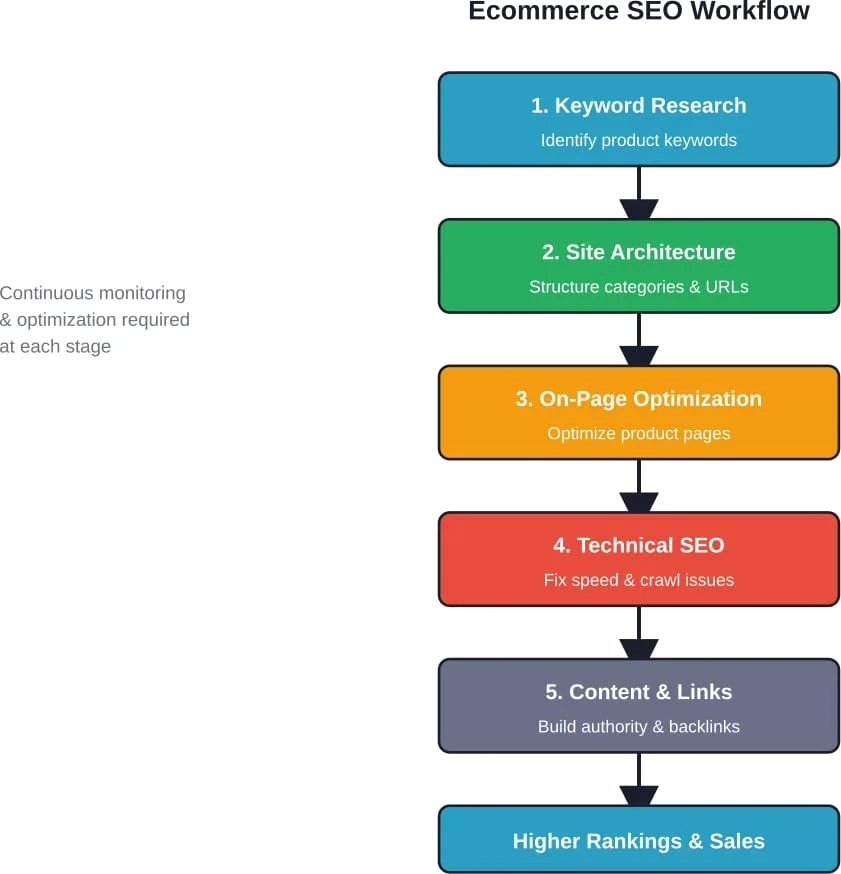
Effective ecommerce SEO isn’t a single tactic—it’s a coordinated strategy across multiple areas. Each component supports the others, creating a comprehensive approach that search engines reward with higher rankings.
Keyword Research for Product Discovery
Keyword research forms the foundation of ecommerce SEO. But the approach differs from content-focused SEO because the intent matters more than search volume alone.
Product keywords typically fall into several categories. There are exact product names (“Sony WH-1000XM5”), product type keywords (“wireless noise cancelling headphones”), comparison keywords (“Bose vs Sony headphones”), and long-tail variations (“best wireless headphones for travel”).
The most valuable keywords show buying intent. Someone searching “wireless headphones price” or “buy wireless headphones online” is much closer to purchase than someone searching “how do wireless headphones work.”
Competitor analysis reveals keyword opportunities. By examining which keywords drive traffic to successful competitors, stores can identify gaps in their own optimization and discover profitable product categories they’ve overlooked.
Site Architecture and URL Structure
Google Search Central emphasizes that well-designed URLs help search engines efficiently locate and retrieve web pages on ecommerce sites. A logical site structure makes crawling easier and improves the user experience.
The ideal architecture follows a clear hierarchy: homepage → category pages → subcategory pages → product pages. This structure should be reflected in URLs, navigation menus, and internal linking patterns.
URL structure best practices for ecommerce include keeping URLs short and descriptive, using hyphens to separate words, including the target keyword when relevant, and avoiding dynamic parameters when possible. A URL like “example.com/wireless-headphones/sony-wh-1000xm5” is far better than “example.com/product?id=42839.”
Categories should be broad enough to contain multiple products but specific enough to target distinct keywords. Overly granular categorization creates thin category pages that struggle to rank, while overly broad categories force hundreds of products onto a single page.
Technical SEO for Online Stores
Technical SEO ensures search engines can crawl, index, and understand an online store efficiently. This foundation determines whether optimization efforts can succeed at all.
- Site speed matters significantly for ecommerce. Product pages with slow load times frustrate users and signal poor quality to search engines. Image optimization, browser caching, content delivery networks, and efficient code all contribute to faster performance.
- Mobile responsiveness is non-negotiable. With the majority of searches now happening on mobile devices, stores must deliver excellent experiences on smartphones and tablets. Google’s mobile-first indexing means the mobile version of a site determines rankings.
- Crawl budget optimization becomes important for large stores. With thousands of product pages, stores must ensure search engines prioritize valuable pages over low-quality ones. This involves strategic use of robots.txt, proper pagination handling, and eliminating duplicate content issues.
According to Google’s documentation on pagination, stores can improve user experience by displaying subsets of results to enhance page performance, but they must ensure Google’s crawler can discover all content.
Structured Data and Rich Results
Structured data markup helps search engines understand product information and display it attractively in search results. This can dramatically improve click-through rates.
Product schema markup includes information like product name, image, price, availability, ratings, and reviews. When implemented correctly, this data can trigger rich results showing star ratings, prices, and availability directly in search listings.
The tagging process is manageable—Google’s documentation indicates it takes about 5 minutes for a single page or about 15 minutes for a pattern of consistently formatted pages. This small investment yields substantial benefits.
Google’s introduction of structured data features dates back years, with the Structured Data Dashboard introduced on August 1, 2012, and getting started guidance published on May 30, 2013, showing the long-term commitment to helping websites leverage this technology.
Optimizing Product Pages for Search and Conversion
Product pages represent the core of ecommerce SEO. These pages must rank well while also converting visitors into buyers—a dual objective that requires careful optimization.
Product Title Optimization
The product title tag is one of the most critical ranking factors. Google Search Central documentation confirms that search engines look at title tags to understand page topics, directly affecting rankings.
Effective product titles should be fewer than 60 characters to avoid truncation in search results. They should include the primary keyword naturally, incorporate the brand name when relevant, and highlight key differentiators.
For instance, “Sony WH-1000XM5 Wireless Noise Cancelling Headphones – Black” is clear, descriptive, and includes the exact product model that buyers search for. It’s far better than generic titles like “Premium Headphones” or overly stuffed titles like “Buy Sony Wireless Bluetooth Noise Cancelling Over-Ear Headphones Online.”
Some stores enhance click-through rates by adding compelling modifiers to title tags. Phrases like “25% off,” “Free Shipping,” “Sale,” or “Lowest Price” can make listings stand out in search results. These “click magnet words” catch attention and signal value to potential customers.
Product Description Best Practices
Product descriptions serve multiple purposes: they provide information search engines need to understand and rank pages, they answer customer questions that influence purchase decisions, and they differentiate products from competitors.
Thin or duplicate product descriptions represent a common mistake. Many stores use manufacturer descriptions verbatim, creating duplicate content issues across the web. Original descriptions help both SEO and conversion rates.
Effective descriptions include the target keyword naturally within the first 100 words, detail specific features and benefits, address common customer questions and concerns, and incorporate related keywords for additional ranking opportunities.
Length matters, but there’s no magic number. Descriptions should be as long as necessary to cover important information without unnecessary fluff. Complex products need more detail; simple products need less.
Meta Descriptions That Drive Clicks
Meta descriptions don’t directly influence rankings, but they dramatically affect click-through rates. A compelling meta description can mean the difference between a searcher clicking through or choosing a competitor.
Best practices include keeping descriptions between 150-160 characters, including the target keyword so it appears bolded in search results, highlighting unique selling propositions, and incorporating calls to action like “Shop now” or “Free returns.”
Phrases like “Great Selection,” “Fast Shipping,” “Best Prices,” and “Money-Back Guarantee” communicate value quickly. These modifiers help product pages stand out in crowded search results.
Image Optimization for Search
Product images are essential for ecommerce, but they must be optimized for search engines and page speed. Large, unoptimized images slow page load times, hurting both user experience and rankings.
Image optimization involves compressing files to reduce size without visible quality loss, using descriptive filenames like “sony-wh-1000xm5-black.jpg” instead of “IMG_4829.jpg,” adding alt text that describes the image and includes keywords naturally, and implementing lazy loading so images below the fold load only when needed.
Alt text serves dual purposes: it helps search engines understand image content, and it provides accessibility for visually impaired users using screen readers. Good alt text is descriptive and natural: “Sony WH-1000XM5 wireless headphones in black with carrying case” rather than keyword-stuffed phrases.
Category and Collection Page Optimization
Category pages often represent the biggest SEO opportunity for ecommerce sites because they target broader, high-volume keywords that individual product pages can’t effectively compete for.
A category page for “wireless headphones” can rank for that broad term and capture searchers early in their research phase. Individual product pages target specific models and variations.
Creating SEO-Friendly Category Pages
Strong category pages combine several elements. They need unique, keyword-optimized descriptions (not just a grid of products), clear navigation and filtering options, breadcrumb navigation for internal linking, and pagination handling that doesn’t create duplicate content issues.
The category description provides an opportunity to include target keywords naturally while adding value for visitors. A 200-300 word description at the top or bottom of the page can explain what the category contains, highlight featured brands or price ranges, and answer common questions.
Internal linking from category pages to related categories and featured products distributes link equity and helps search engines discover and understand site structure.
Handling Filters and Faceted Navigation
Filtering options improve user experience by letting shoppers narrow down products by size, color, price, brand, and other attributes. But they create technical SEO challenges.
Each filter combination can generate a unique URL, potentially creating thousands of near-duplicate pages. Search engines waste crawl budget on these low-value pages instead of indexing important product pages.
Solutions include using JavaScript to filter results without changing URLs, adding canonical tags pointing to the main category page, blocking filter URLs in robots.txt, or strategically allowing certain valuable filter combinations (like brand pages) while blocking others.
Content Marketing for Ecommerce SEO
Product and category pages alone can’t capture all relevant search traffic. Content marketing expands reach by targeting informational keywords that bring potential customers to a store earlier in their buyer journey.
Strategic Blog Content
A blog or resource section allows ecommerce stores to target “how-to” keywords, comparison queries, and educational content that product pages can’t effectively rank for.
For example, a store selling outdoor gear might create content around “how to choose hiking boots,” “best camping locations,” or “backpacking tips for beginners.” These articles attract readers who aren’t ready to buy immediately but are researching products and building awareness.
The key is linking strategically from content to relevant product and category pages. An article about choosing hiking boots should naturally reference and link to the store’s hiking boot category and featured products.
Buying Guides and Comparison Content
Buying guides target high-intent keywords like “best [product type]” or “[product] buying guide.” These pieces attract searchers actively researching purchases.
Effective buying guides explain key features to consider, compare different product types or models, provide honest recommendations with links to specific products, and answer common questions buyers have.
This content type works particularly well because it combines SEO value with conversion potential. Someone reading a comprehensive wireless headphone buying guide is likely close to making a purchase decision.
User-Generated Content Strategy
Product reviews, questions and answers, and customer photos represent valuable user-generated content that improves both SEO and conversion rates.
Reviews add fresh, unique content to product pages regularly, include natural variations of product keywords, provide social proof that influences buying decisions, and can trigger rich results in search listings showing star ratings.
Encouraging customers to leave reviews after purchases, making the review process easy, and responding to reviews all help generate this valuable content.
Link Building for Ecommerce Websites
Backlinks remain a critical ranking factor. Stores with strong link profiles from authoritative websites rank higher than competitors with similar on-page optimization but weaker backlinks.
Ecommerce-Specific Link Opportunities
Certain link-building tactics work particularly well for online stores. Product reviews and roundups from industry blogs and publications provide valuable backlinks while exposing products to new audiences.
Reaching out to bloggers and publications in relevant niches with product samples or partnership opportunities can generate authentic reviews and links. A camping gear store might connect with outdoor adventure bloggers; a kitchen supply store might work with food bloggers.
Manufacturer and supplier pages often link to authorized retailers. Getting listed on these pages provides relevant, authoritative backlinks.
Content-Driven Link Attraction
Creating genuinely useful resources attracts links naturally. Original research, comprehensive guides, industry reports, or unique data visualization can earn links from journalists, bloggers, and other websites.
The outdoor gear store that publishes original research on hiking trail popularity or camping equipment trends creates linkable content that serves both SEO and brand authority goals.
Building Relationships Over Transactions
Sustainable link building focuses on genuine relationships rather than transactional link exchanges. Participating in industry communities, contributing expert insights, and creating value for potential link partners establishes credibility.
Guest posting on relevant industry blogs, contributing to roundup posts, being quoted as an expert source, and collaborating on research or content projects all build both links and brand visibility.
| Link Type | Difficulty | SEO Value | Best For |
|---|---|---|---|
| Product Reviews | Medium | High | Stores with unique or innovative products |
| Manufacturer Links | Low | Medium | Authorized retailers and distributors |
| Resource Pages | Medium | High | Stores with educational content or tools |
| Guest Posts | High | Medium-High | Building industry authority and brand awareness |
| Broken Link Building | Medium-High | Medium | Stores with comprehensive content libraries |
| Digital PR Campaigns | High | Very High | Stores with newsworthy products or data |
Measuring Ecommerce SEO Performance
Effective measurement connects SEO activities to business results. Tracking the right metrics reveals what’s working and where to focus optimization efforts.
Key Metrics for Ecommerce SEO
Organic search traffic represents the most basic metric—how many visitors arrive from search engines. But traffic alone doesn’t indicate success. Drilling deeper into organic traffic by landing page reveals which products and categories attract the most visitors.
Keyword rankings show position changes for target terms. Tracking rankings for priority keywords across product, category, and content pages demonstrates progress over time.
Conversion rate from organic traffic matters more than traffic volume. A page with 500 monthly visitors and a strong conversion rate generates more revenue than a page with 2,000 visitors and a weaker conversion rate.
Revenue from organic search provides the ultimate measure of SEO success. Connecting search traffic to actual sales and calculating customer acquisition cost from organic channels demonstrates ROI.
Tools for Tracking SEO Performance
Several tools help monitor ecommerce SEO effectiveness. Google Analytics tracks organic traffic, user behavior, and conversions. Google Search Console provides data on search impressions, clicks, rankings, and technical issues.
Specialized SEO platforms offer keyword tracking, competitor analysis, backlink monitoring, and site audit features. These tools aggregate data that would otherwise require manual collection from multiple sources.
For stores on platforms like Shopify, WooCommerce, or Magento, built-in analytics integrate with ecommerce data to connect SEO performance directly to revenue.
Scaling Your Store with Lengreo
As the digital landscape becomes increasingly crowded, simply ranking on the first page isn’t enough; your store must be engineered to convert that visibility into tangible revenue. Our team at Lengreo specializes in bridging the gap between technical execution and business growth, ensuring that your SEO efforts lead directly to a healthier bottom line. We understand that sustainable ecommerce success requires a holistic approach, which is why we focus on high-impact strategies that drive results.
By integrating advanced marketing techniques with deep technical expertise, we’ve helped our partners achieve remarkable milestones, such as boosting conversion rates by 53.6% and reducing cost per lead by over six times. We don’t just aim for traffic; we aim for the kind of growth that scales your business. Whether you are looking to reach thousands of new prospects or optimize your current funnel, we provide the comprehensive support needed to dominate your niche in 2026 and beyond.
Common Ecommerce SEO Mistakes to Avoid
Certain mistakes appear repeatedly across ecommerce websites, undermining SEO efforts and limiting growth potential.
Duplicate Content Issues
Duplicate content represents the most common ecommerce SEO problem. Using manufacturer descriptions creates identical content across hundreds of stores selling the same products. Search engines struggle to determine which version deserves to rank.
Similar products with nearly identical descriptions also create duplication issues. A store selling the same shirt in twelve colors needs unique content for each variation, not twelve copies of the same description with only the color changed.
Solutions include writing original descriptions for all products, using canonical tags to indicate preferred versions when duplication is unavoidable, and adding unique elements like customer reviews and sizing guides that differentiate pages.
Neglecting Mobile Experience
With mobile-first indexing, Google primarily uses the mobile version of websites for ranking. Sites that provide poor mobile experiences face ranking penalties regardless of how well-optimized their desktop versions are.
Common mobile issues include slow loading times on cellular connections, navigation menus that are difficult to use on small screens, forms and checkout processes that frustrate mobile users, and images or text that don’t scale properly.
Testing stores on actual mobile devices reveals problems that desktop testing misses. Real users provide the best feedback on mobile usability.
Ignoring Technical SEO Foundations
Many ecommerce store owners focus exclusively on content and links while neglecting technical fundamentals. But technical issues can prevent even the best content from ranking.
Broken links, redirect chains, slow page speed, missing schema markup, inefficient crawling patterns, and poor site architecture all undermine SEO effectiveness. Regular technical audits identify and fix these issues before they impact rankings significantly.
Thin or Missing Product Descriptions
Product pages with only images and basic specs struggle to rank because search engines have little content to evaluate. Thin pages also fail to answer customer questions, reducing conversion rates.
Every product page deserves a unique, detailed description that explains features, benefits, use cases, and specifications. The investment in quality product content pays dividends in both SEO and sales.
The Evolving Search Landscape in 2026
The search environment continues evolving rapidly, particularly with AI-powered features changing how people discover products and information.
AI Overviews and Ecommerce
According to Semrush research, AI Overviews have shifted significantly in their coverage. In January 2025, 91.3% of queries triggering AI Overviews were informational, but by October 2025, that share declined to 57.1%. Meanwhile, commercial queries now account for 8.69% of terms that trigger these features.
This shift toward commercial content means product searches may increasingly feature AI-generated summaries alongside traditional results. Stores need to ensure their product information is structured in ways that AI systems can extract and present accurately.
Google AI Overviews reach 2 billion monthly users, while AI Mode has 100 million users in the US and India alone. The feature is now available in more than 200 countries and territories. These numbers indicate AI search features have moved from experimental to mainstream.
Zero-Click Searches and Ecommerce
Research from Semrush shows that roughly 60% of searches now yield no clicks, with users finding answers directly in search results. For ecommerce, this trend has mixed implications.
Product searches with transactional intent still drive clicks because users need to visit stores to make purchases. But informational searches that once brought traffic to buying guides and educational content may increasingly be answered without clicks.
The response involves focusing on high-intent keywords where clicks are necessary, optimizing for featured snippets and rich results that increase visibility even in zero-click scenarios, and ensuring brand presence is strong enough that users specifically seek out the store.
The Rise of AI Search Platforms
According to Semrush data, AI search traffic increased 527% year over year. While traditional search still dominates, alternative search experiences through ChatGPT, Perplexity, and similar platforms are growing rapidly.
Industry projections suggest website traffic from AI search may surpass traffic from traditional search by 2028. Nearly 35% of Gen Z people in the U.S. already use AI chatbots to search for information, indicating generational shifts in search behavior.
For ecommerce stores, this means ensuring product information is accessible not just to traditional search crawlers but also to AI systems that may aggregate and present product data in new formats.
Building a Sustainable Ecommerce SEO Strategy
Sustainable ecommerce SEO isn’t about quick wins or gaming search algorithms. It’s about building a foundation that generates compounding returns over months and years.
Starting with High-Impact Areas
New stores or those just beginning SEO should prioritize high-impact activities rather than trying to do everything simultaneously.
Start with technical fundamentals—ensure the site is fast, mobile-friendly, and crawlable. Fix critical issues before investing heavily in content or links.
Next, optimize existing product and category pages with proper titles, descriptions, and schema markup. This foundation allows new pages to rank more effectively as they’re added.
Then expand into content marketing and link building once the fundamentals are solid. These activities amplify an already-optimized site rather than compensating for weak foundations.
Creating Repeatable Processes
Ecommerce SEO requires ongoing effort rather than one-time optimization. Creating repeatable processes ensures consistent progress.
Develop templates for product page optimization that make it easy to launch new products with proper SEO elements already in place. Create content calendars for blog posts and guides. Establish monthly technical audit routines to catch issues early.
Documentation helps too. When someone knows how to properly format product titles or implement schema markup, that knowledge should be captured so others can follow the same process.
Balancing SEO with Other Marketing Channels
SEO works best as part of a diversified marketing strategy rather than the sole traffic source. Email marketing, social media, paid advertising, and other channels complement organic search.
Nearly 70% of businesses report higher ROI from using AI in SEO, according to Semrush data, suggesting that stores integrating modern tools and approaches see better results than those relying on outdated tactics.
The goal is creating multiple traffic sources that support each other. Social media activity can attract links that improve SEO. Email subscribers who return to the site signal engagement that search engines value. Paid advertising can identify high-converting keywords worth targeting organically.
Taking Action on Ecommerce SEO
Understanding ecommerce SEO concepts matters less than implementation. The stores that succeed are those that consistently apply optimization principles rather than those with the most theoretical knowledge.
Start with a thorough audit of current SEO performance. Identify technical issues blocking crawling or indexing, product pages with thin or duplicate content, category pages lacking optimization, and gaps in keyword targeting where competitors rank but the store doesn’t.
Prioritize fixes based on potential impact. Technical issues that prevent indexing should be addressed immediately. Product page optimization for bestselling items comes next. Then expand to category pages, content marketing, and link building.
Set realistic expectations about timeline and effort. Ecommerce SEO isn’t a “set it and forget it” activity—it requires ongoing attention as products change, new competitors emerge, and search algorithms evolve.
The rewards justify the investment. Stores that build strong organic search presence create sustainable competitive advantages. While competitors pour money into paid advertising with ever-increasing costs, optimized stores enjoy steady organic traffic that delivers customers month after month.
Ready to improve your online store’s search visibility? Start by auditing your current SEO performance, identifying your highest-priority optimization opportunities, and implementing the strategies outlined in this guide systematically. The sooner optimization begins, the sooner compounding results start accumulating.