


If you have ever clicked a blue, underlined word on a webpage and landed somewhere else, you have interacted with anchor text. It is one of those SEO basics that sounds simple on the surface, yet quietly influences how search engines understand links, context, and relevance.
Anchor text matters because it sits right at the intersection of people and search engines. For readers, it sets expectations about what comes next. For Google, it provides clues about how pages relate to each other. Used well, anchor text helps pages make sense within a site and across the web. Used carelessly, it can confuse users or even raise red flags for search engines. This article breaks it down in plain language, without overcomplicating something that is meant to be straightforward.
Lengreo’s Take on Anchor Text and Its Role in Practical SEO
At Lengreo we see anchor text not as a checkbox, but as part of how strategy, content, and structure come together in real projects. When we work on SEO audits, content planning, or link building, anchor text naturally becomes a quality signal. It tells us whether pages are actually connected in a way that makes sense, or whether links were added just to satisfy a keyword plan. Getting this right helps us avoid internal competition, strengthen topic clusters, and make navigation feel intentional rather than stitched together for search engines.
At Lengreo we also deal with anchor text on the external side, where control is limited and judgment matters more. In link building and content-driven outreach, the focus is not on forcing exact phrases but on earning links that describe a page the way a real editor would. That usually means branded mentions, partial phrases, and contextual wording that matches the surrounding content. Over time, this approach creates anchor text profiles that look believable, support relevance, and hold up through algorithm changes without constant cleanup.
What Anchor Text Actually Is (And What It Is Not)
Anchor text is the visible, clickable text inside a hyperlink. It is the part users see on the page and click to move somewhere else.
For example, in a sentence like this:
Learn more about keyword research tools
The phrase “keyword research tools” is the anchor text. It is attached to a link pointing to another page.
Anchor text is sometimes called link text or link label, but the function is always the same – it tells users and search engines what to expect when they click.
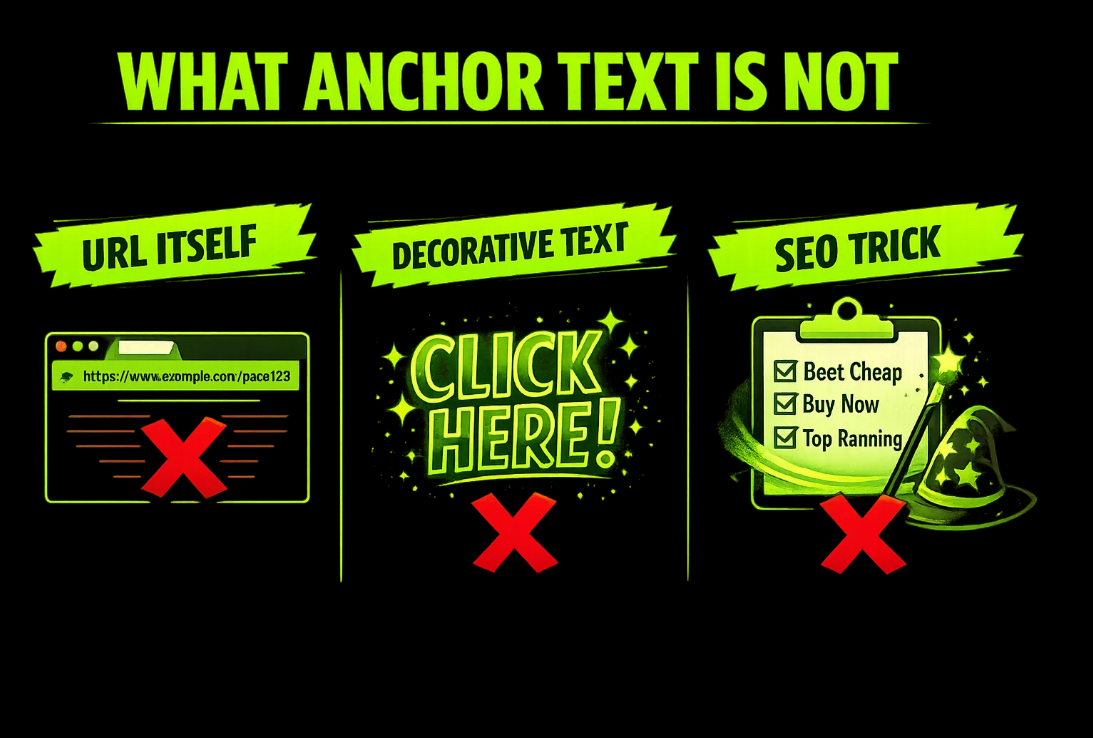
What anchor text is not:
- It is not the URL itself (unless the URL is displayed)
- It is not decorative text
- It is not just an SEO trick
At its core, anchor text is a signpost. It gives context before a click happens.
How Search Engines Use Anchor Text Today
Anchor text still matters, but not in the blunt, mechanical way it once did. Search engines treat it as a supporting signal, not a command. The role of anchor text today is less about telling algorithms what to rank and more about helping them verify whether relationships between pages make sense.
Think of anchor text as evidence, not instructions.
Anchor Text as a Relevance Clue, Not a Ranking Switch
Search engines use anchor text to understand how pages connect conceptually. When one page links to another, the wording of that link offers a hint about why the connection exists.
What anchor text helps search engines infer
- What topic the linked page is associated with
- How other pages frame or describe that page
- Whether the link appears editorial or manufactured
On its own, anchor text does very little. In combination with other signals, it helps confirm relevance.
Pattern Recognition Is More Important Than Individual Links
Search engines do not evaluate anchor text link by link in isolation. They look for patterns over time.
Signals that emerge from anchor text patterns
- Repeated themes across many links
- Consistency between anchor text and page content
- Variation that reflects natural language
- Outliers that suggest manipulation
A single exact-match anchor rarely causes issues. A profile built almost entirely on the same phrasing tells a different story.
Why Anchor Text Still Matters for SEO
Anchor text matters for two reasons that have nothing to do with gaming algorithms.
First, it helps users decide whether to click. Clear anchor text sets expectations. Vague anchor text forces guesswork.
Second, it helps search engines understand page relationships. Internal links, in particular, rely heavily on anchor text to communicate structure.
Anchor text influences:
- How pages are grouped by topic
- Which pages appear most relevant for certain queries
- How authority flows across a site
- Whether pages compete with each other unintentionally
Anchor text does not override content quality or backlinks, but it quietly shapes how everything connects.
What Anchor Text Looks Like in Practice
To users, anchor text usually appears as blue, underlined text. That visual convention signals clickability.
In HTML, anchor text looks like this:
<a href=”https://example.com/seo-guide”>SEO guide</a>
The words between the opening and closing tags are the anchor text.
From an SEO perspective, what matters is not the code, but the wording. The words chosen carry meaning.
The Main Types of Anchor Text You Will Encounter
A natural link profile uses multiple types of anchor text. Relying on one type too heavily is where problems start.
Here are the most common anchor text types, explained without jargon.
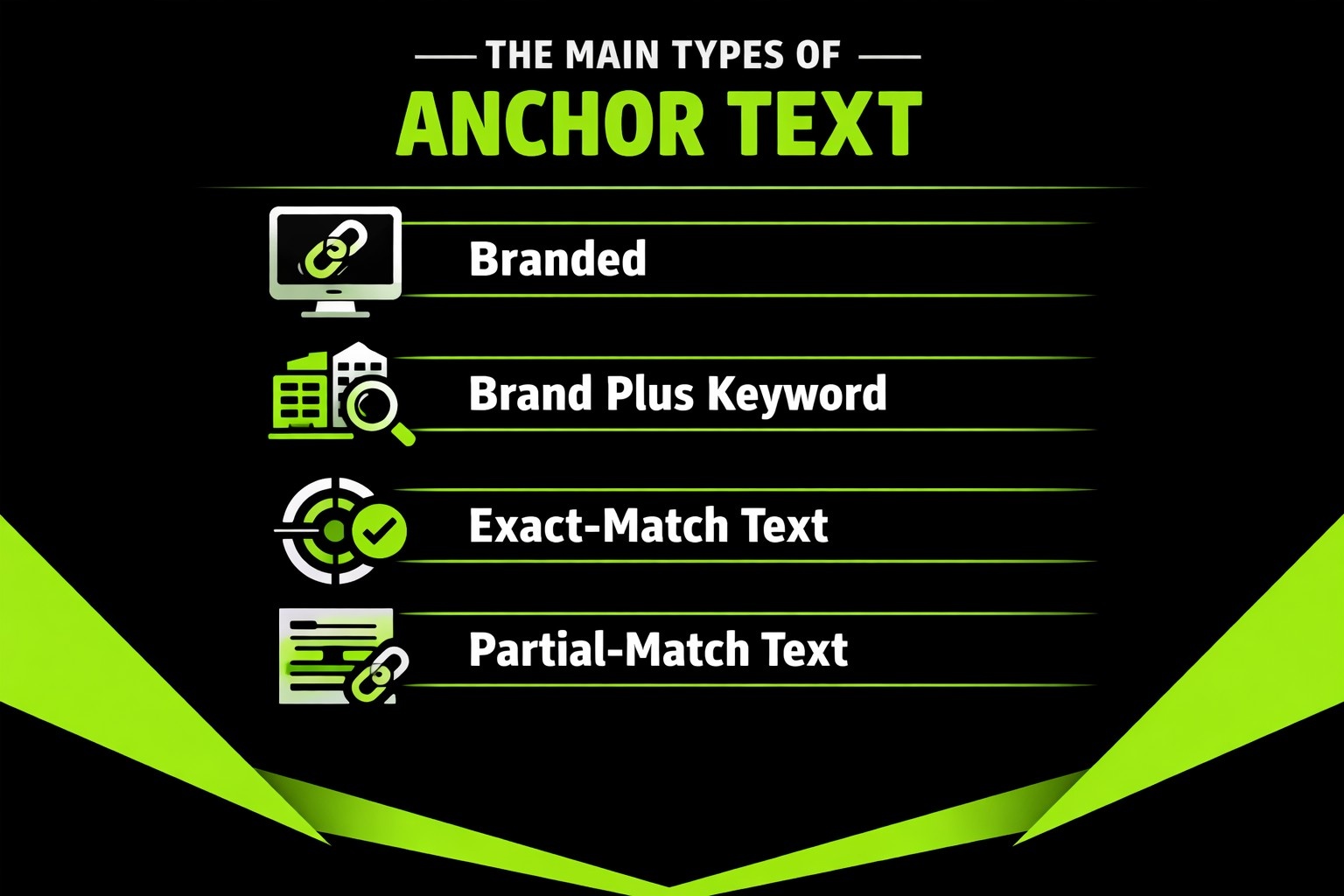
1. Branded Anchor Text
This uses a brand name as the link text.
Examples:
- Moz
- Yoast
- Ahrefs
Branded anchors are common, expected, and safe. They are especially important for backlinks.
Moz and Yoast both receive a large share of branded anchor text naturally.
2. Brand Plus Keyword Anchors
This combines a brand name with descriptive text.
Examples:
- Moz Link Explorer
- Yoast SEO plugin
- Ahrefs keyword research
These anchors add context without feeling forced and are common in editorial content.
3. Exact-Match Anchor Text
Exact-match anchors use the exact keyword a page is targeting.
Example:
- “anchor text” linking to a page optimized for anchor text
These are the most sensitive type. Used sparingly, they are fine. Used aggressively, they look manipulative.
Search engines expect some exact-match anchors, but not dominance.
4. Partial-Match Anchor Text
Partial-match anchors include a variation of the target keyword within a broader phrase.
Examples:
- how anchor text works
- anchor text best practices
- using anchor text correctly
These tend to look more natural and are often safer than exact matches.
5. Related Keyword Anchors
These use terms that are closely connected but not exact matches.
Examples:
- internal linking
- link relevance
- page relationships
They help search engines understand topical context without repeating the same phrasing.
6. Naked URL Anchors
These display the URL itself as the link.
Examples:
- https://example.com
- www.example.com
They are common in forums, citations, and references. Naked URLs are natural and expected in moderation.
7. Generic Anchor Text
These include phrases like:
- click here
- read more
- learn more
Generic anchors provide no context. They are not harmful in small amounts, but they are not helpful either.
Overusing them wastes opportunities to clarify meaning.
8. Image Anchor Text
When an image is linked, the image alt text functions as the anchor text.
If no alt text is present, the anchor provides little context to search engines or screen readers.
This is often overlooked in SEO audits.
Internal Links vs External Links: Anchor Text Differences
Anchor text plays a different role depending on whether the link stays within your site or points to another domain. Internal anchor text is fully under your control, which makes it one of the most useful and most commonly misused SEO tools. The table below highlights how internal and external anchor text differ and why those differences matter.
| Aspect | Internal Anchor Text | External Anchor Text |
| Level of control | Fully controlled by site owner | Largely controlled by other sites |
| Primary purpose | Explain site structure and page relationships | Signal relevance and authority across domains |
| SEO role | Helps define hierarchy, topic clusters, and priority pages | Helps search engines understand how others describe your content |
| Risk level | High when over-optimized or repetitive | High when manipulated or paid |
| Common problems | Keyword cannibalization, forced phrasing, excessive exact matches | Unnatural anchor patterns, spammy backlinks |
| Ideal anchor style | Descriptive, varied, context-driven | Natural, mixed, and imperfect |
| Impact of repetition | Can cause pages to compete against each other | Can trigger spam detection when excessive |
| Best use case | Guide users logically through related content | Reinforce credibility through editorial mentions |
Internal anchor text should act like clear signposting inside a building. Each link helps visitors understand where they are and where they can go next. When the same wording points to multiple destinations, that clarity disappears. External anchor text, on the other hand, reflects how the wider web interprets your content. You influence it, but you do not script it.
Anchor Text Distribution and Why Patterns Matter
Anchor text distribution refers to how often different anchor types appear across links pointing to a page.
Healthy patterns usually include:
- A strong branded base
- Partial-match and related terms
- Some naked URLs
- Occasional exact-match anchors
- Minimal generic anchors
Unhealthy patterns often show:
- Heavy exact-match concentration
- Repeated identical phrases
- Anchors unrelated to content
- Sudden unnatural shifts
Search engines do not use fixed ratios, but they recognize intent.
Anchor Text and Google Penguin: What Changed
The Penguin update marked a turning point in how anchor text is evaluated. What once worked as a shortcut to rankings became a risk almost overnight. The shift was not about removing anchor text from SEO, but about changing how much trust search engines place in it on its own.
The table below shows how anchor text was treated before Penguin and how it is interpreted today.
| Aspect | Before Google Penguin | After Google Penguin |
| Role of anchor text | One of the strongest standalone ranking signals | One signal among many, evaluated in context |
| Exact-match anchors | Often boosted rankings quickly when used aggressively | Overuse can trigger spam signals and suppress rankings |
| Keyword-stuffed anchors | Common and widely exploited | Actively flagged as manipulative |
| Paid links | Frequently passed value if anchor text was optimized | Discounted or penalized, especially with exact-match anchors |
| Automated link building | Scaled easily with predictable anchor text | Patterns detected and neutralized |
| Evaluation context | Anchor text analyzed largely on its own | Analyzed alongside content, link quality, and intent |
| Impact of poor anchor text | Rarely caused penalties by itself | Contributes to penalties when combined with other risks |
| Safe anchor text strategy | Heavy keyword targeting | Natural variation and user-focused language |
Penguin did not eliminate the value of anchor text. It removed the illusion that anchor text could work in isolation. Today, anchor text supports rankings only when it aligns with real relevance, real content, and real user value.
How to Write Good Anchor Text (Without Overthinking It)
Good anchor text reads naturally in a sentence. If it sounds awkward when read out loud, it is probably wrong.
Effective anchor text is:
- Clear about destination
- Relevant to the linked page
- Short and descriptive
- Contextual, not forced
Things to avoid:
- Stuffing keywords
- Repeating identical anchors
- Using vague phrases everywhere
- Linking unrelated content
When writing anchor text, ask one question:
Would this still make sense if search engines did not exist?
Anchor Text and User Experience: The Overlooked Factor
Anchor text often gets treated like a technical SEO lever, something adjusted to send the right signals to search engines. In reality, its first job is much simpler. It helps real people move through content without friction. When anchor text fails at that, no amount of optimization can fully compensate.
Good anchor text reduces uncertainty. Bad anchor text creates hesitation. That difference shows up quickly in how users behave on a page.
How People Actually Use Anchor Text
Most users do not read web pages line by line. They scan. Anchor text becomes part of that scanning pattern, acting as a shortcut to what matters next.
When someone encounters a link, they subconsciously ask a few quick questions.
What users expect from anchor text
- What will I see if I click this?
- Is this link relevant to what I am reading right now?
- Is it worth interrupting my flow to open it?
Anchor text that answers these questions clearly lowers the mental effort required to keep moving. Anchor text that avoids answering them forces guesswork.
Anchor Text as a Trust Signal
Links are promises. Anchor text is the wording of that promise.
What happens when anchor text is clear
- Users feel confident clicking
- Navigation feels intentional rather than random
- Pages feel connected rather than stitched together
Clear anchor text sets expectations and then meets them. That consistency builds trust over time, even if users are not consciously aware of it.
What happens when anchor text is misleading
- Users click and immediately feel disoriented
- Back buttons get used more often
- Frustration quietly increases
Misleading anchor text might win a click, but it loses credibility. Over time, users stop trusting links on the site altogether.
Common Anchor Text Mistakes That Hurt SEO
Some anchor text issues show up so often in audits that they are easy to spot once you know what to look for. Most of them do not come from neglect, but from trying to push optimization a bit too far. The table below breaks down the most damaging mistakes, why they cause problems, and what to do instead.
| Anchor Text Mistake | Why It Hurts SEO | What Works Better |
| Linking multiple pages using the same primary keyword | Search engines struggle to understand which page should rank, leading to keyword cannibalization and weaker signals overall | Use varied, descriptive anchor text that reflects the specific role of each page |
| Overusing exact-match anchors internally | Creates unnatural patterns and can trigger spam signals, especially when repeated across many links | Mix partial-match, related phrases, and natural language anchors |
| Using generic anchors everywhere | Provides no context for users or search engines, wasting the value of internal links | Write anchor text that clearly describes what the linked page offers |
| Linking unrelated content for SEO reasons | Confuses readers and weakens topical relevance, which search engines may treat as manipulation | Link only when there is a clear, logical connection between pages |
| Ignoring image alt text on linked images | Removes context for search engines and accessibility tools, weakening the link signal | Write meaningful alt text that describes the linked content accurately |
| Forcing links where they do not belong | Disrupts readability and user trust, often increasing bounce rates | Add links only where they naturally support the content and reader intent |
Most anchor text problems are not technical failures. They are editorial ones. When links are added to serve readers first, many of these issues disappear on their own.
How to Review and Analyze Anchor Text on Your Site
You do not need complex tools to spot problems, but they help.
Basic steps:
- Review internal links page by page
- Look for repeated anchor phrases
- Identify competing links
- Check image alt text on linked images
Tools like Moz Link Explorer make it easier to see external anchor patterns, but judgment still matters.
Numbers without context can mislead.
Best Practices That Actually Hold Up Long Term
Anchor text best practices are not secret formulas. They are habits.
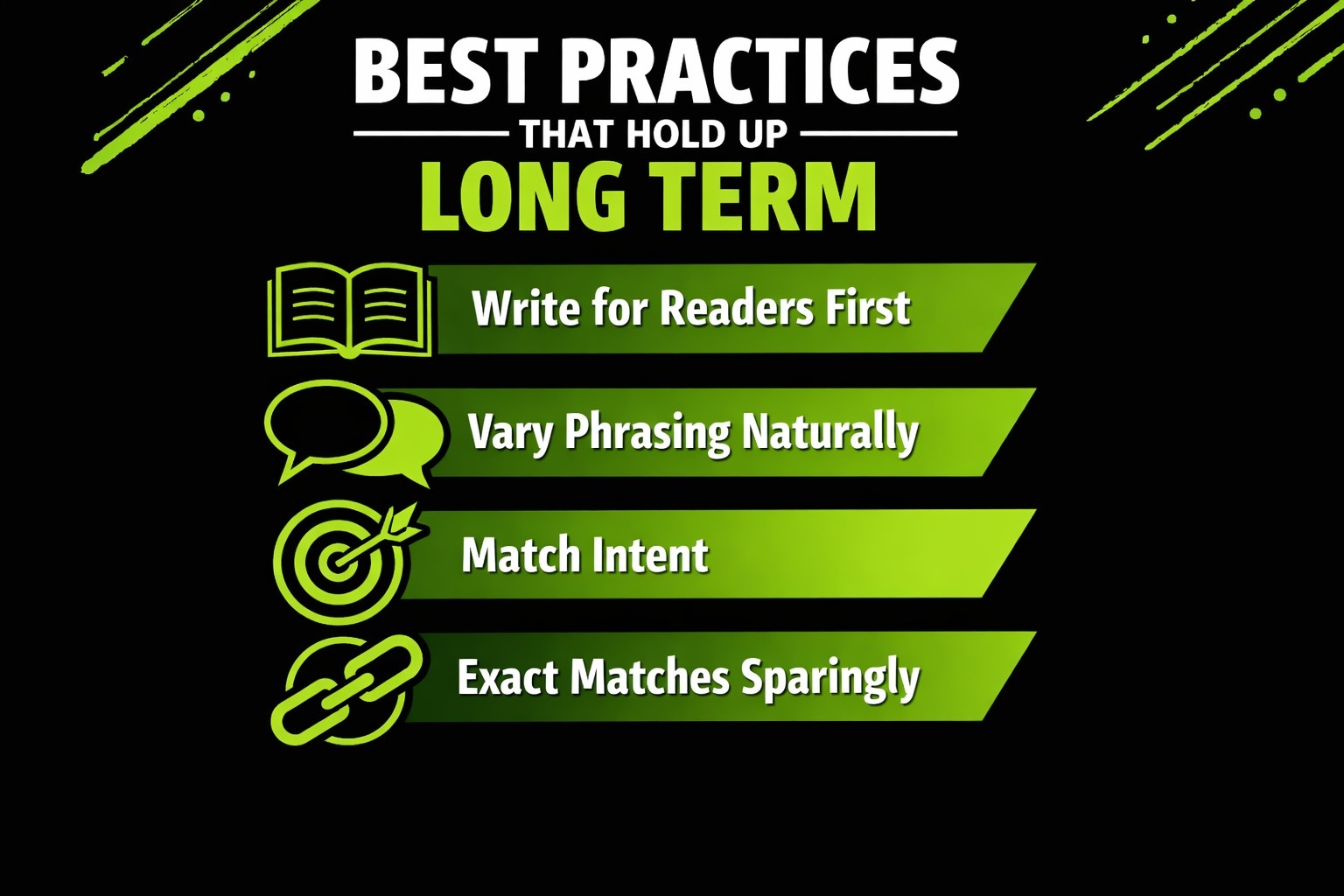
Write for readers first
Anchor text should make sense to a human before it ever makes sense to a search engine. When someone scans a paragraph, the link text should clearly signal what happens after the click. If the wording feels vague, salesy, or out of place, readers hesitate. Search engines tend to follow the same logic. Clear, helpful language that fits the sentence naturally is almost always the safest option.
Vary phrasing naturally
Real people do not describe the same thing using the same words every time. Your links should reflect that. Repeating identical anchor text across a site looks mechanical and can create internal competition. Small variations in wording keep links readable and help search engines see a topic as a broader concept rather than a single forced keyword.
Match intent, not just keywords
Good anchor text aligns with what the linked page actually delivers. If a page answers a how-to question, the anchor text should hint at guidance or explanation, not just a keyword phrase. Matching intent reduces bounce rates and builds trust. It also helps search engines understand why one page links to another, which matters more than exact wording.
Use exact matches sparingly
Exact-match anchor text still has a place, but it should never dominate. A few well-placed exact matches can reinforce relevance, especially in internal linking. Too many, however, start to look intentional in the wrong way. When every link uses the same keyword, it stops feeling like natural navigation and starts looking like manipulation.
Keep internal linking logical
Internal links should follow the structure of your content, not fight it. Anchor text works best when it supports a clear hierarchy and topic flow. Linking sideways, backward, or redundantly just to push keywords weakens the signal. Each internal link should answer a simple question: does this help the reader understand the topic better or move forward?
Let backlinks be imperfect
You cannot and should not try to control every anchor text used by other sites. A healthy backlink profile includes branded links, naked URLs, partial phrases, and even some generic anchors. That messiness is normal. Search engines expect it. Trying to force uniform anchor text across backlinks often creates the very patterns algorithms are designed to catch.
Good anchor text is not optimized. It is earned.
Final Thoughts: Anchor Text Is Quiet, But Powerful
Anchor text does not win rankings on its own. It does not replace content, authority, or relevance. But it shapes how everything connects.
Think of anchor text as the language your site uses to explain itself. Clear language builds understanding. Forced language raises suspicion.
If you get anchor text right, most of the time nothing dramatic happens. Pages just make more sense. Links feel natural. SEO problems quietly disappear. That is usually the best outcome.