


Search traffic doesn’t just show up. Behind most websites that consistently rank, there’s someone quietly fixing structure, shaping content, and making sure the pages actually reach people. That’s the job of an SEO consultant. They look at everything from keywords to crawl issues to conversion paths and help businesses figure out where to focus when search visibility stalls or never gets off the ground in the first place.
Some work independently, others come in through agencies, but the good ones all do the same thing: connect technical improvements and strategy work to measurable results. It’s not instant. And it’s not one-size-fits-all. But done right, SEO consulting isn’t just about rankings. It’s about turning a website into something findable, usable, and valuable.
What an SEO Consultant Actually Does
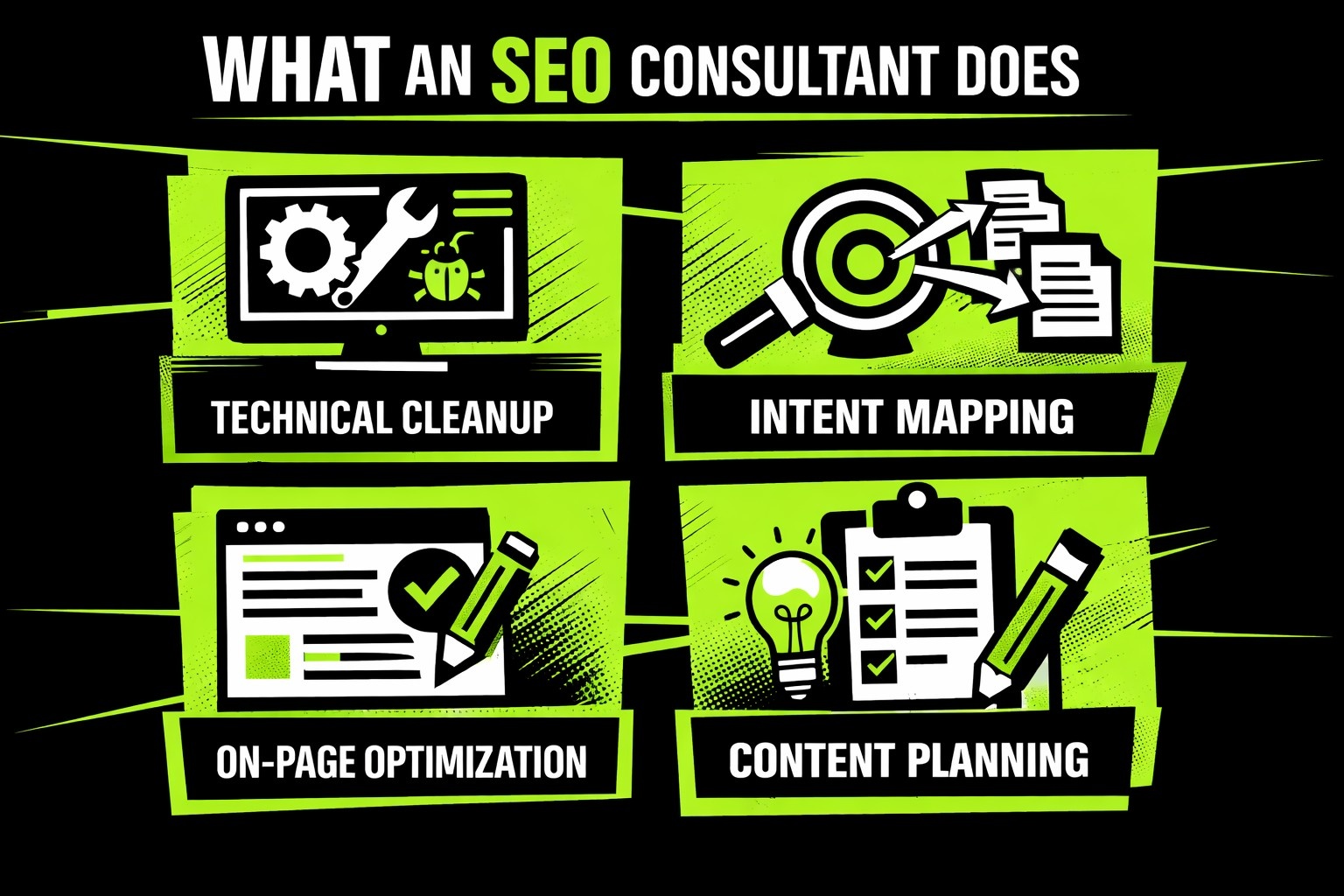
The role isn’t about chasing keywords or guessing what Google wants. It’s about understanding how search visibility really works – then making structured changes that move the right metrics. Depending on the business, an SEO consultant might step in to fix broken fundamentals, design a content strategy from scratch, or help a team refocus on what’s worth ranking for in the first place. Here’s what that usually involves:
- Technical cleanup: Before anything else, consultants dig into the structure. They look for crawl issues, speed problems, poor mobile performance, broken links, and duplicated content. If search engines can’t reach or understand the site, nothing else matters.
- Keyword and intent mapping: It’s not just about search volume. A good consultant identifies what the business should be ranking for based on product fit, user behavior, and where competitors are getting traction. Then they match those queries to specific pages.
- On-page optimization: Titles, meta descriptions, headers, internal links – the basics still matter. But they’re applied with context. Consultants make sure every important page sends the right signals and speaks directly to the intended audience.
- Content planning and refinement: Some consultants write; others advise. Either way, they help shape content that isn’t just “optimized” but actually useful – covering what people search for, avoiding repetition, and connecting content to conversions.
- Link acquisition strategy: Without quality backlinks, even the best pages struggle to rank. Consultants plan outreach, identify linkable assets, and avoid shortcuts that could backfire. It’s a long game – but a necessary one.
- Reporting and iteration: This is the part that separates professionals from guesswork. Consultants monitor rankings, traffic, conversions, and technical health. They report honestly, adjust as needed, and focus on what’s working – not just what looks good on a chart.
An SEO consultant isn’t a copy-paster of best practices. They assess real-world constraints, prioritize what moves the needle, and stay plugged into how search evolves. The work is layered – technical, strategic, and collaborative. But at the end of the day, it’s about clarity: what’s broken, what’s possible, and what needs to happen next.
Lengreo on SEO: Growth-Centered, Context-Driven
At Lengreo, we approach SEO as a strategic growth function – not a silo. It’s tightly connected to how your audience discovers, evaluates, and converts. That means we begin with context: your market landscape, search intent, competitive gaps, and business stage. From there, we tailor the SEO work to match what’s actually needed to grow.
Whether it’s a technical audit, content restructuring, or full SEO ownership, we adapt the work to the business stage and realistic growth potential. In many cases, SEO connects directly with outbound efforts, paid campaigns, or custom landing pages, so visibility and conversion stay aligned instead of drifting apart.
We also share updates and real project snapshots on LinkedIn and Instagram. No packaged stories – just practical examples from ongoing work across SaaS, biotech, cybersecurity, fintech, and other competitive spaces.

Signs You’re Ready for Outside SEO Help
Not every company needs an SEO consultant from day one. But there’s usually a point when internal efforts stall, search performance flatlines, or nobody’s quite sure what’s holding things back. That’s when it makes sense to bring in someone who can cut through the noise and reset the strategy. Here’s what that moment tends to look like.
1. You’re Scaling and Search Isn’t Keeping Up
Growth brings traffic pressure. New products, more content, bigger campaigns – all of it puts extra weight on the site. If the SEO foundation hasn’t kept pace, traffic won’t scale with the rest of the business. Consultants step in here to rework structure, re-prioritize keywords, and make sure visibility isn’t lagging behind.
2. You’re About to Rebuild or Redesign
A site relaunch without SEO guidance usually means dropping rankings for no good reason. Consultants help plan for that – keeping existing visibility intact, flagging risky changes before they go live, and identifying what needs to be improved (not just moved around).
3. You’re Creating a Lot of Content – But It’s Not Landing
Publishing regularly is great, but if none of it’s ranking or converting, something’s off. An SEO consultant can audit what’s already there, identify intent mismatches, and reset the content strategy so it actually connects with search demand. This isn’t about producing more – it’s about making what’s already out there start pulling its weight.
4. You Have the Basics Down – But Need Direction
Plenty of companies know what a title tag is, how to check speed scores, maybe even how to use Search Console. That’s not the issue. The problem is prioritization – too many possibilities, no clear roadmap. Consultants bring focus. They separate urgent from optional, flag what’s actually blocking growth, and help internal teams work smarter.
5. You’re in a Competitive Space and Can’t Afford to Wing It
If you’re in SaaS, finance, biotech, cybersecurity – anything with high-ticket products or long sales cycles – search visibility is rarely a low-stakes issue. Falling behind on SEO here means losing ground to competitors who are investing in it. Consultants help keep the strategy sharp, the execution tight, and the results visible where they need to be.
What Progress Looks Like (and How Long It Really Takes)
SEO doesn’t flip a switch. It builds. What usually happens is this: the first few months go into fixing what’s broken, tightening the structure, and aligning content with actual demand. That foundational work rarely moves the needle overnight – but it sets the stage for everything that follows. Most sites start to see movement around month three or four. For less competitive keywords, it can happen faster. But for terms that actually drive revenue, timelines are closer to six to twelve months, sometimes longer.
Good consultants won’t talk in promises. They’ll show the metrics that matter – improved rankings, stronger conversion rates, lower bounce, faster load times, and better lead quality. In real terms, that might look like landing 25% more qualified sessions, seeing 10% MoM traffic lifts, or cutting cost-per-lead in half through better organic reach. But it only works if the strategy stays consistent. The sites that win long-term usually aren’t the loudest – they’re just the ones that didn’t give up after month five.
Things Real SEO Consultants Avoid for a Reason
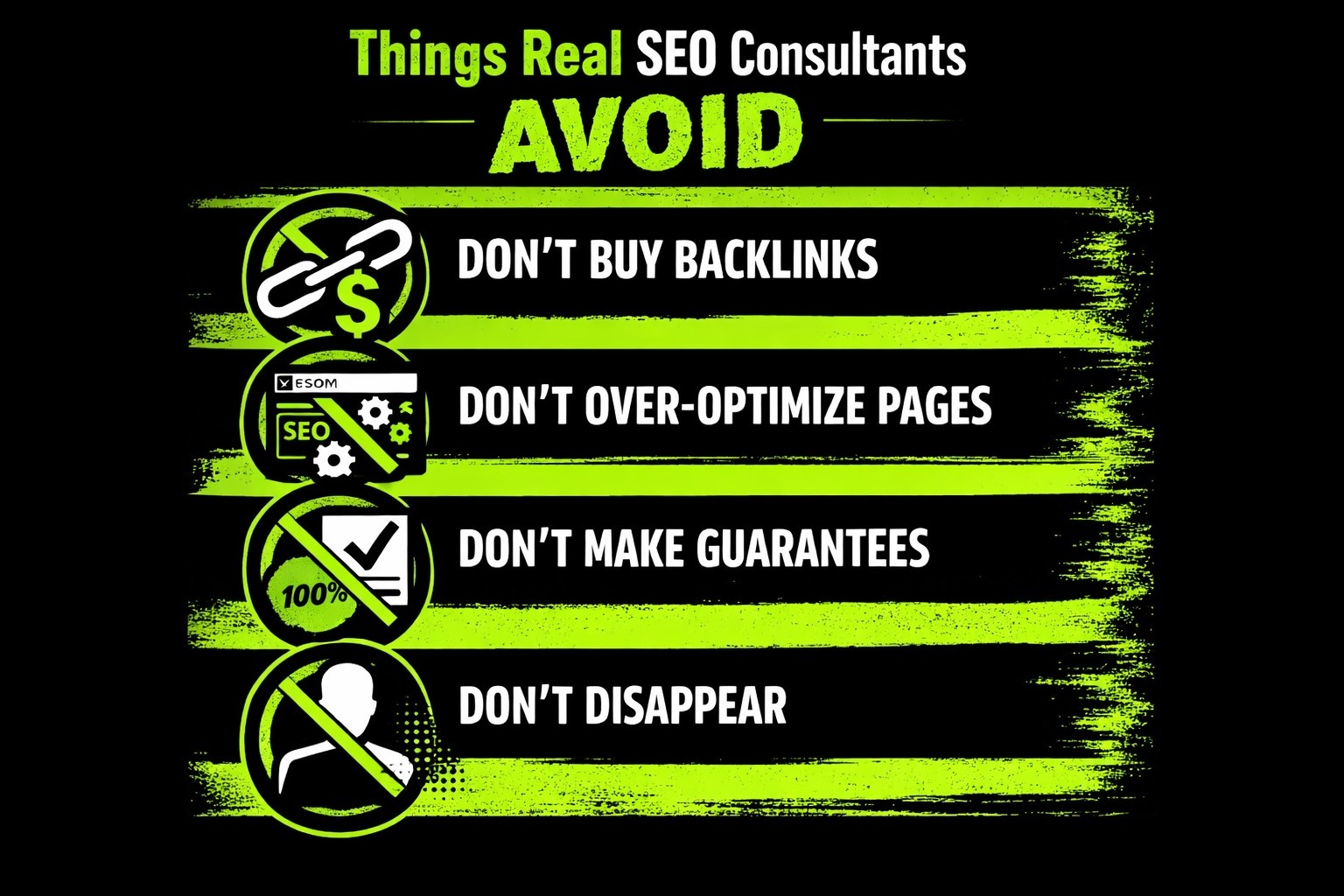
Good SEO isn’t about chasing loopholes. If someone’s promising guaranteed rankings or overnight traffic spikes, it’s not strategy – it’s a red flag. The consultants worth working with don’t just know what to do. They know what not to mess with.
- They don’t buy backlinks or play link roulette: Shortcuts in link building might bump you up for a month, but they almost always lead to penalties or long-term damage. Professionals focus on building credibility, not gaming metrics.
- They don’t over-optimize pages just to hit a checklist: Shoving keywords into every sentence or tweaking a title ten times won’t help if the content doesn’t match intent. Real consultants look at how people actually search and read – not just what the tools say.
- They don’t run fake click-through tests or script bot traffic: Manipulating engagement numbers might fool a crawler short-term, but it doesn’t build lasting visibility – and it’s not worth the risk of being de-indexed.
- They don’t make vague guarantees: No one can promise a #1 ranking – not without cutting corners. What they can do is explain the strategy, the tradeoffs, and what results are realistic based on the competitive landscape.
- They don’t disappear after delivering a PDF: A one-time audit isn’t a solution if no one follows through. The good ones stay involved, answer questions, adjust tactics, and help internal teams move things forward.
What ties all of this together is intent. Real consultants aren’t chasing visibility for its own sake – they’re building trust, relevance, and outcomes that actually hold. That means doing less of what’s flashy and more of what works quietly in the background, month after month.
SEO Pricing: What You’re Really Paying For
SEO pricing isn’t random. It reflects how much effort is needed, how competitive the space is, and what kind of outcomes are on the table. The question isn’t just “how much does it cost?” – it’s “what kind of work justifies that number, and is it aligned with the results the business actually needs?”
Retainers: For Ongoing Work That Needs Consistency
Most long-term SEO projects run on monthly retainers. This model makes the most sense when search plays a central role in acquisition and there’s ongoing content, technical, or link strategy work to be done.
What you’re typically paying for:
- Ongoing site optimization and content planning
- Regular reporting and strategy adjustments
- Communication and integration with internal teams
- Flexibility to respond to shifts in the market or algorithm updates
This setup works well when SEO is baked into broader marketing and growth efforts. It’s predictable, measurable, and gives both sides enough stability to plan ahead.
Hourly Rates: For Tactical Help or Limited Scope
Hourly billing fits when the work is tightly scoped – audits, consultation, second opinions. You pay for the hours used, and that’s it.
When this makes sense:
- You need an expert to review something before launch
- Internal teams can implement fixes but need direction
- You’re not ready for a full engagement but want clarity
It’s straightforward, but keep in mind: complex SEO issues don’t always fit into neat hourly blocks.
Project-Based Pricing: For Audits, Migrations, or Resets
Some SEO work is one-and-done – especially at the beginning. Audits, site migrations, or content overhauls are often priced as fixed-scope projects.
Expect this model for:
- Full SEO audits and roadmaps
- Technical SEO cleanup before a site relaunch
- Keyword + content strategy development for a new product or market
Good consultants set clear boundaries around what’s included. You’re buying outcomes, not just effort.
Performance-Based: Risky, but Sometimes Used
Occasionally, consultants agree to tie their fees to specific outcomes – like traffic increases or lead volume. On paper, this sounds appealing. In practice, it’s rare, and often full of complications.
Why this gets tricky:
- SEO results depend on client-side execution (dev speed, content approvals, etc.)
- Not every valuable outcome is easily tracked
- It encourages chasing easy wins instead of sustainable growth
Most experienced consultants avoid this model unless the working relationship is rock solid and fully transparent.
So What’s a “Normal” Budget?
It depends – obviously – but to give some ballpark figures:
- Local businesses: $500-$1,500/month for basic optimization and upkeep
- Growing companies: $2,000-$6,000/month for strategy + implementation
- Enterprise or high-competition niches: $6,000+/month for full-spectrum SEO with content, tech, and authority work
Hourly rates vary from $75 on the low end to $300+ for senior specialists. Project pricing often falls in the $1,500-$10,000 range, depending on depth.
The main thing to watch for isn’t the price – it’s what’s being delivered. A $5K/month retainer that drives pipeline is more valuable than a $1K/month checklist that doesn’t move anything that matters.
Questions That Actually Tell You Who You’re Hiring
Choosing an SEO consultant isn’t about asking them to explain what SEO is. You want to understand how they think, how they measure progress, and how they operate when things don’t go exactly as planned – because they rarely do. A slick pitch means nothing if there’s no follow-through behind it.
A good place to start is with strategy and process: how do they approach competitive research? What’s their plan for aligning SEO work with the actual sales funnel? Ask them to walk through how they’ve helped businesses with similar challenges. Bonus points if they bring up tradeoffs, not just wins. That usually means they’ve done the work themselves – not just narrated someone else’s case study.
Then dig into reporting and communication. How often will they check in? What metrics do they prioritize, and why? What happens if things stall? If they’re vague here, that’s a problem. SEO takes time, and there will be slow periods – but consultants who know what they’re doing can always explain what’s happening, what’s next, and what’s worth changing. That clarity is often the real value. Not the ranking promises – the roadmap.
Conclusion
An SEO consultant isn’t someone you bring in just to “boost rankings.” At least not the ones worth hiring. Their job is to look at where your visibility is leaking, where opportunities are being missed, and what parts of your site are silently working against you. Sometimes it’s a full reset. Other times, it’s about making a good system tighter, cleaner, and more aligned with how people search – and how your business sells.
The best consultants don’t overpromise. They ask questions you hadn’t considered, give you a clearer view of what’s worth fixing, and focus on sustainable gains that tie into actual business goals. Not everyone needs one. But if traffic has plateaued, if content isn’t landing, or if internal teams are stretched thin and chasing every shiny object – outside perspective can save a lot of time. And mistakes.