


Executive Summary: A technical SEO audit is a comprehensive evaluation of a website’s infrastructure, code, and backend elements that impact search engine crawling, indexing, and ranking. It identifies technical issues like crawl errors, page speed problems, mobile usability issues, and indexation challenges that prevent search engines from properly accessing and ranking your content.
Search engines need to crawl, index, and understand your website before they can rank it. But here’s the thing—even minor technical issues can block that entire process.
A technical SEO audit examines the technical aspects of a website to identify problems that hinder search engine performance. Think broken links, slow page speeds, duplicate content, or crawl barriers. These issues don’t just hurt rankings. They damage user experience and waste organic traffic opportunities.
According to Google Search Central documentation, Google uses automated software called web crawlers to regularly explore the web and find pages to add to its index. When technical barriers block these crawlers, your content becomes invisible regardless of quality.
Understanding Technical SEO Audits
A technical SEO audit analyzes the technical foundation that determines whether search engines can effectively access, crawl, render, and index your website. This differs from content audits or link audits, which focus on what you publish rather than how your site operates behind the scenes.
The audit process involves scanning your entire website—sometimes hundreds of thousands of pages—to detect technical problems. For large-scale websites with over 1,000,000 URLs, community discussions reveal that licensed crawling tools become essential for managing the scope.
But why does this matter?
Google Search operates through three primary stages: crawling, indexing, and serving results. Technical issues can disrupt any of these stages. A robots.txt misconfiguration might block crawlers entirely. Slow server response times might limit crawl budget. Poor mobile optimization might trigger ranking penalties.
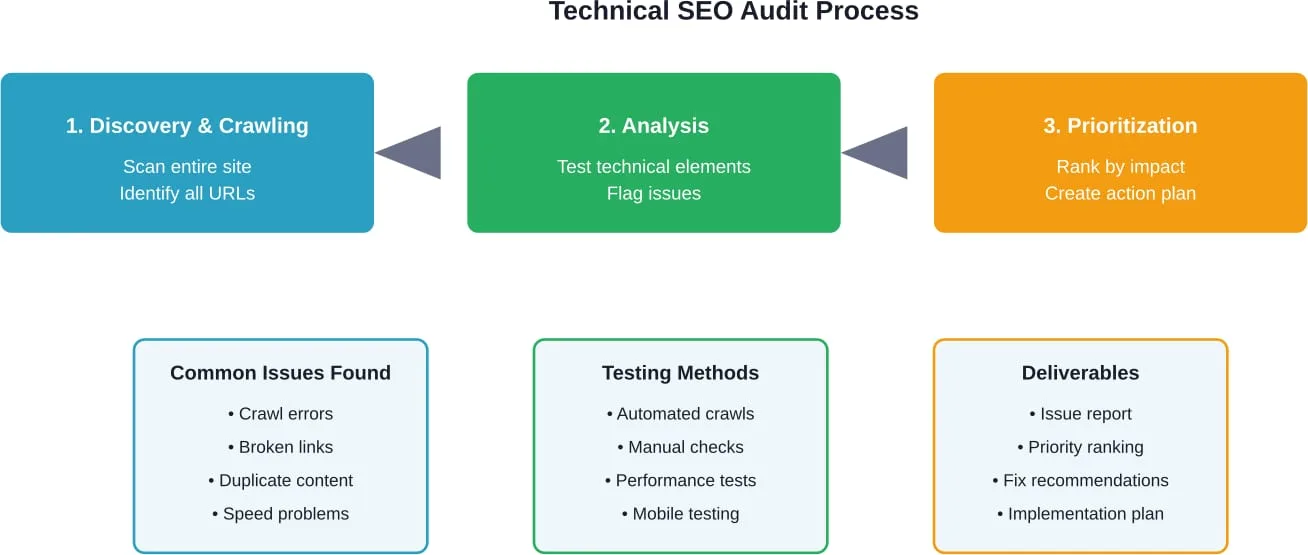
Key Components of a Technical SEO Audit
A comprehensive audit examines multiple technical areas. Each component addresses specific ways search engines interact with your website.
Crawlability and Indexation
Search engines must crawl your pages before they can rank them. The audit checks whether crawlers can access all important pages and whether any barriers exist.
According to Google Search Central, robots.txt files tell crawler software which URLs can be accessed on a site. Misconfigurations here can accidentally block entire sections of your website. The audit verifies robots.txt rules and identifies blocked resources.
XML sitemaps help search engines discover pages efficiently. The audit confirms sitemap accuracy, checks for errors, and ensures submission to search engines.
Site Architecture and URL Structure
Logical site structure helps both users and search engines navigate content. The audit examines URL structure, internal linking patterns, and site hierarchy depth.
Clean, descriptive URLs perform better than complex parameter-heavy strings. Navigation should allow users to reach any page within 3-4 clicks from the homepage.
Page Speed and Core Web Vitals
According to Google Search Console documentation, the Core Web Vitals report measures three critical metrics based on real user data: Largest Contentful Paint (LCP), Interaction to Next Paint (INP), and Cumulative Layout Shift (CLS).
These metrics directly impact user experience. Mobile devices account for a majority of organic search engine visits, making mobile performance particularly critical. The audit measures load times, identifies render-blocking resources, and flags performance bottlenecks.
Mobile Optimization
Mobile-friendliness affects both rankings and user experience. The audit tests responsive design implementation, touch element sizing, viewport configuration, and mobile usability.
Duplicate Content Issues
Duplicate content means multiple webpages contain identical or nearly identical content. This can lead to indexing problems, incorrect page versions appearing in search results, and performance issues for relevant pages.
The audit identifies duplicate title tags, meta descriptions, page content, and canonicalization issues.
JavaScript SEO
According to Google Search Central, while Google Search runs JavaScript with an evergreen version of Chromium, there are important considerations. The audit checks whether JavaScript content renders properly for search engines and whether critical content loads without JavaScript execution.
HTTPS and Security
Secure connections protect user data and serve as a ranking signal. The audit verifies SSL certificate implementation, checks for mixed content warnings, and ensures proper HTTPS redirects.
| Audit Component | What It Checks | Common Issues Found |
|---|---|---|
| Crawlability | Robots.txt, sitemap, crawl errors | Blocked resources, missing sitemap, 404 errors |
| Site Architecture | URL structure, internal links, depth | Poor URL structure, orphaned pages, broken links |
| Page Speed | Load times, Core Web Vitals, resources | Slow LCP, render-blocking CSS/JS, large images |
| Mobile Optimization | Responsive design, usability, viewport | Small text, touch elements too close, no viewport |
| Duplicate Content | Repeated content, canonicals, parameters | Missing canonical tags, URL parameter issues |
| Security | HTTPS implementation, certificates, redirects | Mixed content, expired certificates, HTTP pages |
Why Technical SEO Audits Matter
The benefits extend beyond simply fixing broken elements. A well-executed audit protects organic traffic and uncovers growth opportunities.
Enhanced User Experience
Technical issues that frustrate search engines also frustrate users. Slow load times, broken links, and mobile usability problems drive visitors away. Audits identify these friction points so teams can improve the overall experience.
Improved Search Rankings
Organic searches generate a significant portion of all search result clicks. When technical barriers prevent proper crawling and indexing, that traffic opportunity disappears. Fixing technical issues allows high-quality content to compete effectively.
Case studies have documented significant increases in search visibility through strategic technical improvements combined with targeted optimization work.
Efficient Crawl Budget
Search engines allocate limited resources to crawl each site. Technical problems waste crawl budget on duplicate pages, redirect chains, and error pages. Optimization ensures crawlers focus on valuable content.
Competitive Advantage
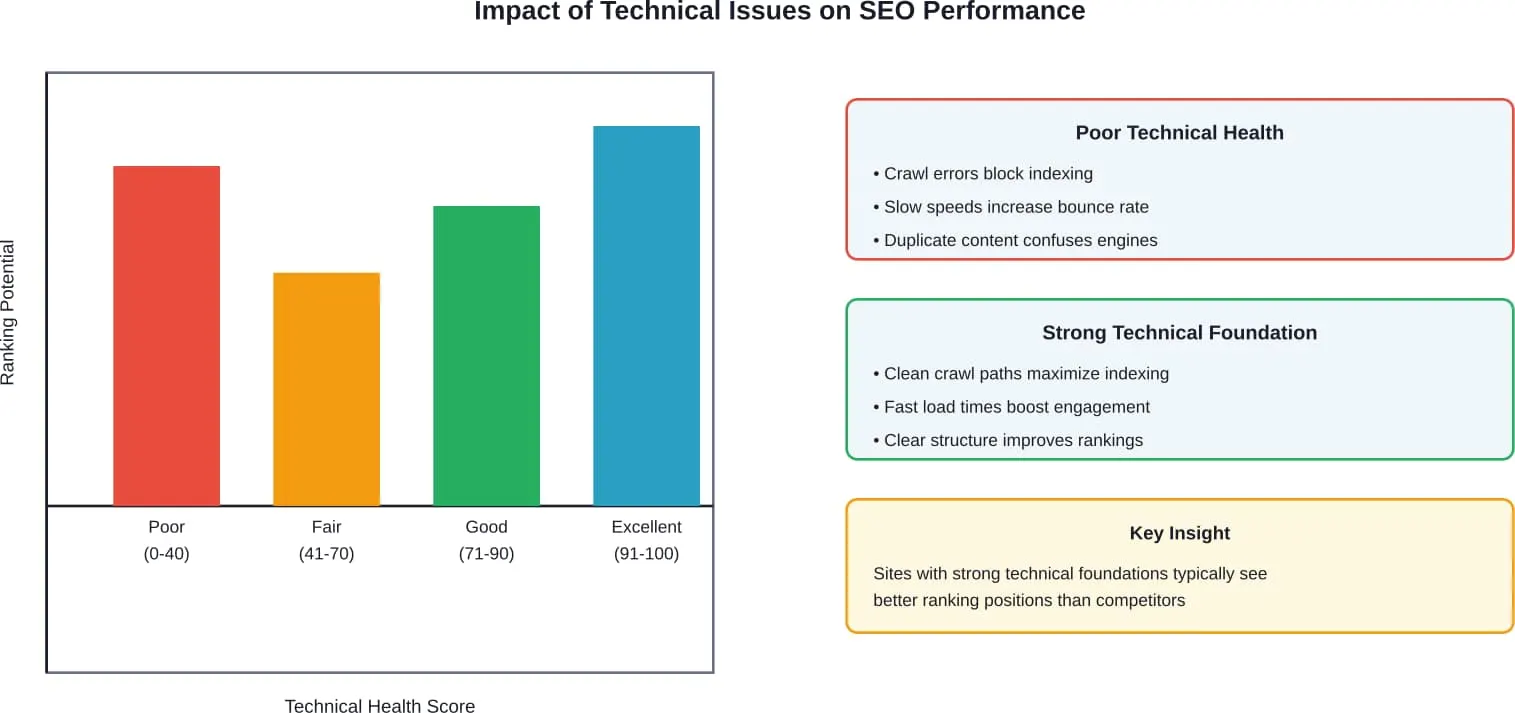
Many websites neglect technical SEO maintenance. Sites with strong technical foundations outperform competitors even when content quality is comparable.
Fix Technical SEO Issues Before They Hurt Rankings
A technical audit identifies crawl errors, indexing issues, and performance bottlenecks. Lengreo analyzes site structure, page speed, and internal linking logic. The goal is to remove barriers that prevent rankings. This creates a stable SEO foundation.
Ready to Run a Technical SEO Audit?
Talk with Lengreo to:
- identify crawl and indexing problems
- fix structural and speed issues
- build a technical improvement plan
👉 Request a technical SEO audit from Lengreo.
How to Perform a Technical SEO Audit
Conducting an audit requires both automated tools and manual expertise. The process typically follows these stages.
Initial Site Crawl
Start with a comprehensive crawl using specialized software. Tools scan the entire website, following links and recording technical data about each page discovered.
For sites with extensive page counts, configure crawl settings appropriately. This includes respecting robots.txt rules, setting appropriate crawl speed limits, and ensuring JavaScript rendering when necessary.
Data Collection and Analysis
The crawl generates massive datasets. Analysis identifies patterns, flags anomalies, and categorizes issues by type and severity.
Cross-reference crawl data with Google Search Console reports. Search Console provides direct insights from Google about crawl errors, indexing status, mobile usability, and Core Web Vitals performance.
Manual Testing
Automated tools miss certain issues. Manual checks verify mobile rendering, test specific user flows, examine structured data implementation, and assess content quality.
Prioritization
Not all issues carry equal weight. Prioritize based on impact potential and implementation difficulty. Critical issues blocking indexing demand immediate attention. Lower-priority optimizations can follow in subsequent phases.
Documentation and Reporting
Create detailed documentation explaining each issue, its impact, and recommended fixes. Include specific examples, screenshots, and step-by-step remediation instructions.
Effective reports organize findings by priority tier rather than technical category. Decision-makers need clarity on what matters most.
Technical SEO Audit Costs and Resources
Budget considerations vary based on approach and site complexity.
| Approach | Typical Cost Range | Best For |
|---|---|---|
| Self-Audit (DIY) | Doing the audit yourself involves minimal costs mainly associated with tool subscriptions. | Small sites, learning purposes, ongoing monitoring |
| Freelancer/Consultant | Hiring a freelancer or SEO consultant typically costs moderate fees. | Medium sites, one-time audit, specific issue diagnosis |
| Agency Audit | Hiring an agency involves significant investment depending on scope and complexity. | Enterprise sites, comprehensive analysis, implementation support |
Cost primarily reflects tool licenses, expertise level, and site complexity. DIY audits work well for smaller websites when combined with quality tools and learning resources.
Common Technical SEO Issues Uncovered
Certain problems appear repeatedly across audits. Recognizing these patterns helps focus efforts.
Crawl Errors and Broken Links
404 errors frustrate users and waste crawl budget. Organizations have reported significant reductions in broken links after systematic identification and fixing.
Google distinguishes between standard 404 errors and soft 404 errors. Soft 404s occur when pages return successful status codes but contain no meaningful content.
Duplicate Content Problems
Duplicate content dilutes ranking signals. Common causes include URL parameter issues, HTTP/HTTPS versions coexisting, WWW and non-WWW versions both resolving, and printer-friendly page versions.
Canonical tags tell search engines which version represents the primary content. The audit verifies canonical implementation across all duplicate scenarios.
Page Speed Issues
Slow sites lose both rankings and conversions. Common speed problems include unoptimized images, render-blocking JavaScript and CSS, excessive server response times, and lack of browser caching.
Mobile Usability Problems
With a majority of organic visits from mobile devices, mobile optimization becomes non-negotiable. Issues include text too small to read, touch elements positioned too close together, content wider than screen, and missing viewport configuration.
Conclusion
Technical SEO audits identify the foundational issues that prevent websites from achieving their ranking potential. These systematic evaluations examine crawlability, site architecture, page speed, mobile optimization, and numerous other factors that determine search engine success.
The audit process combines automated scanning with expert analysis to uncover problems that damage both search performance and user experience. From broken links to duplicate content, from slow load times to indexing barriers—technical issues create obstacles that quality content alone cannot overcome.
But here’s what matters most: identifying issues means nothing without taking action.
Start by crawling your website with appropriate tools. Review Google Search Console data for signals directly from search engines. Prioritize issues based on impact potential. Then systematically implement fixes, starting with critical problems that block indexing or severely impact user experience.
Technical SEO provides the foundation for all other optimization efforts. Strong technical health allows great content to perform, efficient crawling to discover new pages, and positive user signals to accumulate. Check the official documentation for current best practices, monitor performance metrics after implementing changes, and conduct regular audits to maintain technical excellence over time.