SEO metrics represent the measurable data points that reveal whether search optimization efforts are working. But here’s the thing—not all metrics carry equal weight.
Many organizations track dozens of data points without understanding which ones actually drive business results. According to Harvard Business School Online, only 23 percent of marketers are confident that they track the right KPIs. That’s a problem when search visibility directly impacts how billions of users discover companies online.
The difference between successful SEO programs and those that struggle often comes down to metric selection. Tracking the wrong indicators creates what industry experts call “metric debt”—the accumulated cost of optimizing for numbers that no longer reflect how growth happens.
Understanding What SEO Metrics Actually Mean
SEO metrics are quantifiable measurements that evaluate how well a website performs in search engines. They translate abstract concepts like “visibility” or “authority” into concrete numbers that teams can track, analyze, and improve over time.
Think of SEO metrics as the dashboard instruments in a car. Each gauge tells something specific about performance. Some indicate immediate issues requiring attention. Others show long-term trends that inform strategic decisions.
The challenge? Knowing which gauges matter most for the journey ahead.
The Evolution of SEO Measurement
SEO metrics have changed dramatically as search engines evolved. Early optimization focused almost entirely on rankings—where a page appeared for specific keyword searches. That singular focus made sense when search worked simply.
But modern search ecosystems are complex. AI search, zero-click results, and privacy limitations have weakened the connection between traditional SEO metrics and business outcomes. Rankings still matter, but they’re just one piece of a larger puzzle.
According to Google’s Search Central documentation, the search engine’s core ranking systems now evaluate page experience, content helpfulness, and real-world user interaction data. Measuring SEO success requires tracking metrics across multiple dimensions.
Why SEO Metrics Matter for Business
The fundamental purpose of SEO metrics is connecting search activities to business outcomes. Without proper measurement, optimization becomes guesswork.
Effective metrics help organizations:
- Identify which content and pages drive the most valuable traffic
- Understand where technical issues hurt performance
- Compare performance against competitors
- Justify continued investment in search optimization
- Make data-driven decisions about resource allocation
The key is focusing on metrics that reveal actionable insights rather than surface-level vanity numbers.
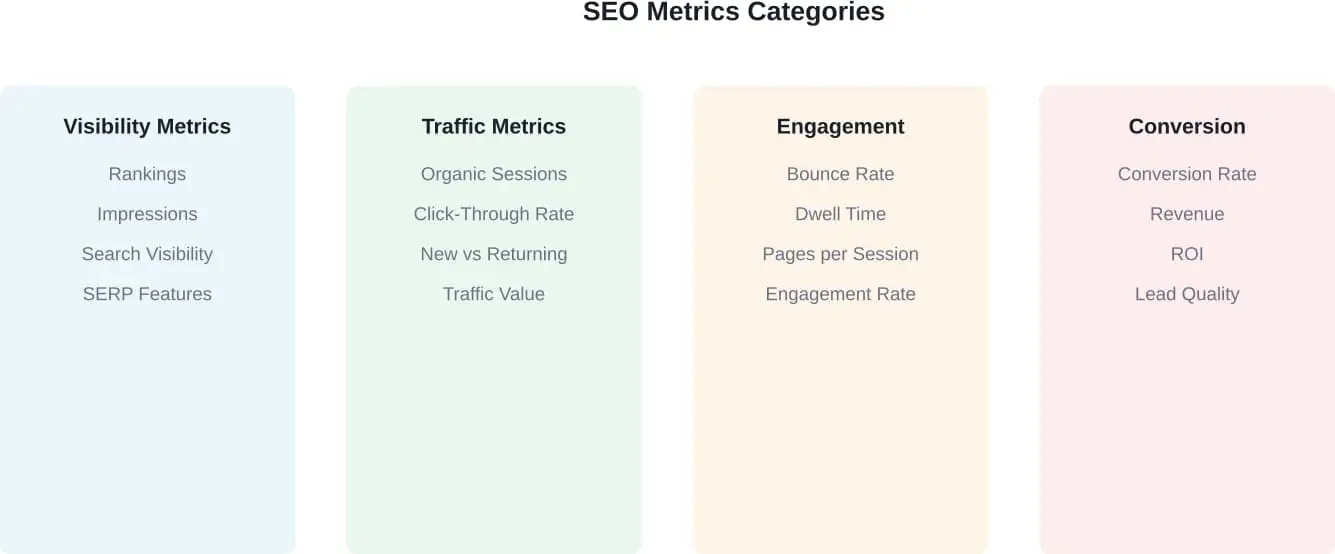
Core SEO Metrics That Drive Business Results
Not all metrics deserve equal attention. Some reveal surface-level information while others connect directly to revenue and growth. Here’s what actually matters.
Organic Traffic and Sessions
Organic traffic represents visitors who arrive through unpaid search results. It’s one of the most fundamental SEO metrics because it shows whether people can find and choose to visit content.
But raw traffic numbers can be misleading. A site might see organic traffic increase while revenue decreases if the new traffic doesn’t match buyer intent. Quality matters more than quantity.
Smart tracking involves segmenting organic traffic by:
- Landing pages (which content attracts visitors)
- Device types (mobile versus desktop behavior patterns)
- Geographic regions (where audiences are located)
- New versus returning visitors (acquisition versus retention)
According to Google Search Console documentation, session tracking should align with business goals rather than focusing solely on volume increases.
Keyword Rankings and Visibility
Keyword rankings show where pages appear in search results for specific queries. While rankings alone don’t generate revenue, they determine whether content gets seen.
The challenge with ranking metrics? Personalization, location, and device type all affect what different users see. A page ranking #1 for one person might appear #5 for another.
Search visibility metrics aggregate ranking data across multiple keywords to show overall presence in search results. This provides a more stable indicator than tracking individual keyword positions.
Click-Through Rate (CTR)
CTR measures how often searchers click on a result after seeing it in search listings. According to Google Search Console Help documentation, impression and click data reveal which titles and descriptions effectively attract audience attention.
A strong CTR indicates that content promises match what searchers want. Poor CTR suggests disconnects between search intent and how results appear.
CTR varies significantly by ranking position. Pages ranking in positions 1-3 typically capture the majority of clicks for most queries.
Conversion Rate and Revenue Per Visit
Conversion metrics show how many visitors complete desired actions—purchases, signups, downloads, or contact form submissions. This is where SEO connects to business outcomes.
For B2B ecommerce sites, industry benchmarks place organic conversion rates at approximately 1.8 percent. Rates significantly below this threshold suggest mismatches between traffic quality and site offerings.
Revenue per organic visitor takes conversion tracking further by calculating actual monetary value generated from search traffic. This metric enables direct ROI calculations for SEO investments.
Referring Domains and Backlink Quality
Referring domains represent the number of unique websites linking to content. Search engines use backlinks as trust signals—more high-quality sites linking to content suggests greater authority and credibility.
According to Moz’s Domain Authority research, tracking referring domains matters more than total backlink counts because multiple links from the same domain provide diminishing returns.
Link quality depends on:
- Authority of the linking domain
- Relevance to the linked content’s topic
- Placement within the linking page
- Anchor text used for the link
Technical SEO Metrics That Impact Performance
Technical factors affect both search engine crawling and user experience. Google explicitly considers many technical metrics as ranking signals.
Core Web Vitals: LCP, INP, and CLS
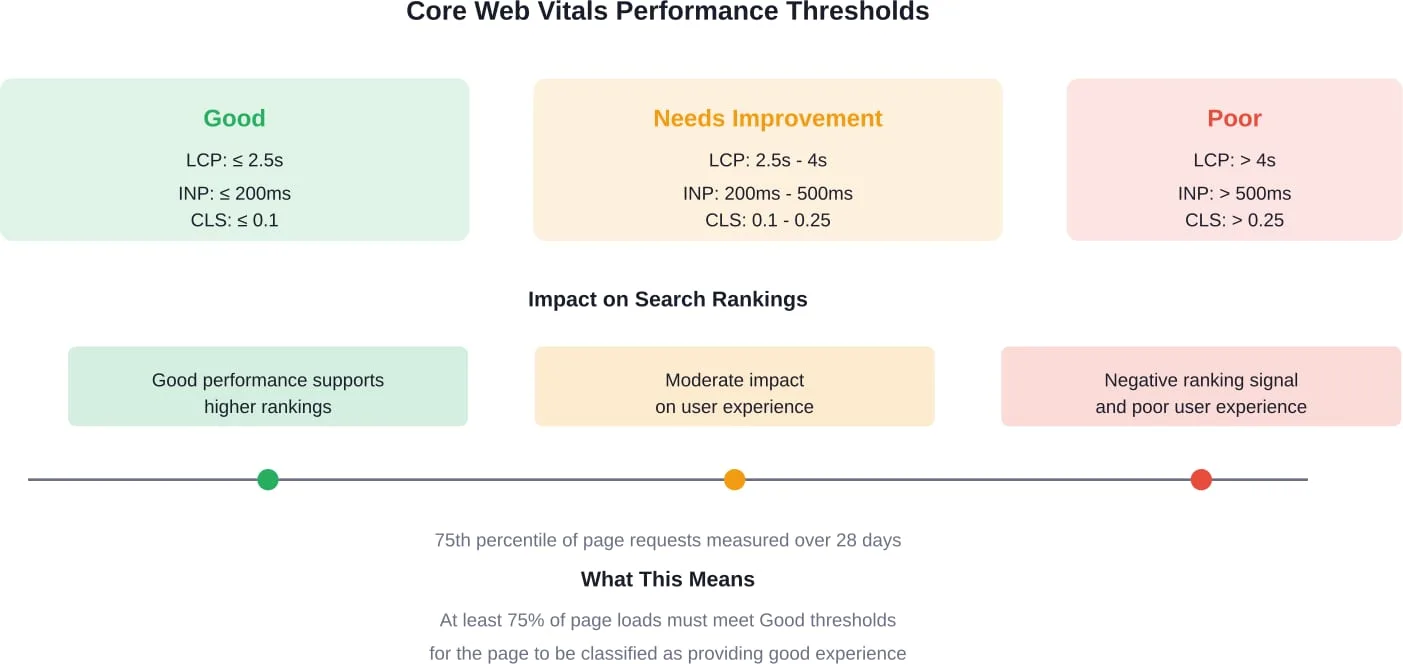
Core Web Vitals is a set of metrics that measure real-world user experience for loading performance, interactivity, and visual stability, according to Google’s Search Central documentation.
The three Core Web Vitals metrics are:
| Metric | Measures | Good Threshold | Poor Threshold |
|---|---|---|---|
| LCP (Largest Contentful Paint) | Loading performance | 2.5 seconds or less | Greater than 4 seconds |
| INP (Interaction to Next Paint) | Responsiveness | 200 milliseconds or less | Greater than 500 milliseconds |
| CLS (Cumulative Layout Shift) | Visual stability | 0.1 or less | Greater than 0.25 |
On March 12, 2024, INP replaced FID (First Input Delay) as a Core Web Vital ranking signal. The Core Web Vitals report shows performance based on the 75th percentile of page requests over the last 28 days.
Google’s core ranking systems reward content that provides good page experience. Sites should aim for “Good” ratings across all three metrics.
Crawl Efficiency and Index Coverage
Crawl metrics reveal how effectively search engines discover and index content. Sites with crawl issues might have high-quality content that never appears in search results.
Key crawl indicators include:
- Pages crawled per day
- Crawl errors and blocked resources
- Total indexed pages versus submitted pages
- Crawl budget utilization for large sites
Google Search Console provides detailed crawl statistics and highlights indexing issues that prevent pages from appearing in search results.
Mobile Usability and Responsive Design
Mobile usability metrics evaluate how well sites function on smartphones and tablets. With mobile-first indexing, Google predominantly uses the mobile version of content for indexing and ranking.
Mobile usability issues include:
- Text too small to read
- Clickable elements too close together
- Content wider than screen
- Missing viewport configuration
Sites failing mobile usability checks face ranking disadvantages regardless of desktop performance.
Authority and Trust Metrics
Authority metrics estimate how search engines perceive site credibility and expertise. While not direct ranking factors, they correlate strongly with search performance.
Domain Authority and Page Authority
Domain Authority is a search engine ranking score developed by Moz that predicts how likely a website is to rank on search engine results pages compared to competitors. The score ranges from 1 to 100, with higher scores indicating greater ability to rank.
Page Authority uses the same 1-100 scale but evaluates individual pages rather than entire domains. Both metrics use machine learning models trained on Google’s actual search results.
Domain Authority was updated to version 2.0 on March 8, 2019, improving prediction accuracy and incorporating additional ranking factors.
According to Moz documentation last updated March 18, 2025, Domain Authority is not a direct ranking factor used by Google. Instead, it’s a comparative metric useful for evaluating relative competitive strength.
Brand Search Volume
Brand search volume measures how often people search for an organization’s name or branded terms. Growing brand searches indicate increasing awareness and trust.
This metric matters because:
- Strong brands receive preference in search algorithms
- Brand searches typically convert at higher rates
- Increasing brand volume suggests marketing effectiveness
Tracking branded versus non-branded traffic ratios reveals whether SEO efforts build long-term brand equity or just capture existing demand.
Engagement Metrics That Reveal Content Quality
Engagement metrics show how visitors interact with content after arriving from search. These indicators help identify whether content meets searcher expectations.
Bounce Rate and Exit Rate
Bounce rate represents the percentage of sessions where users leave after viewing only one page. High bounce rates might indicate content that doesn’t match search intent.
But context matters. Blog posts naturally have higher bounce rates than e-commerce category pages because users often find complete answers without needing to navigate further.
Exit rate differs from bounce rate by measuring which pages users last view before leaving the site. Pages with high exit rates might have usability issues or fail to provide clear next steps.
Dwell Time and Session Duration
Dwell time measures how long users stay on a page after clicking a search result before returning to search. Longer dwell times suggest content satisfies search intent.
Session duration tracks total time spent on a site during a visit. By default, a Google Analytics session lasts until there’s 30 minutes of inactivity.
Neither metric alone determines content quality. A five-minute session might represent deep engagement or frustrated searching for information.
Engagement Rate
Engagement rate in analytics platforms measures the percentage of sessions where users actively interact with content. Google Analytics calculates engagement rate by dividing engaged sessions by total sessions.
For example, 500 engaged sessions out of 1,000 total sessions equals a 50 percent engagement rate. Engaged sessions typically meet criteria like lasting longer than 10 seconds, triggering conversion events, or viewing multiple pages.
Rising engagement rates indicate improving content relevance and user experience.
Tools for Tracking SEO Metrics
Multiple platforms provide SEO metric tracking capabilities. The right tool combination depends on organizational needs and resources.
Google Search Console
Google Search Console is the primary source for understanding how sites perform in Google Search. According to Google Support documentation, it shows search traffic changes over time, query sources, and click-through rates.
Key capabilities include:
- Performance reports with impressions, clicks, and position data
- Core Web Vitals monitoring based on real user data
- Index coverage and crawl error reporting
- Mobile usability issue detection
Google Analytics
Analytics platforms track on-site behavior, traffic sources, and conversion metrics. Google Analytics provides insights into organic traffic patterns, user demographics, and content performance.
Critical reports for SEO include:
- Acquisition reports showing traffic sources
- Landing page performance data
- User flow and behavior patterns
- Goal completions and conversion tracking
Third-Party SEO Platforms
Tools like Semrush, Ahrefs, and Moz provide competitive analysis, keyword research, and backlink monitoring capabilities not available in Google’s free tools.
These platforms offer:
- Keyword ranking tracking across search engines
- Competitor analysis and market share estimates
- Backlink profile monitoring
- Technical SEO audit automation
- Content optimization recommendations
Avoiding Common SEO Metric Mistakes
Many organizations fall into predictable traps when measuring SEO performance. Avoiding these mistakes improves decision quality.
Focusing Only on Rankings
Rankings are visible and easy to track, making them seductive metrics. But ranking #1 for keywords that don’t drive conversions doesn’t help business goals.
The shift toward AI-generated search results and featured snippets means traditional ranking positions matter less than before. Zero-click searches deliver answers directly in results, meaning pages might rank well while generating little traffic.
Ignoring Conversion Quality
Traffic volume means nothing without conversion quality. Attracting thousands of visitors who immediately bounce costs money without generating returns.
Better metrics connect traffic to revenue outcomes. For ecommerce, this means tracking revenue per organic visitor. For B2B, it involves lead quality scores and pipeline contribution from organic channels.
Neglecting Technical Health
Many organizations focus entirely on content and links while ignoring technical foundations. But technical issues can prevent even excellent content from ranking.
Regular technical audits should check:
- Core Web Vitals performance
- Mobile usability
- Structured data implementation
- Internal linking structure
- XML sitemap accuracy
Short-Term Thinking
SEO delivers compounding returns over time. Expecting immediate results from optimization efforts leads to premature strategy changes and resource waste.
Effective measurement requires patience. Most SEO changes take weeks or months to fully impact rankings and traffic. Tracking month-over-month and year-over-year trends reveals true performance better than daily fluctuations.
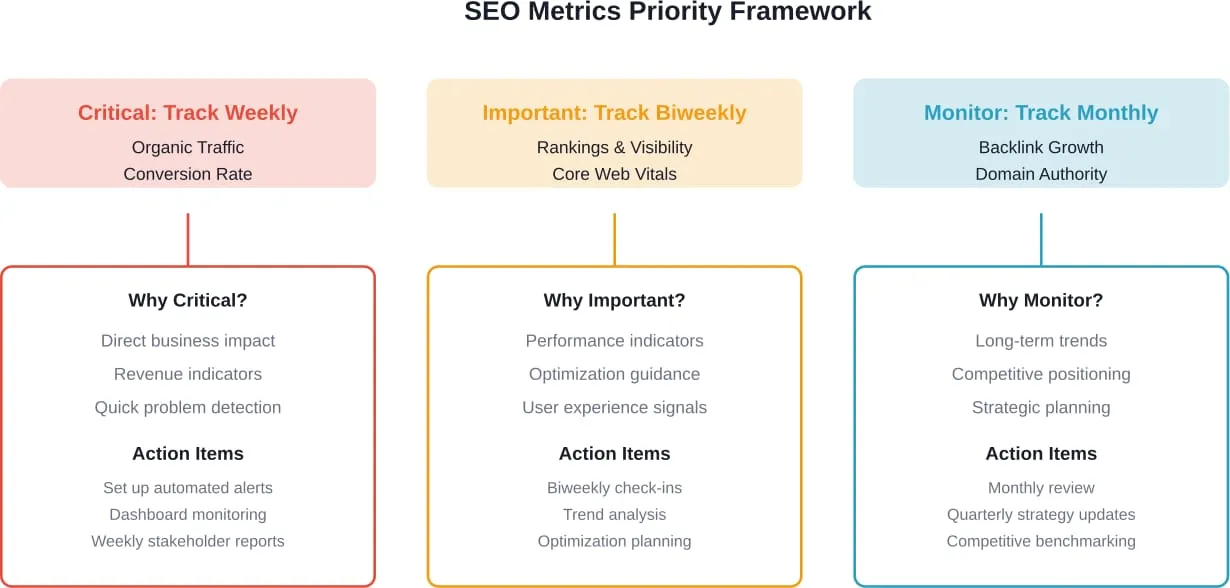
Building an Effective SEO Metrics Dashboard
Dashboards consolidate metrics into actionable views. Effective dashboards answer specific questions rather than displaying every available data point.
Executive Dashboard Components
Leadership needs high-level metrics connecting SEO to business outcomes:
- Organic revenue or lead volume
- Month-over-month and year-over-year growth rates
- SEO contribution to total digital revenue
- Return on SEO investment
Executive dashboards should update monthly or quarterly rather than showing real-time data.
Operational Dashboard Components
Teams executing SEO work need more granular metrics:
- Organic traffic by channel and landing page
- Keyword ranking changes for target terms
- Technical health scores and error counts
- Content performance and engagement metrics
- Backlink acquisition rates
Operational dashboards benefit from weekly updates and automated anomaly detection.
Automated Reporting and Alerts
Manual metric checking wastes time and misses problems. Automation improves both efficiency and response times.
Set up automated alerts for:
- Traffic drops exceeding 20 percent week-over-week
- Core Web Vitals falling below good thresholds
- Major ranking drops for high-value keywords
- Significant increases in crawl errors
- Sudden backlink losses
Drive Business Results with LenGreo
Our team understands that tracking data is only half the battle; the real challenge lies in interpreting those metrics to fuel sustainable growth. At LenGreo, we move beyond surface-level vanity numbers by integrating directly into your team to identify the specific KPIs that impact your bottom line. Whether we are conducting deep-dive website audits or executing high-level content strategies, our focus remains on transparency and tailored execution that transforms abstract search data into tangible revenue.
We believe that every business requires a unique roadmap rather than a pre-packaged template. By leveraging comprehensive keyword research and competitor analysis, we help our partners navigate the complexities of modern search ecosystems. From boosting traffic for biotech firms to scaling client acquisition for software developers, our approach ensures that your SEO investment isn’t just a cost, but a powerful engine for long-term commercial success.
The Future of SEO Metrics
SEO measurement continues evolving as search technology and user behavior change. Several trends are reshaping how organizations track performance.
AI Search and Zero-Click Results
Generative AI search experiences provide answers directly without requiring clicks to websites. This changes the relationship between rankings and traffic.
Emerging metrics for AI search include:
- Citation frequency in AI-generated responses
- Brand mentions in conversational search results
- Click-through rates from AI summaries
Organizations need new measurement frameworks that account for value delivered even when users don’t visit sites.
Privacy and Attribution Challenges
Privacy regulations and browser changes limit tracking capabilities. Cookie deprecation and restricted cross-domain tracking make attribution increasingly difficult.
Response strategies include:
- Investing in first-party data collection
- Using modeling and estimation for lost visibility
- Focusing on aggregate trends rather than individual user tracking
- Implementing server-side analytics
Emphasis on Business Outcomes
Economic pressure drives organizations toward metrics directly tied to revenue and profitability. Vanity metrics that don’t correlate with business results face increasing scrutiny.
The shift toward outcome-based measurement means connecting SEO metrics to:
- Customer lifetime value from organic channels
- Revenue contribution by traffic segment
- Cost per acquisition compared to paid channels
- Pipeline influence for B2B organizations
Conclusion: Making SEO Metrics Work for Your Business
SEO metrics transform abstract optimization activities into measurable business results. But effectiveness comes from tracking the right indicators, not the most indicators.
The most successful SEO programs focus on metrics that:
- Connect directly to revenue and business outcomes
- Provide actionable insights for optimization decisions
- Balance short-term tactical needs with long-term strategic positioning
- Account for evolving search technologies and user behaviors
Start by identifying which metrics function as genuine KPIs for specific business goals. Build dashboards that answer questions rather than display data. Set up automation to catch problems early and free time for analysis instead of data collection.
Remember that SEO success compounds over time. Month-over-month improvements might seem small, but they accumulate into significant competitive advantages. The organizations winning in search focus relentlessly on metrics that matter while ignoring vanity numbers that distract from real progress.
What metrics will you prioritize for your SEO program? The answer depends on business context, competitive landscape, and strategic objectives. But understanding what SEO metrics mean and how to use them effectively provides the foundation for making informed choices.
Ready to improve your SEO measurement strategy? Start by auditing current tracking practices, identifying gaps between measured data and business questions, and implementing systems that surface insights when they matter most.