


Quick Summary: Website development for ticket brokers requires specialized platforms that integrate real-time inventory management, PCI-compliant payment processing, automated SEO for event pages, and white-label customization. The best solutions pull from secondary market databases, handle secure transactions, and provide marketing tools to help brokers compete effectively while maintaining compliance with data security standards and consumer protection regulations.
The ticket brokerage industry has transformed dramatically. What started as phone-based operations has evolved into sophisticated digital marketplaces where milliseconds matter and SEO determines who captures the sale.
But here’s the thing — building a website that actually converts ticket buyers isn’t the same as launching a standard e-commerce store. Ticket brokers face unique technical challenges: fluctuating inventory across multiple venues, pricing that changes by the minute, and regulatory requirements that can shut down operations if handled incorrectly.
This guide breaks down exactly what ticket brokers need from their website development strategy, from database integration to payment security, and how to build a platform that competes in today’s secondary market.
Core Technical Requirements for Broker Websites
Ticket broker websites aren’t built from scratch anymore. The infrastructure required — real-time inventory feeds, payment processing, seat mapping, and compliance frameworks — makes custom development prohibitively expensive for most operations.
Instead, successful brokers rely on specialized platforms designed specifically for secondary market ticket sales. These systems handle the technical complexity while allowing customization of branding and user experience.
Real-Time Inventory Integration
The foundation of any broker website is its connection to inventory databases. Whether working with a single supplier or aggregating from multiple sources, the website must pull current availability and pricing without manual intervention.
Most broker platforms use API connections to sync inventory every few minutes. The best systems update in near-real-time, preventing the awkward scenario where a customer completes checkout only to learn their tickets are already sold.
Database integration also enables automatic page generation. When a new event is announced, the system creates dedicated landing pages for every possible search query — team names, venue locations, date variations. This automation is what allows small broker operations to compete with inventory listings numbering in the thousands.
Payment Processing and PCI Compliance
Here’s where many brokers hit their first major obstacle. Accepting credit cards means complying with Payment Card Industry Data Security Standard (PCI DSS) requirements — a complex framework maintained by the PCI Security Standards Council that governs how payment data is stored, processed, and transmitted.
Non-compliance isn’t just risky; it’s expensive. Security breaches can trigger fines, legal liability, and permanent damage to broker reputation. The University of Utah, for example, processes millions in credit card transactions annually and adheres to strict PCI standards specifically to protect sensitive cardholder data.
For ticket brokers, the practical solution is using platforms that handle PCI compliance at the infrastructure level. When the payment gateway is built into the ticketing system and maintained by the platform provider, brokers inherit compliance without managing the technical details themselves.
Transaction Fees and Pricing Models
Transaction costs directly impact broker margins. Understanding the fee structure is critical during platform selection.
According to data from actual ticketing agreements filed with the SEC, AXS charges a 3% payment administration fee on gross transaction amounts for ticket sales processed through their merchant accounts. The Ticket Reserve, a seat license platform, charges $100 plus 2% for initial sales and 10% with a $5 minimum for resales.
Some platforms advertise rates as low as 2.5% plus $0.29 per transaction, or standard plans at 2.90% plus $0.29. Others use tiered models — premium plans at 2.50% + $0.29 per ticket, or standard plans at 2.90% + $0.29.
The variability is significant. On a $500 ticket sale, the difference between a 2.5% fee ($12.50) and a 3% fee plus fixed costs ($15.29) might seem minor. But across thousands of transactions monthly, those percentages compound quickly.
| Platform Type | Typical Fee Structure | Best For |
|---|---|---|
| White-label ticketing platform | 2.5% – 3% + $0.29 | Brokers wanting full branding control |
| Marketplace integration | 10% – 15% commission | Brokers prioritizing exposure over margins |
| Custom-built solution | Payment processor fees only (1.9% – 2.9%) | High-volume brokers with development resources |
| Hybrid model | Variable based on sales channel | Multi-channel operations |
SEO and Automated Marketing Features
The secondary ticket market is brutally competitive. When someone searches “Yankees tickets” or “Hamilton Broadway,” hundreds of brokers are fighting for that click.
Search engine optimization isn’t optional — it’s the primary customer acquisition channel for most broker operations. And here’s the problem: manually optimizing thousands of event pages is impossible.
Automated Page Generation and Optimization
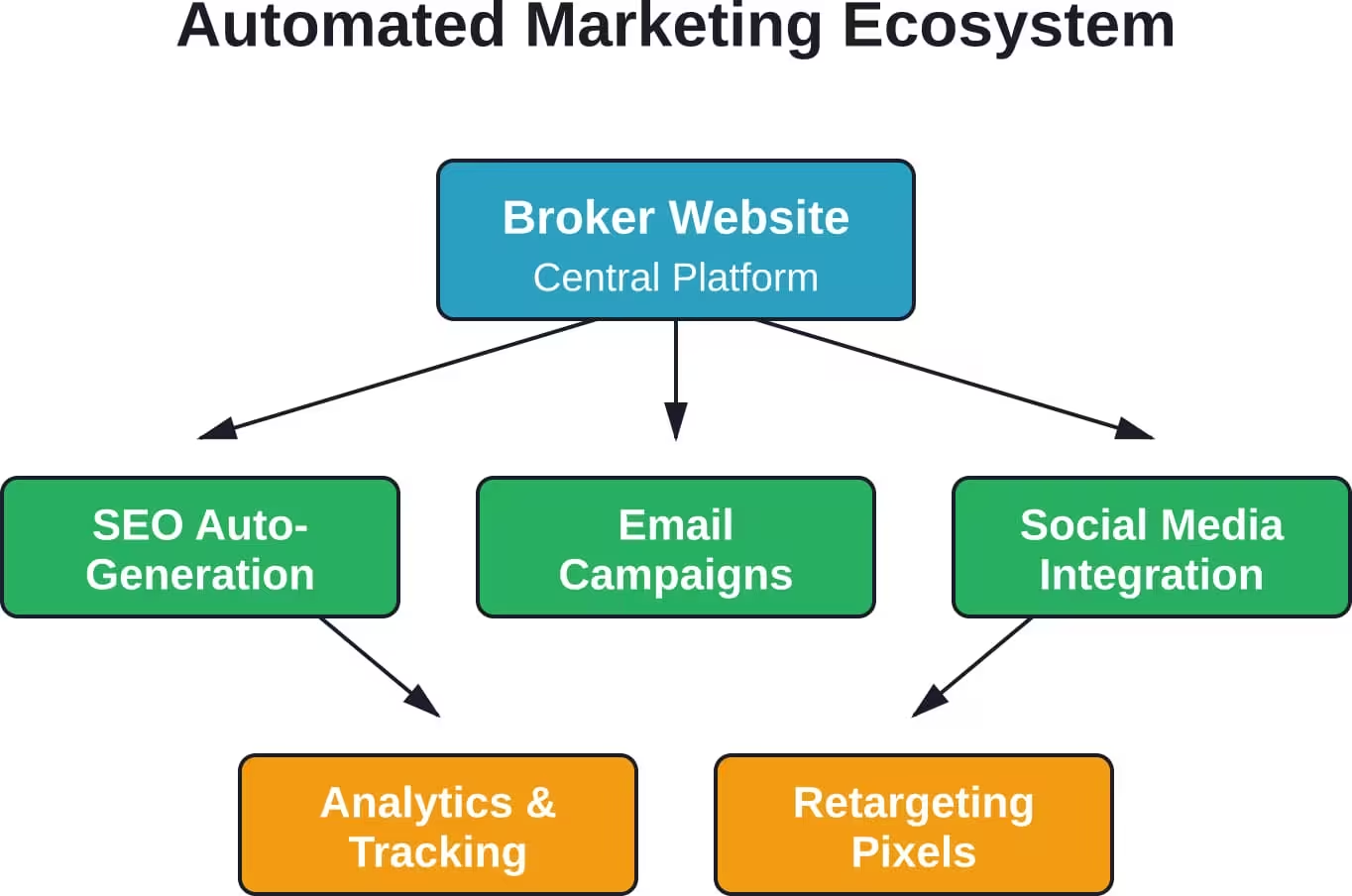
Specialized broker platforms solve this through automated SEO. The system generates unique pages for each event, complete with optimized titles, meta descriptions, and structured content that search engines can index.
This automation extends to related search terms. A single concert might generate pages targeting the artist name, venue location, date variations, and specific seating sections — all populated automatically from the inventory database.
The best systems also handle technical SEO elements: schema markup for events, XML sitemaps that update as inventory changes, and canonical tags that prevent duplicate content penalties when the same tickets appear in multiple categories.
Marketing Integration and Email Campaigns
Beyond organic search, broker websites need built-in marketing tools. Email capture forms, abandoned cart recovery, and automated follow-up sequences can significantly increase conversion rates.
Some platforms include customer relationship management features that track buyer behavior and enable targeted campaigns. When a customer purchases basketball tickets, the system can automatically add them to email lists for similar events.
Social media integration extends reach further. Automated posting of new inventory to Facebook, Twitter, and Instagram keeps brokers visible across channels without manual effort.
White-Label Customization and Branding
The tension in broker website development is this: platforms provide the infrastructure, but brokers need to maintain their unique brand identity.
White-label solutions bridge that gap. The technology runs on the platform’s servers and databases, but customers see the broker’s logo, color scheme, and domain name throughout the experience.
Domain and Branding Control
Serious brokers operate on their own domains, not subdomains of a larger platform. The URL in the address bar should be BrokerName.com, not BrokerName.TicketingPlatform.com.
This matters for both branding and SEO. Search engines give more authority to root domains than subdomains, and customers trust a dedicated brand more than an obvious white-label.
The best platforms allow complete visual customization — fonts, colors, layouts, and imagery — while maintaining the technical infrastructure in the background. The customer experience is seamless; they never know a third-party platform powers the transaction.
Mobile Responsiveness and User Experience
Mobile traffic now dominates ticket purchases. Mobile traffic now dominates ticket purchases, with growing percentages of both searches and actual purchases happening on smartphones.
Broker websites must render properly on every device size. Images should scale, text should remain readable without zooming, and checkout flows should work smoothly on touchscreens.
Responsive design isn’t just about shrinking desktop layouts. Mobile-first design considers how people actually use phones — thumb-friendly navigation, simplified forms, and quick-loading pages even on slower connections.
Regulatory Compliance and Consumer Protection
The ticket resale industry faces increasing regulatory scrutiny. Recent enforcement actions highlight the importance of compliance.
In September 2025, the Federal Trade Commission sued Live Nation and Ticketmaster for illegal ticket resale tactics and deceptive pricing. The agency alleged that Ticketmaster earned hundreds of millions by selling tickets acquired illegally by brokers, costing consumers billions in inflated prices and fees.
The BOTS Act, which prohibits using automated software to circumvent ticket purchasing limits, adds another compliance layer. Brokers must ensure their operations don’t violate these consumer protection laws.
Transparent Pricing and Fee Disclosure
Consumer advocacy has pushed toward all-in pricing — showing the total cost upfront rather than adding fees at checkout.
Broker websites should display total prices clearly, breaking out the ticket cost, service fees, and any additional charges before the customer commits to purchase. Surprising buyers with hidden fees at the last step increases cart abandonment and invites regulatory scrutiny.
Some platforms build fee transparency into their checkout flows automatically, ensuring compliance without manual configuration.
Data Security and Privacy Standards
Beyond payment data, brokers collect customer information — names, addresses, email, phone numbers. This personal data carries privacy obligations.
Many jurisdictions now require explicit consent for marketing communications and give customers the right to request data deletion. Broker platforms should include tools for managing consent, tracking opt-ins, and responding to privacy requests.
Data breaches carry severe consequences. According to SEC documentation, approximately 70 of the 7,217 active registered broker-dealers maintain over 100,000 accounts. The implications for data security at scale are significant — a breach affecting tens of thousands of customer records triggers notification requirements, regulatory penalties, and reputational damage.
Choosing Between Platform Options
Ticket brokers have three main paths for website development: custom builds, white-label platforms, or marketplace integration.
| Development Approach | Pros | Cons |
|---|---|---|
| Custom Development | Complete control, unique features, lower per-transaction costs at scale | High upfront investment ($50k+), ongoing maintenance, slower time to market |
| White-Label Platform | Fast deployment, proven infrastructure, included compliance and updates | Monthly fees, transaction percentages, limited customization depth |
| Marketplace Only | Immediate traffic, no tech development needed, simple operations | High commissions (10-15%), no brand building, compete on price alone |
| Hybrid Model | Own website for branding plus marketplace reach, diversified channels | Managing multiple systems, potential inventory sync issues |
Most brokers starting out choose white-label platforms. The speed to market and included infrastructure outweigh the transaction fees when building initial customer base and testing market fit.
As operations scale and transaction volumes increase, some brokers migrate to custom solutions to reduce per-ticket costs and gain greater control. But that transition typically happens after proving the business model on a platform first.
Launch a High-Converting Ticket Broker Website
Ticket broker websites need fast purchase flows, clear event pages, and stable performance during high-demand campaigns. Lengreo combines website development with lead generation and digital marketing strategy, helping businesses build websites that support visibility, conversions, and long-term growth. Their team handles everything from early research and prototyping to front-end and back-end development, QA, and launch support.
Build a Website Around Conversion and Scalability
With Lengreo, ticket broker businesses can get:
- Landing pages for events and campaigns
- JavaScript and WordPress website development
- Front-end and back-end implementation
- QA and launch support
If you are building a new ticket broker platform or preparing for a redesign, contact Lengreo to discuss your project.
Essential Features Checklist
When evaluating website development options for ticket brokerage, certain features are non-negotiable:
- Inventory Management: Real-time sync with supplier databases, automatic page creation for new events, and seat availability tracking that prevents overselling.
- Payment Processing: PCI-compliant gateway, support for major credit cards and digital wallets, automated fraud detection, and secure refund handling.
- SEO Tools: Automated meta tags and descriptions, schema markup for events, XML sitemap generation, and customizable URL structures.
- Customer Tools: Account creation and order history, email confirmations and ticket delivery, customer support integration, and mobile ticket access.
- Marketing Features: Email list management, abandoned cart recovery, social media integration, and analytics tracking.
- Mobile Optimization: Responsive design across all devices, fast page loading, simplified checkout flow, and digital wallet support.
- Security Compliance: SSL certificates, data encryption, PCI DSS compliance, and privacy policy management.
Implementation Timeline and Costs
Understanding realistic timelines helps brokers plan their launch strategy.
White-label platform deployment can happen in days. Sign up, configure branding, connect inventory feeds, and start selling. The technical complexity is abstracted away.
Custom development takes months. Even with experienced developers, building secure payment processing, inventory management, and all the ancillary features requires significant time. A basic custom platform might launch in 3-4 months; a feature-complete system could take 6-12 months.
Budget expectations vary similarly. White-label platforms typically charge monthly platform fees ($50-$500 depending on features) plus per-transaction percentages. The upfront cost is minimal, but the ongoing fees persist.
Custom development requires substantial upfront investment — often $50,000 to $150,000 for a professionally built system. Ongoing costs include hosting, security updates, and feature development, but per-transaction costs drop to just payment processing fees.
The break-even calculation depends on transaction volume. At lower volumes, platform fees are cheaper than custom development. As monthly sales increase into the hundreds or thousands of tickets, custom solutions become more cost-effective.
Future-Proofing Your Broker Website
Technology changes fast. What works today might be outdated in 18 months.
Smart brokers choose platforms that commit to ongoing development. Regular feature updates, security patches, and adaptation to new regulations shouldn’t require switching providers.
API access provides flexibility. Even when using a white-label platform, the ability to integrate with other tools — CRM systems, accounting software, customer service platforms — extends capabilities without rebuilding from scratch.
Scalability matters from day one. The platform that handles 50 transactions monthly should scale seamlessly to 5,000 without performance degradation or forced migration.
And mobile-first design becomes more critical each year. Voice search, progressive web apps, and new purchasing behaviors require websites that adapt to emerging technologies, not just current ones.
Conclusion
Building an effective ticket broker website requires balancing technical infrastructure, regulatory compliance, and competitive positioning. The platforms that succeed integrate real-time inventory management with secure payment processing, automate SEO to capture search traffic, and maintain brand identity through white-label customization.
For most brokers, white-label platforms provide the fastest path to market and the most cost-effective solution during the growth phase. As transaction volumes scale, the economics may shift toward custom development — but proving the business model on established infrastructure reduces risk substantially.
The ticket industry continues evolving. Regulatory scrutiny increases, consumer expectations rise, and technology advances. Choosing platforms that commit to ongoing development and maintain compliance automatically protects brokers from both current and future challenges.
Ready to launch your ticket broker website? Evaluate platforms based on inventory integration capabilities, transaction costs relative to your projected volume, and the depth of included marketing tools. The right foundation today determines competitive positioning for years ahead.