


Quick Summary: Website development for retail involves creating optimized online stores that drive sales through strategic design, secure payment integration, and user-focused experiences. Modern retail websites require responsive design, fast load times, and seamless checkout processes, with average conversion rates around 3% according to Nielsen Norman Group data. Successful retail development balances aesthetic appeal with technical performance, incorporating mobile optimization, inventory management, and marketing tools to compete in the growing $3.067 trillion B2B e-commerce market projected by Forrester for 2027.
The retail landscape has transformed dramatically since the early days of online commerce. According to Federal Trade Commission data, it took only 3 years for the Internet to reach 50 million domestic users after the first web-browser became widely available. Compare that to radio’s 38 years or network television’s 13 years to reach the same audience size.
Today’s retail websites face expectations that continue to evolve rapidly. Customers demand instant loading, intuitive navigation, and checkout processes that work flawlessly across every device. But here’s the thing—building a retail website that actually converts visitors into buyers requires more than just attractive templates.
The stakes are higher than ever. Forrester research projects the U.S. B2B e-commerce market will reach $3.067 trillion by 2027, growing at an 11% compound annual growth rate. Even traditional brick-and-mortar retailers recognize that online presence isn’t optional anymore. It’s survival.
Understanding Modern Retail Website Development
Retail website development encompasses the technical, design, and strategic work required to create functional online stores. This goes far beyond selecting a template and uploading product photos.
At its core, effective retail development addresses three critical areas: user experience design that guides visitors toward purchase decisions, technical infrastructure that handles transactions securely and efficiently, and backend systems that manage inventory, orders, and customer data.
Nielsen Norman Group research found that around year 2000, ecommerce sites typically had average conversion rates around 1%, and by 2013, that number had risen to around 3%. Today, retailers aim for conversion rates between 1-10%, with the specific target depending on product category, price point, and traffic source.
What changed? Better understanding of user behavior, refined checkout processes, improved site performance, and mobile optimization all contributed. But the fundamental principle remains constant: websites must serve actual human needs, not just look impressive in design portfolios.
The Three Pillars of Retail Website Success
First, design matters—but not in the way most people think. Visual appeal attracts attention, but functional design converts visitors. Navigation must feel intuitive. Product information needs to answer questions before they’re asked. Checkout flows should eliminate friction at every step.
Second, technical performance directly impacts revenue. Page load delays of even a few seconds significantly reduce conversion rates. Security concerns about payment processing cause cart abandonment. Broken mobile experiences send customers to competitors.
Third, backend capabilities determine operational efficiency. Inventory management systems prevent overselling. Order processing automation reduces fulfillment errors. Customer data integration enables personalized marketing that drives repeat purchases.
Build a Better Retail Website With Lengreo
Lengreo builds and improves websites, then connects them with SEO, paid ads, tracking, and lead generation. For retail businesses, this means a website that presents products, categories, store details, offers, delivery options, and contact or purchase paths clearly.
The focus is to make the site easier to browse, easier to measure, and easier to improve over time. Lengreo can help organize product pages, traffic setup, and user paths so visitors can move from browsing to taking action with less friction.
Need a Website That Helps Shoppers Take Action?
Lengreo can help with:
- building or redesigning your website
- improving SEO and paid traffic setup
- setting up tracking and website structure
- refining product, category, and contact pages
👉 Contact Lengreo to discuss your website and setup.
Choosing the Right Development Approach
Retailers face a fundamental choice: build custom from scratch, use a specialized ecommerce platform, or adapt a general website builder with commerce features. Each path offers distinct advantages and limitations.
Custom development provides maximum flexibility and control. Development teams can create exactly the features needed, optimize performance for specific requirements, and integrate with any existing business systems. The tradeoff? Higher costs, longer timelines, and ongoing maintenance responsibility.
Ecommerce platforms like Shopify, BigCommerce, and WooCommerce offer middle-ground solutions. These systems provide pre-built commerce functionality—product catalogs, shopping carts, payment processing, order management—while allowing customization through themes and plugins. For most retail businesses, platforms deliver the best balance of capability and practicality.
General website builders with commerce add-ons work for simple retail operations. Squarespace, Wix, and similar services enable quick store setup with limited technical knowledge. But as businesses grow and requirements become more complex, these solutions often hit capability ceilings.
Platform Cost Considerations
Platform pricing typically includes subscription fees and transaction costs. For most ecommerce services, expect to pay around $30 to $40 per month for a basic plan. Shopify pricing has historically included plans starting at $39 per month, though current pricing should be verified directly with the platform.
But subscription fees represent only part of the total cost. Payment gateway fees apply when processing credit card charges—typically 2.9% + $0.25 per transaction with built-in payment processors. Some platforms charge additional transaction fees if using external payment gateways.
Domain registration, SSL certificates, premium themes, specialized plugins, and development customization add to the bottom line. Small retailers might operate stores for $50-100 monthly all-in. Larger operations with custom development, premium features, and high transaction volumes can easily spend thousands.
| Development Approach | Best For | Typical Cost Range | Time to Launch |
|---|---|---|---|
| Custom Development | Large enterprises with unique requirements | $50,000 – $500,000+ | 6-18 months |
| Ecommerce Platforms | Most retail businesses seeking growth | $500 – $10,000+ monthly | 2-8 weeks |
| Website Builders | Small retailers with simple product catalogs | $30 – $100 monthly | 1-2 weeks |
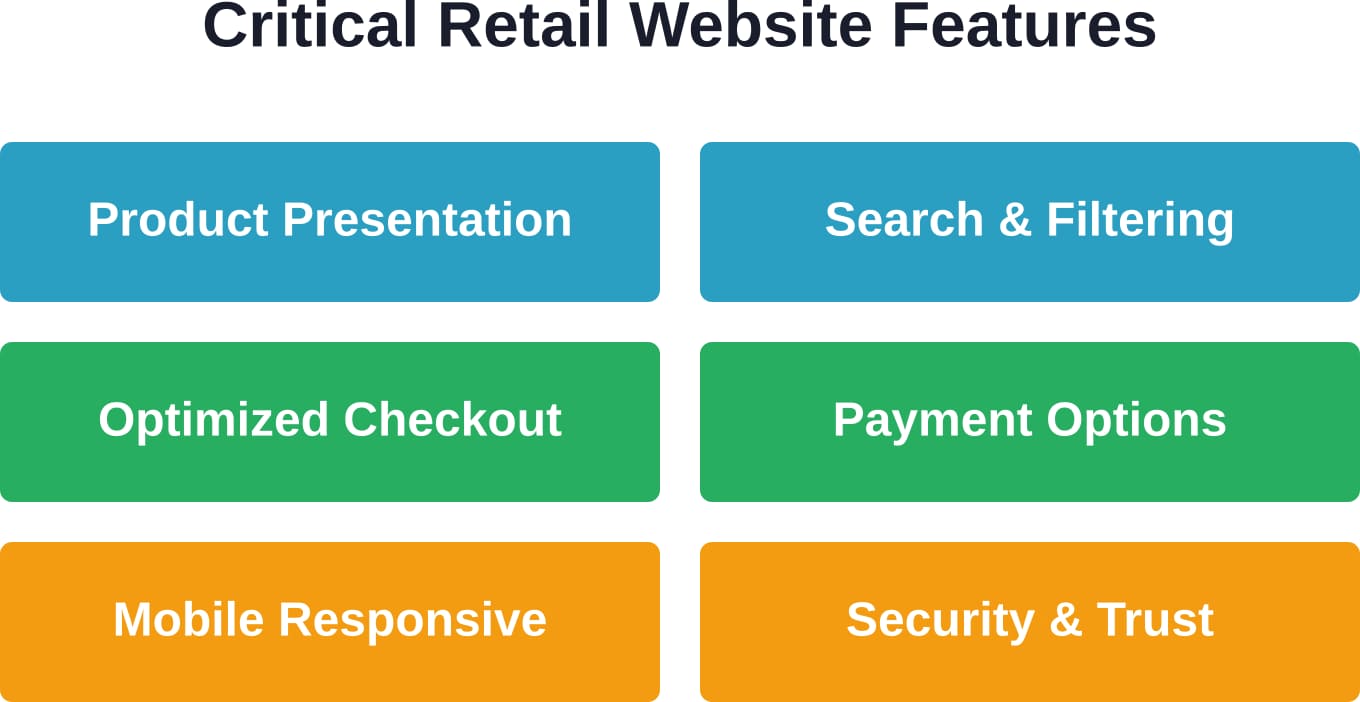
Essential Features for Retail Websites
Certain capabilities prove critical regardless of platform choice or business size. These features directly impact conversion rates, customer satisfaction, and operational efficiency.
Product Presentation and Discovery
High-quality product imagery ranks among the most important elements. Multiple photos showing different angles, detail shots, and products in use help customers make confident purchase decisions. Image optimization for fast loading remains equally crucial—large image files drag down page performance.
Product descriptions must balance informative detail with scannable readability. Technical specifications matter for certain categories. For others, benefits and use cases resonate more strongly. The key is answering customer questions preemptively.
Search and filtering functionality becomes increasingly critical as catalog size grows. Customers should quickly narrow options by price, size, color, brand, rating, or category-specific attributes. Faceted search that shows result counts for each filter helps customers understand available options.
Product recommendations drive additional sales. “Customers who bought this also bought” suggestions, related items, and recently viewed products keep customers engaged and increase average order values.
Shopping Cart and Checkout Optimization
Cart abandonment represents one of retail’s biggest challenges. Complicated checkout processes, unexpected costs, security concerns, and forced account creation all contribute to lost sales.
Guest checkout options remove a major friction point. While capturing customer data for future marketing has value, requiring account creation before purchase drives many customers away. Smart implementations allow guest checkout while offering optional account creation after purchase completion.
Transparent pricing throughout the shopping process builds trust. Display shipping costs, taxes, and fees as early as possible—ideally before customers begin checkout. Surprise charges at final confirmation screens trigger immediate abandonment.
Multiple payment options accommodate customer preferences. Credit cards remain standard, but digital wallets like Apple Pay and Google Pay, PayPal, and buy-now-pay-later services increasingly influence purchase decisions, particularly for younger demographics.
Progress indicators during multi-step checkouts reduce anxiety. Customers want to know how many steps remain and be able to review previous information without losing entered data.
Mobile Responsiveness
Mobile devices generate substantial retail traffic. Websites must function flawlessly on smartphones and tablets—not just display correctly, but provide genuinely usable experiences on smaller screens.
Responsive design automatically adjusts layouts, images, and navigation for different screen sizes. Touch-friendly buttons and links prevent frustrating misclicks. Simplified mobile navigation acknowledges limited screen real estate without hiding important features.
Mobile checkout requires particular attention. Lengthy forms feel more burdensome on small screens. Autofill support for addresses and payment information reduces typing. Large, clearly labeled buttons make actions obvious.
Security and Trust Elements
Customer data protection isn’t optional—it’s mandatory. SSL certificates encrypting data transmission between browsers and servers represent the baseline. Modern browsers actively warn users when submitting information on non-HTTPS sites.
The Federal Trade Commission’s INFORM Consumers Act requires online marketplaces to obtain information from high-volume third party sellers (those with 200 or more sales or $5,000 in gross revenue in 12 months) and disclose seller information for those exceeding $20,000 in annual gross revenue. Retail platforms must understand and comply with these requirements.
Trust badges, security seals, and clear privacy policies reduce purchase anxiety. Display accepted payment methods prominently. Include return policy information before checkout. Customer reviews and ratings provide social proof that influences purchase decisions.
Design Principles That Drive Conversions
Aesthetic appeal matters, but conversion-focused design prioritizes function. Every design decision should support the ultimate goal: moving visitors toward purchase.
Visual hierarchy guides attention. Important elements—products, pricing, add-to-cart buttons—should dominate layouts. Strategic use of size, color, contrast, and whitespace directs eye movement through pages in intentional sequences.
Consistency across pages builds familiarity. Navigation placement, button styles, typography, and color usage should remain predictable. When customers learn the interface once, they navigate more confidently throughout the site.
Loading speed directly correlates with conversion. Studies consistently show that page delays of even a few seconds significantly increase bounce rates. Image optimization, code minification, content delivery networks, and efficient hosting all contribute to performance.
Above-the-Fold Strategy
The visible area before scrolling receives disproportionate attention. Critical information—what the business offers, key benefits, primary calls-to-action—belongs above the fold.
But this doesn’t mean cramming everything into the top section. Clear, focused messaging works better than cluttered layouts trying to show everything immediately. Strong value propositions paired with obvious next steps guide customers deeper into the site.
Color Psychology in Retail
Color choices influence perception and behavior more than most retailers realize. Red creates urgency and attracts attention—useful for sales and clearance. Blue conveys trust and professionalism, making it popular for payment areas. Green suggests growth and environmental consciousness.
Call-to-action buttons benefit from contrasting colors that stand out from surrounding elements. The specific color matters less than visibility and consistency—the same button color throughout the site trains customers to recognize actionable elements.
Typography for Readability
Font choices impact readability across devices and screen sizes. Sans-serif typefaces generally work better for digital reading. Adequate font sizes—at least 16 pixels for body text—prevent eye strain, particularly on mobile devices.
Line length affects reading comfort. Optimal line width falls between 50-75 characters. Wider paragraphs become difficult to track from line to line. Narrow columns create choppy reading experiences.
Sufficient contrast between text and backgrounds ensures legibility. Light gray text on white backgrounds looks refined but strains eyes. Dark text on light backgrounds or vice versa works best, with contrast ratios meeting WCAG accessibility guidelines.
Technical Development Essentials
Behind attractive designs lie technical systems that actually process transactions, manage data, and keep sites running reliably.
Frontend Development
Modern frontend development relies on HTML, CSS, and JavaScript to create interactive experiences. Frameworks like React, Vue, or Angular enable complex functionality without page reloads—adding products to carts, filtering search results, updating quantities.
Progressive enhancement ensures basic functionality works even when JavaScript fails or loads slowly. Core features—viewing products, reading descriptions, accessing checkout—should work with HTML alone, with JavaScript adding enhanced interactions.
Accessibility standards guarantee sites work for users with disabilities. Semantic HTML, keyboard navigation support, screen reader compatibility, and sufficient color contrast aren’t just ethical considerations—they’re often legal requirements and always expand potential customer base.
Backend Development
Server-side code handles business logic, database interactions, payment processing, and integrations with external services. Common backend languages for retail include PHP, Python, Ruby, JavaScript (Node.js), and Java.
Database design impacts performance and scalability. Proper indexing speeds queries. Normalized structures reduce redundancy. Caching frequently accessed data—product catalogs, category listings—reduces database load.
API integrations connect retail websites with payment gateways, shipping carriers, inventory management systems, marketing platforms, and analytics tools. Well-designed APIs enable automation and data synchronization across business systems.
Hosting and Infrastructure
Hosting choices affect performance, reliability, and scalability. Shared hosting offers low costs but limited resources and potential performance impacts from other sites on the same server. Virtual private servers provide dedicated resources at moderate prices. Cloud hosting scales automatically based on traffic but requires more technical knowledge to optimize.
Content delivery networks (CDNs) distribute static assets—images, CSS, JavaScript—across global servers, reducing loading times for geographically distant customers. For retail sites serving national or international audiences, CDNs significantly improve performance.
SSL certificates encrypt data transmission, essential for payment processing and customer trust. Let’s Encrypt provides free certificates suitable for most retail sites, though paid certificates from established authorities add trust indicators some customers recognize.
| Technical Component | Purpose | Impact on Retail Success |
|---|---|---|
| Frontend Framework | Interactive user interfaces | Smooth shopping experiences, faster browsing |
| Backend Language | Business logic and data processing | Reliable transactions, accurate inventory |
| Database | Store product and customer data | Fast queries, consistent information |
| CDN | Distribute content globally | Reduced loading times, better performance |
| SSL Certificate | Encrypt data transmission | Security, trust, search ranking |
Conversion Rate Optimization
Building a retail website represents just the starting point. Continuous optimization based on real customer behavior drives sustained improvement.
Nielsen Norman Group research found that around year 2000, ecommerce sites typically had average conversion rates around 1%, up from around 1% during the dot-com bubble. The range of 1-10% represents good conversion rates for ecommerce websites, though specific benchmarks vary significantly by industry, product category, and traffic source.
But conversion rates alone don’t paint the complete picture. A site converting 5% of visitors purchasing $20 items generates less revenue than one converting 2% purchasing $200 items. Average order value, customer lifetime value, and profit margins matter equally.
A/B Testing Methodology
A/B testing compares two versions of a page, element, or flow to determine which performs better. Changes might involve button colors, headline copy, image choices, form lengths, or entire layout redesigns.
Valid A/B tests require sufficient sample sizes. Traffic gets split between variants, with statistical analysis determining whether observed differences reflect genuine improvements or random variation. Nielsen Norman Group recommends minimum durations of 1-2 weeks for A/B testing to account for day-of-week and other temporal effects.
Test one variable at a time for clearest results. Changing multiple elements simultaneously—button color and headline and layout—makes it impossible to know which change drove results. Sequential testing of individual variables builds understanding of what actually works.
That said, sometimes radical redesigns testing fundamentally different approaches provide more insight than incremental button color tests. Balance depends on traffic volume, resources, and strategic priorities.
Analytics and User Behavior
Analytics platforms track how customers interact with retail sites. Page views, bounce rates, time on site, conversion funnels, and revenue by traffic source reveal patterns and problems.
But quantitative metrics miss crucial context. Heatmaps showing where customers click, scroll recordings revealing navigation patterns, and session replays demonstrating actual usage provide qualitative insights that raw numbers can’t capture.
Customer feedback through surveys, reviews, and support conversations highlights friction points that internal teams might miss. The gap between intended design and actual usage often surprises developers who assumed customers would use sites in specific ways.
Common Optimization Opportunities
Several areas consistently offer optimization potential across retail sites. Checkout flow refinement—reducing steps, minimizing required fields, adding progress indicators—almost always improves conversion. Even small reductions in friction produce measurable revenue increases.
Product page optimization impacts both conversion rates and average order values. Better images, more detailed descriptions, prominent reviews, and effective cross-sells all drive improvement. Testing different layouts helps identify what resonates with specific audiences.
Site search functionality deserves attention on stores with large catalogs. Does search understand common misspellings? Does it prioritize popular or high-margin products? Do results include filters to narrow options? Poor search experience sends customers away frustrated.
Mobile experience optimization continues delivering returns as mobile traffic grows. Touch target sizes, form usability, page loading speed on cellular connections, and mobile-specific checkout flows all warrant testing and refinement.
SEO for Retail Websites
Search engine visibility drives organic traffic without ongoing advertising costs. Retail SEO involves technical optimization, content strategy, and link building.
Technical SEO Foundation
Site architecture affects how search engines crawl and understand content. Logical category hierarchies, descriptive URLs, and internal linking help search engines discover and contextualize products.
Page speed influences search rankings directly. Google explicitly considers loading performance as a ranking factor, particularly for mobile searches. Fast sites also convert better, creating a virtuous cycle.
Structured data markup helps search engines understand product information—prices, availability, reviews, images. This powers rich results in search pages, including product cards with pricing and ratings that attract clicks.
Mobile-friendly design affects mobile search rankings. Google’s mobile-first indexing means the search engine primarily evaluates the mobile version of sites. Responsive design or separate mobile sites both work, but sites must function well on small screens.
Content Strategy for Products
Unique product descriptions help pages rank and convert. Manufacturer-provided descriptions appear on hundreds of other retailers’ sites. Search engines prefer original content, and unique descriptions let retailers emphasize differentiating factors.
Long-tail keyword targeting captures specific searches with high purchase intent. “Running shoes” faces intense competition. “Waterproof trail running shoes women size 8” reflects a customer much closer to purchase and faces less competition.
Category and collection pages deserve optimization attention. These pages often target valuable keywords and can rank well with proper optimization—unique content, internal links to products, customer benefits.
Link Building for Authority
Inbound links from other websites signal authority and trustworthiness. Quality matters far more than quantity—links from respected industry publications carry more weight than hundreds from low-quality directories.
Content marketing generates natural links. Helpful guides, industry insights, original research, and unique data attract links from publications and bloggers referencing useful resources.
But here’s the thing—link building proves difficult for pure retail sites. Product pages rarely attract editorial links naturally. Success requires creating genuinely useful content beyond product listings.
Payment Processing and Security
Handling payments securely and efficiently directly impacts conversion rates and legal compliance.
Payment Gateway Selection
Payment gateways authorize and process credit card transactions. Options include integrated platform solutions like Shopify Payments, independent gateways like Stripe and Braintree, and traditional merchant account providers.
Transaction fees for standard online credit card processing are typically 2.9% + $0.25 or have shifted toward tiered models in 2026. Rates vary based on processing volume, average transaction size, and business risk profile.
Integration complexity affects development effort. Platform-native payment processors integrate seamlessly but may cost more or offer fewer features. Independent gateways require more technical implementation and may provide flexibility to negotiate rates and terms.
Security Standards
PCI DSS (Payment Card Industry Data Security Standard) compliance is mandatory for businesses processing credit cards. Requirements vary based on transaction volume and implementation approach.
The simplest compliance path uses hosted payment pages or tokenization. Customers enter payment information directly on the payment processor’s secure servers, not the retailer’s website. This minimizes PCI scope significantly.
Storing payment information securely for repeat customers requires higher compliance levels. Most small to medium retailers avoid storing card data themselves, relying on payment processors’ vault services instead.
Fraud Prevention
Card fraud costs retailers both product value and chargeback fees. Address verification systems (AVS) compare billing addresses with card issuer records. Card verification values (CVV) confirm physical card possession.
Machine learning fraud detection analyzes transaction patterns to identify suspicious orders. High-value purchases from new accounts, multiple orders to different addresses, and mismatched billing and shipping locations often signal fraud.
Manual review for suspicious orders adds security but slows fulfillment. Balancing fraud prevention with customer experience challenges every retailer. Too strict, and legitimate customers get frustrated. Too lenient, and fraud losses mount.
Inventory and Order Management
Backend systems keep product availability accurate and orders flowing smoothly.
Inventory Synchronization
Real-time inventory tracking prevents overselling. When physical stores, multiple warehouses, and online channels share inventory, synchronization becomes critical.
Integration with point-of-sale systems, warehouse management platforms, and fulfillment services keeps counts accurate. API connections enable automatic updates as inventory changes across channels.
Safety stock buffers account for synchronization delays and demand variability. Setting inventory to zero online when only a few units remain in the warehouse prevents the nightmare scenario of selling products that can’t be fulfilled.
Order Processing Automation
Manual order processing doesn’t scale. Automation routes orders to appropriate fulfillment locations, generates packing slips, transmits tracking information, and updates customers.
Drop shipping arrangements, where suppliers ship directly to customers, require careful integration. Orders must route to correct suppliers with complete information. Inventory availability needs real-time synchronization. Tracking numbers must flow back to retailers and customers.
Returns Management
Clear return policies reduce purchase anxiety. But processing returns efficiently affects profitability and customer satisfaction equally.
Self-service return portals let customers initiate returns, print labels, and track status without contacting support. This reduces service costs while improving customer experience.
Restocking decisions impact inventory accuracy and loss prevention. Not all returned items are resalable. Systems should flag items for inspection, restock only acceptable products, and account for shrinkage appropriately.
Marketing Integration
Retail websites function as hubs connecting various marketing channels.
Email Marketing
Email remains one of retail’s highest-ROI channels. Abandoned cart sequences recover lost sales by reminding customers about items left behind and sometimes offering incentives to complete purchases.
Post-purchase sequences build relationships with order confirmations, shipping updates, and product care tips. Request reviews after delivery. Suggest complementary products based on purchase history.
Segmentation improves relevance. New subscribers receive different messages than repeat customers. High-value customers merit special attention. Product category preferences enable targeted promotions.
Social Media Commerce
Social platforms increasingly enable direct purchases without leaving the app. Instagram Shopping, Facebook Shops, and TikTok Shopping blur lines between discovery and transaction.
Integration synchronizes product catalogs with social platforms. Tagging products in posts enables direct purchase paths. Analytics track which social content drives sales.
User-generated content—customer photos, videos, and reviews—builds social proof and provides authentic marketing material. Encouraging and showcasing customer content strengthens community and drives conversions.
Paid Advertising Optimization
Google Shopping campaigns showcase products directly in search results with images, prices, and retailer names. Product feed optimization—accurate titles, detailed attributes, high-quality images—improves visibility and click-through rates.
Retargeting shows ads to previous site visitors across the web. Cart abandoners, product viewers, and past customers represent warm audiences more likely to convert than cold traffic.
Attribution tracking connects marketing spend to revenue. Multi-touch attribution recognizes that customers often interact with multiple channels before purchasing. Understanding the customer journey enables smarter budget allocation.
Accessibility and Inclusive Design
Accessible websites serve broader audiences while often improving overall usability.
WCAG Guidelines
Web Content Accessibility Guidelines (WCAG) provide standards for making content accessible to people with disabilities. Compliance benefits everyone—clear navigation helps users with cognitive disabilities but also reduces confusion for all visitors.
Keyboard navigation ensures people unable to use mice can still browse and purchase. Proper focus indicators show which element is active. Logical tab order follows visual layout.
Screen reader compatibility relies on semantic HTML and proper labeling. Images need descriptive alt text. Form fields require associated labels. Links should make sense out of context.
Color contrast ratios ensure text remains readable for people with visual impairments. WCAG provides specific ratios for different text sizes. Automated tools check compliance, but manual testing reveals issues scanners miss.
Legal Requirements
The Americans with Disabilities Act (ADA) applies to websites in many interpretations, though specific requirements remain somewhat unclear. Lawsuits targeting inaccessible websites have increased significantly.
Proactive accessibility reduces legal risk while expanding customer base. The disability community represents purchasing power that warrants accessibility investment.
Performance Monitoring and Maintenance
Launching a retail website isn’t the end—it’s the beginning of ongoing monitoring and improvement.
Uptime and Reliability
Downtime directly costs revenue. Every minute a site is inaccessible represents lost sales. Monitoring services continuously check availability and alert teams to outages immediately.
Redundancy and failover systems minimize downtime when problems occur. Load balancers distribute traffic across multiple servers. Database replication provides backup data sources. Content delivery networks cache content even when origin servers fail.
Security Updates
Software vulnerabilities emerge constantly. Ecommerce platforms, plugins, themes, and server software all require regular updates to patch security holes.
Automated update systems help but can cause compatibility issues. Staging environments let teams test updates before applying them to live sites. Update schedules balance security needs against disruption risk.
Performance Optimization
Sites slow down over time as product catalogs grow, databases accumulate data, and new features add complexity. Regular performance audits identify bottlenecks before they seriously impact customer experience.
Database optimization—archiving old data, rebuilding indexes, query tuning—maintains fast response times. Image optimization reduces bandwidth consumption. Code reviews eliminate inefficient algorithms.
Future Trends in Retail Development
Technology evolution continues reshaping what’s possible and what customers expect.
Artificial Intelligence Applications
AI-powered personalization shows different content, products, and offers based on individual behavior and characteristics. Machine learning algorithms optimize these experiences continuously based on conversion data.
Chatbots handle routine customer service questions, freeing human agents for complex issues. Natural language processing has improved enough that many customers can’t distinguish bot from human in text conversations.
Visual search lets customers upload images to find similar products. This proves particularly valuable for fashion and home decor where describing desired items verbally proves difficult.
Voice Commerce
Voice assistants like Alexa and Google Assistant enable shopping through spoken commands. Voice commerce remains small compared to traditional channels but grows steadily, particularly for reordering frequently purchased items.
Optimization for voice search requires different strategies than traditional SEO. Conversational queries and featured snippet optimization become more important.
Augmented Reality Integration
AR lets customers visualize products in their own spaces before buying. Furniture retailers show how couches look in living rooms. Paint companies demonstrate wall colors. Beauty brands enable virtual makeup application.
The technology reduces returns by helping customers make confident decisions. Implementation complexity has decreased as smartphone capabilities improve and development frameworks mature.
Headless Commerce Architecture
Headless commerce separates frontend presentation from backend commerce logic. This enables retailers to create custom experiences—mobile apps, voice interfaces, in-store kiosks—all powered by the same commerce engine.
Flexibility comes at the cost of increased complexity. Traditional platforms bundle frontend and backend tightly, simplifying development but limiting customization. Headless approaches require more technical sophistication but enable differentiated experiences.
Conclusion
Retail website development demands more than technical skills or design talent alone. Success requires understanding customer behavior, conversion psychology, technical infrastructure, and business operations simultaneously.
The bar continues rising. What impressed customers five years ago now feels dated. What works today will seem inadequate in a few years. Forrester research projects the U.S. B2B e-commerce market reaching $3.067 trillion by 2027, growing at 11% annually. Competition intensifies as more retailers invest in digital capabilities.
But opportunity exists for retailers willing to focus on fundamentals: fast, reliable websites that make shopping intuitive, checkout processes that remove friction, and ongoing optimization based on actual customer behavior. These principles remain constant even as specific technologies evolve.
Start with clear business goals. Understand target customers deeply. Choose platforms and approaches that match current capabilities while allowing growth. Launch quickly, then improve continuously based on data.
The retailers winning online aren’t necessarily those with the largest budgets or fanciest features. They’re the ones obsessively focused on removing barriers between customers and purchases, making every interaction smoother, and testing relentlessly to find what actually works for their specific audiences.
Retailers should consider: what barriers exist between current state and optimized experience? Identify the biggest barriers—whether design, performance, checkout friction, or something else—and start addressing them systematically. The gap between current state and optimized experience represents opportunity waiting to be captured.