


Quick Summary: Website development for real estate in 2026 demands mobile-responsive design, IDX/MLS integration, lead capture tools, and compliance with Fair Housing Act advertising standards. Real estate professionals can choose between website builders like Wix (starting $17/month) or custom development, with platform selection hinging on budget, technical skill, and required functionality. Virtual tours and SEO optimization remain critical for reducing days-on-market and attracting qualified buyers.
Real estate professionals face a digital-first market where online presence directly impacts transaction volume. The stakes? Research analyzing nearly 43,000 properties from 2018 to 2019 found virtual reality tours reduced days-on-market from 34 to 19 days on average. That’s a 44% faster sales cycle, driven purely by digital presentation.
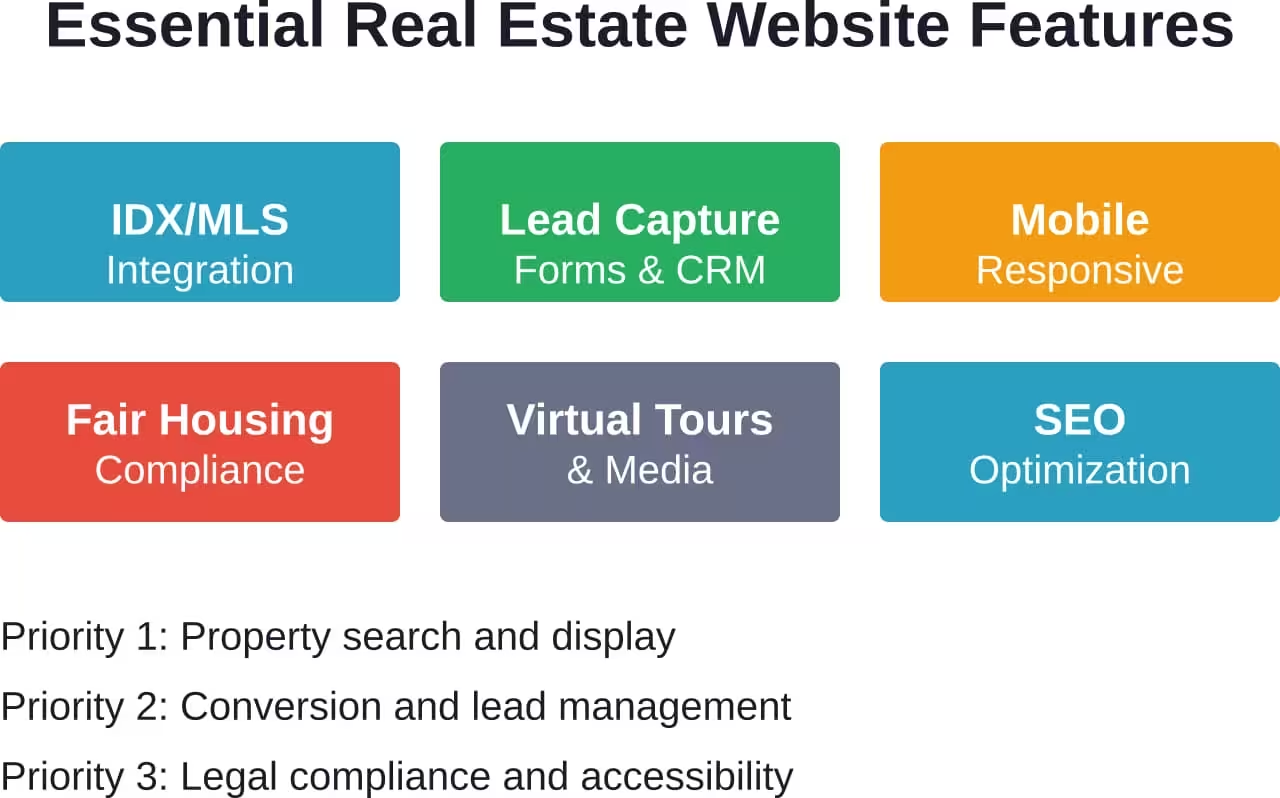
But here’s the thing—building a high-performing real estate website isn’t about flashy graphics or trendy design. Technical functionality matters more. IDX/MLS integration, Fair Housing Act compliance, mobile responsiveness, and lead capture architecture determine whether a site generates qualified buyer leads or becomes expensive digital wallpaper.
The real estate industry has matured past template-and-pray strategies. Over 30% of the Wall Street Journal’s top agents and teams use specialized real estate website platforms, and annual website traffic growth of 300% has been documented for agencies that commit to proper development.
The Core Technical Requirements Nobody Talks About
Real estate websites operate under unique constraints that generic business sites don’t face. Three technical pillars separate functional platforms from amateur attempts.
IDX/MLS Integration Isn’t Optional Anymore
IDX (Internet Data Exchange) allows real estate websites to display MLS (Multiple Listing Service) property data directly on agent and broker sites. Without it, visitors bounce to Zillow or Realtor.com instead.
Most website builders for real estate now include IDX capability as a standard feature. Wix offers pre-built real estate templates, with plans starting at $17/month. SITE123 provides fast setup with MLS search functionality from day one. The technical hurdle isn’t availability—it’s configuration.
IDX feeds require API credentials from local MLS boards, data refresh schedules (typically every 15 minutes to 6 hours), and field mapping between MLS taxonomies and website display formats. Developers often underestimate this complexity. What looks like a simple plugin install becomes a three-week troubleshooting project when listing photos don’t render or price updates lag by 24 hours.
Fair Housing Act Compliance in Web Design
The Fair Housing Act prohibits discrimination based on race, color, national origin, religion, sex, familial status, and disability in housing-related activities—including website advertising and content.
According to HUD, housing discrimination is illegal in nearly all housing types, covering rental, purchase, mortgage applications, and housing assistance. Real estate websites must implement this in practice through neutral language, accessible design, and non-discriminatory search filters.
Practically speaking, this means:
- Avoid demographic-targeted language like “perfect for young professionals” or “ideal for retirees”
- Ensure WCAG 2.1 AA accessibility standards for users with disabilities
- Never implement search filters that allow users to sort by neighborhood demographics
- Use truthful, substantiated claims in property descriptions—FTC advertising rules require evidence to back up claims
The penalty structure is serious. Under the CAN-SPAM Act, each separate email in violation is subject to penalties of up to $53,088. Fair Housing violations can result in civil penalties, injunctions, and damages.
Mobile Responsiveness as Default Standard
Mobile traffic dominates real estate search behavior. Buyers browse listings during commutes, at lunch breaks, during open houses of competing properties.
Real talk: if property images don’t load in under 3 seconds on 4G connections, or if contact forms break on iOS Safari, the site actively damages business development. Modern real estate website builders handle responsive design automatically, but custom development projects often treat mobile as an afterthought.
Testing should cover iPhone, Android, iPad, and tablet viewports. Pay special attention to touch-target sizing on contact buttons and lead capture forms—small tap areas on mobile equal lost leads.
Website Builder vs. Custom Development: The Real Cost Analysis
Real estate professionals face a fork in the road early: pre-built platforms or custom development. The decision tree is simpler than most vendors admit.
When Website Builders Make Sense
Platforms like Wix, SITE123, and Squarespace dominate the real estate market for good reason. They handle the technical infrastructure—hosting, security certificates, template updates, mobile optimization—while agents focus on content and lead generation.
Depending on plan features, monthly prices generally range from $12 to $159 per month. Wix offers 40 pre-built real estate templates with IDX integration, with plans starting at $17/month. SITE123 offers faster setup with simplified interfaces. Squarespace provides stylish templates that appeal to luxury market positioning.
These platforms work particularly well for solo agents, small teams (under 5 people), and brokerages that need to launch quickly without dedicated IT staff. Josh Jerman of Hawaii Life Real Estate Brokers in Maui describes the get.realtor platform setup as “practically effortless,” having previously hired a web developer for 20 hours to build a website for his business.
The limitation? Customization ceiling. Website builders constrain design flexibility, limit advanced integrations, and lock data into proprietary systems that complicate future migration.
When Custom Development Becomes Necessary
Large brokerages, luxury market specialists, and teams managing proprietary buyer/seller workflows eventually outgrow template platforms. Custom development offers unlimited design control, complex CRM integrations, and competitive differentiation through unique features.
The trade-off is cost and maintenance. Custom builds start at $5,000 for basic implementations and scale to $50,000+ for enterprise platforms with advanced functionality. Ongoing maintenance, security patches, and feature updates require retained developer relationships or in-house technical staff.
Custom development makes strategic sense when:
- Brand differentiation justifies premium investment (luxury market positioning)
- Proprietary workflows require custom tools (unique buyer matching algorithms, specialized commercial property search)
- Scale demands performance optimization beyond shared hosting (100+ agents, thousands of listings)
- Data ownership and export flexibility matter for long-term strategy
| Feature | Website Builder | Custom Development |
|---|---|---|
| Initial Cost | $12-$159/month | $5,000-$50,000+ |
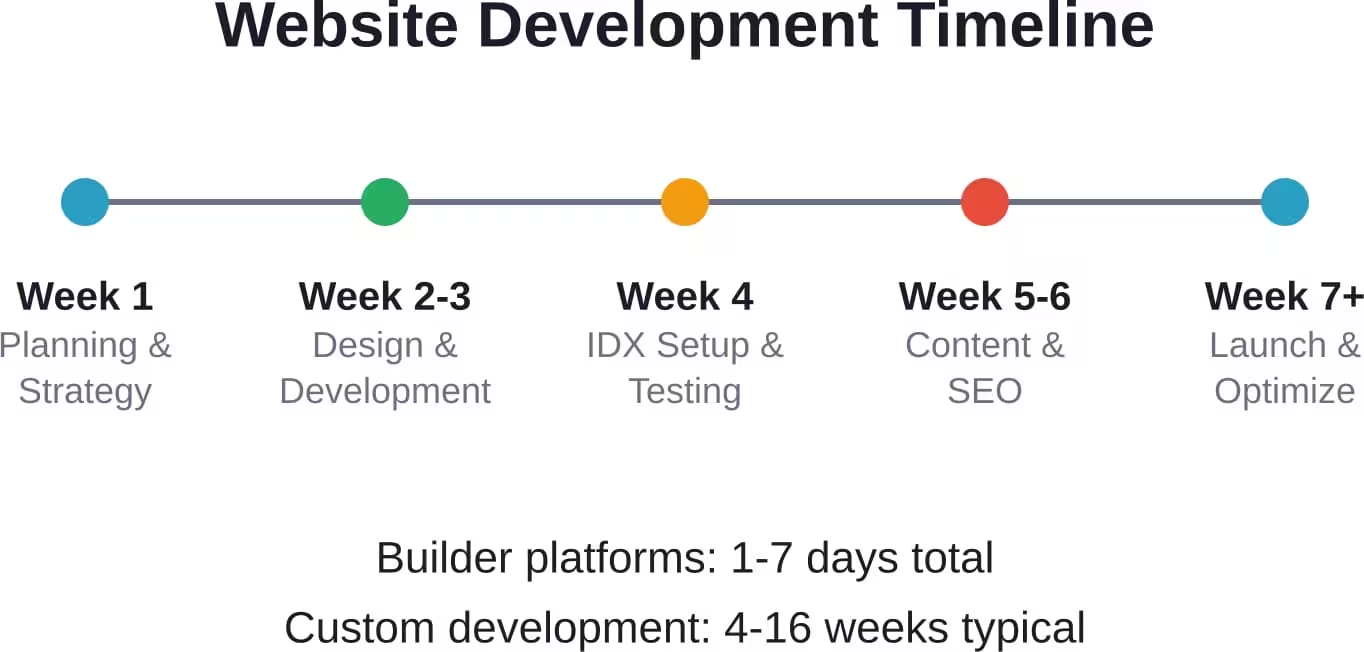
| Launch Timeline | 1-7 days | 4-16 weeks |
| Technical Skills Required | Minimal (drag-and-drop) | High (developer needed) |
| IDX/MLS Integration | Pre-built plugins | Custom API implementation |
| Design Flexibility | Template constraints | Unlimited |
| Maintenance Responsibility | Platform handles it | Owner/developer manages |
Launch a Real Estate Website Built Around Your Listings
When property listings are hard to browse or compare, users leave before taking the next step. A lot of real estate websites run into this because they rely on standard layouts that don’t fit how listings are actually presented. Lengreo works with custom website development to solve these gaps. Instead of adjusting your listings to a fixed structure, they build the website around how you present properties, services, and information. This makes it easier to organize listings, highlight key details, and keep the browsing experience clear for potential clients.
Add the Features Your Real Estate Website Actually Needs
Lengreo builds websites around how users interact and convert:
- Clear page structure that makes services and content easy to understand
- Navigation that helps users find relevant information more easily
- Flexible setups using JavaScript and WordPress to match different business needs
- A strong focus on creating websites that support lead generation
Plan your real estate website, contact Lengreo, and get a setup that fits your business.
Lead Capture Architecture That Actually Converts
The website exists to generate qualified buyer and seller leads. Everything else is decoration.
Lead capture architecture determines conversion rates more than design aesthetics. The difference between 0.5% and 3% conversion rates often comes down to form placement, required fields, and post-submission workflow.
Strategic Form Placement
Forms should appear at decision points, not random scroll depths. Effective placements include:
- Property detail pages (schedule showing, request information)
- Search results pages (save search, get new listing alerts)
- Neighborhood guides (download market reports, schedule consultation)
- Above-the-fold homepage (free home valuation, buyer consultation request)
Minimize required fields. Name and email suffice for initial contact. Phone number, property address, and timeline questions reduce completion rates but increase lead quality. Testing determines the right balance for specific markets and price points.
CRM Integration and Lead Routing
Capturing leads means nothing if they sit in an inbox for 48 hours. Immediate routing to appropriate agents, automated follow-up sequences, and CRM logging separate functional systems from data graveyards.
Most website builders offer basic integrations with platforms like FollowUpBoss, LionDesk, and kvCORE. Custom developments can implement more sophisticated routing logic—geographic assignment, price-point specialization, buyer vs. seller segmentation.
The technical implementation matters less than the operational discipline. Real estate businesses that respond to web leads within 5 minutes dramatically outperform those that wait hours or days. Website development should enable this speed, not hinder it with complex handoffs.
Content Strategy for Real Estate SEO
Technical infrastructure provides the foundation. Content drives organic traffic and establishes market authority.
Real estate SEO differs from generic local business optimization. Property searches are highly specific—address-level in hot markets, neighborhood-level in growth markets, city-level in emerging markets. Content strategy should map to actual search behavior.
Neighborhood and Market Area Pages
Individual pages targeting “[Neighborhood] homes for sale” and “[Neighborhood] real estate” generate consistent organic traffic. These pages should include:
- Current active listings with IDX integration
- Recent sales data and price trends
- Neighborhood characteristics (schools, parks, transportation)
- Market statistics (median price, days-on-market, inventory levels)
Content depth matters. Thin 200-word placeholder pages don’t rank. Comprehensive 800-1,200 word guides that actually help buyers understand a neighborhood outrank competitors consistently.
Property Listing Optimization
IDX feeds often import generic MLS descriptions that don’t rank well. Custom property descriptions, high-quality photography, and virtual tour embeds improve both SEO and user engagement.
Research analyzing nearly 43,000 properties found virtual tours reduced days-on-market from 34 to 19 days on average. A separate Harvard Business School study of 75,000+ home sales confirmed the post-pandemic value of virtual tours, though with more nuanced findings.
Virtual tours provide two benefits: improved buyer qualification (fewer low-intent showings) and stronger SEO signals (longer time-on-page, lower bounce rates).
Market Reports and Educational Content
Quarterly market reports, first-time homebuyer guides, and local market analysis establish topical authority. This content targets upper-funnel search queries and builds email lists through gated downloads.
Educational content that addresses legitimate buyer and seller questions—financing options, inspection processes, closing timelines—positions agents as trusted advisors rather than transactional facilitators, in line with industry professional standards.
Performance Optimization and Technical SEO
Page speed directly impacts conversion rates and search rankings. Real estate sites face unique challenges—high-resolution property photos, embedded virtual tours, and IDX database queries can bloat load times if not properly optimized.
Image Optimization
Property photos should be compressed to 200-400KB per image without visible quality loss. Modern formats like WebP provide better compression than JPEG. Lazy loading defers off-screen images until users scroll to them.
Most website builders handle this automatically, but custom developments need explicit implementation. Unoptimized image galleries with 20+ high-resolution photos routinely push page sizes to 15-25MB, killing mobile performance.
Database Query Optimization
IDX search functionality runs database queries that can slow page loads if poorly optimized. Caching search results, indexing frequently queried fields, and implementing pagination prevent performance degradation as listing counts grow.
Testing should simulate realistic traffic loads. An IDX search that performs well with 500 listings may collapse under 5,000 listings without proper indexing.
Core Web Vitals
Google’s Core Web Vitals—Largest Contentful Paint, First Input Delay, and Cumulative Layout Shift—now influence search rankings. Real estate sites should target:
- LCP under 2.5 seconds (time until main content loads)
- FID under 100 milliseconds (interactivity delay)
- CLS under 0.1 (visual stability during loading)
Third-party virtual tour embeds and chat widgets often tank these metrics. Selective loading and performance monitoring identify problematic components.
Security and Data Protection
Real estate websites handle sensitive personal information—contact details, financial qualification data, property search preferences. Security breaches damage reputation and create legal liability.
Basic security requirements include:
- SSL certificates (HTTPS) for all pages
- Regular software and plugin updates
- Strong password policies for admin access
- Database encryption for stored lead information
- Regular backups with tested restoration procedures
The CAN-SPAM Act, enforced by the FTC, establishes requirements for commercial email and gives recipients the right to stop receiving emails. Real estate websites must implement proper unsubscribe mechanisms and honor opt-out requests promptly. Under the CAN-SPAM Act, each separate email in violation is subject to penalties of up to $53,088.
Website builders typically handle security infrastructure as part of hosting services. Custom developments require active security management—patch deployment, vulnerability scanning, and incident response planning.
Analytics and Conversion Tracking
Development doesn’t end at launch. Continuous measurement and optimization separate high-performing sites from digital brochures.
Essential Metrics to Monitor
Traffic metrics provide baseline understanding:
- Organic search traffic trends
- Direct traffic (repeat visitors, brand awareness)
- Referral sources (social media, directory sites, partner links)
- Geographic distribution of visitors
But conversion metrics determine business impact:
- Lead form completion rates
- Property inquiry submissions
- Phone calls initiated from the website
- Email newsletter signups
- Showing requests per listing view
Agencies documenting 300% website traffic growth have shown the value of tracking metrics weekly and adjusting strategy based on performance data.
A/B Testing for Continuous Improvement
Systematic testing reveals what actually works versus what sounds good in theory. Common high-impact tests include:
- Lead form field requirements (name + email vs. full qualification)
- Call-to-action button copy (“Schedule Showing” vs. “Request Tour”)
- Homepage hero content (featured listings vs. search bar vs. neighborhood guides)
- Contact form placement (sidebar vs. modal popup vs. dedicated page)
Small percentage improvements in conversion rates compound significantly at scale. A 1% improvement on a site generating 200 leads monthly equals 24 additional leads annually—potentially worth tens of thousands in commission.
Common Development Mistakes to Avoid
Real estate website projects fail predictably. Recognizing common pitfalls prevents wasted investment.
Prioritizing Design Over Functionality
Beautiful websites that don’t integrate with MLS feeds or capture leads effectively are expensive failures. Functionality—search capability, lead capture, mobile performance—must come before aesthetic refinement.
Start with core features working properly. Polish design iteratively based on user feedback and conversion data.
Ignoring Local SEO Fundamentals
Real estate is inherently local. Websites that don’t optimize for local search miss the majority of qualified traffic.
Basic local SEO requirements include:
- Google Business Profile optimization
- Consistent NAP (Name, Address, Phone) across all directories
- Local schema markup on contact and location pages
- City and neighborhood-specific landing pages
- Embedded Google Maps on contact pages
Underestimating Content Maintenance Requirements
Websites require ongoing content updates to maintain search rankings and user relevance. Stale market reports, outdated statistics, and broken links signal neglect to both search engines and potential clients.
Plan for quarterly content audits, monthly blog posts or market updates, and regular refresh of neighborhood guides. This requires either internal staff allocation or retained content services.
Skipping Mobile Testing
Desktop-only testing misses the majority of user experience issues. Real estate search happens on phones during drives through neighborhoods, at coffee shops, and during lunch breaks.
Test on actual devices, not just browser resize tools. Safari on iOS, Chrome on Android, and various screen sizes reveal issues that desktop simulation misses.
Platform Selection Criteria
Choosing the right development approach requires honest assessment of business requirements, technical capabilities, and growth trajectory.
| Business Profile | Recommended Approach | Key Considerations |
|---|---|---|
| Solo agent, new to market | Website builder (Wix, SITE123) | Speed to launch, minimal cost, proven templates |
| Small team (2-5 agents) | Website builder or low-code platform | Shared backend, simple lead routing, budget constraints |
| Mid-size brokerage (5-20 agents) | Specialized real estate platform | Advanced CRM integration, agent microsites, brand consistency |
| Large brokerage (20+ agents) | Custom development or enterprise platform | Complex workflows, data ownership, competitive differentiation |
| Luxury market specialist | Custom development | Premium positioning, unique design, high-end media presentation |
Future-Proofing Real Estate Websites
Technology shifts rapidly. Real estate websites built today should accommodate foreseeable changes without complete rebuilds.
Artificial Intelligence Integration
AI-powered chatbots, predictive property matching, and automated lead qualification are becoming standard expectations. Website architecture should support third-party AI tool integration through APIs and webhooks.
Emerging technology trends in professional practice support the value of websites built with open systems. Websites built with closed, proprietary systems struggle to adopt new AI capabilities as they mature.
Enhanced Virtual Experiences
Virtual tours proved their value during pandemic restrictions, and research shows they continue to reduce days-on-market for certain property types post-pandemic. Future developments may include augmented reality neighborhood overlays, virtual staging customization, and interactive floor plan editors.
Supporting these features requires robust media handling, sufficient bandwidth, and flexible content management systems that accommodate new media types.
Data Privacy and Compliance
Privacy regulations continue evolving. California’s CCPA, Europe’s GDPR, and potential federal privacy legislation require websites to implement user data controls, consent management, and data deletion capabilities.
Platforms and custom developments should include privacy-compliant contact forms, cookie consent management, and documented data handling procedures.
Measuring Return on Website Investment
Website development is a business investment that should generate measurable returns through lead generation and brand positioning.
Track these business metrics to assess website ROI:
- Lead acquisition cost (total website investment divided by leads generated)
- Lead-to-client conversion rate for web-sourced leads versus other channels
- Average transaction value for web-sourced clients
- Brand search volume growth (people searching for agent or brokerage name)
- Time savings from automated showing requests and lead qualification
Real estate businesses serving 18,000+ clients demonstrate that systematic web investment, when properly executed, generates sustainable competitive advantage. The website becomes a 24/7 lead generation and qualification system that scales without proportional labor cost increases.
Taking Action on Real Estate Website Development
Website development for real estate ultimately serves one purpose: generating qualified leads and supporting successful transactions. The technical complexity—IDX integration, Fair Housing compliance, mobile optimization, lead capture architecture—exists to facilitate this business outcome.
The path forward depends on current positioning. Solo agents entering the market should prioritize speed and cost-effectiveness through proven website builders. Established teams outgrowing template platforms should evaluate specialized real estate platforms before committing to full custom development. Large brokerages and luxury specialists can justify significant custom investment when competitive differentiation and brand positioning warrant premium positioning.
But regardless of approach, certain principles remain constant. Mobile performance matters more than desktop aesthetics. Lead capture functionality determines business value more than design polish. Content strategy and SEO fundamentals generate long-term organic traffic more reliably than paid advertising alone. Legal compliance isn’t optional—Fair Housing Act requirements and advertising standards apply to all real estate web presence.
The real estate professionals winning market share in 2026 treat websites as core business infrastructure, not afterthought marketing. They invest appropriately for their scale, measure systematically, and optimize continuously based on performance data.
Start by auditing current web presence against the technical requirements outlined here. Identify gaps in IDX functionality, mobile performance, lead capture effectiveness, and compliance standards. Then select the development approach that addresses those gaps within budget and timeline constraints.
The website won’t close transactions automatically. That still requires professional expertise, market knowledge, and client service. But proper website development creates the digital foundation that generates opportunity, establishes credibility, and scales business growth beyond individual networking capacity.