Quick Summary: Website development for private equity firms requires specialized digital infrastructure that builds investor confidence, showcases portfolio performance, and drives capital formation. Modern PE websites prioritize secure investor portals, performance dashboards, and compliance-ready content management—with 80% of PE firms now valuing digital transformation as a strategic asset.
Private equity firms don’t get second chances at first impressions. When limited partners evaluate fund opportunities or portfolio companies assess operational support, the firm’s website becomes the deciding factor.
But here’s the thing—generic corporate websites don’t cut it in private capital markets. PE firms face unique challenges: investor confidentiality requirements, regulatory reporting standards, portfolio company integration, and the need to convey decades of institutional expertise through digital channels.
According to research cited in NKU’s online MBA program article, a Forbes study revealed that 80% of PE firms valued digital transformation for portfolio companies, and 75% planned to increase digital investments. That same logic applies internally. Firms that lag in their own digital presence send the wrong signal to sophisticated investors.
Why Private Equity Website Development Differs from Corporate Web Design
Private equity website development isn’t just about aesthetics. It’s about building digital infrastructure that supports capital formation, investor relations, and operational value creation.
Traditional corporate websites focus on customer acquisition and brand awareness. PE firm websites serve multiple stakeholder groups with conflicting needs: prospective limited partners requiring detailed fund performance data, current investors demanding secure portal access, intermediaries seeking deal flow information, and portfolio companies looking for operational resources.
Real talk: many PE firms still operate with outdated websites that undermine their market positioning. Industry research indicates that 73% of users would switch financial providers for better user experience. That’s not just a statistic—it’s millions in potential commitments walking out the door because navigation felt clunky or fund information proved difficult to locate.
Regulatory and Compliance Considerations
SEC regulations add another layer of complexity. Form N-PORT requirements mandate that all registered management investment companies (except money market funds and small business investment companies) file monthly reports no later than 30 days after the close of each month. While these filings don’t appear directly on public websites, the operational infrastructure supporting them often does.
Investment Company Act Section 3(a)(1)(C) specifies that an entity is an investment company if it is engaged in the business of investing, reinvesting, owning, holding, or trading in securities, and owns or proposes to acquire investment securities having a value exceeding 40 per centum of the value of such issuer’s total assets (exclusive of Government securities and cash items) on an unconsolidated basis. This regulatory framework shapes how PE firms present themselves digitally and what fund information they can publicly disclose.

Core Features Every PE Firm Website Needs
The best private equity websites share common architectural elements that balance transparency with confidentiality.
Secure Investor Portal Infrastructure
Limited partners expect password-protected access to fund documents, quarterly reports, capital call notices, and distribution statements. This isn’t a nice-to-have feature—it’s table stakes.
Modern investor portals integrate with fund administration platforms, allowing real-time performance data synchronization. The technical architecture typically includes multi-factor authentication, role-based access controls, document versioning, and audit trails that satisfy institutional LP compliance requirements.
Firms managing multiple funds need granular permission systems. An LP committed to Fund III shouldn’t accidentally access Fund IV materials. That sounds obvious, but many legacy systems lack this segmentation, creating compliance headaches and eroding investor confidence.
Portfolio Company Presentation
How PE firms showcase portfolio companies reveals their value-creation thesis. Leading firms create dedicated portfolio sections with company profiles, investment theses, value-creation initiatives, and exit outcomes.
Apollo’s approach to building AI capabilities into portfolio companies—detailed in MIT Sloan Management Review—demonstrates this strategic communication. The firm highlights specific initiatives: Cengage achieving 40% cost reduction in content production processes, Yahoo improving engineering team productivity by 20% with 10,000 lines of AI-generated code accepted daily, and Univar’s AI-driven sales agent achieving 30% engagement rates in pilot testing.
These aren’t vanity metrics. They’re proof points that attract both capital (LPs see operational excellence) and deal flow (management teams see hands-on support).
Performance Dashboard Design
Transparency builds trust, but PE firms must balance disclosure with competitive sensitivity. Performance sections typically feature fund vintage years, capital deployed, realized vs. unrealized values, sector allocation, and geographic distribution—without revealing company-specific details that might disadvantage portfolio investments.
| Performance Element | Public Website | Investor Portal |
|---|---|---|
| Fund vintage years | Yes | Yes |
| Aggregate IRR ranges | Often | Always |
| Company-level returns | No | Yes |
| Sector allocation | Yes | Yes |
| Individual investments | Selected | Complete |
| Capital call schedules | No | Yes |
Digital Transformation’s Role in PE Website Strategy
The same digital transformation PE firms drive in portfolio companies applies to their own operations. And the website sits at the center of that transformation.
According to a Forbes study cited in NKU’s online MBA program material, 75% of PE firms planned to increase digital investments. This trend manifests in several ways: advanced analytics platforms that track website engagement by investor segment, AI-powered chatbots handling preliminary deal inquiries, automated content management systems that push portfolio company updates to relevant stakeholders, and CRM integration that captures prospect behavior for relationship teams.
Large institutional PE firms illustrate why this matters, given the scale required to manage investor communications and deal flow across multiple funds and portfolios. Digital infrastructure becomes operational leverage.
Value Creation Through Portfolio Company Digital Support
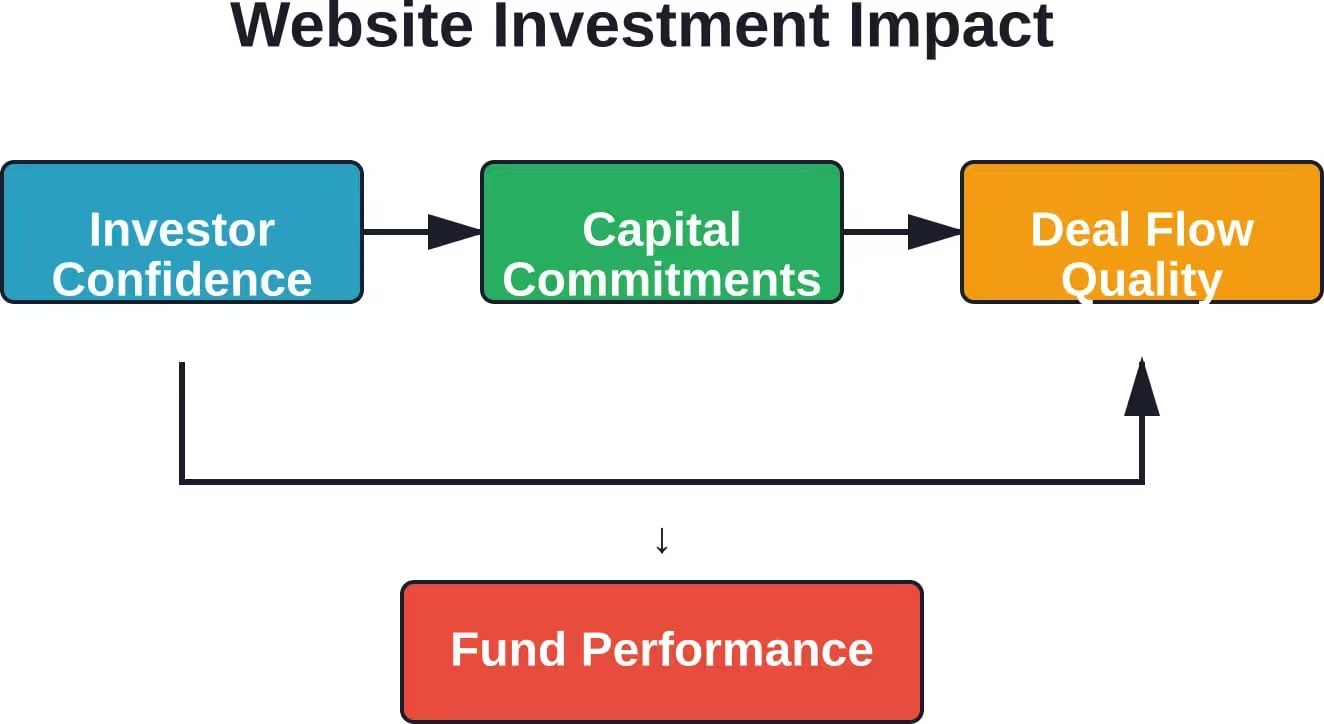
Forward-thinking PE firms extend their digital capabilities to portfolio companies. This creates a flywheel effect: better portfolio company websites improve exit multiples, which improves fund performance, which attracts more LP capital, which enables larger deals.
NYU Stern’s research on responsible private equity demonstrates quantifiable returns from systematic approaches. One case study documented €300,000 in annual savings from ESG-linked financing and projected 15% absenteeism reduction through employee welfare initiatives. These outcomes don’t happen without the digital infrastructure to measure, track, and communicate progress.
Choosing the Right Development Partner for PE Websites
Not all web design agencies understand private equity’s unique requirements. Generic digital agencies lack the sector expertise to navigate investor relations nuances, compliance frameworks, and stakeholder communication hierarchies.
Specialized agencies serving private equity bring institutional knowledge that accelerates project timelines and reduces revision cycles. Since 2000, agencies like MVP Design have built expertise specifically in private capital, working with firms including Wind Point Partners (Chicago, $7B+ AUM), Godspeed (Washington, DC, $1B+ AUM), and Bank Street, a digital infrastructure investment bank with $500B+ in cumulative transaction value.
That specialized experience matters. These agencies inherently understand why a PE firm can’t publish certain performance metrics, how investor portals should structure document hierarchies, what compliance language belongs in fund descriptions, and how to position a firm’s investment strategy without revealing proprietary sourcing methods.
Key Evaluation Criteria
When evaluating website development partners, PE firms should assess several dimensions beyond portfolio aesthetics.
Look for agencies with documented private capital experience—not just financial services broadly, but specifically PE, venture capital, or family office clients. Check whether they’ve built investor portal infrastructure with the security architecture institutional LPs require. Evaluate their understanding of regulatory constraints that shape public disclosures.
Technical capabilities matter equally. Modern PE websites require content management systems that non-technical staff can update (portfolio company acquisitions, team changes, fund performance updates). They need mobile-responsive designs that render correctly on the iPads LPs use during investment committee meetings. And they must integrate with existing technology stacks—CRM platforms, fund administration systems, and marketing automation tools.
| Evaluation Dimension | Why It Matters | Red Flags |
|---|---|---|
| PE sector experience | Understands stakeholder complexity and compliance | Only corporate or consumer clients |
| Security infrastructure | Protects confidential investor data | No mention of authentication protocols |
| CMS capabilities | Enables internal teams to maintain content | Requires developer for basic updates |
| Integration experience | Connects to fund admin and CRM systems | Standalone website only |
Build a Website That Matches Your Firm’s Standards
Private equity websites need to look professional, load fast, and present information clearly without unnecessary complexity. Whether someone is reviewing your portfolio, investment focus, or firm background, the website should feel structured, modern, and easy to navigate across devices. Lengreo develops websites using technologies like WordPress and JavaScript, allowing their team to build anything from streamlined business websites to fully customized platforms. Their development process is focused on flexibility, maintainability, and creating websites that are easier to scale as business needs change over time.
Increase Your Website Performance and Long-Term Usability
Lengreo provides private equity firms with:
- Custom website development for investment firms
- Flexible WordPress and JavaScript development
- SEO-ready website structure and page organization
- Mobile-friendly and easy-to-maintain layouts
If your firm needs a more modern and scalable website, contact Lengreo and book a consultation for your website development project.
Portfolio Company Website Strategy
PE firms increasingly provide website development support to portfolio companies as part of value-creation initiatives. This dual benefit strengthens portfolio company market positioning while demonstrating operational capabilities to current and prospective LPs.
The strategic rationale is straightforward: better digital presence improves customer acquisition, which drives revenue growth, which increases exit valuations. But executing this at scale across 10-20 portfolio companies requires systematic processes.
Leading firms develop website frameworks and design systems that can be customized for individual portfolio companies while maintaining efficiency. This might include WordPress templates with industry-specific modules, brand guidelines that accelerate design decisions, approved vendor relationships that streamline procurement, and project management playbooks that keep initiatives on schedule.
Cost Considerations and Budget Planning
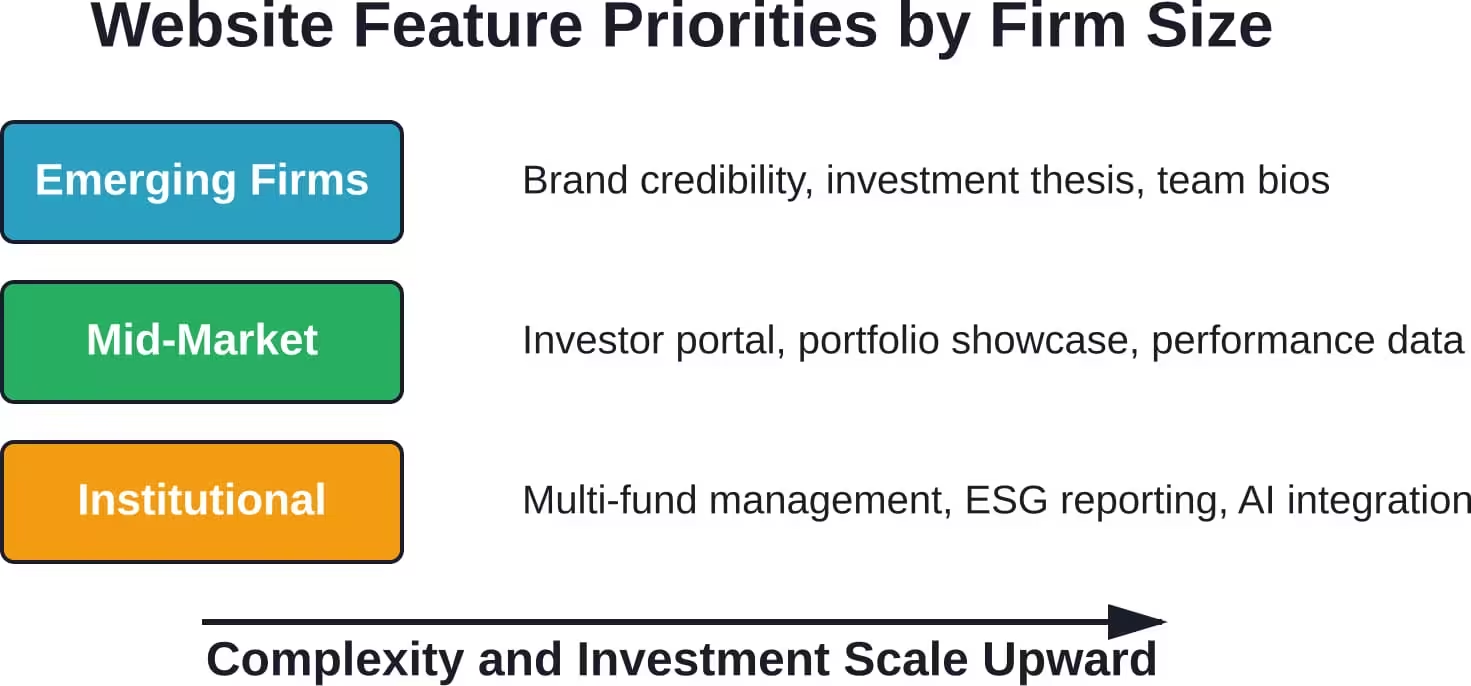
Private equity website development costs vary widely based on complexity, feature requirements, and agency positioning. Basic informational websites for smaller funds might range from $25,000-$50,000. Mid-market firms requiring investor portals, portfolio showcases, and custom integrations typically invest $75,000-$150,000. Large institutional firms with multiple funds, complex reporting requirements, and extensive stakeholder groups can exceed $250,000 for comprehensive platforms.
These figures represent initial development only. Ongoing costs include hosting and security (typically $500-$2,000 monthly depending on traffic and data volumes), content management and updates (either internal staff time or agency retainers), and periodic redesigns every 3-5 years as technology and design standards evolve.
Sounds expensive? Consider the alternative. A single LP commitment of $25 million more than justifies a $150,000 website investment if that digital presence contributed to the capital raising outcome. Most PE firms raising $300 million to $1 billion funds will close that LP commitment from institutional investors who thoroughly evaluated the firm’s digital presence during diligence.
Emerging Trends Shaping PE Website Development
Several technology and market trends are reshaping how private equity firms approach their digital presence.
AI Integration for Investor Services
Artificial intelligence is moving beyond portfolio company value-creation into investor-facing applications. Natural language processing enables chatbots that answer preliminary fund questions, freeing investor relations teams to focus on qualified prospects. Machine learning algorithms analyze website engagement patterns to identify when prospects show serious interest versus casual research.
These aren’t theoretical concepts. Apollo’s experience—documented in MIT Sloan Management Review—shows practical implementation across portfolio companies. The same principles apply to fund operations.
ESG Transparency and Reporting
Environmental, social, and governance considerations now influence LP allocation decisions. PE firm websites increasingly feature dedicated ESG sections detailing responsible investment frameworks, portfolio company impact metrics, and alignment with sustainable development goals.
NYU Stern research demonstrates that systematic ESG approaches generate measurable financial returns. Firms that transparently communicate these initiatives through their digital presence gain competitive advantage in LP fundraising, particularly with institutional investors facing their own ESG mandates.
Video Content and Interactive Media
Static text descriptions of investment strategies don’t engage modern audiences. Leading PE firms incorporate video interviews with managing partners explaining investment theses, interactive portfolio maps showing geographic diversification, animated explanations of value-creation processes, and virtual office tours that humanize institutional brands.
These content formats improve engagement metrics and time-on-site statistics. More importantly, they help prospective LPs develop relationships with key decision-makers before formal fundraising conversations begin.
Conclusion: Digital Infrastructure as Competitive Advantage
Private equity has always been a relationship business. But relationships now begin digitally.
The firms that recognize their website as strategic infrastructure—not marketing overhead—gain measurable advantages in fundraising, deal sourcing, and value creation. They attract higher-quality LP capital. They position themselves effectively to target company management teams. And they create scalable processes that support portfolio company growth.
Investment in specialized website development pays dividends across the entire value chain. With 80% of PE firms valuing digital transformation and 75% increasing digital investments, the competitive gap between digitally sophisticated firms and digital laggards will only widen.
The question isn’t whether to invest in proper website development. It’s whether to lead the digital transformation of private equity or follow once competitors have already captured the advantage.
Ready to evaluate your firm’s digital presence? Start by auditing your current website against the framework outlined here. Identify gaps in investor portal functionality, portfolio presentation, performance transparency, and mobile experience. Then engage specialized agencies with documented private equity expertise to transform your digital infrastructure into a capital formation engine.