


Quick Summary: Memory care website development requires specialized design principles that prioritize accessibility, cognitive ease, and family engagement. An effective memory care website balances intuitive navigation, HIPAA-compliant security, and compassionate content that addresses the unique needs of families researching dementia care options. Strategic development focuses on trust-building elements, mobile responsiveness, and digital tools that support decision-making during an emotionally challenging search process.
Families searching for memory care face one of life’s most difficult decisions. They’re stressed, overwhelmed, and seeking clarity during an emotional crisis. Your website becomes their first impression of how you’ll care for their loved one.
But here’s the thing—most memory care websites fail this crucial test. They’re cluttered, confusing, or worse, they feel clinical and cold when families desperately need warmth and reassurance.
The memory care sector faces unique digital challenges. With projected Alzheimer’s Disease patients reaching 14 million by 2050 and annual estimated societal costs attributable to Alzheimer’s Disease at approximately $450 billion – $500 billion, the demand for quality memory care continues climbing. Your website isn’t just a marketing tool—it’s the digital front door to your community.
Why Memory Care Websites Require Specialized Development
Memory care differs fundamentally from standard senior living. Families aren’t browsing leisurely. They’re often in crisis mode, researching frantically after a diagnosis or incident.
The National Institute on Aging supports AI technology research and pilot projects to improve care for older Americans with Alzheimer’s and related dementias. This shift toward technology-assisted care evaluation means families arrive at your site expecting sophisticated resources, not just pretty photos.
Their questions are specific: What’s your staff-to-resident ratio? How do you handle wandering? What happens during cognitive decline? Generic assisted living content doesn’t address these concerns.
Development costs reflect this complexity. As a rule-of-thumb, smaller senior living websites using semi-custom designs typically range between $3,500 and $5,500, while small custom projects or larger semi-custom sites fall between $5,500 and $10,000. Large websites with extensive functionality exceed $10,000.
Build a Memory Care Website With Lengreo
Lengreo builds and improves websites, then connects them with SEO, paid ads, tracking, and lead generation. For memory care providers, this means a website that explains care options, safety features, staff support, living arrangements, costs, visiting details, and contact paths clearly.
The focus is to help families find important information without feeling overwhelmed. Lengreo can help organize key pages, improve traffic setup, and make inquiry or tour booking steps easier to follow.
Need a Website That Helps Families Inquire?
Lengreo can help with:
- building or redesigning your website
- improving SEO and paid traffic setup
- setting up tracking and website structure
- refining care, safety, and inquiry pages
👉 Contact Lengreo to discuss your website and setup.
Core Development Principles for Memory Care Sites
Simplified Navigation Architecture
Cognitive load matters—not just for residents, but for stressed family members making decisions under pressure. Navigation should be immediately intuitive.
Limit top-level menu items to five or six maximum. Each click should move visitors closer to their goal, whether that’s scheduling a tour, downloading a pricing guide, or reading testimonials.
Academic research on dementia accessibility shows that clarity trumps cleverness. Skip the creative menu labels. Use plain language: “About Our Care,” “Amenities,” “Costs & Insurance,” “Schedule a Visit.”
Mobile-First Responsive Design
Adult children researching memory care for aging parents conduct searches during work breaks, commutes, and late-night worry sessions—predominantly on mobile devices.
Responsive design isn’t optional. Touch targets need adequate spacing. Forms must work seamlessly on small screens. Phone numbers should be tap-to-call enabled.
Page load speed becomes critical. Slow mobile performance kills conversions. Compress images aggressively, minimize plugins, and implement caching strategies that keep performance under three seconds.
Trust Signals and Credibility Markers
Families entrusting you with dementia care need constant reassurance. Strategic placement of trust signals throughout your site reduces anxiety and builds confidence.
Display state licensing information prominently. Showcase staff training in dementia care. Feature authentic testimonials from families, not generic stock quotes.
Awards and recognition from Alzheimer’s organizations carry weight. If you’ve earned them, make them visible.
Technical Requirements and Compliance
HIPAA Considerations for Healthcare Websites
While marketing websites typically don’t fall under HIPAA’s direct mandates, memory care providers must still think carefully about data protection. Contact forms collecting health information require secure transmission.
The Health Insurance Portability and Accountability Act established national standards for electronic transactions to improve efficiency in healthcare. Memory care communities handling any protected health information through digital channels need HIPAA-compliant hosting and form processing.
Use SSL certificates universally. Encrypt form submissions. Store inquiry data securely. Partner with hosting providers experienced in healthcare compliance rather than generic shared hosting.
Accessibility Standards Beyond ADA Compliance
Web Content Accessibility Guidelines (WCAG) provide the baseline, but memory care sites should exceed minimum standards. Consider families accessing your site who may themselves have early cognitive changes.
Implement high color contrast. Use readable font sizes—16px minimum for body text. Provide alt text for all images. Ensure keyboard navigation works flawlessly.
Avoid flashing animations or autoplay videos that can disorient or distress visitors. Test with screen readers to confirm compatibility.
Content Strategy for Memory Care Audiences
Addressing Family Concerns Directly
Effective memory care content anticipates questions before they’re asked. Families want specific information about daily routines, medication management, behavioral support, and end-of-life planning.
Create dedicated pages for each memory care stage: early-stage support, moderate dementia care, advanced Alzheimer’s services. Families need to know you can support their loved one throughout disease progression.
Be transparent about costs. Nothing frustrates families more than having to call for basic pricing information. Provide ranges, explain what’s included, and clarify Medicare versus private pay options.
Visual Content That Builds Emotional Connection
Photography makes or breaks memory care websites. Stock photos of generic seniors look fake and undermine trust. Invest in authentic photography showing your actual community, residents, and staff.
Video tours have become essential. Research on digital tools for dementia care indicates families increasingly expect virtual engagement options. A well-produced video tour can eliminate properties that don’t fit before families invest time in physical visits.
Show activities, dining spaces, memory gardens, and resident rooms. Let families see the warmth of your environment rather than just reading about it.
Lead Generation and Conversion Optimization
Strategic Call-to-Action Placement
Every page needs a clear next step. Homepage visitors should see prominent options to schedule tours, download guides, or speak with admissions within seconds of landing.
| Page Type | Primary CTA | Secondary CTA | Conversion Goal |
|---|---|---|---|
| Homepage | Schedule a Tour | Download Care Guide | Direct inquiry or lead capture |
| Memory Care Services | Speak with Specialist | Watch Video Tour | Phone consultation booking |
| About/Staff Pages | Meet Our Team | Schedule Visit | Build trust, move to tour |
| Cost/Insurance | Get Personalized Quote | Insurance FAQs | Qualified lead with budget info |
| Contact Page | Request Information | Call Now | Direct contact capture |
Use action-oriented language. “Schedule Your Personal Tour” converts better than “Contact Us.” Be specific about what happens next: “Get a response within 2 hours” reduces hesitation.
Forms That Actually Get Completed
Long forms kill conversions. Families won’t fill out ten fields when they’re just beginning research. Start with the minimum: name, phone, email, and one optional question field.
Multi-step forms can work well for memory care. Step one asks relationship to resident (spouse, adult child, etc.) and stage of decision-making. Step two customizes questions based on those answers.
Implement smart defaults and autofill support. Make mobile completion painless. Always provide a phone number for those who prefer calling over form submission.
Performance Metrics and Analytics
Track what matters: tour requests, phone calls, form submissions, and virtual tour completions. These are actual leads, not vanity metrics like page views.
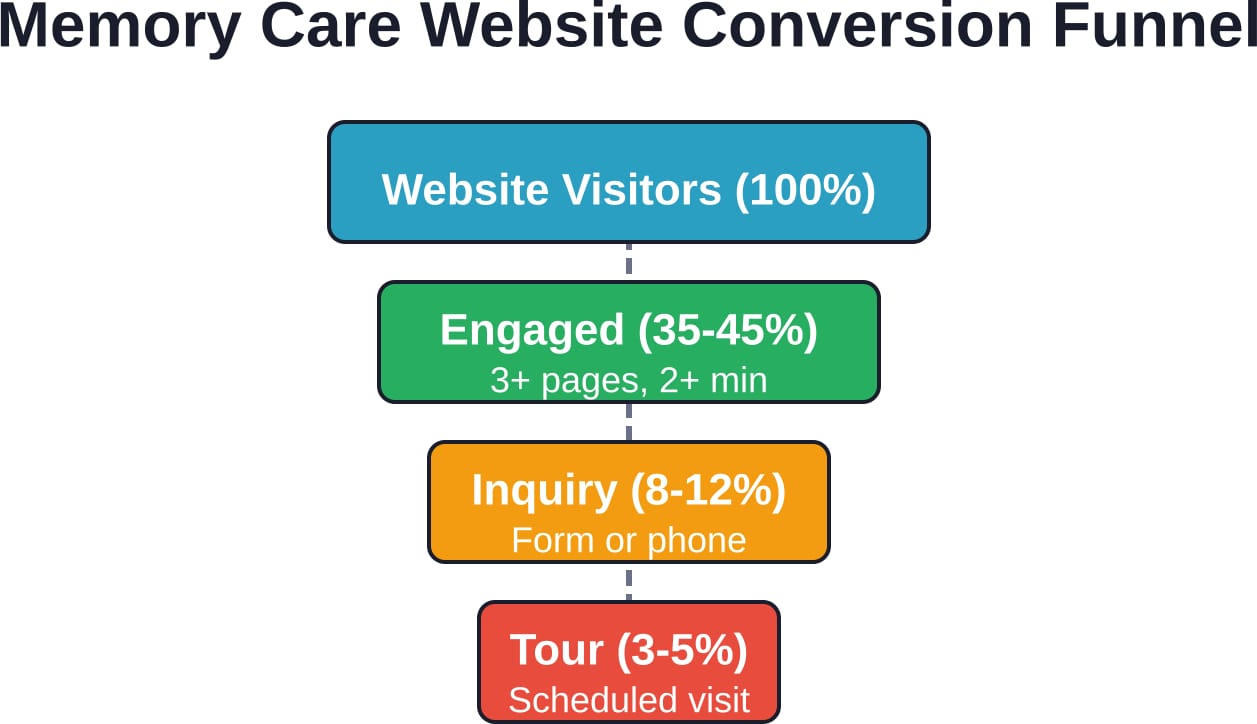
Set up goal tracking in analytics platforms. Monitor bounce rates on key pages. High bounce rates on your memory care services page signal content problems or mismatch with visitor expectations.
Call tracking numbers help attribute phone inquiries to digital marketing efforts. Families still prefer calling for sensitive topics, so don’t obsess solely over form submissions.
Emerging Technologies in Memory Care Digital Marketing
The National Institute on Aging supports AI technology research and pilot projects to improve care for older Americans with Alzheimer’s and related dementias. These innovations are trickling into consumer-facing applications.
Web-based cognitive tests that detect mild cognitive impairment can be completed in under 15 minutes. While memory care communities won’t offer diagnostic tools on their websites, understanding this technological shift helps frame how tech-savvy families approach care decisions.
Chatbots specifically trained on memory care FAQs can provide immediate answers when admissions staff aren’t available. Implementation requires careful scripting—automated responses must feel compassionate, not robotic.
Virtual reality tours represent the cutting edge. Families across the country can experience walking through your community in immersive 360-degree video, dramatically expanding geographic reach.
Maintenance and Content Updates
Memory care websites aren’t set-it-and-forget-it projects. Regular content updates signal an active, well-run community while abandoned sites raise red flags about facility management.
Publish blog content addressing family concerns: managing sundowning, activity ideas for dementia patients, understanding Alzheimer’s stages, navigating Medicare coverage. Position your team as knowledgeable resources, not just service sellers.
Update resident testimonials and family stories quarterly. Refresh photography annually. As regulations change—and they do frequently in healthcare—audit compliance pages to ensure accuracy.
Security updates matter enormously. Outdated website platforms become vulnerable to hacking. Monthly security patches and plugin updates protect both your data and visitor information.
Building Digital Trust When It Matters Most
Memory care website development isn’t about flashy design or trendy features. It’s about meeting families in their moment of crisis with clarity, compassion, and credible information.
The families landing on your site are making one of life’s hardest decisions. They’re entrusting you with a parent, spouse, or loved one who can no longer fully advocate for themselves. Your website either builds confidence in that decision or sends them searching elsewhere.
Focus development efforts on the fundamentals: intuitive navigation that reduces cognitive load, authentic visual content that showcases your actual community, transparent information that answers questions before they’re asked, and conversion paths that make taking the next step effortless.
Technical excellence matters—security, speed, mobile responsiveness, accessibility—but never loses sight of the emotional journey your website must support. Every design choice should ask: does this help a stressed family member feel more confident about our care?
Ready to develop a memory care website that truly serves families? Start by auditing your current site against these principles, or partner with developers experienced in senior living and healthcare compliance. The right digital presence doesn’t just generate leads—it begins the relationship of trust that defines quality memory care.