


Quick Summary: Medium-sized businesses need professional website development that balances sophistication with budget-consciousness. Costs typically range from $5,000-$20,000, depending on features like CRM integration, custom design, and e-commerce functionality. A strategic approach includes responsive design, security protocols, and scalability to support growth from 50-1,000 employees.
Medium-sized businesses occupy a unique position in the digital landscape. Too big for simple template solutions, yet not quite enterprise-scale, these companies need websites that reflect their sophistication without draining resources.
The right website becomes a growth engine—generating leads, streamlining operations, and establishing market credibility. But what separates a functional business site from one that actually drives revenue?
Here’s the thing though—most medium businesses underestimate what their website should accomplish. It’s not just a digital brochure. It’s your hardest-working salesperson, available 24/7, never taking a break.
What Makes Medium Business Websites Different
Medium-sized businesses (SMEs)—defined by the European Commission as enterprises which employ fewer than 250 persons and which have an annual turnover not exceeding EUR 50 million (in the US, the SBA often defines mid-market as up to 250 or 1,000 employees depending on the industry)—face distinct challenges. Small business sites focus on simplicity and basic contact forms. Enterprise platforms prioritize complex integrations and massive scale.
Medium businesses need something in between. Real talk: the gap between a $2,000 small business template and a full custom enterprise build is exactly where medium companies live.
These organizations require professional design that conveys authority. They need integration with existing business systems. And they can’t afford the six-month timelines or six-figure budgets of enterprise projects.
Core Requirements for Growth-Stage Companies
A medium business website must handle increased traffic without performance issues. It needs to integrate with CRM systems, email marketing platforms, and potentially e-commerce functionality.
Based on available data, over 60% of users visit websites from mobile devices. This means responsive design isn’t optional—it’s fundamental. Sites must deliver seamless experiences across smartphones, tablets, and desktops.
Security becomes critical at this scale. Medium businesses handle customer data, process transactions, and store sensitive business information. According to OWASP guidelines, secure coding practices must be implemented from day one, not bolted on later.
Budget and Cost Realities
Website development for medium-sized businesses ranges from $5,000-$20,000 or more, reflecting custom design needs and functionality requirements. This contrasts sharply with small business sites, which often cost $500-$2,000 using templates.
What drives these costs? Custom design work, advanced functionality, third-party integrations, and ongoing support all factor in.
Professionally designed templates can be purchased for under $100 from places like ThemeForest or TemplateMonster. For many medium businesses though, templates don’t provide the customization needed.
Budget planning should account for initial development plus ongoing maintenance, hosting, security updates, and content management. Expect to allocate 15-20% of the initial build cost annually for maintenance and improvements.
Essential Features That Drive Results
Not all website features deliver equal value. Medium businesses should prioritize functionality that directly supports business objectives.
Responsive Design and Mobile Performance
Mobile optimization isn’t just about looking good on smaller screens. It affects search rankings, user experience, and conversion rates. Google prioritizes mobile-friendly sites in search results.
Responsive design means fluid layouts that adapt to any screen size. Buttons must be tap-friendly. Navigation should simplify on mobile devices. Google’s Core Web Vitals (LCP) standard requires page load times to be 2.5 seconds or less for a good user experience.
Integration Capabilities
Medium businesses already use various software tools—CRM systems, email marketing platforms, inventory management, accounting software. The website should connect with these existing systems rather than creating data silos.
Common integrations include Salesforce or HubSpot for customer relationship management, Mailchimp or Constant Contact for email marketing, and payment processors for e-commerce functionality.
API connections allow seamless data flow between systems. When a potential customer fills out a contact form, that information should automatically populate in the CRM without manual data entry.
Content Management and Scalability
The marketing team needs to update content without calling developers for every change. A robust content management system (CMS) empowers non-technical staff to publish blog posts, update product information, and manage media assets.
WordPress, Drupal, and custom CMS solutions each offer different advantages. WordPress dominates the medium business space due to its balance of flexibility and ease of use.
But scalability matters more than the initial platform choice. As the business grows from 50 to 250 employees or more, the website architecture should accommodate increased traffic, additional product lines, and expanding content libraries without requiring a complete rebuild.
Security and Compliance Considerations
Medium businesses become attractive targets for cyberattacks. They handle valuable data but often lack the security infrastructure of larger enterprises.
The National Institute of Standards and Technology (NIST) provides frameworks for cybersecurity and secure software development. These aren’t just for government contractors—they represent industry best practices any organization can adopt.
OWASP (Open Web Application Security Project) maintains the Top 10 list of critical web application security risks. Development teams should reference this throughout the build process.
Common Security Measures
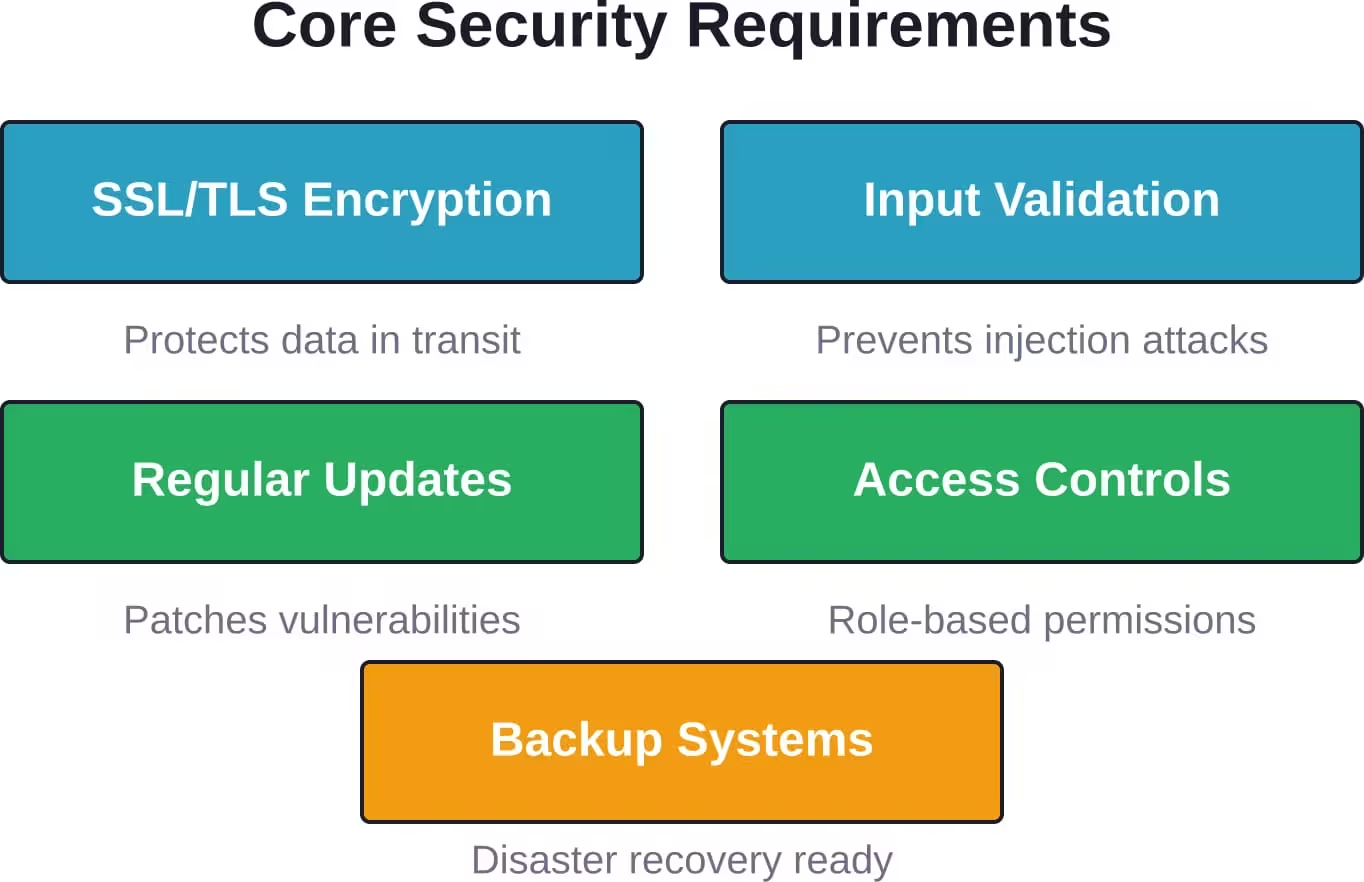
SSL/TLS certificates encrypt data between the browser and server. This protects sensitive information during transmission and signals trust to visitors.
Input validation prevents injection attacks where malicious code gets inserted through form fields or URL parameters. According to OWASP secure coding practices, all input from untrusted sources must be validated on the server side.
Regular security updates patch newly discovered vulnerabilities. Content management systems, plugins, and server software all require ongoing maintenance.
Access controls limit who can modify website content or access backend systems. Role-based permissions ensure employees only access what they need for their specific responsibilities.
Strategic Planning for Digital Growth
Technology choices matter less than strategic alignment. The best websites support specific business objectives rather than showcasing every possible feature.
Start by defining what success looks like. Does the website need to generate qualified leads? Process e-commerce transactions? Reduce customer service calls by providing self-service resources?
Aligning Online and Offline Strategy
Research and industry discussions often highlight the disconnect between physical operations and digital presence. The website should reflect and reinforce offline brand positioning.
If the company positions itself as a premium provider in physical locations, the website design must convey that same quality. Discount-focused businesses need sites optimized for quick transactions and deal discovery.
Customer journey mapping identifies how prospects move from awareness to purchase. The website should support each stage with appropriate content and functionality.
Content Strategy and User Experience
The Small Business Administration emphasizes regularly freshening content. Outdated information undermines credibility faster than almost anything else.
A restaurant website highlighting last Thanksgiving’s menu in January signals neglect. The same principle applies across industries—stale content suggests the business isn’t paying attention.
Navigation should be intuitive. Visitors should find what they need within three clicks. Clear calls to action guide users toward desired outcomes whether that’s requesting a quote, making a purchase, or scheduling a consultation.
Choosing Development Partners
Finding the right web development agency or freelancer significantly impacts project success. Medium businesses need partners who understand their unique position—sophisticated needs with realistic budgets.
| Evaluation Criteria | What to Look For | Red Flags |
|---|---|---|
| Portfolio | Similar-sized business projects, variety of industries, case studies with results | Only small sites or massive enterprise work, no medium business experience |
| Process | Clear discovery phase, defined milestones, regular communication schedule | Vague timelines, no project management system, poor communication |
| Technical Expertise | Modern frameworks, security knowledge, integration experience | Outdated tech stack, dismisses security concerns, unfamiliar with business tools |
| Support | Ongoing maintenance plans, training for internal teams, responsive support | Build-and-abandon approach, no training offered, slow response times |
Ask about their development process. How do they handle scope changes? What’s included in the initial quote versus additional costs?
Request references from similar-sized businesses. What was the experience like? Did the project stay on budget and schedule? How’s the relationship been post-launch?
Build Your Medium Business Website With a Proven Partner
After evaluating development partners, the next step is working with a team that can move your project forward without confusion or constant rework. Lengreo develops websites through a structured process that includes discovery, design, development, testing, and launch. This keeps each stage clearly defined and ensures the website is delivered according to the initial requirements.
Get a Website Delivered With Clear Execution
With Lengreo, your website development includes:
- Defined stages from research to launch
- Development using JavaScript and WordPress
- Quality assurance before launch
- Post-launch support for final adjustments
👉Contact Lengreo to discuss your project and get your website built through a clear, structured process.
Performance Optimization and SEO
A beautiful website that nobody finds delivers limited value. Search engine optimization should be baked into the development process, not added later.
Technical SEO includes site speed optimization, mobile responsiveness, clean URL structures, proper heading hierarchy, and schema markup. These foundation elements affect search rankings significantly.
Page load speed impacts both user experience and search rankings. Images should be compressed and properly sized. Code should be minified. Content delivery networks (CDNs) can speed delivery to geographically distributed users.
Content strategy supports SEO through targeted keyword usage, comprehensive topic coverage, and regular publishing schedules. Blog content, case studies, and resource pages all contribute to organic search visibility.
Measuring Success and ROI
How do businesses know if the website investment paid off? Tracking the right metrics provides clarity.
Traffic metrics show how many people visit and where they come from. But traffic alone doesn’t indicate success—engagement and conversion matter more.
Conversion rate tracks the percentage of visitors who complete desired actions. For lead generation sites, this might be submission forms or phone calls. E-commerce sites measure completed purchases.
Average session duration and pages per session indicate engagement. Visitors who quickly leave haven’t found value. Those who explore multiple pages and spend several minutes are genuinely interested.
Goal tracking in analytics platforms connects specific actions to business outcomes. Set up tracking for form submissions, phone clicks, downloads, purchases, or whatever constitutes success for the business model.
Common Pitfalls to Avoid
Medium businesses make predictable mistakes when approaching website development. Learning from others’ errors saves time and money:
- Feature creep adds functionality that sounds good in planning but never gets used: Every feature adds complexity, cost, and maintenance burden. Prioritize ruthlessly based on actual user needs and business objectives.
- Neglecting mobile experience remains surprisingly common: Designers often work on large monitors and forget that most visitors use phones. Test extensively on actual devices, not just responsive design modes in browsers.
- Ignoring page speed optimization creates frustrated users and poor search rankings: Developers focused on functionality sometimes overlook performance until it becomes a problem.
- Insufficient training leaves internal teams unable to manage content effectively: Budget time for thorough training on the CMS and related tools.
Future-Proofing Your Digital Presence
Technology changes rapidly, but smart architectural decisions create flexibility for future needs. Building on established platforms with active development communities reduces the risk of obsolescence.
Modern web development emphasizes progressive enhancement—starting with a solid foundation that works everywhere, then layering on advanced features for capable browsers and devices.
AI and automation increasingly influence digital marketing and customer experience. The SBA has highlighted workshops on using AI tools for content creation, social media management, and marketing efficiency. While specific tools evolve quickly, the website architecture should accommodate these integrations as they mature.
Accessibility isn’t just good practice—it’s increasingly a legal requirement. Websites should work for users with disabilities, following WCAG (Web Content Accessibility Guidelines) standards.
Moving Forward with Confidence
Website development for medium businesses requires balancing sophistication with practicality. The right approach combines professional design, robust functionality, solid security, and strategic alignment with business goals.
Success doesn’t require the biggest budget or most cutting-edge technology. It requires clear objectives, realistic planning, and choosing partners who understand the unique needs of growth-stage companies.
The digital landscape will continue evolving, but fundamental principles remain constant: serve users effectively, protect their data, provide genuine value, and align digital presence with overall business strategy.
Start by defining specific business objectives the website should support. Research development partners who’ve successfully delivered similar projects. Budget realistically for both initial development and ongoing maintenance.
A well-executed website becomes a competitive advantage—generating leads, supporting sales, and scaling with the business as it grows. The investment pays dividends for years when approached strategically.