


Quick Summary: Website development for financial services requires strict regulatory compliance, robust security architecture, and user-centric design that builds trust. Modern financial websites must integrate encryption protocols, adhere to SEC and FDIC guidelines, implement secure coding practices from OWASP standards, and deliver seamless experiences across devices while maintaining data privacy per Regulation S-P requirements.
Financial services firms face unique challenges when building websites. Unlike standard business sites, these platforms handle sensitive financial data, operate under strict regulatory oversight, and serve clients who demand absolute trust and security.
The stakes are high. A poorly designed financial website can expose client data, violate compliance requirements, or fail to convert qualified leads. But when done right, a professional web presence becomes a powerful asset that establishes credibility, streamlines operations, and drives measurable growth.
This guide covers everything from regulatory frameworks to conversion optimization. Whether managing a wealth advisory firm, developing fintech solutions, or providing personal finance services, these principles apply across the financial sector.
Understanding the Regulatory Landscape
Financial institutions can’t simply build a website and launch. Multiple regulatory bodies govern how these organizations collect, store, and display information online.
The Securities and Exchange Commission enforces Regulation S-P, which establishes privacy requirements for consumer financial information. According to SEC guidelines, companies must implement administrative, technical, and physical safeguards to protect client data. This regulation affects investment advisers, broker-dealers, and investment companies.
Here’s what that means practically:
- Privacy notices must be provided to clients explaining data collection and sharing practices
- Opt-out mechanisms are required before sharing nonpublic personal information with third parties
- Security programs must address identified risks to customer information
- Regular risk assessments and updates to security measures are mandatory
The Federal Deposit Insurance Corporation provides additional guidance through appendices to Part 364, which establish information security standards for FDIC-supervised institutions. These standards address administrative, technical, and physical safeguards to protect customer information.
But wait. There’s more to consider beyond federal regulations. State securities regulators, FINRA rules for broker-dealers, and industry-specific standards all create layers of compliance requirements.
Ownership and Control Thresholds
When building websites that display company information or facilitate transactions, understanding SEC ownership thresholds matters. According to SEC regulations, ownership of more than 25% of voting securities creates a presumption of control over management and policies. This affects how affiliated entities must be disclosed on public-facing platforms.
Companies with more than $10 million in assets and a class of equity securities held by 2,000 or more persons (or 500 or more persons who are not accredited investors) must register and file reports with the SEC. These reporting requirements influence what information gets published on corporate websites and how frequently it needs updating.
Build a Clear Financial Services Website With Lengreo
Lengreo builds and improves websites, then connects them with SEO, paid ads, tracking, and lead generation. For financial services companies, this means a website that explains services, client types, compliance information, consultation options, and contact paths in a clear structure.
The focus is to make complex services easier to understand without making the site feel heavy. Lengreo can help organize key pages, improve traffic setup, and make consultation requests easier for visitors to complete.
Need a Website That Makes Your Services Clear?
Lengreo can help with:
- building or redesigning your website
- improving SEO and paid traffic setup
- setting up tracking and website structure
- refining service, trust, and contact pages
👉 Contact Lengreo to discuss your website and setup.
Security Architecture for Financial Platforms
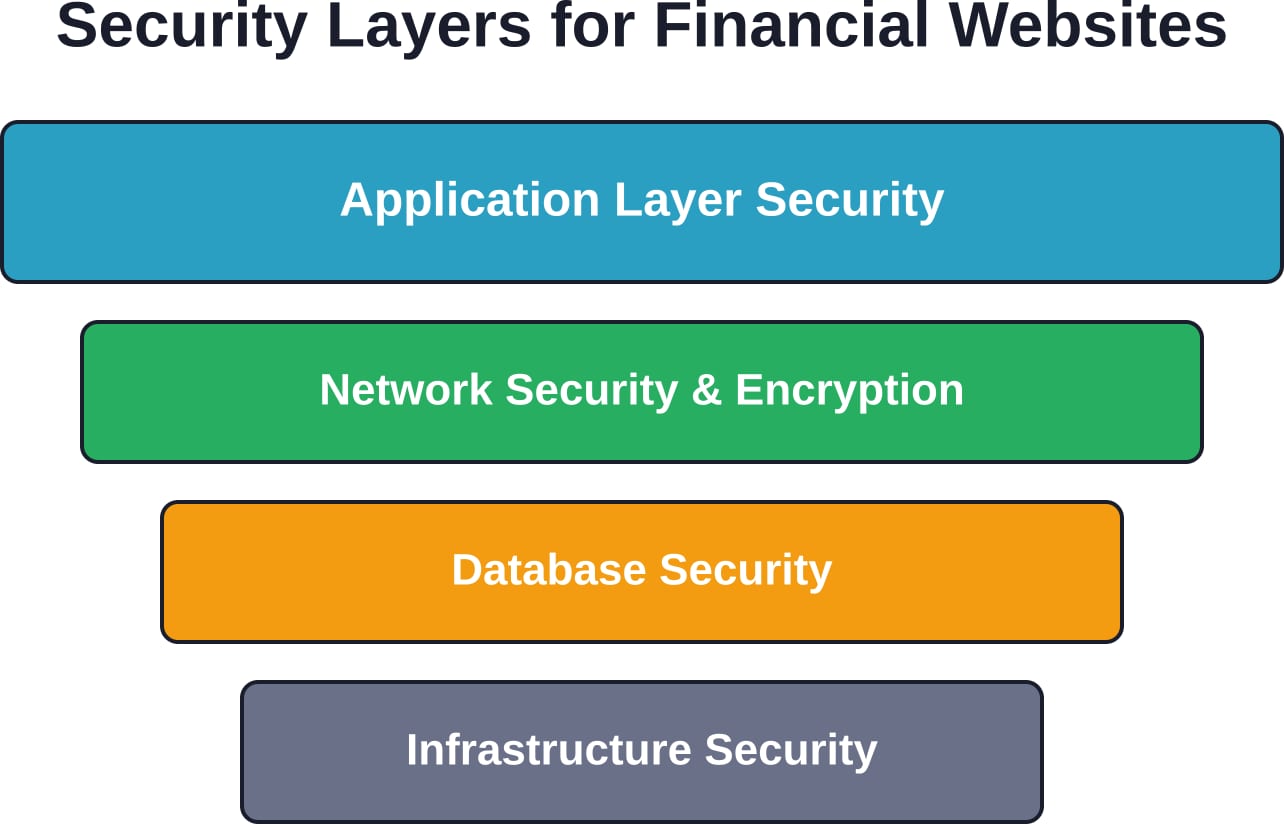
Security isn’t an afterthought in financial services website development. It’s the foundation everything else builds upon.
The National Institute of Standards and Technology publishes the Cybersecurity Framework, which provides a structured approach to managing cybersecurity risk. This framework has become a de facto standard for financial institutions designing secure systems.
Real talk: implementing robust security requires multiple layers working together.
OWASP Secure Coding Standards
\p>The OWASP Foundation publishes secure coding practices that have become essential references for financial application development. These guidelines address common vulnerabilities through a comprehensive checklist approach.
Key practices include:
- Conducting all input validation on trusted systems rather than client-side
- Identifying and classifying all data sources as trusted or untrusted
- Using centralized input validation routines across the application
- Specifying character sets like UTF-8 for all input sources
- Validating data length, range, format, and type before processing
These practices prevent injection attacks, cross-site scripting, and other exploitation vectors that target financial platforms. The cost of implementing these protections during development is substantially lower than addressing security breaches after launch.
Encryption and Data Protection
Financial websites must encrypt data both in transit and at rest. TLS 1.3 has become the minimum acceptable standard for protecting communications between clients and servers. Older protocols like SSL and TLS 1.0 contain known vulnerabilities that attackers actively exploit.
Database encryption protects stored information from unauthorized access. Even if infrastructure is compromised, encrypted data remains protected when proper key management is implemented.
That said, encryption alone doesn’t guarantee security. Access controls, authentication mechanisms, and audit logging work together to create defense in depth.
User Experience Design That Builds Trust
Financial services websites walk a tightrope. They need sophisticated functionality while maintaining simplicity that doesn’t overwhelm visitors. Security requirements must stay invisible to legitimate users while blocking threats.
Research consistently shows that 88% of visitors are less likely to return after a bad experience. In financial services, that percentage likely runs higher because alternative options are readily available.
Navigation and Information Architecture
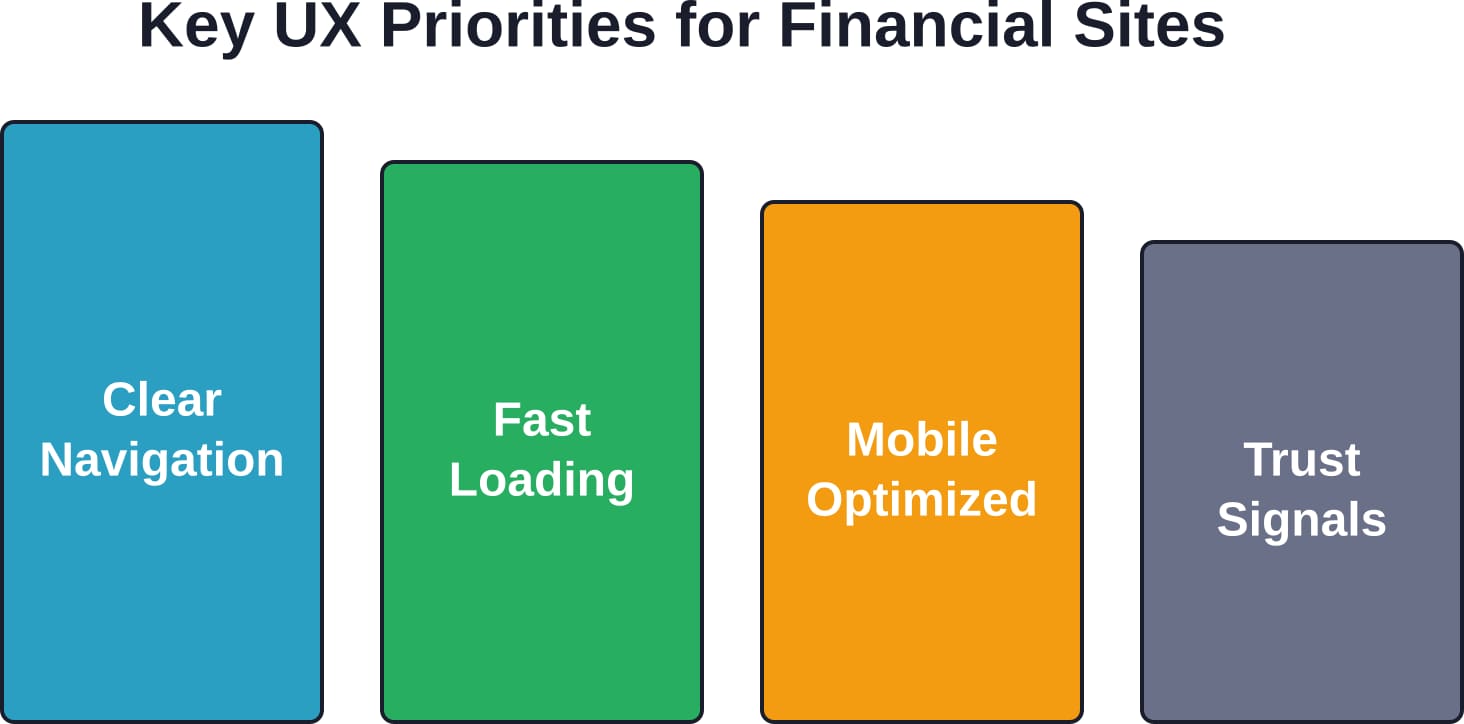
Clear navigation signals professionalism and competence. Financial services sites should organize content around client needs rather than internal organizational structure.
For wealth management firms, this might mean structuring navigation around life stages or financial goals rather than product categories. Investment platforms benefit from separating educational content, market data, and trading interfaces into distinct sections.
Site search functionality becomes critical as content libraries grow. Users searching for specific investment information or account features need accurate results delivered quickly.
Mobile Responsiveness Requirements
Mobile traffic accounts for the majority of web visits across most industries, and financial services is no exception. Responsive design ensures consistent functionality across devices without maintaining separate mobile sites.
But mobile optimization goes beyond responsive layouts. Touch targets need appropriate sizing, forms require mobile-friendly input methods, and critical actions should remain accessible without excessive scrolling or navigation.
Performance on mobile networks matters tremendously. Page load times under three seconds are essential, which requires optimized images, efficient code, and content delivery networks that serve assets from geographically distributed servers.
Content Strategy for Financial Audiences
Content serves multiple purposes on financial services websites. It educates prospects, demonstrates expertise, improves search visibility, and provides answers to common questions that would otherwise require client service time.
The challenge is creating content that satisfies both human readers and search engines without sacrificing compliance requirements.
Educational Content That Converts
Effective financial content addresses specific questions potential clients are actually asking. Generic information about investment principles or financial planning basics rarely drives meaningful engagement.
Better approaches focus on specific scenarios:
- Tax implications of different retirement account withdrawal strategies
- Comparing 529 plans versus custodial accounts for education savings
- Estate planning considerations for blended families
- Risk management strategies for concentrated stock positions
Each piece should guide readers toward a clear next step, whether scheduling a consultation, downloading detailed resources, or subscribing for updates.
Compliance Review Processes
Financial content requires review before publication. Investment advisers subject to SEC oversight must ensure marketing materials comply with rule 206(4)-1 under the Investment Advisers Act. As of January 2026, the SEC’s marketing compliance FAQs provide updated guidance on testimonials, endorsements, and performance advertising.
Establishing efficient review workflows prevents bottlenecks while maintaining compliance. Many firms implement tiered review where routine content requires single-person approval while complex claims or performance data trigger multi-level review including compliance officers.
Technology Stack Considerations
Selecting appropriate technologies for financial services websites requires balancing security, functionality, maintainability, and cost.
Modern financial platforms typically combine several specialized systems:
| Component | Purpose | Key Requirements |
|---|---|---|
| Content Management System | Public-facing content and marketing | Security patches, role-based access, audit logs |
| Client Portal | Secure document sharing, account access | Multi-factor authentication, encryption, session management |
| CRM Integration | Lead tracking, client management | Data synchronization, privacy controls, API security |
| Analytics Platform | Traffic analysis, conversion tracking | Privacy compliance, data retention policies |
API Security Standards
Financial services increasingly rely on APIs to connect systems and enable functionality. ISO 20022 remains the universal standard for financial messaging, while updated API security is governed by the FAPI (Financial-grade API) 2.0 security profile as of 2026.
API security requires authentication, authorization, rate limiting, input validation, and comprehensive logging. Each API endpoint represents a potential attack surface that must be hardened against exploitation.
Token-based authentication with short expiration windows limits exposure from compromised credentials. OAuth 2.0 has become the standard framework for delegated authorization, allowing third-party applications limited access without exposing primary credentials.
Scalability and Performance
Financial platforms experience variable load patterns. Market volatility drives traffic spikes as clients check portfolios or execute trades. Tax seasons create predictable surges in retirement account activity.
Infrastructure must scale to accommodate peak demand without over-provisioning for average loads. Cloud hosting enables elastic scaling where server capacity automatically adjusts based on traffic levels.
Content delivery networks cache static assets at edge locations closer to users, reducing latency and offloading traffic from origin servers. Database query optimization, caching strategies, and asynchronous processing all contribute to responsive performance under load.
Lead Generation and Conversion Optimization
Financial services websites should generate measurable business results. That means converting anonymous visitors into identified leads and nurturing those leads toward client relationships.
Survey data from 2024 found that 98% of advisors plan to increase website spending to generate more leads. This investment makes sense only when conversion mechanisms are properly implemented.
Conversion Path Design
Every page should have a clear purpose and appropriate calls to action. Homepage visitors might be ready to schedule consultations or might need education first. Content pages should offer related resources and gentle nudges toward engagement.
Effective conversion paths include:
- Consultation scheduling with calendar integration
- Resource downloads that capture contact information
- Newsletter subscriptions providing ongoing value
- Assessment tools that generate personalized results
- Chat interfaces for immediate question answering
Forms should request only essential information initially. Asking for comprehensive financial details before establishing trust creates friction that kills conversions. Progressive profiling gathers additional data over multiple interactions as relationships develop.
Trust Signals and Social Proof
Financial decisions involve significant trust. Websites must convey credibility through multiple signals that reassure skeptical visitors.
Effective trust elements include professional certifications prominently displayed, client testimonials with attribution, case studies demonstrating results, media mentions and industry recognition, and security badges confirming data protection.
But authenticity matters more than volume. One detailed testimonial explaining how specific guidance solved a real problem builds more trust than dozens of generic praise statements.
Search Visibility and AI Discoverability
Financial services websites compete in crowded search results where established players dominate top positions. Breaking through requires strategic optimization focused on specific audience segments and queries.
Technical SEO Foundation
Search visibility starts with technical fundamentals. Crawlable site architecture, XML sitemaps, robots.txt configuration, structured data markup, canonical URL management, and mobile-first indexing compatibility all enable search engines to properly discover and index content.
Schema markup provides explicit context about content type and meaning. Financial organizations can implement Organization schema, LocalBusiness schema for physical locations, Article schema for content pieces, and FAQPage schema for question-answer content.
Page speed directly impacts rankings and user experience. Core Web Vitals metrics measuring loading performance, interactivity, and visual stability have become ranking factors. Financial sites must optimize without compromising security or functionality.
Content Optimization for AI Search
Artificial intelligence is reshaping how users discover information. AI-powered search assistants extract direct answers rather than simply linking to pages. This shift requires content structured for extraction.
Strategies include concise answers to specific questions positioned early in content, clear section headings that signal topic coverage, bulleted lists and tables that present structured data, definition-style explanations for complex concepts, and natural language matching conversational queries.
Metadata and alt text provide additional context that AI systems use for understanding and categorization. These elements should accurately describe content without keyword stuffing that degrades quality.
Ongoing Maintenance and Updates
Financial services websites require continuous attention. Regulatory requirements change, security threats evolve, and user expectations advance.
Security Patch Management
Software vulnerabilities are discovered regularly in content management systems, plugins, frameworks, and dependencies. Unpatched vulnerabilities provide entry points for attackers specifically targeting financial institutions.
Effective patch management includes monitoring security announcements from vendors, testing updates in staging environments before production deployment, maintaining rollback capabilities for failed updates, and documenting all changes for compliance and troubleshooting.
The draft NIST guidelines released in December 2025 rethink cybersecurity for the AI era, addressing how organizations can incorporate AI into operations while mitigating risks. Financial institutions should monitor these evolving standards as AI capabilities become more prevalent in web platforms.
Content Refresh Cycles
Financial information becomes outdated quickly. Tax laws change, contribution limits adjust, and market conditions shift. Stale content damages credibility and provides inaccurate guidance.
Regular content audits identify pages requiring updates. High-traffic pages and those targeting important keywords deserve priority. Outdated statistics, changed regulations, and broken links all require correction.
Publication dates help visitors assess information currency. Transparent dating builds trust by acknowledging when content was created and last reviewed.
Measuring Success and ROI
Website investments should produce measurable returns. Tracking the right metrics enables data-driven decisions about optimization priorities.
| Metric Category | Key Indicators | Success Benchmarks |
|---|---|---|
| Traffic Quality | Organic search growth, target audience percentage | Month-over-month growth, 60%+ qualified traffic |
| Engagement | Pages per session, time on site, bounce rate | 3+ pages, 2+ minutes, under 50% bounce |
| Conversion | Lead form completions, consultation requests | 2-5% conversion rate for qualified traffic |
| Client Acquisition | Website-sourced clients, acquisition cost | Varies by service model and client value |
Attribution and Analytics
Understanding which channels drive valuable traffic enables effective budget allocation. Multi-touch attribution recognizes that financial services decisions involve extended research across multiple interactions.
Analytics platforms track visitor behavior, conversion paths, and content performance. Privacy-compliant implementations balance data collection with regulatory requirements and user expectations.
Campaign tracking with UTM parameters identifies traffic sources and campaign effectiveness. Consistent parameter usage enables accurate reporting across all marketing channels.
Choosing Development Partners
Many financial firms lack internal expertise for comprehensive website development. Selecting the right development partner significantly impacts project success.
Evaluation Criteria
Financial services experience matters because developers familiar with the industry understand regulatory requirements, security standards, and audience expectations without extensive education.
Technical capabilities should include modern frameworks, security best practices, performance optimization, accessibility standards, and integration experience with financial platforms.
Portfolio review reveals actual work quality and range of solutions delivered. Ask about specific security implementations, compliance challenges addressed, and performance metrics achieved.
Support and maintenance capabilities determine long-term success. Development projects don’t end at launch. Ongoing security updates, content management, feature additions, and optimization require continued partnership.
Project Management Approach
Clear requirements definition prevents scope creep and ensures deliverables match expectations. Detailed functional specifications, content inventories, integration requirements, and compliance needs should be documented before development begins.
Agile methodologies enable iterative development with regular feedback cycles. Rather than waiting months for complete builds, staged releases allow testing and refinement of core functionality before adding advanced features.
Transparent communication about progress, challenges, and timelines keeps projects on track. Regular status updates and accessible project management tools enable collaboration between development teams and stakeholders.
Future Trends in Financial Web Development
Several emerging trends will shape financial services websites over the coming years.
Personalization at Scale
Generic content gives way to personalized experiences tailored to individual visitor characteristics and behavior. Machine learning analyzes engagement patterns and predicts relevant content, product recommendations, and next steps.
Dynamic content assembly serves different information based on visitor segments, referral sources, or previous interactions. Personalization engines balance relevance with privacy, using anonymous behavioral data rather than personally identifiable information for initial segmentation.
Voice and Conversational Interfaces
Voice search adoption continues growing as natural language processing improves. Financial platforms optimized for voice queries position content to answer spoken questions.
Conversational interfaces powered by AI handle routine inquiries, schedule appointments, and guide visitors through complex processes. These systems reduce friction while freeing human advisors to focus on high-value interactions requiring judgment and relationship building.
Blockchain Integration
IEEE standard P3250.05 presents a reference framework for blockchain-based financial data circulation and valuation platforms. While still emerging, blockchain technologies offer potential for transparent transaction records, automated contract execution, and decentralized identity verification.
Financial institutions exploring blockchain applications should consider security implications, regulatory compliance, and practical use cases that deliver client value rather than implementing technology for its own sake.
Common Implementation Challenges
Financial services website projects encounter predictable obstacles. Awareness enables proactive mitigation.
Balancing Security and Usability
Robust security can create friction that frustrates legitimate users. Multi-factor authentication, session timeouts, and complex password requirements protect data but complicate access.
Smart implementations find middle ground through risk-based authentication that applies stricter controls only when suspicious activity is detected, biometric authentication that balances security with convenience, and single sign-on solutions that maintain security while reducing authentication frequency.
Managing Stakeholder Expectations
Website projects involve multiple stakeholders with different priorities. Compliance teams emphasize risk reduction, marketing focuses on lead generation, executives want impressive visuals, and technology teams prioritize maintainability.
Successful projects establish clear priorities early and document how design decisions support those priorities. Regular demos and feedback sessions keep stakeholders engaged while preventing last-minute surprises that derail timelines.
Integration Complexity
Financial websites rarely exist in isolation. Client portals, CRM systems, portfolio management platforms, document management solutions, and communication tools all require integration.
Each integration point introduces complexity, potential failure modes, and maintenance requirements. Careful planning identifies essential integrations while deferring nice-to-have connections that add cost without proportional value.
Accessibility Requirements
Financial services should be accessible to all clients regardless of disabilities. Beyond being the right thing to do, accessibility is increasingly required by law.
Web Content Accessibility Guidelines provide technical standards for accessible websites. Compliance requires semantic HTML structure, keyboard navigation support, screen reader compatibility, sufficient color contrast, text alternatives for images, and video captions.
Automated testing catches common issues but human testing with assistive technologies reveals usability problems that automated tools miss. Including users with disabilities in testing provides authentic feedback about accessibility quality.
Final Thoughts
Website development for financial services requires more than technical skill. Success demands understanding regulatory frameworks, implementing robust security, designing trust-building experiences, and creating measurable business results.
The financial sector continues evolving as technology enables new service models and client expectations rise. Websites must adapt while maintaining the security and compliance standards that protect clients and firms.
Organizations that treat websites as strategic assets rather than digital brochures gain competitive advantages through superior client experiences, operational efficiency, and sustained lead generation.
Start by assessing current digital presence against the standards outlined here. Identify gaps in security, compliance, user experience, or conversion optimization. Prioritize improvements based on risk, impact, and feasibility. Partner with experienced developers who understand financial services unique requirements.
The investment in professional website development pays dividends through enhanced credibility, operational efficiency, and growth. Take action now to build digital presence that serves clients effectively while driving business forward.