Quick Summary: Website development for doctors requires HIPAA-compliant platforms, mobile optimization, patient portal integration, and accessibility features. According to healthit.gov data, 87% of office-based physicians used telemedicine in 2021, making professional websites essential for practice growth. The right platform balances ease of use, security compliance, and patient engagement features while meeting federal privacy and interoperability standards.
Patient expectations have shifted dramatically. Over 77 percent of patients search online before booking an appointment, and nearly 60 percent say a provider’s website influences whether they trust the practice.
But here’s the thing though—building a medical website isn’t like launching a standard business site. Healthcare websites operate under strict federal regulations, privacy requirements, and security mandates that can expose practices to penalties can vary significantly depending on factors such as willful neglect, with annual caps for multiple violations of the same requirement.
The gap between what physicians need and what generic website builders offer has never been wider. This guide covers the technical, legal, and practical requirements that separate compliant medical websites from risky ones.
Why Standard Website Builders Fall Short for Medical Practices
Generic platforms like Wix or Squarespace offer beautiful templates. They’re fast to launch. But they weren’t architected with protected health information in mind.
The HIPAA Security Rule establishes mandatory safeguards to protect electronic protected health information (ePHI). According to HHS.gov guidance, these requirements apply the moment a website collects, stores, or transmits any patient-identifiable data—even something as simple as an appointment request form with a name and birth date.
Real talk: most doctors don’t realize their contact forms might be creating HIPAA exposure. If the form asks for health-related information and the platform lacks a Business Associate Agreement (BAA), the practice is operating outside compliance.
Standard builders also struggle with healthcare-specific functionality. Patient portals, telemedicine integration, insurance verification tools, and HL7 FHIR data exchange protocols require specialized development that general-purpose platforms simply don’t support.
Federal Compliance Requirements Doctors Can’t Ignore
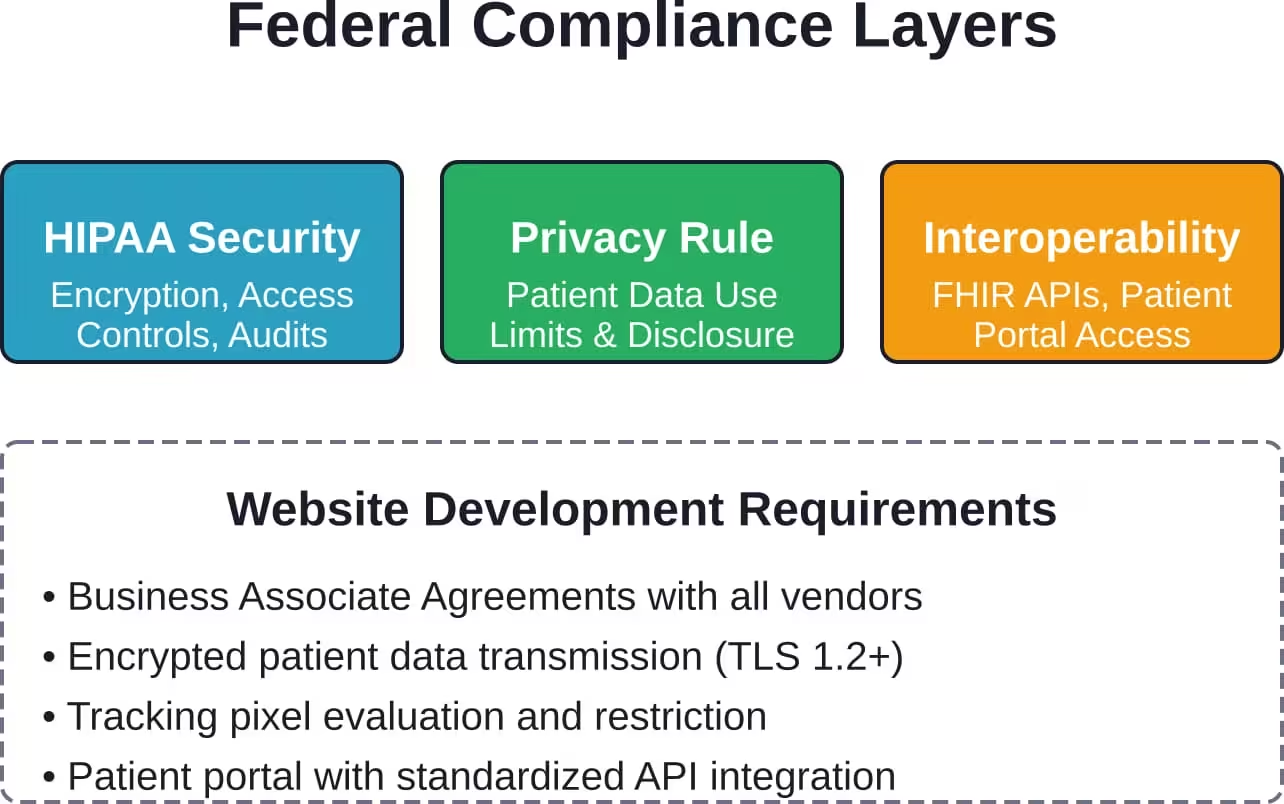
Three federal frameworks govern medical website development in 2026. Miss any one of them and practices face regulatory penalties, patient trust erosion, or both.
HIPAA Privacy and Security Rules
The Privacy Rule sets limits on how protected health information can be used and disclosed. The Security Rule mandates administrative, physical, and technical safeguards for ePHI.
For websites, this translates to:
- Encryption for data in transit (HTTPS/TLS certificates are mandatory, not optional)
- Access controls limiting who can view patient data
- Audit logs tracking all ePHI access
- Regular risk assessments identifying vulnerabilities
- Business Associate Agreements with any vendor handling patient data
According to HHS.gov penalty guidelines, fines vary significantly depending on factors such as the date of violation and whether willful neglect was involved, with calendar year caps for multiple violations of the same requirement. The distinction between “didn’t know” and “willful neglect” matters—a lot.
Online Tracking Technologies Guidance
In December 2022, HHS issued guidance on tracking pixels and analytics tools (updated in March 2024). The rule: if your website uses Google Analytics, Facebook Pixel, or similar trackers on pages where patient information is collected or displayed, those tools may be transmitting ePHI to third parties without proper authorization.
A federal court partially vacated portions of this guidance in June 2024, but the core principle remains: practices must evaluate whether tracking technologies create unauthorized disclosures. Many medical practices have removed analytics entirely from patient portal pages to eliminate risk.
Interoperability and Patient Access Standards
The CMS Interoperability and Patient Access Rule requires covered providers to make health information accessible to patients through standardized APIs. According to healthit.gov data, 96% of non-federal acute care hospitals now electronically send care records, and according to healthit.gov data, 65% of individuals were offered and accessed online medical records or patient portals in 2024.
For website development, this means planning for HL7 FHIR API integration, patient portal functionality, and secure data exchange capabilities from day one. Retrofitting these features later costs significantly more than building them into the initial architecture.
Core Features Every Medical Website Needs
What separates a functional medical website from one that converts visitors into patients? Testing across hundreds of practices reveals consistent patterns.
Mobile-First Responsive Design
Over 70 percent of healthcare searches now happen on mobile devices. But responsive design in healthcare means more than shrinking desktop layouts.
Touch targets for phone numbers and appointment buttons need minimum 44×44 pixel dimensions. Forms must work with auto-fill. Insurance card uploads require mobile camera integration. Map directions should trigger native navigation apps with a single tap.
Practices with properly optimized mobile experiences report 40-60% higher appointment request completion rates compared to desktop-first designs.
Patient Portal Integration
According to healthit.gov statistics, 65% of individuals were offered and accessed online medical records or patient portals in 2024. That number continues climbing.
Modern patient portals provide:
- Appointment scheduling and reminders
- Lab results and imaging access
- Prescription refill requests
- Secure messaging with care teams
- Bill payment and insurance information
- Health history documentation
The technical challenge: integrating portals with existing Electronic Health Record (EHR) systems. HL7 FHIR standards make this more feasible than legacy HL7 v2 protocols, but implementation still requires specialized development expertise.
Telemedicine Capabilities
According to healthit.gov Data Brief 65, telemedicine use among office-based physicians increased from 15% in 2018-2019 to 87% in 2021. That’s a six-fold increase in under three years.
But here’s what the data also shows: a significant portion of physicians report patient difficulty with telemedicine tools as a main barrier to adoption. Technical friction—confusing interfaces, failed connections, browser compatibility issues—directly reduces utilization.
Effective telemedicine website integration requires:
- Browser-based video (no app downloads)
- Pre-visit connectivity testing
- Clear troubleshooting instructions
- Mobile device support
- HIPAA-compliant video encryption
- Session recording controls and patient consent
Physician satisfaction with telemedicine implementation varies, with reports indicating room for improvement in technical design.
Accessibility Compliance (WCAG 2.1 AA)
The Americans with Disabilities Act applies to healthcare websites. Lawsuits targeting inaccessible medical sites have increased 300% since 2020.
WCAG 2.1 Level AA compliance requires:
- Keyboard navigation for all interactive elements
- Screen reader compatibility with proper ARIA labels
- Sufficient color contrast (4.5:1 minimum for body text)
- Captions for video content
- Descriptive link text (not “click here”)
- Resizable text up to 200% without breaking layouts
Accessibility isn’t just legal compliance—it’s good medicine. Patients with disabilities represent a significant portion of healthcare consumers, and accessible design serves them better while simultaneously improving usability for all visitors.
Platform Selection: Specialized vs. General Solutions
The market offers two paths: healthcare-specific website builders or general platforms with medical customization.
| Platform Type | Compliance Support | Customization | Cost Range | Best For |
|---|---|---|---|---|
| Healthcare-Specific | Built-in HIPAA, BAAs included | Limited to templates | $100-500/month | Solo and small practices |
| Custom Development | Requires expert implementation | Fully customizable | $40,000-200,000+ | Large groups, hospitals |
| WordPress (Medical Themes) | Plugin-dependent, varies widely | High with technical skill | $2,000-15,000 | Tech-savvy practices |
| General Builders (Wix, Squarespace) | Limited or absent | Moderate | $20-100/month | Non-patient-data sites only |
Healthcare-specific builders like Officite, RemedyConnect, and Dr. Leonardo provide pre-configured HIPAA compliance, Business Associate Agreements, and medical-focused features. Over 8,000 healthcare professionals use Officite according to Officite’s company information.
The trade-off: less design flexibility and higher ongoing costs compared to self-hosted solutions. But for practices without in-house technical staff, the compliance peace of mind often justifies the premium.
Custom development offers maximum control but requires significant upfront investment. Research in digital health technology development indicates projects can range from $40,000 to $200,000 depending on complexity, which aligns with medical website development costs for sophisticated patient engagement platforms.
Content Strategy for Medical Websites
Technical compliance means nothing if patients can’t find or trust the information they need.
Patient Education and Trust Building
Research indicates a significant gap between patient desire for physician-recommended web-based medical information and actual receipt of such recommendations. That’s a massive gap.
The opportunity: practices that provide vetted educational content directly on their websites build trust while simultaneously improving search visibility. Patients searching “how to manage diabetes” or “what to expect after knee replacement” represent high-intent traffic when the practice treats those conditions.
But there’s a quality threshold. Research on medical teaching websites found that only a minority included all components of active learning (critical thinking, independent learning, evidence-based content, feedback), and fewer than 50% met any active learning criteria according to Cook et al.
Effective medical content:
- Answers patient questions in plain language (8th-grade reading level)
- Cites credible sources without excessive medical jargon
- Includes visuals explaining complex concepts
- Updates regularly to reflect current clinical guidelines
- Avoids overpromising outcomes or guarantees
Local SEO Optimization
Most medical practices serve geographic areas. Local search optimization determines whether “cardiologist near me” searches surface your practice or competitors.
Critical elements include:
- Google Business Profile optimization with accurate hours, services, photos
- NAP consistency (Name, Address, Phone) across all directory listings
- Schema markup for medical businesses and providers
- Location pages for multi-site practices
- Patient reviews and reputation management
Local search optimization significantly impacts visibility for medical search queries. The difference between ranking #1 and #4 locally can mean dozens of additional patient appointments per month.
Security Architecture Beyond Basic Compliance
Meeting minimum HIPAA requirements and building genuinely secure infrastructure aren’t the same thing.
The National Institute of Standards and Technology (NIST) publishes SP 800-66, “Implementing the Health Insurance Portability and Accountability Act (HIPAA) Security Rule,” which provides technical guidance beyond the regulatory text. NIST also released updated cybersecurity guidance for healthcare organizations in 2022 and published CSWP 34 on mitigating cybersecurity and privacy risks in telehealth smart home integration.
Advanced security measures include:
- Web Application Firewalls (WAF) blocking common attack patterns
- Content Security Policy headers preventing cross-site scripting
- Rate limiting on authentication endpoints to prevent brute force
- Automated vulnerability scanning and patch management
- Penetration testing on annual or bi-annual schedules
- Intrusion detection systems monitoring for anomalous traffic
None of these appear in HIPAA’s minimum standards, but all represent security best practices for organizations handling sensitive health data.
Cost Considerations and Budget Planning
Website development costs vary dramatically based on approach, features, and compliance requirements.
| Development Approach | Initial Cost | Annual Maintenance | Compliance Support |
|---|---|---|---|
| DIY Website Builder | $0-500 | $240-1,200 | Minimal |
| Healthcare Platform (Officite, etc.) | $1,500-3,000 | $1,200-6,000 | Comprehensive |
| Custom WordPress Development | $5,000-15,000 | $1,500-3,000 | Developer-dependent |
| Full Custom Development | $40,000-200,000 | $10,000-30,000 | Comprehensive if specified |
The hidden costs matter more than initial development. Ongoing expenses include:
- Hosting and SSL certificates
- Security monitoring and incident response
- Compliance audits and documentation
- Content updates and medical accuracy reviews
- Software updates and vulnerability patches
- Patient portal maintenance and support
Practices that budget only for initial development typically face unexpected bills when security incidents occur or regulatory audits identify gaps.
Build a Medical Website That Drives Patient Requests
Many medical websites look outdated or hard to use, which makes it difficult for patients to find information or get in touch. In healthcare, this usually leads to missed inquiries and extra friction in communication.
Lengreo works on website development as a structured, step-by-step process rather than a quick build. They begin with research and analysis, then move into design, development, and launch. This approach helps create websites that are easier to navigate and better aligned with how a medical practice presents its services and communicates with patients.
Set Up a Clear Medical Website With Reliable Support
Lengreo handles the full development cycle so the website is built and launched without gaps:
- Analysis and research before any design decisions
- Prototype creation with ongoing feedback
- Front-end and back-end development in controlled stages
- Full setup, migration, and testing before launch
- Short-term fixes after launch and optional ongoing support
Talk to Lengreo and get a clear plan for your medical website.
Common Implementation Mistakes to Avoid
After reviewing hundreds of medical website projects, certain patterns of failure emerge consistently.
Neglecting Business Associate Agreements
Every vendor with access to ePHI needs a signed BAA. That includes hosting providers, analytics platforms, form processors, appointment schedulers, and email service providers.
Many practices launch websites without securing these agreements, creating immediate HIPAA violations. The risk compounds when practices don’t even know which third-party services their website uses—tracking pixels and embedded widgets often transmit data without clear disclosure.
Ignoring Mobile Performance
Sites that load slowly on mobile devices lose patients. Mobile site performance significantly impacts user retention and conversion rates.
Medical websites frequently suffer from oversized images, unoptimized scripts, and excessive third-party integrations. Testing with actual mobile devices on cellular connections (not just desktop browsers resized) reveals issues that desktop-focused development misses.
Overlooking Content Maintenance
Launch-day content becomes outdated quickly. Office hours change. Providers join or leave. Insurance networks shift. Treatment protocols evolve.
Outdated information erodes trust faster than no information. Practices need documented content review schedules—quarterly at minimum for static pages, more frequently for time-sensitive information like hours and insurance acceptance.
Measuring Website Performance and ROI
What metrics actually matter for medical websites?
Vanity metrics like page views and session duration don’t translate to business value. Focus instead on:
- Appointment request conversions (form submissions per visitor)
- Phone call tracking (unique callers from website traffic)
- Patient portal registrations and active usage rates
- Local search rankings for target procedures and conditions
- New patient acquisition cost (marketing spend ÷ new patients)
Analytics implementation in healthcare requires privacy considerations. Track aggregate patterns, not individual patient journeys. Avoid collecting ePHI in analytics platforms. Use server-side tracking where possible to maintain better data control.
Practices should benchmark against industry standards: medical website conversion performance varies by practice and design approach. Focus on setting internal baselines and tracking improvement over time rather than comparing against external benchmarks, as conversion rates vary based on specialty, patient population, and local competition.
Future-Proofing Your Medical Website
Healthcare technology evolves rapidly. Websites built today need architecture that accommodates tomorrow’s requirements.
Key considerations include:
- API-first design enabling integration with emerging tools
- Scalable hosting that grows with practice expansion
- Headless CMS architecture separating content from presentation
- Progressive Web App capabilities for app-like mobile experiences
- AI readiness for chatbots and automated patient communication
According to HL7 blog analysis, cloud providers including Amazon, Google, IBM, Microsoft, Oracle, and Salesforce committed to healthcare interoperability using open standards. Building on standards-based platforms positions practices to adopt new technologies as they mature without complete rebuilds.
The rapid adoption of artificial intelligence in healthcare also creates new considerations. AI-powered features like symptom checkers, appointment optimization, and clinical decision support will increasingly integrate with medical websites. Practices building flexible, API-enabled platforms can adopt these capabilities incrementally rather than facing forklift upgrades.
Taking the Next Step
Website development for doctors balances competing demands: patient engagement and regulatory compliance, aesthetic appeal and functional performance, ease of use and robust security.
The practices succeeding online don’t necessarily have the biggest budgets or fanciest designs. They have websites built on solid technical foundations, maintained consistently, and designed with patient needs as the primary focus.
Start by auditing current web presence against the requirements outlined here. Identify compliance gaps first—these create the most immediate risk. Then evaluate patient-facing functionality: can visitors easily find information, request appointments, and access care?
Whether building from scratch or updating an existing site, prioritize these elements: HIPAA-compliant infrastructure, mobile optimization, clear patient pathways, and accurate, accessible content. Everything else is refinement.
The investment in professional website development pays dividends in patient acquisition, operational efficiency, and regulatory risk reduction. In 2026, a medical practice without a strong web presence operates at a fundamental competitive disadvantage—one that compounds with every passing month.