


Quick Summary: B2B website development in 2026 focuses on creating sophisticated digital platforms that support complex purchasing journeys, with 70% of decision-makers now open to self-serve purchases exceeding $50,000. Successful B2B websites combine fast performance (70% of users say page speed influences buying decisions), robust ecommerce functionality, and conversion-focused design. Strategic development addresses longer sales cycles, multiple stakeholders, and the need for detailed product information while leveraging emerging technologies like AI and advanced analytics.
The B2B buying landscape has transformed dramatically. Business buyers expect the same sophisticated digital experiences they get as consumers, and they’re increasingly comfortable making substantial purchasing decisions entirely online.
According to McKinsey & Company research, 70% of B2B decision-makers are open to making new, fully self-serve or remote purchases exceeding $50,000. Even more striking, 27% would spend more than $500,000 through digital channels.
This shift creates both opportunity and pressure. B2B leaders expect more than half their revenue to come from digital channels over the next two years. But capturing that revenue requires website development that goes far beyond basic brochure sites.
What Makes B2B Website Development Different
B2B website development addresses fundamentally different challenges than B2C projects. The stakes are higher, the buying journey is longer, and the technical requirements are more complex.
Business buyers aren’t impulsive. They ask more questions, perform extensive research, and spend considerable time evaluating options. Multiple stakeholders often participate in purchase decisions, each with different concerns and priorities.
This means B2B websites need to support complex information architecture, detailed product specifications, custom pricing models, and content that speaks to various roles within client organizations.
The Multi-Stakeholder Challenge
A single B2B purchase might involve technical evaluators, financial decision-makers, end users, and executive approvers. Each needs different information presented in formats that match their concerns.
Technical teams want specifications, integration documentation, and performance data. Financial stakeholders need ROI calculators, pricing transparency, and cost-of-ownership breakdowns. Executives look for strategic value propositions and risk mitigation.
Effective B2B website development creates pathways for all these personas without creating a cluttered, confusing experience.
Longer Sales Cycles Demand More Content
B2C purchases often happen in minutes. B2B sales cycles can stretch across months or even years for enterprise solutions.
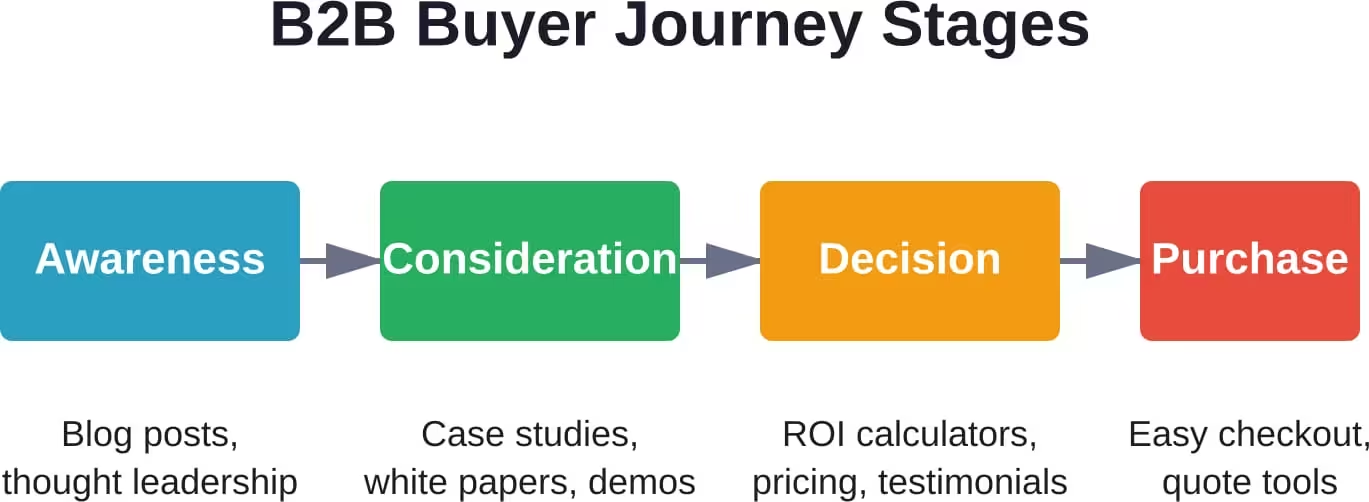
This extended timeline requires websites that nurture prospects through multiple touchpoints. Case studies, white papers, webinars, product demos, and thought leadership content all play roles in moving buyers through consideration stages.
The development architecture must support this content ecosystem while making it easy for prospects to find exactly what they need at each stage.
Get a B2B Website, Supporting Lead Generation From Day One
In B2B, a website isn’t just a place to describe services. It needs to support how leads are generated, qualified, and moved forward. Without that connection, even a well-designed site won’t deliver consistent results. Lengreo works across both website development and B2B digital marketing, which allows them to build websites that support lead generation and outreach efforts. Instead of treating the website as a standalone asset, it’s developed to fit alongside traffic, conversion, and ongoing growth activities.
Connect Your Website to Your B2B Growth Efforts
With Lengreo, the website is built to fit alongside your marketing and lead generation activities:
- Aligns with your B2B strategy and targeting
- Supports SEO and organic traffic growth
- Works with paid campaigns and outreach channels
- Expands as your marketing efforts grow
Talk to Lengreo and build a website that works together with your B2B strategy.
Essential Features for B2B Website Development
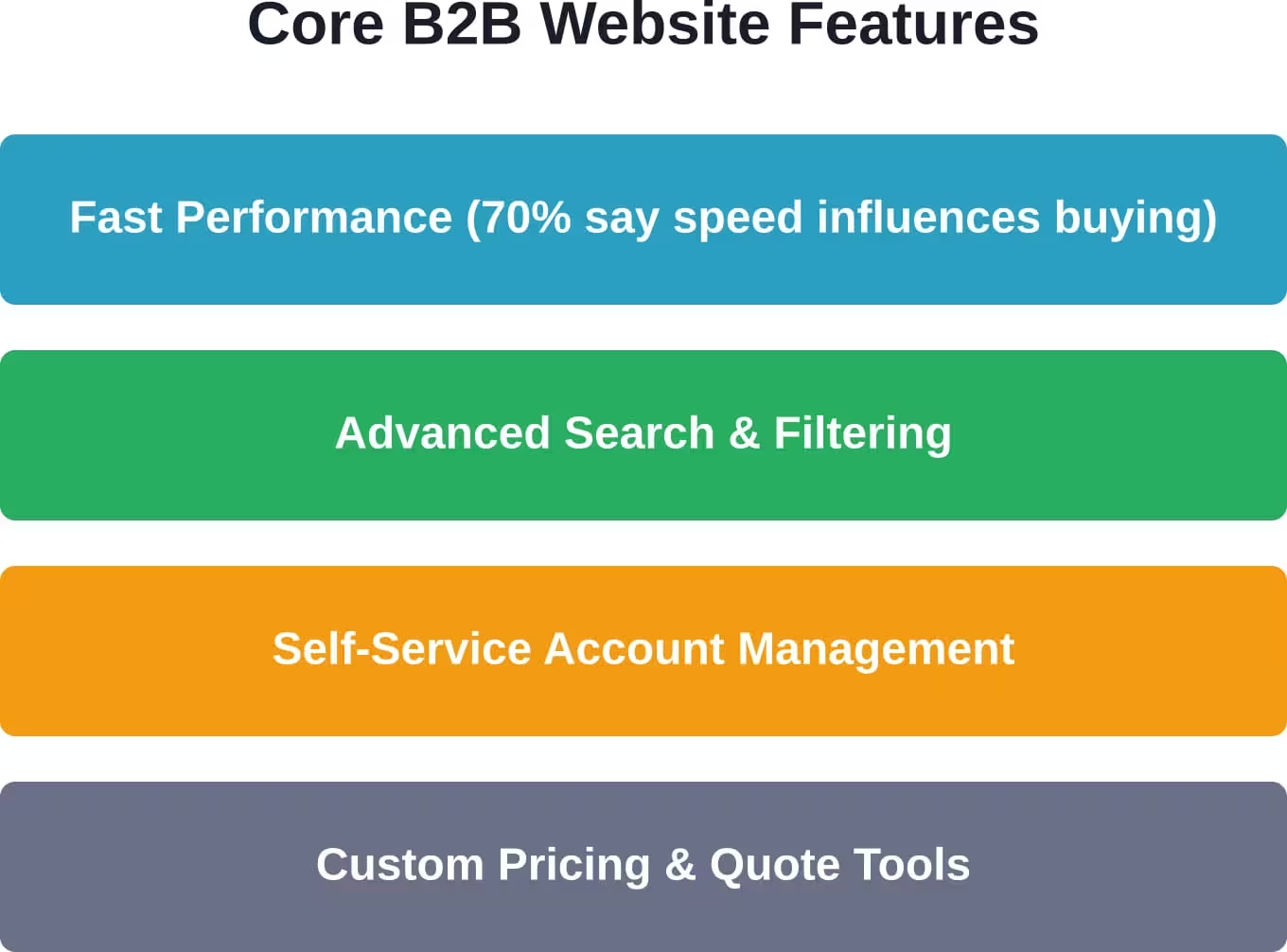
Certain capabilities have become table stakes for competitive B2B websites in 2026. Missing any of these creates friction that sends potential clients elsewhere.
Performance Optimization
Speed isn’t optional. About 70% of online users say page load speed influences their purchasing decisions.
Business buyers are busy professionals. Slow sites create immediate negative impressions and tangibly hinder sales. The highest conversion rates occur on pages with load times between 0-2 seconds.
B2B website development must prioritize performance from the foundation. This includes optimized hosting infrastructure, efficient code, image optimization, lazy loading for below-the-fold content, and strategic caching.
Content delivery networks (CDNs) help ensure fast load times regardless of geographic location, particularly important for companies serving global markets.
Advanced Search Functionality
B2B catalogs often contain hundreds or thousands of products with complex specifications. Buyers need powerful search tools to find exactly what they need without frustration.
Effective search goes beyond basic keyword matching. It includes faceted filtering (refine by category, specification, price range, availability), autocomplete suggestions, search result relevance ranking, and the ability to save searches or create comparison lists.
For technical products, search should handle part numbers, model variations, and specification-based queries.
Self-Service Account Portals
B2B buyers want autonomy. They expect to access order history, track shipments, download invoices, manage users, view account-specific pricing, and reorder quickly without contacting sales representatives.
Gartner predicted that 80% of B2B sales interactions between suppliers and buyers would occur via digital channels by 2025, making robust self-service capabilities essential rather than optional.
Development should include secure authentication, role-based permissions (especially for organizations with multiple users), intuitive dashboards, and integration with backend business systems.
Custom Pricing and Quote Generation
Unlike B2C’s fixed pricing, B2B often involves negotiated rates, volume discounts, contract pricing, and custom quotes based on specific requirements.
Website development must accommodate these complexities. This might include displaying customer-specific pricing after login, quote request forms that capture detailed requirements, configurators for customizable products, and integration with CRM and ERP systems.
For companies with standardized pricing, transparency builds trust. For those with variable pricing, tools that help buyers understand cost drivers and get quick estimates reduce friction.
B2B Ecommerce Website Development
The wholesale ecommerce market reached $12.2 trillion in value in 2019, six times larger than the B2C market. B2B ecommerce website development has become a strategic imperative, not a nice-to-have.
But ecommerce for business buyers requires capabilities far beyond standard online store platforms.
Complex Ordering Workflows
B2B transactions involve approval workflows, purchase order integration, blanket orders, scheduled deliveries, and split shipments. Development must support these operational realities.
Buyers might need to submit orders for approval before purchase, route different order types through different processes, or set up recurring orders with specific delivery schedules.
The ecommerce platform architecture should handle these variations without forcing buyers into rigid, consumer-style checkout flows that don’t match their procurement processes.
Integration Requirements
B2B ecommerce doesn’t exist in isolation. It must connect with existing business systems to provide real value.
Critical integrations typically include ERP systems for inventory and order management, CRM platforms for customer data and sales tracking, accounting software for invoicing and payments, warehouse management systems, and shipping carriers for real-time rates and tracking.
API-first development approaches provide flexibility for these integrations while maintaining security and performance.
| Integration Type | Primary Benefit | Common Challenges |
|---|---|---|
| ERP Systems | Real-time inventory accuracy and automated order processing | Legacy system limitations, data synchronization timing |
| CRM Platforms | Unified customer view, better sales enablement | Maintaining data consistency across systems |
| Payment Gateways | Secure transactions, multiple payment methods | PCI compliance, international payment variations |
| Shipping Services | Accurate rates, automated tracking, label generation | Handling multiple carriers, address validation |
Payment Flexibility
B2B payment preferences differ significantly from consumer expectations. While credit cards work for some transactions, many businesses prefer terms like Net 30 or Net 60, purchase orders, wire transfers, or ACH payments.
Ecommerce development should accommodate multiple payment methods, credit limit enforcement for account-based payment terms, partial payments for large orders, and integration with accounts receivable processes.
Security is paramount when handling business financial information and storing payment credentials for repeat purchases.
Design Principles for B2B Websites
Design for B2B serves different goals than consumer-facing sites. The focus shifts from emotional engagement to credibility, clarity, and conversion optimization.
That doesn’t mean B2B websites should be boring. But aesthetic choices must support functional objectives and build trust with professional buyers.
Credibility-Focused Visual Design
First impressions matter enormously. A massive 42% of people will leave a website if functionality isn’t up to scratch or if they can’t quickly find needed information.
Visual design signals professionalism and competence. This includes clean, modern layouts that don’t feel dated, consistent branding that reinforces company identity, high-quality imagery (especially product photography), and thoughtful typography that enhances readability.
White space isn’t wasted space. It creates a visual breathing room that helps buyers focus on important information without feeling overwhelmed.
Conversion-Optimized User Experience
Every element should guide buyers toward desired actions, whether that’s requesting a quote, downloading a resource, scheduling a demo, or completing a purchase.
Clear calls-to-action, intuitive navigation that matches how buyers think about products or services, prominent search functionality, and removal of unnecessary friction points all contribute to better conversion rates.
Forms deserve special attention. B2B often requires more information than B2C, but every field adds friction. Development should balance the need for qualifying information against the risk of form abandonment.
Mobile Responsiveness
Business buyers increasingly research on mobile devices, even if final purchases happen on desktop. Responsive design ensures positive experiences across all devices.
This means more than just resizing content. Touch-friendly interface elements, streamlined mobile navigation, fast mobile load times, and consideration for how mobile users interact with complex product information all factor into effective responsive development.
SEO Strategy for B2B Website Development
Search engine optimization for B2B differs from consumer SEO in significant ways. Business buyers use different search patterns, often including technical terms, industry jargon, and specific product identifiers.
Understanding keyword optimization forms the foundation of search-friendly site design. But technical SEO and content strategy matter just as much.
Technical SEO Foundation
Search engines must be able to crawl, understand, and index website content effectively. Technical issues create barriers that prevent even great content from ranking.
Development should address site architecture and URL structure that makes sense to both users and search engines, XML sitemaps that help search engines discover content, schema markup that provides context about products and organization, canonical tags to avoid duplicate content issues, and proper redirect handling for changed URLs.
Page speed factors directly into rankings, making performance optimization an SEO requirement as well as a user experience necessity.
Content Strategy for Long Sales Cycles
B2B SEO succeeds when content addresses questions buyers ask throughout extended purchase journeys.
This requires mapping content to different stages. Early-stage buyers need educational content that helps them understand problems and potential solutions. Middle-stage prospects want detailed product information, comparisons, and proof points. Late-stage buyers seek pricing, implementation details, and risk mitigation.
Product pages should include comprehensive specifications, use cases, compatibility information, and answers to common questions. Industry-specific terminology helps match how buyers actually search.
Local SEO for Regional B2B Companies
Companies serving specific geographic markets need local SEO strategies. This includes optimized Google Business Profiles, location-specific landing pages for multi-location businesses, local citations and directory listings, and content addressing regional market conditions or regulations.
Even national B2B companies often want to rank for location-specific searches when buyers prefer local suppliers or require on-site service capabilities.
Technology Stack Decisions
Choosing the right technology foundation influences everything from development timelines to long-term scalability and maintenance costs.
The ideal stack depends on specific business requirements, technical team capabilities, budget constraints, and growth projections.
Platform Options
B2B websites can be built on various foundations, each with trade-offs.
Enterprise ecommerce platforms like Salesforce Commerce Cloud, SAP Commerce, or Adobe Commerce offer comprehensive features and scalability but come with higher costs and complexity. They make sense for large organizations with significant transaction volumes and complex requirements.
Mid-market platforms such as BigCommerce, Shopify Plus, or WooCommerce provide good feature sets at lower price points. They work well for companies with straightforward B2B needs and smaller technical teams.
Custom development using frameworks like Next.js, Laravel, or Django offers maximum flexibility but requires substantial development resources and ongoing maintenance.
Headless architectures separate frontend presentation from backend commerce logic, providing flexibility to create unique experiences while leveraging robust commerce engines.
| Approach | Best For | Investment Level |
|---|---|---|
| Enterprise Platform | Large catalogs, high volume, complex workflows | $50,000+ initial, significant ongoing costs |
| Mid-Market Platform | Growing businesses, standard B2B features | $10,000-$50,000 initial, moderate ongoing costs |
| Custom Development | Unique requirements, full control needed | $25,000-$100,000+, higher maintenance |
| Headless Commerce | Omnichannel needs, developer resources available | $30,000-$80,000, technical expertise required |
Security Requirements
B2B websites handle sensitive business information including customer data, pricing agreements, order details, and payment information. Security can’t be an afterthought.
Essential security measures include SSL certificates for encrypted data transmission, regular security updates and patches, secure authentication with multi-factor options, role-based access controls, PCI compliance for payment processing, and regular security audits and penetration testing.
Data privacy regulations like GDPR or CCPA may apply depending on markets served, requiring careful attention to data collection, storage, and processing practices.
Scalability Planning
Websites should grow with the business. Scalability considerations during initial development prevent costly rebuilds later.
This includes hosting infrastructure that can handle traffic growth, database architecture that performs well as product catalogs expand, code optimization that maintains speed under load, and integration approaches that accommodate adding new systems.
Cloud hosting provides flexibility to scale resources up or down based on demand, making it particularly attractive for B2B ecommerce with seasonal variations or rapid growth.
Emerging Technologies in B2B Website Development
Technology continues evolving rapidly. Forward-thinking B2B companies explore emerging capabilities that can provide competitive advantages.
Artificial Intelligence Applications
AI adoption is accelerating across commerce, with many commerce leaders experimenting with AI technologies.
Practical B2B applications include personalized product recommendations based on purchase history and browsing behavior, intelligent search that understands intent and context, chatbots for initial customer service inquiries, predictive analytics for inventory management, and automated content generation for product descriptions.
According to the U.S. Small Business Administration, AI can help businesses do more with less, a particularly valuable capability for small and mid-sized B2B companies.
Advanced Personalization
Personalization goes beyond addressing customers by name. Sophisticated implementations adapt entire experiences based on account type, role, purchase history, and behavior.
This might include showing different product assortments to different customer segments, surfacing relevant content based on industry or use case, displaying account-specific pricing and inventory, or customizing navigation based on how individual users interact with the site.
Personalization requires data infrastructure to capture and analyze user behavior while respecting privacy boundaries and preferences.
Augmented Reality for Product Visualization
For products where size, appearance, or spatial relationships matter, AR helps buyers visualize solutions in their own environments.
Industrial equipment manufacturers might offer AR views showing how machines fit in factory layouts. Office furniture suppliers could let buyers see products in their actual spaces. Technical products might use AR to explain internal components or assembly processes.
While still emerging, AR technology is becoming more accessible through web-based implementations that don’t require dedicated apps.
Content Development for B2B Sites
Content strategy deserves dedicated attention in B2B website development. The right content educates buyers, builds credibility, and moves prospects through sales funnels.
Product Content That Sells
Product pages are where research converts to action. They must answer every question a buyer might have.
Comprehensive product descriptions include technical specifications, dimensions and materials, use cases and applications, compatibility information, certifications or compliance details, and clear pricing or quote mechanisms.
High-quality images from multiple angles, technical drawings or schematics, and videos demonstrating products in use all enhance understanding and build confidence.
Educational Resources
Buyers engage with multiple pieces of content before making purchase decisions. Educational resources position companies as trusted advisors rather than just vendors.
Effective formats include how-to guides addressing common challenges, industry trend analyses, comparison guides helping buyers evaluate options, best practice documentation, and technical white papers for complex solutions.
According to the Small Business Administration’s guidance on marketing and sales, creating valuable content helps persuade potential customers by demonstrating expertise and understanding of their needs.
Case Studies and Social Proof
Business buyers want evidence that solutions work for companies like theirs. Case studies provide concrete proof points.
Strong case studies describe the initial problem or challenge, the solution implemented, specific results achieved with quantifiable metrics, and lessons learned or best practices.
Client testimonials, industry certifications, awards, and partnership badges all contribute to credibility. Display these prominently but authentically.
Post-Launch Optimization
Website launch isn’t the finish line. It’s the starting point for continuous improvement based on real user data and business results.
Analytics and Measurement
Tracking the right metrics reveals what’s working and where opportunities exist.
Key performance indicators for B2B sites typically include conversion rate (quote requests, account registrations, purchases), average order value, revenue per visitor, page load times, bounce rates by page type, and customer acquisition cost.
Analytics platforms should track user journeys across multiple visits, since B2B buying cycles rarely complete in single sessions.
A/B Testing Strategy
Testing removes guesswork from optimization decisions. Systematic experimentation identifies changes that actually improve results.
Productive test areas include call-to-action copy and placement, form field requirements and layout, product page content organization, navigation structures, and checkout process flows.
Testing should focus on meaningful business outcomes, not vanity metrics. A change that increases quote requests by 15% matters more than one that improves time-on-page but doesn’t affect conversions.
Ongoing Maintenance
Websites require regular attention to remain secure, performant, and effective.
Maintenance activities include security updates and patches, content updates and expansions, performance monitoring and optimization, backup verification, broken link checks, and integration maintenance as connected systems evolve.
Planning for ongoing costs during initial development prevents surprises. Maintenance typically runs 15-20% of initial development costs annually.
Working with B2B Website Development Agencies
Many B2B companies partner with specialized agencies rather than building websites entirely in-house. The right agency brings expertise, efficiency, and fresh perspectives.
Choosing the Right Partner
Not all web development agencies understand B2B requirements. Look for partners with demonstrated B2B experience, case studies from similar industries or business models, technical capabilities matching project requirements, and cultural fit with internal teams.
The best agencies ask probing questions about business goals, target buyers, and success metrics rather than jumping straight to design discussions.
Pricing for agency work typically ranges from $5,000 to $25,000 for smaller projects, with complex enterprise implementations extending significantly higher depending on scope and requirements.
Project Collaboration
Successful projects require active collaboration between agency teams and internal stakeholders.
Companies should plan to provide access to subject matter experts who understand products and buyers, content and materials for the site, decision-makers for timely approvals, and integration access to relevant business systems.
Clear communication protocols, defined approval processes, and realistic timelines all contribute to smooth project execution.
Budget Planning for B2B Website Development
Understanding cost drivers helps create realistic budgets and make informed trade-off decisions.
Initial Development Costs
Development budgets vary enormously based on complexity, feature requirements, design customization, integrations needed, and content volume.
Basic B2B brochure sites with lead generation might start around $5,000-$15,000. Mid-complexity sites with custom design, substantial content, and basic ecommerce typically run $15,000-$50,000. Enterprise implementations with complex catalogs, multiple integrations, and advanced features often exceed $100,000.
These ranges reflect professional development. Unrealistically low quotes often indicate inexperience or cut corners that create problems later.
Ongoing Operational Costs
Beyond initial development, budget for hosting and infrastructure, security certificates and compliance, maintenance and updates, content creation and updates, and marketing and optimization.
Platform subscription fees (for SaaS solutions), transaction fees for payment processing, and support costs should factor into total cost of ownership calculations.
ROI Considerations
B2B website development represents an investment that should generate measurable returns.
Returns might come from increased lead volume, higher conversion rates, reduced sales cycle length, lower customer acquisition costs, improved customer retention, or operational efficiencies from self-service capabilities.
Establishing baseline metrics before development and tracking improvements afterward helps quantify ROI and justify continued investment in optimization.
Common Pitfalls to Avoid
Learning from common mistakes saves time, money, and frustration.
Treating B2B Like B2C
The biggest mistake is applying consumer website patterns to business buyer needs. B2B buyers have different motivations, constraints, and decision processes.
Design choices, content approaches, and technical features should reflect how businesses actually buy, not how consumers shop for personal items.
Neglecting Mobile Experience
Assuming B2B transactions only happen on desktop misses how buyers actually work. Research happens everywhere, on whatever device is handy.
Mobile experience must support research and decision-making, even if final purchases happen on desktop. This includes readable content, accessible navigation, and functional tools on smaller screens.
Insufficient Content Planning
Beautiful design can’t compensate for missing or weak content. Buyers need substantive information to make confident decisions.
Content development should start during planning phases, not after design is complete. This ensures the information architecture supports content needs and that quality content is ready for launch.
Overlooking Integration Complexity
Integration challenges often exceed initial estimates. Legacy systems, incomplete documentation, and unforeseen compatibility issues create delays.
Thorough technical discovery, involvement of system owners early in planning, and realistic timeline padding for integration work reduce surprises.
Future Trends in B2B Website Development
Staying informed about emerging trends helps companies make forward-thinking decisions rather than constantly playing catch-up.
Continued Digital Channel Growth
The trend toward digital-first B2B buying will continue accelerating. Gartner’s prediction that 80% of B2B sales interactions were expected to occur via digital channels reflects fundamental shifts in buyer preferences and business operations.
Companies treating websites as supplementary rather than central to sales strategies risk falling behind competitors who embrace digital transformation.
Composable Commerce Architecture
Composable approaches assemble best-of-breed components rather than relying on monolithic platforms. This provides flexibility to swap components as needs evolve or better solutions emerge.
API-first development, microservices architectures, and headless implementations all support composable strategies. The trade-off is increased technical complexity versus increased flexibility.
Sustainability and Social Responsibility
Business buyers increasingly consider vendor sustainability practices and social responsibility in purchase decisions.
Website content addressing environmental impact, ethical sourcing, diversity initiatives, and community engagement resonates with buyers whose companies prioritize these values.
Transparent reporting on sustainability metrics and certifications builds trust with socially conscious buyers.
Conclusion: Building B2B Websites That Drive Growth
B2B website development in 2026 requires strategic thinking that goes far beyond creating attractive pages. Successful sites support complex buying journeys, integrate with business systems, provide sophisticated self-service capabilities, and continuously optimize based on real user behavior.
The fundamentals remain constant. Fast performance, credible design, comprehensive content, and conversion-focused user experience form the foundation. But the best B2B websites go further, leveraging technologies like AI, personalization, and advanced analytics to create competitive advantages.
With business buyers increasingly comfortable making substantial purchases through digital channels—70% willing to spend over $50,000 in self-serve transactions—companies can’t afford websites that underperform. The opportunity is significant for organizations that invest in development that truly serves buyer needs.
Start by understanding how buyers actually research and purchase. Map their journey, identify friction points, and design experiences that make complex buying processes simpler rather than more complicated. Prioritize features that matter most to business buyers rather than trying to replicate every consumer website trend.
Whether building in-house or partnering with specialized agencies, approach development as an investment in digital revenue growth. Set clear goals, measure results, and commit to ongoing optimization. The B2B companies thriving in 2026 treat their websites as strategic business assets, not marketing afterthoughts.
Ready to transform your B2B digital presence? Start with a comprehensive audit of current performance, clearly defined objectives for what success looks like, and a realistic budget that matches your ambitions. The investment in strategic website development pays dividends through increased leads, higher conversion rates, and sustainable digital growth.