


Most video marketing guides focus on creative tips while ignoring the part that matters to anyone who has to justify budget: measurable business impact. Beautiful videos that generate zero pipeline are just expensive art projects.
Everything in this guide comes from real campaigns that consistently turn video into one of the top revenue channels. No fluff, no guesswork – only the processes that survive contact with actual KPIs.
Why Video Marketing Still Crushes Everything Else
Search engines often boost organic traffic for pages with well-optimized video content by up to 157%, but integration with SEO is essential. Social algorithms push native video harder than any other format. Decision-makers would rather watch a 90-second clip than read a 2,000-word case study. Combine those three facts and you understand why video, when done right, delivers the highest controllable ROI in modern B2B and B2C marketing.
How We Scale Video Marketing That Pays for Itself at Lengreo
We’re Lengreo – a B2B digital marketing team that actually covers the full stack under one roof. We got tired of watching clients juggle five different agencies (one for SEO, one for ads, one for the website, one for outreach, and nobody taking ownership of the final numbers). So we built things differently: strategy, lead gen, SEO, paid ads, content, demand gen, and web development – all in-house, all speaking the same language, all accountable for the outcome.
Over the past couple of years we’ve helped a US software development company grow their annual client acquisition by 400%, generated 50+ qualified opportunities for a UK architecture and design studio, dropped cost-per-lead more than 6× for a Dutch event-tech company, turned 13,000 cold prospects into 400 real opportunities for a Swiss sports-tech provider, and lifted conversion rates 53.6% for a Ukrainian IT outfit – and that’s just a few of the stories we’re proud of.
If you’re done with agencies that over-promise, under-deliver, and disappear after the first invoice, let’s talk. We don’t sell packages – we solve problems. And we stick around long enough for you to recommend us to your friends with a grin.
10 Video Marketing Strategies That Actually Move the Needle
Here’s the thing nobody says out loud: many video marketing failures happen because teams treat video as a standalone creative project instead of an integrated growth lever. They create something beautiful, post it once, wonder why nothing happens, and blame the algorithm. The ten tactics below fix that. They’re not random tips – they’re the exact sequence we force every campaign through at Lengreo, from the first brief to the final revenue report. Follow them in order and video finally starts working for you instead of the other way around.
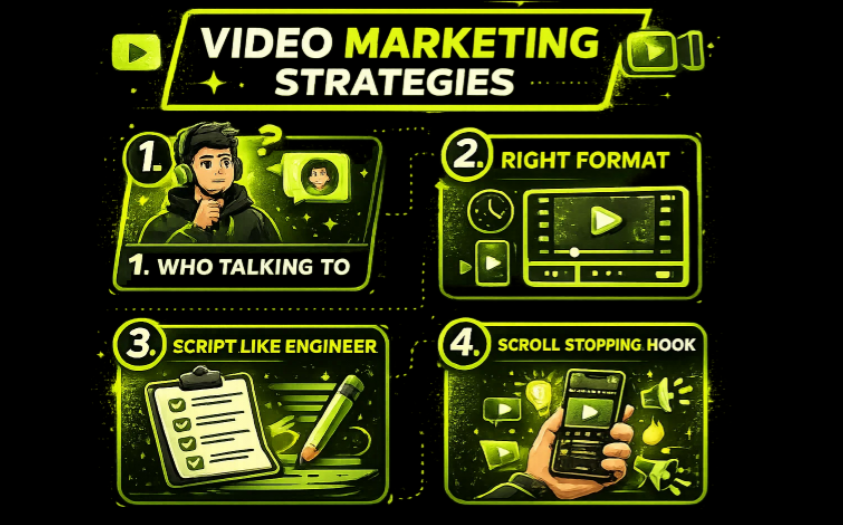
1. Know Exactly Who You’re Talking To (Before You Write a Single Line)
Vague “target audience” guesses produce vague results. Document job titles, industries, biggest daily headaches, and where they already watch video. A technical founder wants dense YouTube walkthroughs. A small-business owner wants 15-second Instagram fixes. Get this wrong and everything else collapses.
One extra step that pays off immediately: pull the last 50-100 closed-won deals from your CRM and note exactly which videos (or lack of them) appeared in the customer journey. You’ll instantly see patterns – certain roles always watch the pricing explainer, others binge the how-to playlist. Use that real data to refine personas instead of guessing.
2. Pick the Right Format for the Exact Job
Stop defaulting to the same three formats. Use seven proven types deliberately: launch videos, how-to series, behind-the-scenes clips, co-marketing conversations, user-generated content, vertical short-form series, influencer takeovers. Mix them across the funnel instead of praying one demo does everything.
Map each format to a specific conversion goal upfront. Example: launch videos drive email sign-ups on release day, how-to series trigger free-trial starts, UGC becomes social proof on the pricing page. When every format has a defined KPI from day one, you stop producing “nice” videos and start producing revenue-driving assets.
3. Script Like an Engineer, Not an Artist
Treat scripting as a repeatable six-step process: lock one core message → build a 3-second hook → write the 15-30 second version first → follow the four-phase framework → add visual direction inline → final polish and triple export. Do it in this order every time and retention jumps overnight.
Force every script through a 30-second “elevator test” before expanding. If the entire value proposition and CTA don’t survive in 30 seconds, the longer version will bleed viewers at the same point.
The exact four-phase timing we enforce on every script:
- Problem/Agitation: 5-10 sec (make them feel the pain)
- Insight/Solution: 10-20 sec (one new possibility only)
- Proof/Demonstration: 30-90 sec (show, never tell)
- Single CTA repeated: 5-15 sec (one action, said twice + on-screen)
4. Start Every Video with a Scroll-Stopping Hook
You have three seconds. Four hooks still dominate:
- Pain-point callout (“Still losing 40 % of deals in onboarding?”)
- Shocking stat in giant text
- Direct question to camera
- Instant visual proof (before/after or problem exploding → fix)
Make it work on mute with captions and bold overlays. Test five variations with a tiny $50-100 paid test before final production – the winner routinely gets 3-5× higher click-through and completion rates.
5. Keep One Video, One Message
Trying to cover multiple ideas in one asset kills retention and makes repurposing impossible. One clear outcome per video is the rule. Everything else gets its own asset.
This discipline also makes measurement clean. When a video has only one CTA (book demo, download guide, start trial), you can directly attribute every conversion to that exact piece instead of guessing which part of a 4-minute ramble actually moved the needle.
6. Build the Distribution Plan Before You Shoot
Open a spreadsheet and map every channel, format, embed location, and owner before the camera rolls. This single habit eliminates 90 % of “we forgot the vertical version” panic and forces you to shoot the right footage on the day.
Include exact UTM parameters and tracking links in the same sheet. When launch day comes, every embed, email, and paid campaign already has its unique tag. Closed-loop reporting becomes automatic instead of a six-week forensic project.

7. Turn One Master Into 8-15 Pieces the Same Week
One 5-minute master becomes 3-5 vertical shorts, 2-3 horizontal cuts, GIF previews, quote cards, YouTube chapters, a full transcript blog post, and a 30-second ad teaser. Track everything in the same sheet.
The math is brutal but true: a repurposed campaign routinely delivers 5-8× more qualified leads than the master alone at zero additional production cost. Clients who adopted this workflow cut video CPL by 60-80 % within two quarters.
8. Boost Only What Already Works Organically
Wait 48-72 hours. Look at retention curves. Spend money only on the single clip that already proves it can hold attention without paid help.
Set a hard rule: any creative must hit at least 50 % average watch percentage and top-quartile engagement organically before it sees a single dollar. Clients who enforce this typically improve ROAS by 3-6× within the first month.
9. Put Video in the Sales Team’s Hands the Same Week
Upload the library tagged by stage and use case. Run a 15-minute training. Personalized 15-30 second videos in outreach emails consistently outperform text by double-digit reply rates.
Track usage inside the CRM. One client discovered their top-performing rep was attaching the exact same 22-second objection-handling clip to every pricing conversation – that single clip alone influenced over $1.2 M in pipeline in six months.
Tags on every sales-library video:
- Funnel stage (TOFU/MOFU/BOFU)
- Industry vertical
- Specific objection it handles
- Length
- Date created
10. Measure Outcomes, Not Outputs
Ignore total views. Track these five numbers only:
- Retention percentage
- Click-through rate
- View-to-conversion rate
- Pipeline influenced
- ROAS (including production cost)
Build a simple monthly dashboard that shows cost per lead, pipeline generated, and ROAS broken down by format and channel. When leadership sees video sitting in the top three revenue channels instead of the marketing expense column, budget fights disappear and the program scales itself.
Quick Checklist Before You Hit Record
- Do we know the exact viewer and their biggest pain?
- Is there only one core message?
- Does the hook survive 3 seconds on mute?
- Is the distribution map already finished?
- Do we have the master + all derivative formats planned?
- Is success defined in pipeline or revenue, not views?
If any answer is no, fix it first.
Final Thoughts
Video marketing only becomes expensive and disappointing when teams treat it as art instead of engineering. Start with the business goal, reverse-engineer the distribution, script ruthlessly, repurpose aggressively, boost surgically, and measure relentlessly. Do that and video stops being a “nice-to-have” and starts being the channel that predictably pays for itself – quarter after quarter.