


Quick Summary: Shopify website development for D2C brands involves far more than building an online storefront—it requires integrating payments, tax compliance, fulfillment logistics, marketing automation, and customer support systems. Successful D2C Shopify stores combine custom development, strategic apps, and scalable infrastructure to create seamless customer experiences while maintaining control over data, pricing, and brand identity. The platform powers over 26% of global e-commerce websites and offers D2C-specific features like first-party data ownership, checkout extensibility, and API-first architecture for enterprise-scale operations.
The direct-to-consumer model has fundamentally changed how brands interact with customers. Instead of relying on third-party retailers, wholesalers, or marketplaces, D2C brands control the entire customer journey—from discovery to delivery.
D2C ecommerce sales in the US recently surpassed $239.75 billion. That’s not a trend anymore. It’s a permanent shift in how commerce operates.
But here’s the thing: launching a D2C channel on Shopify isn’t as simple as picking a theme and adding products. Real talk? The storefront is maybe 20% of the work. The other 80% involves payments, taxes, fulfillment, marketing, customer support, and data orchestration.
This guide breaks down what it actually takes to build a scalable, profitable D2C website on Shopify—covering custom development, essential integrations, fulfillment strategies, and growth tactics used by successful brands.
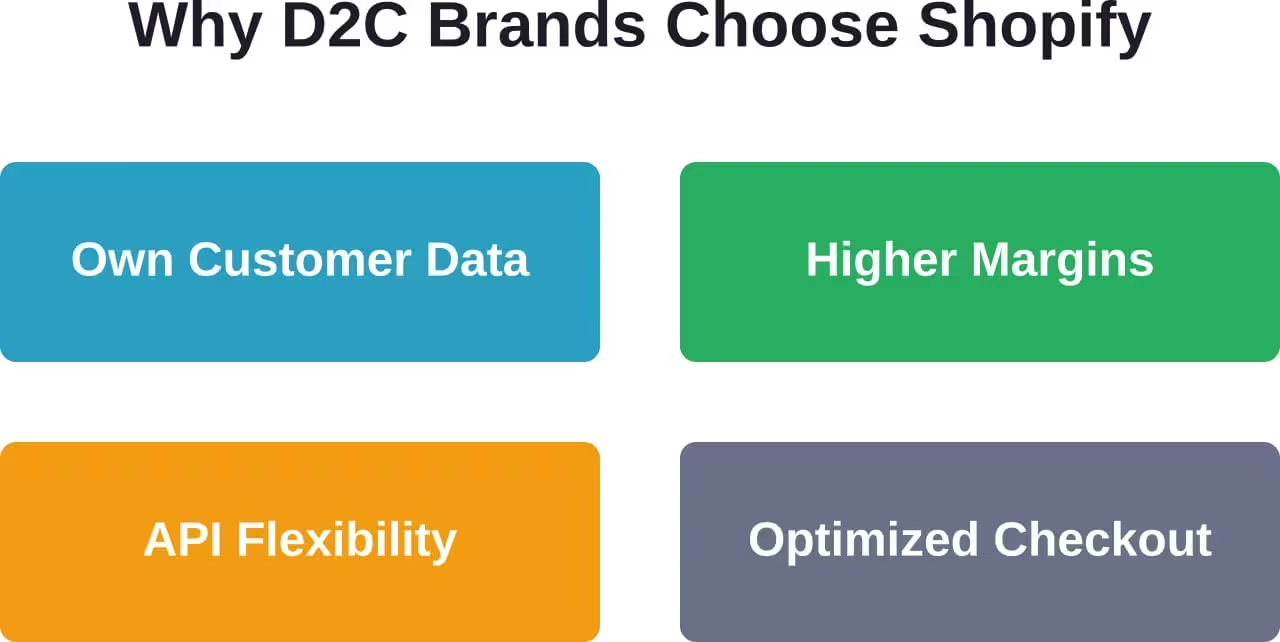
Why D2C Brands Choose Shopify for Website Development
Shopify powers over 26% of global e-commerce websites, and D2C brands make up a significant portion of that market share. The platform offers a rare combination: enterprise-level capabilities with relatively accessible setup costs.
For brands selling directly to consumers, several Shopify features stand out:
First-Party Data Ownership and Control
Unlike selling through Amazon (which captures 2.5 billion monthly visitors but owns the customer relationship), Shopify merchants own their customer data completely. Every email address, purchase history, browsing pattern, and cart abandonment becomes an asset the brand controls.
This matters because 89% of business leaders say personalization is critical to success. Brands need that data to deliver personalized experiences that drive loyalty and repeat purchases.
Higher Profit Margins Through Direct Sales
Traditional retail models force brands to sell wholesale at 40-50% discounts to retailers, who then mark up products for end consumers. The D2C model eliminates that middleman markup entirely.
Established brands recognize this advantage.
API-First Architecture for Custom Development
Shopify’s extensive API ecosystem enables custom development that scales. In 2024, data shows 63% of teams can ship a new API in under a week, up from 47% in 2023. The same report found that 74% of organizations identified as API-first, and these leaders were 83% more likely to restore a failed API within an hour.
For D2C brands, this translates to faster time-to-market for custom features, integrations with third-party systems (ERPs, CRMs, warehouse management), and the flexibility to build unique customer experiences.
Checkout Extensibility and Conversion Optimization
Shopify’s checkout is highly optimized—the result of billions of transactions worth of A/B testing. But D2C brands can also customize it through Shopify’s checkout extensibility features, adding trust badges, upsells, custom fields, and subscription options without compromising performance.
The platform handles technical complexities like PCI compliance, cart recovery, and multi-currency support out of the box, letting development teams focus on brand-specific customization rather than reinventing infrastructure.
The Real Scope: What Shopify D2C Website Development Entails
Ask most non-technical founders what it takes to build a D2C Shopify store, and they’ll say “pick a theme and add products.” Ask someone who’s actually done it at scale, and you’ll get a very different answer.
The storefront—the part customers see—represents a fraction of the total development work. The backend systems, integrations, and operational infrastructure make or break D2C success.
Payments, Tax Compliance, and Legal Frameworks
Accepting payments isn’t just about connecting Shopify Payments. D2C brands selling across borders need to navigate:
- Multi-currency processing and dynamic exchange rates
- Regional payment method preferences (Klarna in Europe, Afterpay in Australia, digital wallets everywhere)
- Sales tax calculation across thousands of jurisdictions
- VAT, GST, and import duty handling for international orders
- PCI compliance and fraud detection systems
Some brands handle this in-house through Shopify’s native tax engine and payment gateway. Others work with Merchant of Record providers who assume liability for tax compliance—particularly valuable when expanding into complex markets like the EU.
Warehouse Management and Fulfillment Integration
Once an order is paid, it needs to ship. That sounds obvious, but fulfillment is where many D2C operations break down.
Shopify development for D2C must connect the store to fulfillment infrastructure—either internal warehouse management systems or third-party logistics providers (3PLs). Target order accuracy rates exceed 99.5%, and anything less erodes customer trust fast.
Development considerations include:
- Real-time inventory synchronization across multiple warehouses or fulfillment centers
- Automated order routing based on customer location, product availability, and shipping speed
- Tracking number injection and customer notification workflows
- Returns management and reverse logistics automation
- Integration with warehouse management systems (WMS) for pick/pack/ship operations
Brands like Parachute processed 1,300 click-and-collect orders in Q4 2024, representing 35% of their buy-online-pickup-in-store (BOPIS) volume. That requires tight integration between Shopify, point-of-sale systems, and inventory management.
| Fulfillment Approach | Pros | Cons |
|---|---|---|
| In-House | Full brand control over packaging and unboxing; custom QA standards; faster feedback loops | Fixed costs for space and equipment; seasonal elasticity risk; leadership time on logistics |
| 3PL Partner | Scalable capacity; distributed inventory; technology already built; expertise in logistics | Complex fee structures; longer onboarding; less packaging customization; active contract management |
| Hybrid Model | Balance control and scale; test markets before committing infrastructure; flexibility | Coordination overhead; split inventory management; potential customer experience inconsistency |
Marketing Technology and Customer Acquisition
D2C brands don’t have foot traffic or retail shelf space. Customer acquisition happens through digital channels, and customer acquisition costs for D2C brands vary significantly by channel and business model.
Shopify development must integrate marketing and analytics tools to make that spend sustainable:
- Email marketing platforms for cart abandonment, welcome series, and lifecycle campaigns
- SMS marketing for time-sensitive promotions and shipping updates
- Advertising pixel integration (Meta, Google, TikTok, Pinterest) for retargeting and attribution
- Referral and loyalty program apps to reduce acquisition costs through word-of-mouth
- Analytics dashboards that unify data from multiple sources
According to a Shopify Merchant Survey from November 2025, 53% of merchants rely on word-of-mouth as their primary growth strategy in their first year. Another 35% focus on building social media presence early on. But merchants earning more than $1 million cite paid advertising as the most effective channel at 31%.
The development challenge: connecting all these systems so data flows bidirectionally. Customer behavior in the store should trigger email sequences. Email engagement should inform ad retargeting. Purchase history should personalize product recommendations.
Customer Support and Self-Service Infrastructure
When you own the customer relationship, you also own customer support. That means building systems for:
- Live chat and chatbot integration for pre-purchase questions
- Help desk platforms to manage tickets, returns, and exchanges
- Self-service portals where customers can track orders, initiate returns, and manage subscriptions
- Knowledge bases with product guides, sizing charts, and FAQ content
Many D2C brands underestimate support volume until they launch. Proper development planning includes customer service infrastructure from day one, not as an afterthought when support emails start overwhelming the founder’s inbox.
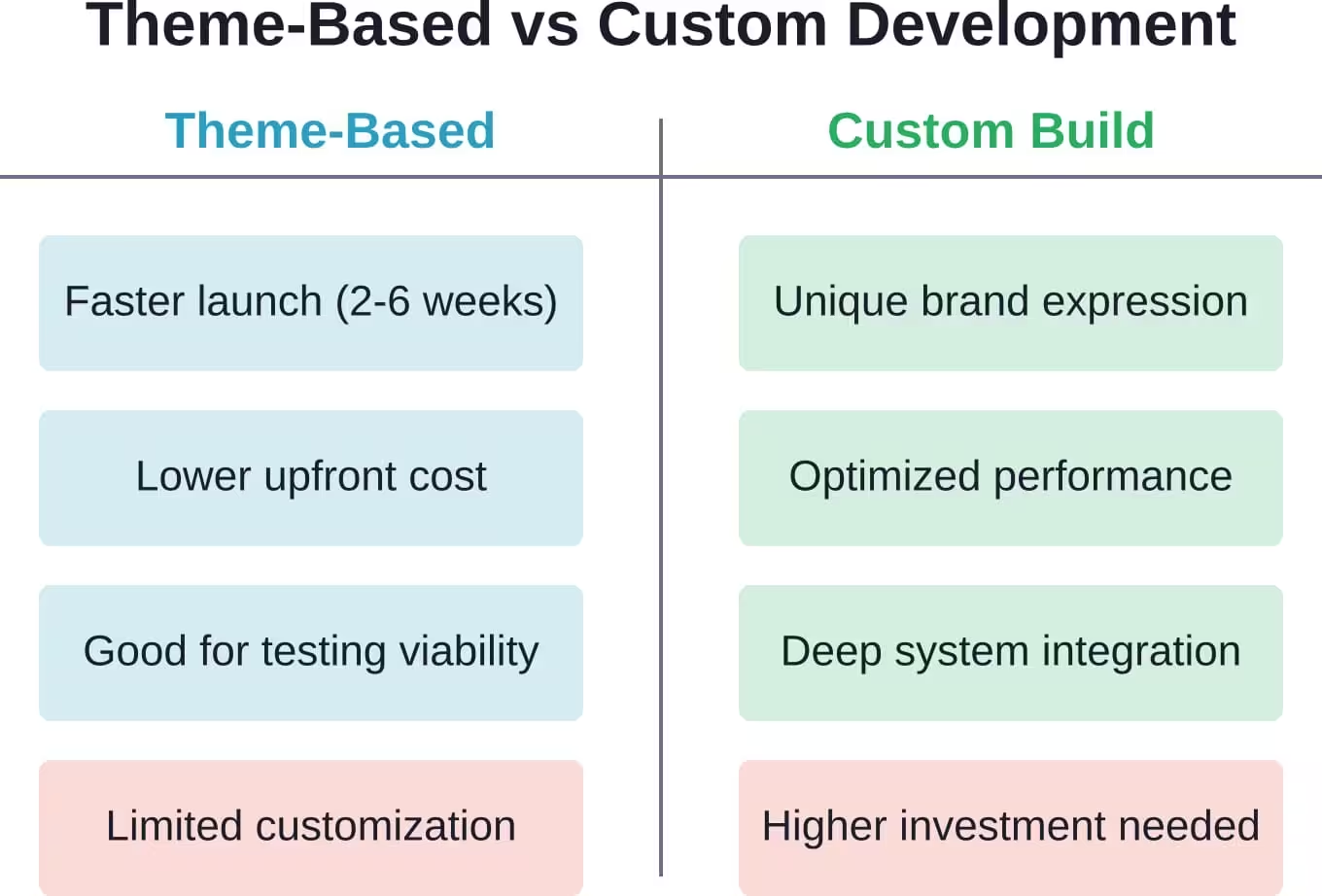
Custom Shopify Development vs. Theme-Based Approaches
One of the first decisions D2C brands face: use an off-the-shelf theme or invest in custom development?
Neither answer is universally correct. The right choice depends on budget, timeline, differentiation needs, and technical resources.
When Theme-Based Development Makes Sense
Shopify’s theme ecosystem includes thousands of professionally designed templates. Many are built specifically for D2C brands and include features like quick-buy buttons, product filtering, and mobile-optimized layouts.
Theme-based development works well when:
- The brand is testing D2C viability before full commitment
- Speed to market matters more than unique design
- The product catalog fits standard ecommerce patterns (simple products, straightforward variants)
- Budget constraints prevent custom development investment
Themes can be customized through Shopify’s theme editor and with some Liquid template coding. But there are limits—complex functionality often requires custom development or app integrations that can bloat site performance.
When Custom Development Becomes Necessary
As D2C brands scale, they inevitably hit theme limitations. Custom development becomes necessary when:
- The brand needs unique shopping experiences that themes can’t support (custom product configurators, subscription flows, bundling logic)
- Performance optimization is critical—custom themes can be drastically lighter and faster than feature-heavy commercial themes
- The brand requires deep integration with backend systems (ERP, PIM, custom inventory management)
- Headless commerce architecture is preferred, separating the frontend experience from Shopify’s backend
Custom Shopify development typically involves building themes from scratch using Liquid (Shopify’s templating language), React components for dynamic sections, and extensive API work to connect external systems.
Development costs vary widely—anywhere from $15,000 for a relatively simple custom theme to $150,000+ for complex headless builds with extensive integrations. The investment makes sense when brand differentiation and operational efficiency justify the cost.
Essential Integrations for D2C Shopify Websites
Shopify’s app ecosystem includes thousands of apps. D2C brands don’t need thousands of integrations—but they do need the right ones.
These categories represent essential functionality for most D2C operations:
Email and SMS Marketing
Email remains one of the highest-ROI channels for D2C brands. Popular integrations include Klaviyo, Omnisend, and Mailchimp. Key features to look for:
- Automated flows for cart abandonment, browse abandonment, welcome series, and post-purchase
- Segmentation based on purchase history, browsing behavior, and customer lifetime value
- A/B testing for subject lines, send times, and content variations
- SMS capabilities for time-sensitive promotions and shipping updates
Proper integration ensures customer data flows from Shopify to the marketing platform in real-time, enabling immediate triggered campaigns based on customer actions.
Subscription Management
For D2C brands with recurring products (supplements, beauty, consumables, meal kits), subscription functionality is non-negotiable. Apps like Recharge, Bold Subscriptions, and Appstle handle:
- Recurring billing on custom schedules (weekly, monthly, quarterly)
- Customer portals for subscription management (skip, pause, cancel, modify)
- Dunning management to recover failed payments
- Subscription analytics to track churn, lifetime value, and cohort performance
Alpha Box & Dice moved their wine club to Shopify and installed Recharge to process recurring payments. Since the migration, their subscription revenue grew by 700%, with the wine club revenue up by 38%. Subscription sales now account for 30% of the brand’s total D2C revenue.
Reviews and Social Proof
Customer reviews directly impact conversion rates. Apps like Yotpo, Judge.me, and Loox collect, display, and syndicate product reviews. Advanced features include:
- Photo and video review collection to increase authenticity
- Review request automation via email and SMS
- Review syndication to Google Shopping and other channels
- Referral program functionality to turn customers into advocates
The integration layer ensures reviews sync with product catalog changes and display properly across all templates and pages.
Inventory and Order Management
As D2C brands scale beyond a single sales channel (adding wholesale, retail, or additional marketplaces), inventory management becomes critical. Apps like Stocky, Sellbrite, and custom ERP integrations help:
- Synchronize inventory across multiple channels in real-time
- Set safety stock levels and automate reorder notifications
- Manage purchase orders and supplier relationships
- Generate inventory reports and forecasts based on sales velocity
Proper integration prevents overselling, reduces stockouts, and improves cash flow management by optimizing inventory levels.
Analytics and Business Intelligence
Shopify’s native analytics provide basic reporting. Serious D2C operations need deeper insights through integrations like Google Analytics 4, Littledata, or custom data warehouses. These tools enable:
- Customer acquisition cost (CAC) tracking by channel and campaign
- Lifetime value (LTV) analysis and cohort reporting
- Attribution modeling to understand which touchpoints drive conversions
- Custom dashboards that unify data from Shopify, marketing platforms, and fulfillment systems
The integration architecture ensures accurate data flow from Shopify to analytics platforms, maintaining consistency across all reporting systems.
Building for Performance and Conversion
Look, nobody cares how beautiful your Shopify store is if it takes seven seconds to load. Performance directly impacts revenue.
Research consistently shows that every second of page load delay reduces conversions. For D2C brands competing on customer experience, site speed isn’t optional.
Technical Performance Optimization
Shopify development for D2C should prioritize:
- Image optimization: Compress all product images, use WebP format where supported, implement lazy loading
- JavaScript management: Minimize third-party scripts, defer non-critical JS, use async loading where possible
- App audit: Every installed app adds code to your store; regularly audit and remove unused apps
- CDN leverage: Shopify’s CDN is excellent; ensure all assets load from CDN rather than external servers
- Theme code efficiency: Custom development should prioritize lean code over feature bloat
Shopify merchants using AI-powered recommendations report up to a 20% increase in conversion rates. But those gains disappear if the recommendation engine adds three seconds to page load time.
Conversion Rate Optimization (CRO) Essentials
Beyond speed, D2C Shopify stores need strategic CRO elements:
- Clear value propositions above the fold on landing pages
- High-quality product photography including lifestyle images and multiple angles
- Detailed product descriptions that answer common questions and objections
- Trust signals—security badges, return policies, customer reviews, press mentions
- Simplified checkout with minimal form fields and clear progress indicators
- Multiple payment options including digital wallets (Apple Pay, Google Pay, Shop Pay)
Some 64% of consumers say personalized offers are important. Development should support dynamic content that adapts based on customer segment, browsing history, and purchase behavior.
Mobile-First Development Approach
Mobile commerce continues to grow as a percentage of total ecommerce. D2C Shopify development must adopt mobile-first thinking:
- Touch-friendly interfaces with appropriately sized tap targets
- Streamlined navigation that works on small screens
- Fast mobile performance (mobile users are even less patient than desktop)
- Mobile-optimized checkout with autofill support and minimal typing
- Responsive images that load appropriate sizes based on device
Test religiously on actual devices, not just browser simulators. Real-world mobile performance often differs significantly from desktop testing environments.
Scaling Your D2C Shopify Store: Growth Strategies
Building the store is phase one. Scaling it profitably is the real challenge.
Marketing Channel Diversification
Relying on a single acquisition channel creates fragility. Algorithm changes, policy updates, or increased competition can overnight destroy a single-channel strategy.
Successful D2C brands diversify across:
- Paid social (Meta, TikTok, Pinterest) for scalable reach and retargeting
- Paid search (Google, Bing) to capture high-intent buyers actively searching
- Content marketing and SEO for sustainable organic traffic growth
- Email and SMS for owned-channel communication with existing customers
- Influencer and affiliate partnerships to tap established audiences
- Referral programs that turn customers into acquisition channels
According to Shopify data, 69% of online shoppers trust endorsements from influencers. Micro-influencers with fewer than 5,000 followers often have higher engagement rates than macro-influencers, making them cost-effective partners for D2C brands.
Retention and Lifetime Value Focus
Acquiring customers is only half the equation. These customers must generate significantly more revenue over time to create a sustainable business model. D2C brands must obsess over retention:
- Post-purchase email sequences that educate on product usage and care
- Loyalty programs that reward repeat purchases
- Subscription options for consumable products
- Personalized product recommendations based on purchase history
- Exceptional customer service that builds brand affinity
Development should support these retention mechanics through proper integration of loyalty platforms, subscription management, and personalization engines.
International Expansion Considerations
D2C brands often start domestic but eventually eye international markets. Shopify supports multi-market selling, but international expansion requires:
- Multi-currency pricing and checkout
- International shipping rate calculation
- Customs and duties handling
- Localized content and translation
- Regional payment method support
- Tax compliance across jurisdictions (VAT, GST, import duties)
Some brands handle this complexity in-house. Others work with Merchant of Record providers who manage tax compliance, payment processing, and regulatory requirements across markets.
The development consideration: build infrastructure that can support multiple markets from day one, even if initially launching in a single country. Retrofitting international capabilities later is expensive and time-consuming.
Common Pitfalls in D2C Shopify Development
Based on patterns observed across hundreds of D2C launches, certain mistakes appear repeatedly.
Over-Engineering the Initial Build
Brands often want every feature on day one: subscriptions, bundles, complex product configurators, loyalty programs, advanced personalization. This approach delays launch and burns the budget.
Better strategy: launch with core functionality, validate demand, then iterate based on actual customer behavior. Many D2C brands experiment with relatively small tests to prove customer relationships work before investing heavily in custom development.
Neglecting Post-Launch Operations
Development teams focus intensely on launch, then move on. But D2C success depends on continuous optimization—testing checkout variations, improving email flows, refining product recommendations, updating content.
Build operational capacity for ongoing optimization, not just one-time development.
Ignoring Mobile Performance
Desktop testing shows fast load times, but mobile users experience laggy, frustrating experiences. Test on actual devices with realistic network conditions (not office WiFi). Optimize ruthlessly for mobile performance.
App Bloat and Technical Debt
Shopify’s app ecosystem makes it easy to install solutions for every problem. But each app adds code, increases load time, and creates potential integration conflicts.
Regular app audits help identify unused or redundant apps. Consolidate functionality where possible, and remove apps that aren’t delivering clear value.
Insufficient Fulfillment Planning
Brands launch with unrealistic assumptions about shipping costs, fulfillment complexity, and international logistics. Then reality hits: dimensional weight pricing, customs delays, high return rates.
Model fulfillment economics before launch. Understand all-in costs including packaging, labor, carrier fees, and returns. Build those costs into a pricing strategy from the start.
Shopify Plus vs. Standard Shopify for D2C Brands
As D2C brands scale, they eventually evaluate Shopify Plus—the enterprise tier. When does the upgrade make sense?
Key Shopify Plus Advantages
Shopify Plus offers several capabilities unavailable on standard plans:
- Checkout customization and extensibility for advanced conversion optimization
- Automation capabilities through Shopify Flow for complex business logic
- Wholesale channel for B2B alongside D2C operations
- Unlimited staff accounts for larger teams
- Dedicated success management and priority support
- Lower transaction fees on high-volume stores
- Advanced API rate limits for complex integrations
The pricing difference is significant—Shopify Plus pricing is significantly higher than standard plans. That investment makes sense for brands doing $1M+ in annual revenue or those with complex operational needs.
When to Upgrade to Plus
Consider Shopify Plus when:
- Transaction volume reaches a level where Plus fee savings offset the higher platform cost
- The brand needs checkout customization beyond what standard Shopify allows
- Automation requirements exceed Shopify’s native capabilities
- The business operates both D2C and B2B channels requiring different experiences
- The team needs advanced collaboration features and unlimited staff accounts
Many successful D2C brands start on standard Shopify and upgrade to Plus as they prove the model and scale revenue. There’s no need to start with Plus unless specific features are absolutely required from day one.
Working with Shopify Development Agencies vs. In-House
D2C brands face another decision: hire an agency for Shopify development or build in-house capability?
Agency Development: Pros and Cons
Shopify agencies bring expertise and speed. They’ve built dozens or hundreds of stores and understand common pitfalls. Advantages include:
- Faster time to launch with experienced teams
- Access to specialized skills (design, development, integration) without hiring full-time
- Knowledge of best practices and common integration patterns
- Established relationships with app developers and solution providers
Disadvantages:
- Ongoing dependency for updates and customization
- Higher hourly costs compared to in-house staff
- Potential misalignment if agency doesn’t deeply understand the brand
- Knowledge transfer challenges when moving development in-house later
In-House Development Teams
Larger D2C brands often build internal Shopify expertise. Benefits include:
- Deep brand knowledge and alignment with business goals
- Faster iteration on changes without external dependencies
- Long-term cost efficiency for brands with continuous development needs
- Better integration with internal business systems and processes
Challenges:
- Longer ramp-up time to build Shopify expertise
- Higher fixed costs for salaries and benefits
- Need to maintain skills across design, frontend, backend, and integration disciplines
- Risk of knowledge silos if team members leave
Many brands use a hybrid approach: agency for initial build and major projects, in-house team for ongoing optimization and maintenance.
Future-Proofing Your D2C Shopify Website
Ecommerce technology evolves quickly. D2C brands need development approaches that adapt to change rather than requiring rebuilds every few years.
Headless Commerce Considerations
Headless architecture separates the frontend customer experience from Shopify’s backend commerce engine. The storefront could be built on React, Next.js, or another modern framework, while Shopify handles cart, checkout, and order management through APIs.
Advantages of headless for D2C:
- Ultimate flexibility in customer experience design
- Superior performance through static site generation and edge caching
- Ability to use Shopify commerce capabilities across multiple frontend experiences (web, mobile app, kiosks)
- Future flexibility to swap commerce platforms without rebuilding frontend
Disadvantages:
- Significantly higher development complexity and cost
- Need for specialized frontend and API integration skills
- More maintenance overhead compared to traditional Shopify themes
- Potentially longer time to market
Headless makes sense for established D2C brands with unique experience requirements and development resources. For most brands launching D2C, traditional Shopify theme development offers better time-to-value.
API-First Architecture
Even with traditional Shopify development, adopting API-first thinking creates flexibility. Build integrations through APIs rather than directly in theme code. This approach allows:
- Easier platform migration if needed in the future
- Integration reuse across multiple customer touchpoints
- Better testing and debugging of business logic
- Faster development cycles through modular architecture
The data supports API-first approaches: 62% of organizations work with revenue-generating APIs in 2024, and 21% of companies drive over 75% of total revenue through APIs.
Composable Commerce Principles
Composable commerce means building with best-of-breed components that can be swapped independently. Instead of monolithic platforms, D2C brands assemble:
- Commerce engine (Shopify)
- Content management (Contentful, Sanity)
- Search and discovery (Algolia, Elasticsearch)
- Personalization (Dynamic Yield, Nosto)
- Customer data platform (Segment, mParticle)
This approach requires more technical sophistication but provides maximum flexibility. Components can be replaced without rebuilding the entire stack.
Build a D2C Website That Handles More Than the Storefront
In D2C, the storefront is only one part of the system. What actually drives results is how everything behind it works together – payments, customer data, marketing tools, and order handling. Lengreo approaches website development with a focus on building a stable foundation that supports these connections. Instead of treating the website as a standalone page, they work on creating a setup that stays usable as new tools, integrations, and workflows are added over time.
Apply a Development Setup That Doesn’t Break as You Grow
Lengreo focuses on keeping the website practical to run over time:
- Focus on keeping the website clear and manageable
- Builds with long-term usability and updates in mind
- Aligns development with real business requirements from the start
- Delivers projects in line with timelines and defined scope
👉 Get a consultation with Lengreo to plan your D2C website development the right way.
Final Thoughts: Building D2C Success on Shopify
Shopify website development for D2C brands extends far beyond picking a theme and adding products. Successful D2C operations require strategic planning across payments, tax compliance, fulfillment, marketing, customer support, and data infrastructure.
The brands winning in D2C understand that the website is just one component of a larger operational system. They invest in proper integrations, prioritize performance and conversion optimization, and build with scalability in mind from day one.
But here’s the thing: perfection isn’t the goal. Launch isn’t the finish line—it’s the starting point. The most successful D2C brands ship quickly, gather customer feedback, analyze data, and iterate continuously.
Whether using an agency or building in-house, whether starting with themes or investing in custom development, whether launching domestic or going global immediately—the key is making informed decisions aligned with business goals, customer needs, and resource constraints.
D2C ecommerce in the US has surpassed $239.75 billion and continues growing. The opportunity is massive. The brands that succeed will be those that combine strong product-market fit with operational excellence and customer-centric experiences.
Ready to build your D2C Shopify website? Start by mapping your customer journey, identifying critical integrations, defining performance requirements, and assembling the right development team—whether agency, in-house, or hybrid. The technology exists. The market opportunity is proven. Now it’s about execution.