

Quick Summary: SEO (Search Engine Optimization) builds organic visibility through content and technical improvements, while SEA (Search Engine Advertising) delivers instant paid traffic through platforms like Google Ads. SEO requires patience but offers sustainable long-term results, whereas SEA provides immediate visibility with ongoing costs. Most successful digital strategies combine both approaches, using SEA for quick wins and SEO for lasting growth.
Search engines drive the majority of online traffic. Getting found matters more than almost anything else in digital marketing. But there’s a fundamental split in how businesses approach search visibility.
On one side sits SEO, the practice of earning rankings through content quality and technical excellence. On the other, SEA offers immediate placement through paid advertising.
Both fall under the umbrella of search engine marketing (SEM), but they couldn’t be more different in execution, timeline, cost structure, and strategic purpose.
Here’s the thing though—most guides present this as an either-or decision. That’s misleading. The real question isn’t which to choose, but how to deploy each for specific business objectives.
What Is SEO and How Does It Work?
SEO stands for Search Engine Optimization. It encompasses all efforts to improve a website’s position in organic (unpaid) search results.
When someone searches for “project management software” and clicks a result that wasn’t marked as an ad, that’s organic traffic driven by SEO.
The mechanics involve three core pillars:
Technical SEO Foundation
Search engines need to crawl, understand, and index website content. Technical SEO ensures this happens smoothly through proper site architecture, fast loading times, mobile responsiveness, and clean code.
According to Search Engine Land data from October 2025, Core Web Vitals carry significant weight in Google’s page experience evaluation. Largest Contentful Paint accounts for 25% of the score, Total Blocking Time for 30%, and Cumulative Layout Shift for 25%.
These metrics directly influence both SEO performance and user experience. A slow, janky site won’t rank well regardless of content quality.
Content Optimization
Content remains the primary ranking signal. Pages need to match search intent, provide comprehensive coverage of topics, and demonstrate expertise.
This means researching what people actually search for, understanding the questions they’re asking, and creating content that delivers genuine value. Keyword stuffing died years ago. Modern SEO demands substance.
Authority Building
Search engines interpret links from other reputable sites as votes of confidence. Building this authority requires creating content worth linking to, fostering relationships within an industry, and sometimes outreach.
The process takes time. SEO results rarely appear overnight.
Most sites need several weeks to months before seeing meaningful organic traffic growth. Competitive industries can take even longer.
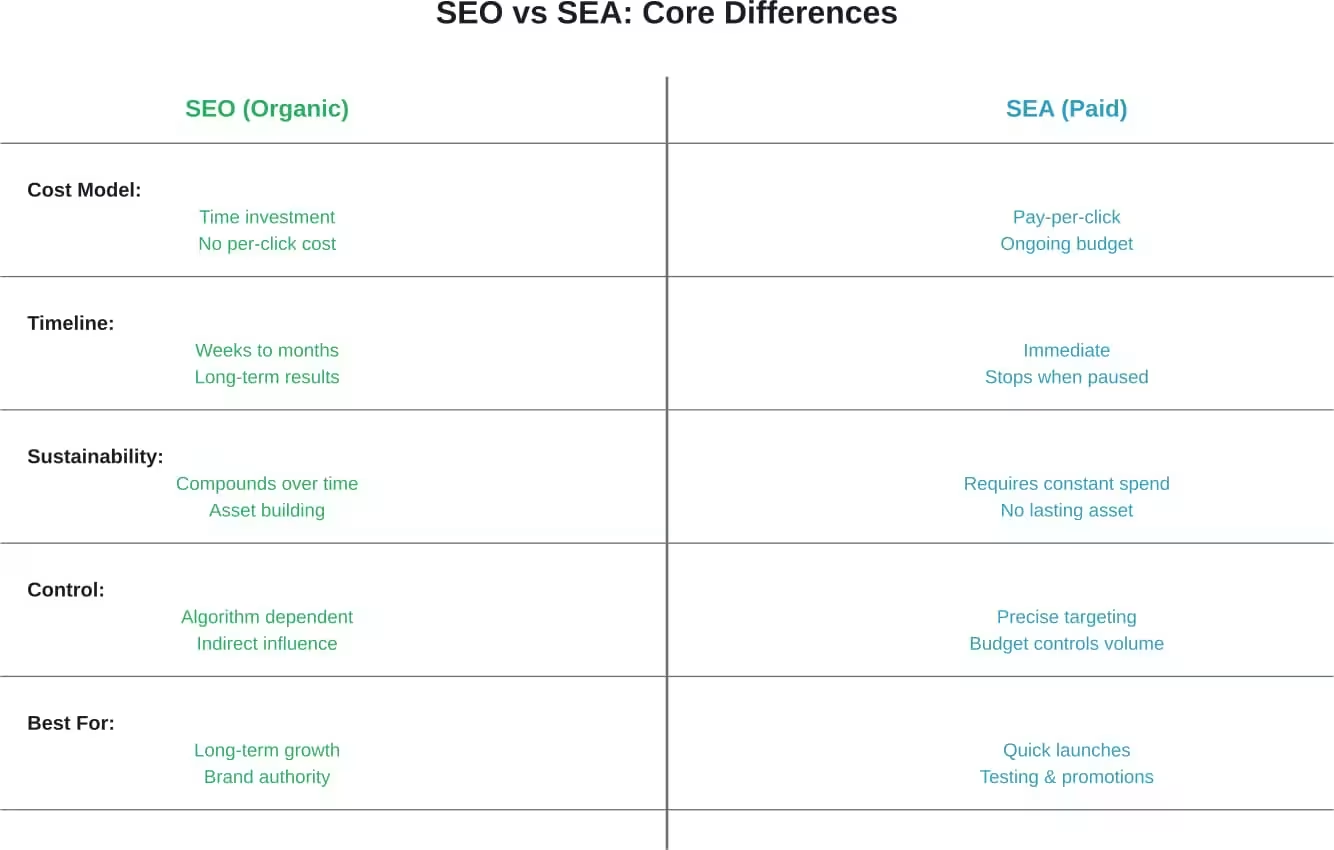
But here’s what makes SEO compelling: once rankings are established, they generate traffic without ongoing per-click costs. The investment shifts from continuous spending to periodic maintenance and content updates.
What Is SEA and How Does It Work?
SEA stands for Search Engine Advertising. It’s the practice of buying placement in search results through paid ads.
The most common platform is Google Ads, which holds over 80% of the global search engine market according to Search Engine Land. When advertisers talk about paid search, they’re almost always running campaigns here.
The Auction Model
SEA operates on a bidding system. Advertisers specify how much they’re willing to pay when someone clicks their ad (cost-per-click or CPC). But it’s not purely about highest bid wins.
Google evaluates ad relevance, landing page experience, and expected click-through rate. A highly relevant ad with a strong landing page can outrank higher bids from less relevant competitors.
This quality score mechanism rewards advertisers who create genuinely useful experiences.
Campaign Structure and Targeting
SEA campaigns organize around keywords, ad groups, and targeting parameters. Advertisers select specific search terms to trigger their ads, write compelling ad copy, and direct traffic to dedicated landing pages.
Targeting options extend beyond keywords. Geographic location, device type, time of day, audience demographics, and even previous site visitors can all be targeted or excluded.
As of October 2025, Google renamed the “Views” metric to “TrueView views” in Google Ads Video campaigns, though this change applies specifically to video campaign reporting. The change doesn’t impact billing or counting methodology, but reflects ongoing platform evolution.
Immediate Visibility, Ongoing Cost
The defining characteristic of SEA is speed. Launch a campaign today, and ads can appear within hours. Traffic starts flowing immediately (assuming proper setup and approval).
But that visibility disappears the moment spending stops. SEA is a continuous investment. Budget determines reach and duration.
Costs vary dramatically by industry and competition.
Despite cost increases, SEA remains effective when campaigns are properly optimized. The key lies in conversion tracking, bid strategy, and continuous refinement.
Work With a Team That Handles SEO and Paid Search
SEO and SEA usually make more sense when they are planned together rather than treated as separate tracks. Lengreo works as a B2B marketing and tech partner, not just an SEO-only provider. The company offers SEO, paid ads, website development, lead generation, demand generation, and digital marketing strategy. On the SEO side, its services include Local SEO, keyword research, competitor analysis, website audits, link building, and content planning. That makes it a practical fit for businesses that need search work connected to broader acquisition activity, not handled in isolation.
Looking for SEO and Paid Search Support?
Lengreo can help with:
- SEO
- PPC and paid ads
- website audits and optimization
- keyword research and competitor analysis
- link building
- content strategy and planning
👉 Contact Lengreo to discuss the search support your business needs.
The Cost Reality: Investment vs Expense
One of the biggest misconceptions is that SEO is “free” because there’s no per-click cost. That’s technically accurate but misleading.
SEO requires substantial investment in content creation, technical optimization, tools, and often personnel or agency fees. The difference is this investment builds an asset that generates returns over time without proportional ongoing costs.
Think of it like buying versus renting.
SEA is operational expense. Budget determines traffic volume. Double the budget, roughly double the traffic (assuming inventory exists). Cut the budget, traffic drops proportionally.
SEO is capital investment. Effort put in today can generate traffic for months or years. Rankings, once earned, don’t disappear overnight. Content continues working without additional payment for each visitor.
Cost Dynamics in Practice
A competitive keyword in legal or insurance industries might cost $50-$200 per click in SEA. Ranking organically for the same term delivers those clicks without direct cost.
But reaching that organic position might require dozens of hours of content development, technical optimization, and authority building. The ROI timeline extends much longer.
For established businesses with stable cash flow, SEO’s long-term economics often win. For startups needing immediate validation or businesses with seasonal demands, SEA’s predictability and speed offer distinct advantages.
Timeline and Results Expectations
Let’s address the elephant in the room: patience versus urgency.
SEO Timeline Reality
Most sites need a minimum of 3-6 months to see meaningful organic traffic growth from SEO efforts. Competitive industries often require 6-12 months or longer.
This isn’t failure. It’s how search engines work. Google needs time to crawl new content, evaluate quality signals, and test rankings. Authority accumulates gradually as other sites discover and link to content.
Early months often show minimal visible progress. Rankings might fluctuate as Google tests positions. Traffic grows slowly at first, then accelerates as momentum builds.
The frustrating part? Doing everything right doesn’t guarantee specific timeline outcomes. Algorithm updates, competitor actions, and market shifts all influence results.
SEA Timeline Reality
Launch a properly configured campaign today, and traffic can start within hours after ad approval. Adjustments produce immediate changes in performance.
This speed enables rapid testing. Test five different value propositions in a week. Identify which audience segments convert best within days, not months.
But SEA optimization isn’t instant either. While traffic starts immediately, campaign refinement requires data accumulation. Understanding which keywords, ad copy, and landing pages perform best takes testing over weeks.
Bidding strategies also need learning periods. According to Google Ads documentation on Target CPA bidding, automated strategies set bids based on conversion probability to achieve specified cost-per-action targets. These systems improve as they gather conversion data.
The Impact of AI Overviews on Search Strategies
The search landscape shifted significantly with Google’s rollout of AI Overviews. These AI-generated summaries appear at the top of many search results, fundamentally changing click behavior.
Data from Search Engine Land published in November 2025 reveals the dramatic impact. For queries where AI Overviews appear, organic click-through rates dropped from 1.76% to 0.61%—a 61% decline. Paid click-through rates fell from 19.7% to 6.34%—a 68% drop.
Even queries without AI Overviews saw organic CTRs fall to 1.62%, down 41% year-over-year. Users are simply clicking less everywhere.
What does this mean for SEO and SEA strategies?
Adapting SEO for the AI Overview Era
Zero-click searches—where users get answers without clicking any result—are increasingly common. SEO strategies must evolve beyond simply ranking well.
Content needs to target informational queries where AI Overviews add value while also creating pathways to deeper engagement that AI summaries can’t satisfy. Product comparisons, detailed how-to guides with visuals, and interactive tools all offer experiences beyond what AI overviews provide.
Visibility matters even without clicks. Brand presence in AI Overviews still registers with users, building familiarity over time.
SEA as a Traffic Offset
As Search Engine Land noted in May 2025, strategic paid media can help bridge gaps from declining organic traffic. When organic CTRs compress, paid placement becomes relatively more valuable.
Ads still appear prominently, and while their CTRs also declined in AI Overview contexts, the drop is from a higher baseline. In many commercial queries, paid results capture the majority of remaining clicks.
The takeaway? Both channels face headwinds from AI Overviews, but combining them provides more resilience than relying on either alone.
When to Choose SEO, SEA, or Both
So which approach makes sense? The answer depends on business context, resources, and objectives.
Choose SEO When:
- Building long-term sustainable traffic is the priority
- Budget constraints limit ongoing ad spending
- The business model depends on content and thought leadership
- Patient timelines align with business goals
- Competitive keywords have prohibitively high SEA costs
Choose SEA When:
- Immediate visibility is necessary (product launches, events, seasonal campaigns)
- Testing market demand or new offerings quickly is valuable
- Precise targeting and budget control are priorities
- The sales cycle is short enough to validate ROI within campaign duration
- Organic competition makes SEO unrealistic in reasonable timeframes
Combine Both When:
- Resources support parallel efforts (most established businesses)
- Comprehensive market coverage matters
- Short-term needs exist alongside long-term growth objectives
- Data sharing between channels can inform both strategies
The reality? Most successful digital strategies employ both. SEA provides immediate results and testing insights while SEO builds toward sustainable long-term traffic.
Key Advantages and Disadvantages
Let’s break down the practical pros and cons that influence strategic decisions.
| Aspect | SEO Advantages | SEO Disadvantages |
|---|---|---|
| Cost Efficiency | No per-click costs once ranked; scales without proportional cost increases | Significant upfront investment in content, technical work, and tools |
| Sustainability | Traffic continues even during budget constraints; builds lasting assets | Rankings can decline if maintenance stops or competitors improve |
| Credibility | Users often trust organic results more than paid ads | Difficult to rank for branded competitor terms or highly commercial queries |
| Timeline | Compounds over time; older content can continue generating traffic for years | Weeks to months before seeing meaningful results; patience required |
| Click Volume | Top organic positions often receive higher click volumes than ads | Declining CTRs due to AI Overviews and zero-click searches |
| Speed | Immediate visibility within hours of launch; instant traffic | Traffic stops immediately when budget is paused or depleted |
| Control | Precise targeting by keyword, location, device, time, audience | No lasting asset built; all investment disappears when spending stops |
| Testing | Rapid experimentation with offers, messaging, and landing pages | Costs can escalate quickly in competitive industries; budget management critical |
| Predictability | Budget determines volume; easier to forecast traffic and costs | Quality Score and competition affect actual costs; not always predictable |
| Data | Detailed performance data enables precise optimization | Less user trust; ad blockers and banner blindness reduce effectiveness |
Synergies Between SEO and SEA
The most sophisticated digital strategies don’t treat SEO and SEA as separate channels. They leverage synergies that make both more effective.
Keyword Data Sharing
SEA provides immediate performance data on keyword variations, search intent, and conversion rates. This intelligence can guide SEO content strategy without waiting months for organic data.
Conversely, SEO research uncovers long-tail keywords and content gaps that might not appear in paid keyword tools. These insights can inform expanded SEA targeting.
SERP Real Estate Domination
Appearing in both paid and organic results for the same query increases overall visibility and click probability. Users seeing a brand in multiple positions often perceive greater authority.
Some research suggests that combined presence can actually increase click-through rates on both organic and paid results, though this varies by query type and position.
Conversion Rate Intelligence
SEA campaigns quickly reveal which landing pages, offers, and messaging convert effectively. These learnings can be applied to organic landing pages without waiting for sufficient organic traffic to reach statistical significance.
Page experience improvements driven by SEO—faster loading, better mobile experience, clearer navigation—also benefit paid landing pages, potentially improving Quality Score and reducing CPC.
Seasonal and Gap Coverage
SEO might not rank well for newly important seasonal terms or trending topics quickly enough. SEA can provide immediate coverage for these opportunities while SEO catches up.
When organic rankings drop temporarily (due to algorithm updates or technical issues), SEA can maintain visibility while investigating and fixing problems.
According to Search Engine Land reporting from October 2025, establishing shared standards between SEO and PPC teams unlocks mutual gains. Both channels benefit from aligned content quality standards, shared audience insights, and coordinated messaging.
Measuring Success: Different Metrics, Same Goal
SEO and SEA require different measurement approaches, but both ultimately aim to drive profitable business outcomes.
SEO Success Metrics
Organic traffic volume and growth rate provide the clearest visibility indicators. But traffic alone doesn’t equal success.
Keyword rankings for target terms show progress, though rankings matter less than the traffic they generate. Track rankings for strategic terms that drive business value.
Conversion rate from organic traffic determines whether that traffic actually supports business goals. A thousand visitors who don’t convert accomplish nothing.
Backlink profile growth and domain authority indicate increasing site credibility, which typically correlates with improved rankings over time.
SEA Success Metrics
Cost-per-click shows efficiency but doesn’t indicate profitability. Low CPC with terrible conversion rates wastes money just as surely as high CPC.
Click-through rate indicates ad relevance and appeal. Higher CTRs generally improve Quality Score, reducing costs and improving position.
Conversion rate and cost-per-acquisition determine campaign profitability. These metrics connect spending directly to business outcomes.
Return on ad spend (ROAS) provides the clearest picture of campaign value. A 5:1 ROAS means every dollar spent generates five dollars in revenue.
Unified Success Measurement
Smart organizations track overall search contribution—organic plus paid—to understand total search marketing effectiveness.
Customer acquisition cost across all channels helps determine appropriate budget allocation. If SEO generates customers at $30 each and SEA at $120 each, that informs strategic emphasis.
Customer lifetime value considerations change the equation. Higher CAC might be acceptable if those customers generate substantially more long-term revenue.
Technical Implementation Considerations
Both strategies require technical capabilities, though in different domains.
SEO Technical Requirements
Site architecture must be crawlable and logically structured. XML sitemaps, robots.txt configuration, and internal linking all affect how search engines discover and understand content.
Page speed directly impacts rankings and user experience. Optimization techniques include image compression, code minification, caching strategies, and content delivery networks.
Mobile responsiveness isn’t optional. Mobile-first indexing means Google primarily uses mobile versions for ranking and evaluation.
Structured data markup helps search engines understand content context, enabling rich results like review stars, FAQ snippets, and product information.
SEA Technical Requirements
Conversion tracking implementation is foundational. Without accurate conversion data, optimization becomes guesswork. Google Tag Manager, Google Analytics, and Google Ads conversion tracking must be properly configured.
Landing page quality directly affects Quality Score and campaign costs. Technical issues—slow loading, poor mobile experience, confusing navigation—reduce ad effectiveness and increase costs.
Account structure organization matters. Well-organized campaigns with tightly themed ad groups enable more relevant ads and better performance tracking.
Bid management approaches range from manual CPC to automated strategies like Target CPA or Target ROAS. According to Google Ads documentation, Target CPA bidding automatically sets bids to achieve a specified average cost per conversion. For example, setting a target CPA of $10 means Google Ads optimizes bids to generate conversions at that average cost.
Common Mistakes and How to Avoid Them
Both SEO and SEA have pitfalls that trap inexperienced marketers.
SEO Mistakes
- Expecting immediate results. SEO takes time. Abandoning efforts after six weeks almost guarantees wasted investment. Realistic expectations prevent premature strategy abandonment.
- Neglecting technical foundations. Beautiful content on a slow, broken site won’t rank. Technical health must precede content investment.
- Creating content without search demand. Writing about topics nobody searches for generates no organic traffic. Keyword research should guide content strategy.
- Ignoring user intent. Ranking for keywords that don’t match business offerings wastes effort. A local bakery ranking for “how to bake bread” attracts DIYers, not customers.
- Buying links or using manipulative tactics. These strategies risk penalties that can devastate organic visibility. The temporary gains aren’t worth the existential risk.
SEA Mistakes
- Insufficient conversion tracking. Running campaigns without knowing which clicks convert is like driving blindfolded. Proper tracking is non-negotiable.
- Using broad match keywords without negative keyword management. Broad match can trigger ads for irrelevant searches, wasting budget on unqualified clicks.
- Sending traffic to generic homepages. Dedicated landing pages that match ad messaging convert far better than generic destinations.
- Setting campaigns and forgetting them. SEA requires ongoing optimization. Performance degrades without regular refinement.
- Optimizing for clicks instead of conversions. High CTR means nothing if visitors don’t convert. Always optimize toward business outcomes.
The Future: Adaptation and Integration
Search marketing continues evolving rapidly. Several trends are reshaping how SEO and SEA work.
AI and Automation Expansion
Google continues expanding automated bidding and creative optimization. AI Max for Search campaigns, introduced in Google Ads, leverage comprehensive AI-driven targeting and creative features including search term matching and asset optimization.
These systems reduce manual optimization burden but require proper setup and high-quality input signals. According to a March 2026 Search Engine Land article, algorithms optimize based on the signals they’re given, making signal quality critical to performance.
SEO similarly faces increasing AI influence through content generation tools and search features like AI Overviews. The challenge becomes differentiating content and providing value that AI summaries can’t replicate.
Zero-Click Search Growth
As noted earlier, zero-click searches continue rising. Both SEO and SEA must adapt to a world where fewer searches result in website visits.
Strategies might include optimizing for visibility even without clicks (brand awareness), creating content too complex for AI summaries, or focusing on transactional queries where clicks remain necessary.
Privacy and Tracking Changes
Ongoing privacy regulations and browser changes continue limiting tracking capabilities. Both SEO and SEA must adapt to less granular data.
First-party data collection becomes increasingly valuable. Building owned audiences through email lists, loyalty programs, and direct relationships provides targeting capabilities that third-party cookies once offered.
Making the Strategic Choice
So where does this leave decision-makers trying to allocate resources?
The fundamental truth is that SEO and SEA serve different strategic purposes. They’re not alternatives—they’re complementary tools with distinct strengths.
SEO builds the foundation for sustainable, cost-efficient long-term growth. It creates assets that continue generating value over time. It supports thought leadership and brand authority. But it requires patience and consistent investment before delivering meaningful returns.
SEA provides controllable, immediate visibility. It enables rapid testing and quick market response. It delivers predictable traffic volume based on budget. But it’s an ongoing operational expense that builds no lasting assets.
Most successful digital strategies employ both, with emphasis shifting based on business stage, competitive position, and market dynamics.
New businesses or product launches often start SEA-heavy to generate immediate traction while SEO foundations are built. As organic traffic grows, SEA budgets can shift toward testing, competitive defense, and seasonal opportunities rather than baseline traffic generation.
The worst approach? Paralysis. Doing nothing while competitors capture search visibility—both paid and organic—surrenders market position that becomes increasingly difficult to recover.
Start somewhere. If budget is extremely limited, invest in SEO foundations with minimal SEA testing. If immediate revenue is critical, launch SEA while planning SEO development. If resources allow, pursue both in parallel for maximum strategic flexibility.
Search visibility matters. How it’s achieved matters less than achieving it consistently and profitably.