


Summary: SEO costs in 2026 typically range from $500 to $50,000+ monthly depending on business size, competition, and scope. Small businesses pay $500-$3,500/month, mid-sized companies $1,500-$10,000/month, and enterprises $5,000-$50,000+ monthly. Hourly consulting runs $75-$250/hour, while one-time projects cost $2,500-$15,000.
One agency quotes $800 per month. Another demands $8,000. Both claim to offer “comprehensive SEO services.”
This 10x price difference isn’t unusual in the SEO world. It’s exactly why business owners feel lost when trying to budget for search optimization.
The confusion is understandable. SEO isn’t a product with a price tag. It’s a service with variables that shift based on competition, business goals, website size, and who’s doing the work.
But here’s the thing—while SEO pricing varies widely, it’s not random. Patterns exist. Market rates exist. And understanding what drives these costs helps separate reasonable investment from overpaying.
This guide breaks down exactly what SEO costs in 2026, what factors influence pricing, and how to determine what budget makes sense for your business.
The Short Answer: What Does SEO Actually Cost?
SEO costs range from $500 to $50,000+ per month based on business size, competitive pressure, and strategic requirements.
Here’s the typical breakdown according to current market rates:
| Service Type | Typical Cost Range | Best For |
|---|---|---|
| Hourly SEO Consulting | $75 – $250 per hour | One-off audits, strategy sessions |
| Freelancer SEO Services | $500 – $3,000 per month | Startups, solopreneurs, micro businesses |
| Small Business SEO | $1,000 – $5,000 per month | Local businesses, established small companies |
| Mid-Size Business SEO | $1,500 – $10,000 per month | Regional companies, competitive industries |
| Enterprise SEO | $5,000 – $50,000+ per month | Large corporations, national/international reach |
| One-Time SEO Projects | $2,500 – $15,000 | Website audits, migration support, content strategy |
According to data from Toronto-based agencies, hourly consulting in major markets like the GTA runs $125-$200 CAD per hour. Small local campaigns start at $1,500-$2,500 monthly, while aggressive growth campaigns targeting competitive markets run $3,000-$6,000+ per month.
These aren’t arbitrary numbers. They reflect the labor, tools, and expertise required to move the needle in competitive search environments.
Why SEO Pricing Varies So Dramatically
When one agency charges $1,200 and another charges $12,000, what’s actually different?
Several core factors drive SEO cost variation:
Business Size and Website Complexity
A 10-page local service website needs different optimization than a 10,000-page ecommerce platform. According to current industry data, SEO costs differ substantially by business size primarily due to differences in scope, competitive pressure, and strategic requirements.
Small businesses pay $500-$3,500 monthly, focused on building visibility and validating organic search as a growth channel. Mid-sized companies invest $1,500-$10,000 monthly, balancing ongoing optimization with expansion into new markets or product lines.
Large enterprises spend $5,000-$50,000+ monthly to maintain visibility across multiple product categories, geographic regions, and competitive battlegrounds.
The difference isn’t just about page count.
Larger businesses face:
- More complex technical infrastructure requiring specialized expertise
- Coordination across multiple teams and stakeholders
- Higher stakes where small ranking changes impact significant revenue
- More aggressive competitors with bigger budgets
Industry Competition
Ranking for “personal injury lawyer Chicago” costs more than ranking for “artisan soap maker Vermont.”
Why? Competition density.
In saturated industries—legal, finance, insurance, healthcare—dozens of well-funded competitors fight for the same keywords. Outranking them requires more content, more authoritative backlinks, more technical optimization, and more sustained effort.
Less competitive niches allow smaller budgets to generate meaningful results faster.
Geographic Scope
Local SEO targeting a single city costs less than national campaigns targeting multiple metros. International SEO adds another layer of complexity—different languages, search engines, cultural contexts, and competitive landscapes.
Geographic scope directly impacts:
- Number of location-specific pages needed
- Content volume and localization requirements
- Link building strategies and outreach scale
- Technical considerations like hreflang tags and geo-targeting
Current Website Condition
A brand-new website needs foundational work—technical setup, site architecture, initial content creation. An established site with existing traffic and authority requires different optimization—refinement, expansion, conversion improvement.
Sites with technical debt—slow loading speeds, poor mobile experience, indexation issues—require more upfront investment to fix foundational problems before strategic SEO work generates returns.
Service Provider Type
Who does the work matters as much as what work gets done.
Freelancers typically charge $500-$3,000 monthly, handling smaller clients with focused needs. They offer flexibility and lower overhead but limited bandwidth and specialized expertise.
Small agencies run $1,000-$5,000 monthly, providing more diverse skill sets and capacity. Mid-size agencies charge $2,500-$10,000+ monthly, offering specialized teams and proven processes.
Enterprise agencies command $10,000-$50,000+ monthly, delivering comprehensive strategy, dedicated teams, and integration with broader marketing initiatives.
In-house SEO specialists add another dimension—salary, benefits, tools, and training typically total $60,000-$120,000+ annually depending on experience and market.
Breaking Down SEO Service Models and Their Costs
SEO services come packaged in several distinct models, each with different cost structures and value propositions.
Monthly Retainer (Most Common)
Monthly retainers range from $1,000 to $20,000+ depending on scope. This model provides ongoing optimization—content creation, link building, technical fixes, reporting, and strategic adjustments.
Most reputable agencies structure retainers around defined deliverables: X blog posts monthly, Y backlinks acquired, technical audits quarterly, strategy calls monthly.
The retainer model works well when SEO needs consistent attention—which describes most competitive markets in 2026.
Project-Based Pricing
One-time projects typically cost $2,500-$15,000.
Common project types include:
- SEO audit and strategy: $2,500-$7,500
- Website migration SEO: $5,000-$15,000
- Local SEO setup: $1,500-$5,000
- Content strategy development: $3,000-$10,000
Project pricing makes sense for businesses needing specific deliverables without ongoing commitment. But SEO rarely ends with one project—organic search requires sustained effort.
Hourly Consulting
Hourly SEO consulting rates run $75-$250 depending on experience and market, with rates in major markets like Toronto running $125-$200 CAD per hour. Consultants at the higher end typically bring specialized expertise—enterprise technical SEO, international expansion, industry-specific strategy.
Hourly consulting works for businesses with in-house teams needing expert guidance on specific challenges. It’s also common for audits, second opinions, or temporary capacity boosts.
Performance-Based Pricing
Some agencies offer performance-based models where payment depends on results—rankings achieved, traffic gained, or revenue generated.
This sounds appealing but introduces complexity. What happens when algorithm updates tank rankings through no fault of execution? Who controls conversion rate optimization, which impacts revenue attribution?
Performance-based pricing exists in the market but remains less common than retainers due to these complications.
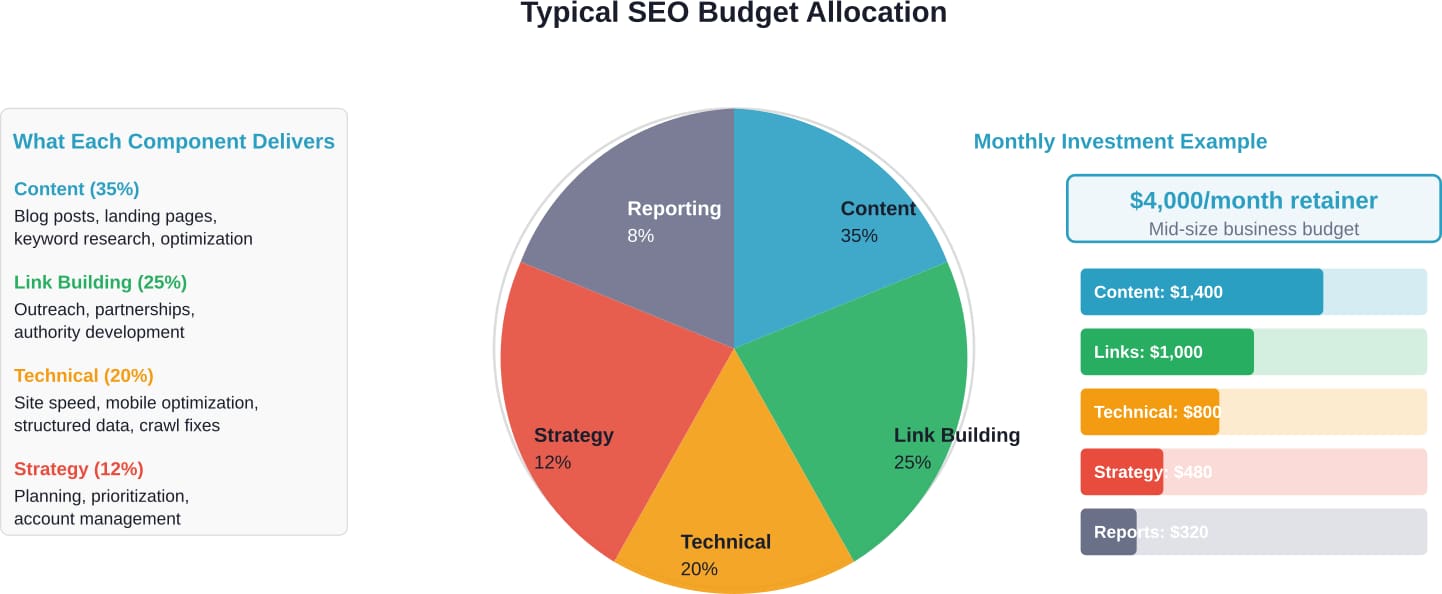
What Actually Happens With Your SEO Budget
Where does the money go when agencies charge $3,000 monthly?
Understanding the work breakdown helps assess whether pricing reflects actual value or inflated promises.
Technical SEO (15-25% of Budget)
Technical optimization includes site speed improvements, mobile usability fixes, structured data implementation, crawl error resolution, and indexation management.
This work prevents search engines from missing, misunderstanding, or de-prioritizing content. It’s foundational but often invisible to clients until something breaks.
Content Creation (30-40% of Budget)
Content drives most SEO success. Blog posts, landing pages, product descriptions, guides—all require research, writing, editing, and optimization.
Quality content costs money. A single well-researched 2,000-word article might require 8-12 hours between keyword research, writing, editing, and optimization.
Link Building (20-30% of Budget)
Earning authoritative backlinks remains critical despite Google’s evolving algorithms. Link building involves outreach, relationship development, content promotion, and strategic partnerships.
Ethical link building takes time. Shortcuts—buying links, participating in schemes—risk penalties that devastate rankings.
Analytics and Reporting (10-15% of Budget)
Tracking performance, analyzing trends, and communicating results requires dedicated effort. Tools like Google Analytics, Search Console, and third-party platforms need configuration, monitoring, and interpretation.
Strategy and Account Management (15-20% of Budget)
Someone coordinates everything—prioritizing initiatives, adapting to algorithm changes, communicating with clients, managing teams.
Strategy prevents SEO from becoming a disconnected set of tactics without business alignment.
The Hidden Costs Nobody Mentions
Quoted prices rarely include everything needed for SEO success. Several hidden costs catch businesses off guard:
SEO Tools and Software
Professional SEO requires tools. Ahrefs charges $129-$449 monthly depending on the plan (Lite, Standard, Advanced tiers). SEMrush runs similar rates. Then add rank trackers, technical audit tools, content optimization platforms, and analytics software.
Some agencies include tool costs in retainers. Others charge separately. Always clarify.
In-house teams bear full tool costs—easily $500-$2,000 monthly for a comprehensive stack.
Content Creation Beyond SEO Writing
SEO agencies might write blog posts but not create custom graphics, videos, or interactive content. These assets increasingly drive engagement and backlinks but require separate investment.
Website Development and Technical Implementation
SEO audits identify technical issues. Fixing them requires developer time—potentially hundreds or thousands of dollars depending on complexity.
Not all SEO agencies provide development resources. Some coordinate with existing teams. Others charge separately for implementation.
Conversion Rate Optimization
Driving traffic without optimizing conversion wastes budget. The average ecommerce site conversion rate is 1.4%, with a very good rate being 3.2% or above (Shopify data).
Conversion Rate Optimization is the second-most-used optimization technique among marketers (50%), second to audience segmentation refinement by just one percent (HubSpot State of Marketing Report, 2026).
CRO often requires separate expertise and budget beyond standard SEO services.
How AI is Changing SEO Costs in 2026
AI hasn’t made SEO cheaper. It’s made it more complex.
Google AI Overviews reach 2 billion monthly users (Semrush, 2025), while Google AI Mode has 100 million users in the US and India. AI Mode is now in more than 200 countries and territories (Semrush, 2025).
Website traffic from AI search may surpass traffic from traditional search in some segments. AI search traffic is up 527% year over year (Semrush, 2025).
This shift creates new optimization requirements:
Answer Engine Optimization (AEO)
Emerging trends in Answer Engine Optimization are reshaping how brands earn visibility in AI-powered search. Using AI to create personalized content (48.57%) and leveraging automation (47.38%) rank among top marketing trends (HubSpot State of Marketing, 2026).
AEO requires optimizing for how AI systems understand, extract, and present information—different from traditional keyword targeting.
Content for Zero-Click Results
AI search often provides answers without sending traffic to websites. This forces strategic shifts—optimizing for brand visibility within AI responses rather than just click-through.
AI-Assisted Content Creation
AI tools accelerate content production but don’t eliminate human expertise. AI-related skill requirements in SEO job postings are up 21% (National University analysis, 2025).
Smart agencies use AI for research, outlining, and drafting—then apply human expertise for strategy, quality control, and brand voice.
The cost impact? Mixed. AI enables some efficiency gains but demands new strategic expertise. Most agencies haven’t reduced prices—they’ve redirected saved time toward higher-value activities.
Building Your SEO Budget: A Framework
So what should you actually spend?
There’s no universal answer, but this framework helps:
Step 1: Define Clear Objectives
What does success look like? More leads? Higher revenue? Specific keyword rankings? Brand visibility in AI search?
Vague goals produce vague strategies and wasted budget.
Step 2: Assess Competitive Reality
Research who ranks for target keywords. Analyze their domain authority, content quality, and backlink profiles. Understand what it takes to compete.
Unrealistic budgets in competitive markets guarantee failure.
Step 3: Calculate Potential ROI
A $100,000 annual digital marketing budget allocating $80,000 toward PPC might generate 25,000 paid clicks and 500 conversions (based on $3.20 CPC and 2% conversion rate).
SEO works differently—slower initial returns but compounding benefits. Model scenarios: if SEO captures X organic visitors monthly at Y conversion rate, what’s the customer lifetime value?
B2B ecommerce conversion rates average 1.8% (industry benchmarks). If organic conversion rates fall far below benchmarks, the issue isn’t traffic—it’s content and expectation mismatch.
Step 4: Match Budget to Business Stage
Startups validating product-market fit might start at $500-$1,500 monthly, focused on foundational optimization and testing organic search viability.
Growing businesses scaling revenue should invest $2,000-$8,000 monthly, balancing ongoing optimization with expansion into new markets or categories.
Established enterprises defending market position or expanding nationally might allocate $10,000-$50,000+ monthly across comprehensive strategies.
Step 5: Plan for the Long Term
SEO rarely delivers meaningful results in under six months. Most competitive campaigns need 12-18 months to generate substantial ROI.
Budget accordingly. Don’t commit three months of funding then cancel when results don’t materialize immediately.
| Business Stage | Recommended Monthly Budget | Primary Focus | Expected Timeline |
|---|---|---|---|
| Startup/New Business | $500 – $1,500 | Foundation, local visibility, content testing | 6-12 months for traction |
| Growing Small Business | $1,500 – $3,500 | Market expansion, content scaling, link building | 8-12 months for growth |
| Established Mid-Size Business | $3,000 – $8,000 | Competitive positioning, authority building, AEO | 10-18 months for dominance |
| Regional/Multi-Location Business | $5,000 – $15,000 | Geographic expansion, local SEO at scale, reputation | 12-20 months for coverage |
| National/Enterprise | $10,000 – $50,000+ | Market leadership, comprehensive coverage, innovation | 18-24+ months for market dominance |
Ready to Get a Clear SEO Budget in Writing?
If you are trying to figure out what SEO should cost in 2026, the hard part is usually scope, not the hourly rate. Lengreo works across the practical pieces that affect pricing – technical fixes, keyword and page planning, content work, and link building – so the estimate is tied to real tasks. They also run lead gen and paid ads, but for an SEO cost discussion, it helps that the work can be broken into monthly deliverables.
Ready to Price Your SEO Based on Scope, Not Guesswork?
Talk with Lengreo to:
- clarify what work your site actually needs first
- turn that scope into a monthly plan with deliverables
- get a budget range you can compare against other quotes
👉 Start by requesting an SEO consultation and a written scope from Lengreo
Red Flags That Signal Overpriced or Low-Quality SEO
Not all SEO investment generates equal returns. Watch for these warning signs:
Guaranteed Rankings
Nobody controls Google’s algorithm. Agencies guaranteeing “#1 rankings” or “page one in 30 days” either target ultra-low-competition keywords or use tactics that risk penalties.
Suspiciously Low Prices
Quality SEO costs money. Agencies charging $99 or $299 monthly either outsource to low-skill labor, use automated tools without strategy, or spread thin resources across too many clients.
Lack of Transparency
Reputable providers explain what they’ll do, how they’ll do it, and how they’ll measure success. Vague promises without clear deliverables indicate problems.
No Customization
Cookie-cutter packages rarely fit specific business needs. Agencies should ask detailed questions about goals, competition, and constraints before proposing solutions.
Outdated Tactics
Link schemes, keyword stuffing, low-quality content farms—these tactics worked years ago but now invite penalties. Modern SEO requires quality, relevance, and user focus.
In-House vs. Agency vs. Freelancer: Cost Comparison
Three primary approaches exist for executing SEO. Each has different cost structures:
In-House SEO Specialist
Hiring full-time SEO talent typically costs $60,000-$120,000+ annually in salary, plus benefits (20-30% additional), tools ($500-$2,000 monthly), and training.
Total annual cost: $80,000-$160,000+
Benefits include dedicated focus, deep business knowledge, and immediate availability. Drawbacks include limited breadth (one person can’t master all SEO disciplines), no built-in backup, and potentially slower execution on specialized tasks.
SEO Agency
Agencies charge $1,000-$20,000+ monthly ($12,000-$240,000+ annually).
Benefits include diverse expertise, proven processes, scalability, and no HR overhead. Drawbacks include less intimate business knowledge, potential account churn, and possible conflicts between client needs and agency efficiency.
Freelance SEO Consultant
Freelancers charge $500-$5,000 monthly or $75-$250 hourly.
Benefits include flexibility, lower costs, and specialized expertise. Drawbacks include limited capacity, potential availability issues, and lack of team backup.
Hybrid Approach
Many businesses combine models—in-house coordinator managing strategy while agencies or freelancers handle execution. This balances control with expertise and capacity.
How to Evaluate SEO Pricing Proposals
When comparing quotes, look beyond the bottom line:
What’s Actually Included?
Does the price cover strategy, execution, reporting, and tools? Or just a subset? Compare apples to apples.
Who’s Doing the Work?
Senior strategists? Junior coordinators? Offshore contractors? Expertise level impacts results dramatically.
What Are the Deliverables?
Specific outputs matter more than vague promises. How many content pieces monthly? How many backlinks? What technical fixes? What reporting cadence?
How Do They Measure Success?
Rankings matter but aren’t everything. Traffic, conversions, revenue—these business metrics should drive strategy.
Many SEO teams have accumulated metric debt—optimizing for KPIs that no longer reflect how growth happens (Search Engine Journal, Feb 2026). Economic pressure, AI search, zero-click results, and privacy limits have all weakened the connection between traditional SEO KPIs and business outcomes.
Look for providers tracking business impact, not just vanity metrics.
What’s the Contract Structure?
Month-to-month contracts provide flexibility but may reduce provider commitment. Longer commitments (6-12 months) often secure better pricing and more strategic investment.
Avoid contracts longer than 12 months without performance clauses—too much risk if things go wrong.
The Real Question: Is SEO Worth the Cost?
SEO demands significant investment with delayed returns. So is it worth it?
The data says yes—for most businesses.
Organic search commanding a 53% share of traffic for most companies (BrightEdge data). Despite AI search growth, organic search remains the cornerstone of digital growth according to 2025 data.
Unlike paid advertising where traffic stops when spending stops, SEO builds compounding assets. Content created today can drive traffic for years. Rankings earned build on themselves. Authority developed opens new opportunities.
Real talk: SEO isn’t right for every business. Companies needing immediate results, operating in extremely competitive markets with limited budgets, or lacking patience for 12-18 month timelines might see better returns elsewhere initially.
But for businesses building sustainable growth, organic search delivers unmatched long-term ROI.
Getting Started: Your Next Steps
Ready to invest in SEO? Here’s how to start smart:
- Audit your current state. Understand existing website performance, technical issues, content gaps, and competitive position. Many agencies offer free or low-cost initial audits.
- Define clear goals. Specific, measurable objectives guide strategy and enable performance evaluation.
- Research providers. Interview 3-5 agencies or consultants. Ask about process, experience in your industry, case studies, and how they measure success.
- Start with a test phase. Consider 3-6 month initial engagements to evaluate fit before committing long-term.
- Monitor and adjust. SEO requires ongoing optimization based on performance data, algorithm changes, and competitive dynamics.
Final Thoughts: Investing Wisely in SEO
SEO costs vary dramatically—from $500 to $50,000+ monthly. But the variation isn’t arbitrary.
Pricing reflects business size, competitive intensity, geographic scope, service model, and provider expertise. Understanding these factors helps separate reasonable investment from overpriced promises or suspiciously cheap offers.
The smartest approach? Start with clear objectives, assess competitive reality honestly, and match budget to business stage and goals. Don’t expect $1,000 monthly to compete in markets where successful competitors invest $10,000. But also don’t overspend on enterprise strategies when simpler tactics would suffice.
Most importantly, view SEO as long-term investment, not expense. The businesses winning in organic search today started building 12-24 months ago. The businesses that will win 12-24 months from now are starting today.
With 53% of web traffic coming through organic search and AI platforms like Google AI Overviews now reaching 2 billion monthly users, optimizing for search and AI discovery isn’t optional—it’s essential for sustainable growth.
The question isn’t whether SEO costs money. It’s whether the investment generates returns that justify the cost.
For most businesses, the answer is yes—if executed strategically, measured rigorously, and sustained consistently.
Ready to develop your SEO strategy? Start by defining what success looks like, understanding your competitive landscape, and finding partners who demonstrate expertise, transparency, and alignment with your business goals.
The investment you make in SEO today builds the organic visibility that drives growth tomorrow.