


Key Highlights: Tracking SEO performance requires monitoring key metrics like organic traffic, rankings, conversions, and technical health through tools like Google Search Console, Analytics, and specialized platforms. Success comes from establishing baseline measurements, connecting SEO data to business outcomes, and adapting strategies based on what the data reveals about user behavior and search visibility.
SEO without measurement is just expensive guesswork. Teams spend countless hours optimizing content, building links, and fixing technical issues—but without proper tracking, there’s no way to know what’s actually working.
The challenge isn’t just collecting data. It’s identifying which metrics actually matter, understanding what they reveal about performance, and connecting SEO efforts to tangible business results. When algorithms shift and user behavior evolves, measurement becomes the foundation for adapting strategies that continue to drive growth.
This guide breaks down exactly how to track SEO performance, which metrics deserve attention, and how to prove that SEO investments generate real returns.
Why SEO Performance Measurement Matters Now More Than Ever
The search landscape has transformed dramatically. AI-powered features like AI Overviews change how users interact with search results. According to data from Seer Interactive, CTR for the top organic result is 46% when no AIO is present. When an AIO is present and the site is NOT cited, CTR drops to 16% (a 65% decrease). When an AIO is present and the site IS cited, CTR is 23% (a 49% decrease).
That shift means traditional metrics like rankings and clicks tell an incomplete story. Sites need visibility in multiple places—organic results, AI features, voice search, and platform-specific searches. Without systematic measurement, teams can’t identify where visibility exists, where it’s declining, or which optimization efforts produce the strongest returns.
Real talk: most businesses track vanity metrics that look impressive in reports but don’t connect to revenue. Rankings for branded terms, total impressions, or page views might trend upward while actual business impact stagnates. Effective measurement connects search visibility to user actions that matter—conversions, engagement, revenue.
Establishing Your Baseline: What to Measure Before Optimizing
Before implementing any SEO changes, establish baseline measurements. Without knowing where performance starts, there’s no way to measure improvement accurately.
Start by documenting current organic traffic levels. Use Google Analytics to identify total organic sessions, which pages receive traffic, and how users behave after arrival. Track this over at least 30 days to account for normal fluctuations.
Next, record current search rankings for target keywords. Focus on terms that drive qualified traffic—not just high-volume keywords that don’t convert. Tools like Semrush or specialized rank trackers capture this data systematically.
Document technical health through Google Search Console. Note crawl errors, index coverage issues, mobile usability problems, and Core Web Vitals measurements. These technical metrics directly impact how search engines access and rank content.
Finally, establish conversion baselines. Identify which organic landing pages drive conversions, what the current conversion rate sits at, and how organic traffic contributes to business goals. This connects SEO measurement to actual business outcomes from day one.
Core SEO Metrics That Actually Drive Decisions
Not all metrics deserve equal attention. Some reveal actionable insights, while others just create noise in reports. Here’s what matters.
Organic Traffic Patterns
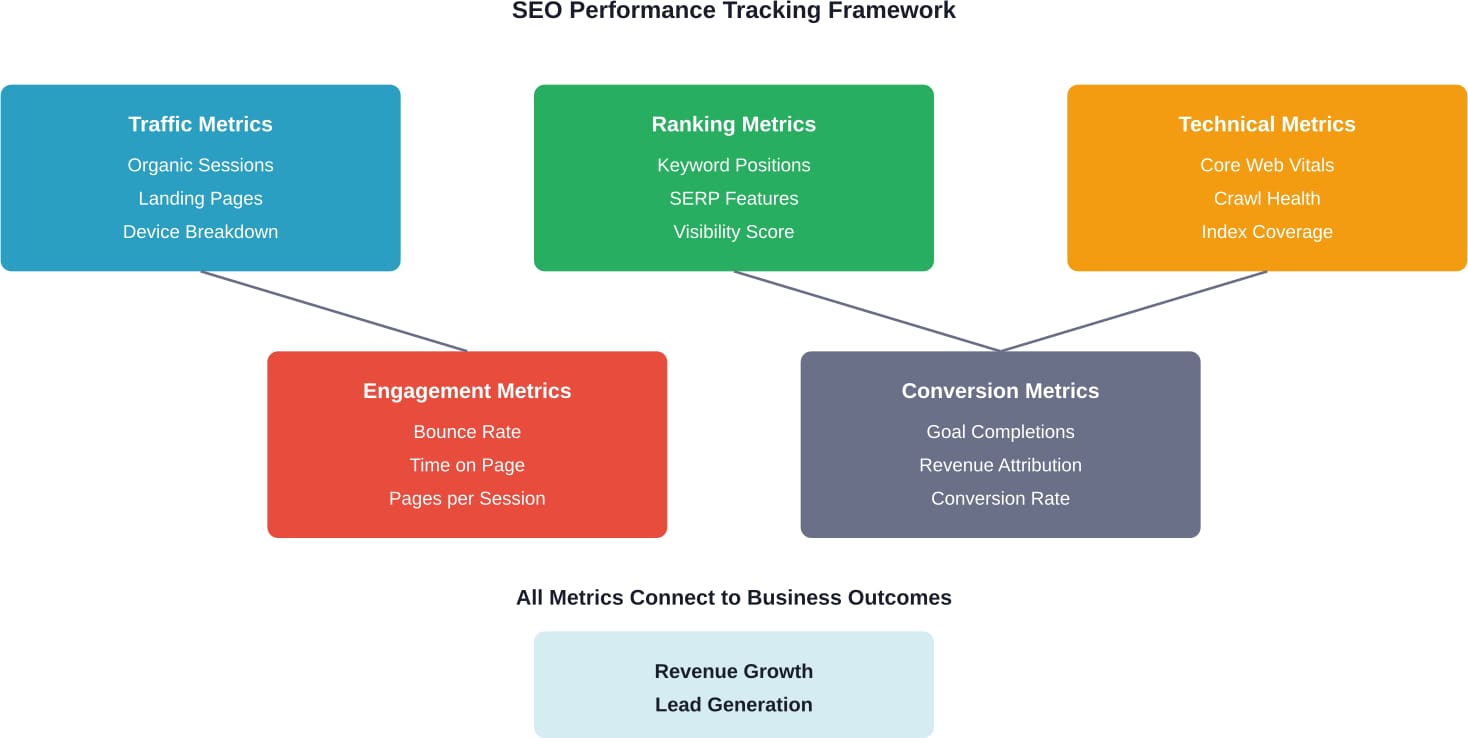
Total organic traffic provides a high-level health indicator, but segmentation reveals the real story. Break traffic down by landing page, device type, geographic location, and user intent.
Monitor traffic trends over time rather than fixating on daily fluctuations. Week-over-week and month-over-month comparisons smooth out anomalies and reveal genuine patterns. Seasonal businesses especially need year-over-year comparisons to distinguish growth from seasonal cycles.
Pay special attention to new versus returning organic visitors. Steady growth in new visitors indicates successful content discovery, while returning visitors suggest content provides ongoing value.
Search Rankings and Visibility
Rankings still matter, but context determines their value. A top-three ranking for a low-intent keyword that doesn’t convert wastes more resources than it generates.
Track rankings for keywords that align with business goals. Monitor not just current position but ranking volatility—frequent fluctuations often signal relevance issues or algorithm sensitivity.
Google introduced the branded queries filter in Search Console on November 20, 2025, allowing automatic segmentation of branded vs non-branded queries in the Performance report.
This distinction matters because branded traffic indicates existing awareness, while non-branded traffic represents new discovery.
Also monitor SERP features—featured snippets, local packs, knowledge panels. Capturing these positions often drives more visibility than traditional organic rankings.
Engagement and Behavior Signals
Search engines increasingly prioritize user experience signals. Pages that engage visitors tend to rank better over time.
Track engagement rate—the percentage of sessions where users actively interact with content. Google Analytics calculates this by measuring sessions with meaningful engagement: spending at least 10 seconds on site, triggering a conversion event, or viewing multiple pages.
Monitor time on page for key landing pages. Short durations on long-form content often indicate relevance mismatches or readability issues. Compare performance across similar content types to identify patterns.
Pages per session reveals whether content encourages further exploration. Strong internal linking and relevant content recommendations should drive users deeper into the site.
Conversion Metrics That Tie to Revenue
Here’s where measurement connects directly to business impact. Track conversions specifically from organic traffic—form submissions, purchases, signups, downloads, or whatever actions matter for the business model.
Calculate organic conversion rate: conversions divided by organic sessions. Track this by landing page to identify which content drives the most valuable traffic.
For ecommerce, track organic revenue, average order value from organic traffic, and revenue per organic session. These metrics prove SEO’s financial contribution unambiguously.
Don’t forget assisted conversions. Many users discover a brand through organic search but convert through other channels later. Multi-touch attribution reveals SEO’s full contribution to the customer journey.
Technical Health Indicators
Technical issues silently destroy SEO performance. Regular monitoring catches problems before they crater rankings.
Core Web Vitals measure loading performance, interactivity, and visual stability. Google confirmed these metrics factors into ranking decisions. Monitor Largest Contentful Paint (LCP), Interaction to Next Paint (INP), and Cumulative Layout Shift (CLS). FID was officially replaced by INP as a Core Web Vital on March 12, 2024.
Track crawl statistics in Search Console: crawl requests, crawl timing, crawl errors. Sudden changes often indicate technical problems that need immediate attention.
Monitor index coverage to ensure important pages get indexed while low-value pages stay out. Unexpected drops in indexed pages signal serious issues requiring investigation.
Check mobile usability. Most organic traffic now comes from mobile devices (over 60% of internet users globally access content via smartphones or tablets), so mobile-specific issues directly impact visibility and user experience.
Essential Tools for Comprehensive SEO Tracking
The right tools transform raw data into actionable insights. Most effective measurement strategies combine multiple tools, each serving specific purposes.
Google Search Console: The Foundation
Search Console remains the most authoritative source for understanding how Google sees a site. It reveals which queries drive impressions and clicks, which pages rank, and technical issues blocking performance.
On December 4, 2025, Google announced AI-powered configurations in Search Console’s performance report as an experimental feature. This uses natural language to help users quickly filter and compare data without manual setup, making analysis more efficient.
Use Search Console to monitor search query performance, identify pages losing visibility, track index coverage, and diagnose technical problems. The data comes directly from Google, making it the definitive source for search performance insights.
Google Analytics: Understanding User Behavior
While Search Console shows how users find a site, Analytics reveals what happens after arrival. Track organic traffic patterns, engagement metrics, conversion paths, and revenue attribution.
Set up custom segments isolating organic traffic. This allows analyzing organic visitors separately from other channels, revealing behaviors specific to search-driven traffic.
Configure goal tracking for key conversion actions. This connects traffic to business outcomes, making it possible to calculate organic conversion rates and attribute revenue specifically to SEO efforts.
Use the landing page report to identify which organic entry points perform best. Analyze engagement and conversion rates by landing pages to prioritize optimization efforts.
Specialized SEO Platforms
Tools like Semrush, Ahrefs, Moz, and others provide capabilities Google’s tools don’t offer—competitive analysis, broader keyword tracking, backlink monitoring, and technical audits.
These platforms track rankings across thousands of keywords automatically, revealing visibility trends that individual keyword checks would miss. They also monitor competitors, showing where competing sites gain or lose rankings.
Use these tools to identify keyword opportunities, track backlink growth and quality, audit technical issues at scale, and benchmark performance against competitors.
| Primary Use Cases | Key Metrics Provided | Best For |
|---|---|---|---|
| Google Search Console | Search visibility, technical health, index monitoring | Impressions, CTR, rankings, crawl stats, Core Web Vitals | Authoritative Google data, technical diagnostics |
| Google Analytics | Traffic analysis, user behavior, conversion tracking | Sessions, engagement rate, conversions, revenue | Understanding post-click behavior and ROI |
| SEO Platforms (Semrush, Ahrefs, Moz) | Keyword research, rank tracking, competitive analysis | Keyword rankings, backlinks, domain authority, site audits | Competitive intelligence and comprehensive monitoring |
| Technical SEO Tools (Screaming Frog, Sitebulb) | Site crawling, technical audits, issue identification | Crawl data, broken links, redirect chains, page speed | Deep technical analysis and site architecture |
| AI Visibility Tools (Profound, Otterly) | AI search monitoring, LLM citation tracking | AI feature visibility, citation frequency, prompt performance | Tracking visibility in AI-powered search experiences |
Emerging AI Visibility Monitoring
As AI-powered search features become more prominent, new tools track visibility in these experiences. Platforms like Profound, Otterly, and Semrush’s AI Tracker monitor whether brands appear in AI Overviews, ChatGPT responses, Perplexity citations, and similar AI-generated results.
These tools test various prompts related to a business or industry, tracking which sources AI systems cite. While AI search results remain somewhat probabilistic—varying based on phrasing and timing—monitoring citation patterns reveals overall visibility trends.
According to Reddit practitioners in the digital marketing community, monitoring AI visibility is becoming increasingly important, though it’s still early days. Some practitioners manually test prompts and document results, while others use specialized tools for systematic tracking at scale.
Building an SEO Performance Dashboard
Data scattered across multiple platforms creates friction. A centralized dashboard consolidates key metrics, making it easy to spot trends and identify issues quickly.
Effective dashboards balance comprehensiveness with clarity. Include enough metrics to understand performance holistically without overwhelming users with noise.
Dashboard Structure That Works
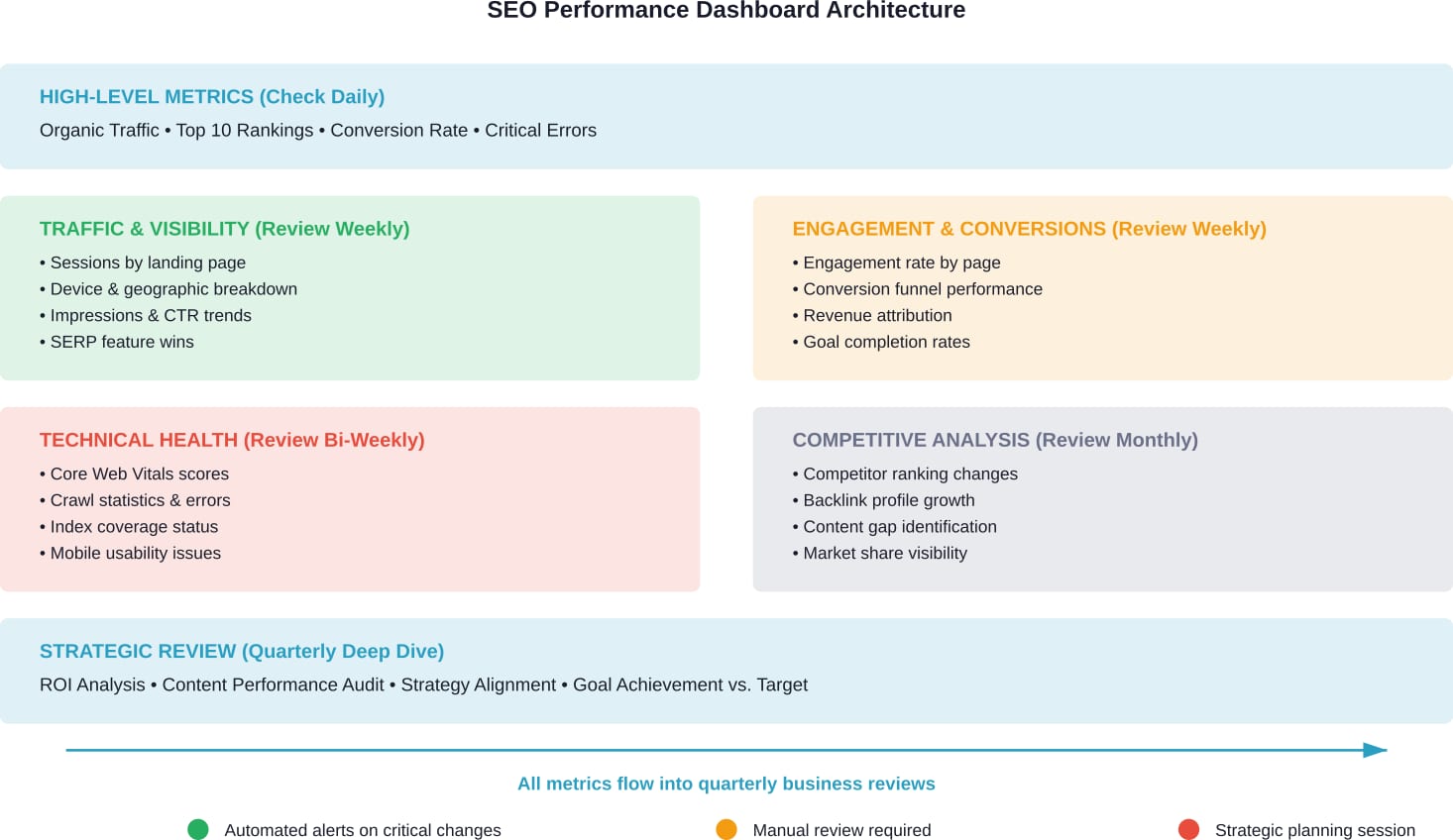
Organize dashboards into logical sections aligned with SEO priorities:
- Traffic Overview: Total organic sessions, week-over-week change, month-over-month change, year-over-year change. Segment by device and geography for added context.
- Ranking Performance: Average position for target keywords, number of keywords ranking in positions 1-3, 4-10, and 11-20. Track movement week over week.
- Visibility Metrics: Total impressions, average CTR, SERP feature wins. Include both branded and non-branded segments.
- Engagement Signals: Average engagement rate, bounce rate, pages per session, average session duration for organic traffic.
- Conversion Performance: Organic conversions, organic conversion rate, assisted conversions, revenue from organic (for ecommerce).
- Technical Health: Core Web Vitals scores, crawl error count, index coverage percentage, mobile usability issues.
Update dashboards automatically through API integrations wherever possible. Manual updates introduce delays and errors that reduce dashboard value.
Frequency and Monitoring Cadence
Different metrics require different monitoring frequencies. Traffic and rankings can be checked daily, but week-over-week comparisons provide more meaningful insights than day-to-day fluctuations.
Review dashboards weekly for trend identification and issue spotting. Conduct deeper monthly analyses comparing performance against goals and identifying optimization priorities.
Set up automated alerts for significant changes—traffic drops exceeding 20%, sudden ranking losses for priority keywords, or spikes in crawl errors. Automated alerts enable rapid response to problems before they compound.
Proving SEO ROI to Stakeholders
Data in dashboards means nothing if it doesn’t connect to business outcomes. Stakeholders care about revenue, leads, and growth—not rankings or impressions.
Speaking the right language makes the difference between SEO being viewed as a cost center versus a growth driver. According to Moz’s research on stakeholder communication, traditional SEO language often falls short with senior leaders who think in terms of revenue, market share, and competitive positioning.
Connecting Metrics to Business Outcomes
Start with revenue attribution. For ecommerce sites, track revenue generated from organic traffic directly. Show month-over-month and year-over-year growth, clearly demonstrating SEO’s financial contribution.
For lead generation businesses, track leads from organic sources and calculate lead value based on close rates and customer lifetime value. This transforms abstract traffic numbers into projected revenue figures stakeholders understand.
Calculate cost per acquisition from organic traffic. Compare this to paid channel CPAs to highlight SEO’s efficiency. While SEO requires upfront investment, the ongoing CPA from organic traffic typically runs far lower than paid channels.
Show the compounding value of SEO. Unlike paid ads that stop delivering when budget stops, organic visibility continues generating traffic long after content is published. Demonstrate cumulative traffic and conversions from content published months or years earlier.
Reporting Framework That Resonates
Structure reports around business priorities, not SEO metrics. Lead with outcomes—revenue growth, lead increases, conversion rate improvements—then explain which SEO activities drove those results.
Use comparison frameworks stakeholders already understand. Show SEO performance against targets, previous periods, and industry benchmarks. Visualize trends that make patterns immediately obvious.
Include narrative context explaining what happened and why. Data without interpretation leaves stakeholders guessing. Explain algorithm updates, seasonal factors, competitive changes, or internal efforts that influenced performance.
Be honest about challenges and setbacks. Credibility comes from acknowledging problems alongside successes. When traffic drops or conversions decline, explain what happened, what’s being done to address it, and expected recovery timelines.
Stop Guessing Your SEO, Start Getting Clear Results
Tracking metrics is one thing. Turning SEO into consistent traffic, leads, and revenue is another.
Lengreo works with companies that need more than rankings on a dashboard. Their team focuses on technical fixes that move the needle, content that matches real search intent, and link building that supports long term authority. Everything is tied back to measurable outcomes, not vanity numbers.
If your reports look busy but growth feels flat, it may be time to bring in a team that connects strategy with proof.
👉 Book a call with Lengreo and build an SEO plan you can actually measure and defend.
Advanced Tracking: Measuring Content Performance
Content drives most SEO results, so measuring content performance reveals what’s working and what needs improvement.
Individual Content Asset Analysis
Track performance metrics for each significant content piece: organic traffic over time, ranking keywords, conversion rate, engagement metrics, and backlinks earned.
Identify content with declining traffic. These pages either face new competition, suffer from content decay, or target keywords with shifting intent. Prioritize refreshing high-value pages showing downward trends.
Find content that ranks on page two (positions 11-20) for valuable keywords. These pages sit on the edge of visibility—often, relatively minor improvements push them onto page one where they capture significantly more traffic.
Analyze top-performing content to identify success patterns. What topics resonate? What content formats drive engagement? What depth and structure work best? Apply these insights to future content development.
Content Cluster Performance
Beyond individual pages, track performance for content clusters—groups of related content targeting connected topics. Clusters demonstrate topical authority and often rank better collectively than isolated articles.
Monitor cluster-wide metrics: total organic traffic to all cluster pages, internal link flow between cluster content, keyword rankings across cluster topics, and conversion performance from cluster entry points.
Identify gaps in clusters where additional content would strengthen topical coverage. Use search data to find related queries users search for but existing content doesn’t address.
Technical Performance Monitoring
Technical issues silently erode SEO performance. Systematic monitoring catches problems early, before they significantly impact visibility.
Core Web Vitals Tracking
Google explicitly confirmed Core Web Vitals factor into ranking decisions, making them non-negotiable for performance monitoring.
Track Largest Contentful Paint (LCP)—measuring loading performance. Pages should achieve LCP under 2.5 seconds for good performance. Monitor this separately for mobile and desktop, as mobile often performs worse.
Monitor Interaction to Next Paint (INP)—measuring responsiveness. Pages should respond to user interactions within 200 milliseconds for good performance (threshold: ≤ 200 ms good, 200–500 ms needs improvement, > 500 ms poor). Heavy JavaScript often causes INP problems.
Watch Cumulative Layout Shift (CLS)—measuring visual stability. Pages should maintain CLS under 0.1 to avoid frustrating users with unexpected layout shifts during loading.
Track these metrics through Search Console’s Core Web Vitals report, which shows real user data. Also use tools like PageSpeed Insights or Lighthouse for diagnostic information explaining issues and suggesting fixes.
Crawl Health and Index Status
Search engines can’t rank pages they can’t crawl or index. Monitor crawl statistics and index coverage religiously.
Check Search Console’s crawl stats report for total crawl requests, kilobytes downloaded per day, and time spent downloading pages. Sudden changes indicate problems worth investigating.
Monitor the index coverage report for errors preventing indexing, valid pages with warnings, excluded pages, and indexed page counts. Investigate any unexpected changes—pages suddenly excluded, error spikes, or indexed page counts dropping.
Set up monitoring for critical pages. Ensure key landing pages, conversion pages, and high-value content remain indexed and accessible. Configure alerts if these pages develop problems.
Site Speed and Performance
Site speed directly impacts both user experience and rankings. Faster sites rank higher and convert better.
Monitor page speed using real user data from Chrome User Experience Report (available through PageSpeed Insights and Search Console). Lab-based testing provides diagnostics, but real user data shows actual performance users experience.
Track speed separately for mobile and desktop. Mobile connections often run slower, so mobile optimization requires special attention despite separate measurement.
Identify specific bottlenecks slowing pages: large images, unoptimized JavaScript, slow server response times, or render-blocking resources. Prioritize fixing issues affecting the most visited pages first.
Competitive Performance Benchmarking
SEO performance exists relative to competitors. Understanding how competitors perform reveals opportunities and threats.
Visibility Share Analysis
Track share of voice—the percentage of visibility across target keywords a brand captures versus competitors. Rising share indicates growing dominance, while declining share signals competitors gaining ground.
Monitor which competitors gain or lose rankings for priority keywords. When competitors surge, analyze what changed—new content, technical improvements, link acquisition campaigns.
Identify keywords where competitors outrank the site. Analyze their content to understand why it performs better: greater depth, better structure, stronger relevance signals, more authoritative sources.
Content Gap Identification
Use competitive analysis tools to find content gaps—keywords competitors rank for but the site doesn’t. These represent opportunities to capture incremental traffic.
Prioritize gaps based on search volume, keyword difficulty, and relevance to business goals. Not every gap deserves filling—focus on opportunities aligned with offerings and user needs.
Analyze competitors’ top-performing content. What topics drive their traffic? What formats work for them? What’s missing from that content that could be improved?
Adapting Measurement for AI Search
The emergence of AI-powered search features requires evolving measurement approaches. Traditional metrics don’t fully capture visibility in AI experiences.
Google’s guidance on succeeding in AI search experiences (e.g., AI Overviews) was reinforced on May 21, 2025, emphasizing that core principles remain rooted in fundamentals like high-quality, user-focused content.
Tracking AI Overview and AI Mode Visibility
Monitor whether content appears in Google’s AI Overviews and AI Mode results. Being cited in these features provides visibility even when users don’t click through to the site.
Tools like Semrush’s AI Tracker help monitor AI visibility systematically. They test prompts related to a business and track which sources Google’s AI cites.
But here’s the thing—AI search results show more variability than traditional organic results. The same prompt may return different sources on different days, or when phrased slightly differently. Measurement requires tracking patterns over time rather than fixating on individual results.
Multi-Platform Search Visibility
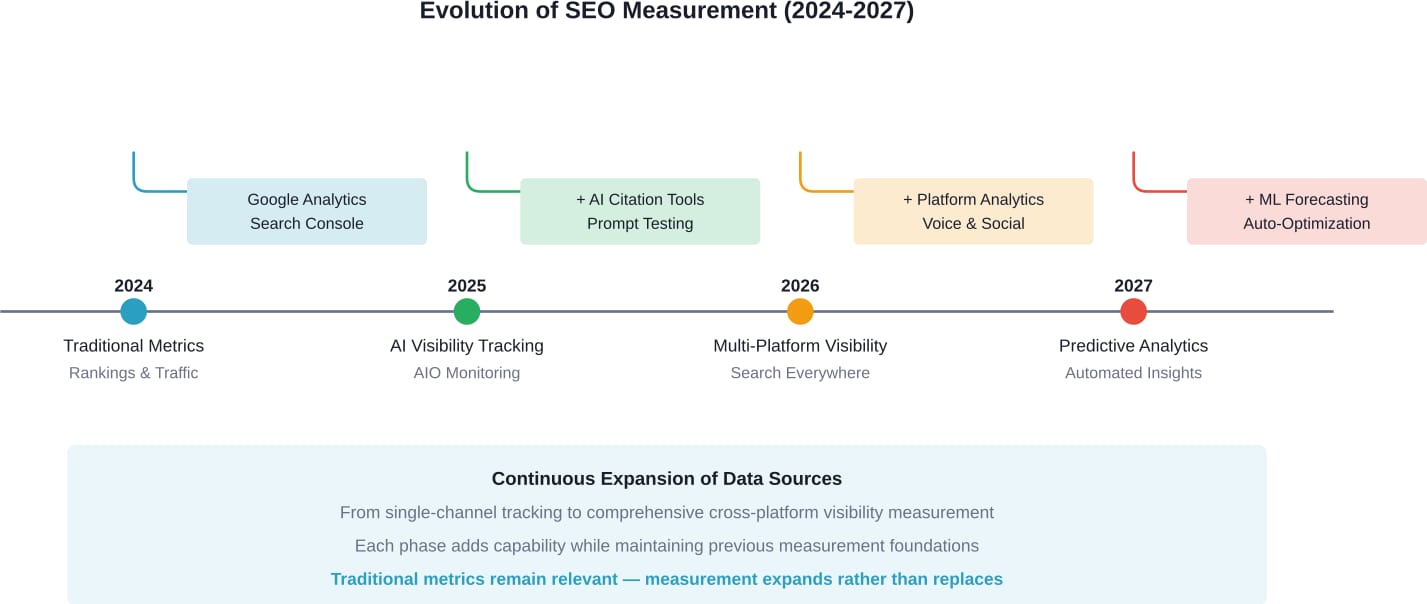
Users now search across platforms: Google, ChatGPT, Perplexity, social media, voice assistants. Comprehensive visibility measurement extends beyond Google organic results.
Track brand mentions and citations across AI platforms. Tools like Profound, Otterly, and others monitor whether brands appear when users ask questions in ChatGPT, Perplexity, or other LLM-based systems.
Monitor visibility on platform-specific search: YouTube, LinkedIn, Reddit, TikTok. Each platform has its own search algorithm and user behavior patterns. Content optimized for one platform may need adaptation for others.
Understand that search everywhere optimization differs from traditional SEO. It requires creating content that satisfies diverse user intents across platforms, not just optimizing for Google’s algorithm.
| Measurement Approach | Key Visibility Indicators | Optimization Focus |
|---|---|---|---|
| Traditional Google Search | Rankings, impressions, CTR, traffic | Top 10 rankings, SERP feature wins, organic sessions | Keywords, technical SEO, content relevance, backlinks |
| AI Overviews / AI Mode | Citation frequency, prompt testing | Appearing in AI responses, citation positioning | Clear answers, structured data, factual accuracy, authority |
| ChatGPT / LLM Platforms | Brand mention monitoring, source attribution | Frequency of citation across prompts, context of mentions | Authoritative content, clear positioning, online presence |
| Platform Search (YouTube, LinkedIn) | Platform-specific analytics | Search impressions, views, engagement within platform | Platform-native content, algorithm alignment, engagement signals |
| Voice Search | Featured snippet capture, question-based queries | Featured snippet ownership, conversational keyword rankings | Conversational content, direct answers, schema markup |
Actionable Steps to Implement Performance Tracking Today
Theory means nothing without implementation. Here’s how to start measuring SEO performance systematically:
- Step 1: Audit current measurement capabilities. What tools are already in place? What data is being collected? What’s missing? Identify gaps between current measurement and comprehensive tracking.
- Step 2: Set up foundational tools if not already configured. Ensure Google Search Console and Google Analytics are properly installed, tracking accurately, and connected to each other. Verify tracking covers all important subdomains and site sections.
- Step 3: Define specific, measurable goals aligned with business objectives. Vague goals like “improve SEO” accomplish nothing. Specific goals like “increase organic traffic to product pages by 25% in six months” or “generate 100 organic leads per month” create clear targets.
- Step 4: Establish baseline measurements for all key metrics. Document current performance across traffic, rankings, technical health, engagement, and conversions. This baseline enables measuring improvement accurately.
- Step 5: Build or configure a centralized dashboard pulling data from multiple sources. Start simple—dashboards grow more sophisticated over time. The first version just needs to consolidate key metrics in one place.
- Step 6: Set up automated alerts for critical issues: significant traffic drops, ranking losses for priority keywords, spikes in crawl errors, or Core Web Vitals degradation. Automated monitoring enables rapid response.
- Step 7: Establish a regular review cadence. Schedule weekly metric reviews, monthly performance analysis, and quarterly strategic assessments. Regular reviews transform data into insights that drive decisions.
- Step 8: Create a reporting template tailored to stakeholders. Structure reports around business outcomes first, supporting data second. Include narrative explanations that provide context and interpretation.
- Step 9: Document measurement processes and standards. Ensure multiple team members understand how tracking works, where data lives, and how to interpret metrics. This prevents measurement from depending on a single person.
- Step 10: Iterate and improve measurement over time. Start with fundamentals, then add sophistication gradually. Competitive tracking, AI visibility monitoring, advanced attribution—these can layer in after basic measurement works reliably.
Common Measurement Mistakes to Avoid
Even with proper tools and frameworks, certain mistakes undermine measurement effectiveness:
- Tracking vanity metrics: Impressions, page views, and domain authority look impressive but may not connect to business outcomes. Prioritize metrics that directly influence revenue, leads, or strategic goals.
- Ignoring statistical significance: Small changes in metrics often reflect normal variation, not actual performance shifts. Require meaningful changes over sufficient time periods before declaring success or failure.
- Cherry-picking data: Selecting only metrics that show positive results creates false narratives. Comprehensive measurement includes both successes and challenges.
- Over-attributing to single causes: SEO performance rarely traces to a single factor. Algorithm updates, competitive actions, seasonal patterns, and internal efforts all influence results simultaneously. Avoid oversimplified cause-and-effect conclusions.
- Neglecting mobile vs. desktop breakdown: Mobile and desktop users behave differently, face different technical constraints, and often see different search results. Combined metrics obscure important patterns.
- Forgetting about seasonality: Many businesses experience predictable seasonal patterns. Year-over-year comparisons account for seasonality better than month-over-month metrics.
- Measuring too frequently: Daily ranking checks or hourly traffic monitoring creates noise and anxiety without providing actionable insights. Most metrics need weekly or monthly analysis for meaningful patterns to emerge.
- Setting unrealistic expectations: SEO delivers results over months, not days. Expecting immediate returns from optimization efforts sets up disappointment and undermines long-term strategy.
The Future of SEO Performance Measurement
Measurement continues evolving as search itself transforms. Several trends are reshaping how performance gets tracked.
AI-driven search features are expanding rapidly. Google introduced AI Mode recently, and other platforms continue developing AI-powered experiences. Measurement must extend beyond traditional organic results to capture visibility across these experiences.
Attribution modeling is becoming more sophisticated. Multi-touch attribution reveals how SEO contributes throughout the customer journey, not just at the final conversion. Advanced models show SEO’s role in awareness, consideration, and decision stages.
Predictive analytics are emerging. Machine learning models can forecast traffic changes, predict ranking impacts from algorithm updates, and identify content with declining performance before major drops occur.
Privacy-focused measurement adapts to reduced tracking capabilities. As third-party cookies disappear and privacy regulations expand, measurement relies more on first-party data, aggregated patterns, and privacy-preserving techniques.
Real-time optimization becomes possible. As measurement systems become more automated and integrated, they can trigger optimization actions automatically—updating content, adjusting internal links, or flagging issues for review without manual intervention.
Conclusion: Measurement Enables Sustainable SEO Growth
SEO without measurement is marketing theater—activity without accountability, effort without evidence of impact.
Proper performance tracking transforms SEO from a speculative exercise into a data-driven growth channel. It reveals which strategies work, where opportunities exist, and how to allocate resources for maximum return.
The measurement frameworks outlined here—from establishing baselines to building dashboards, from tracking traditional metrics to monitoring AI visibility—create the foundation for sustainable SEO success. They connect optimization efforts to business outcomes, prove ROI to stakeholders, and enable continuous improvement based on what data reveals.
But here’s the thing: perfect measurement matters less than consistent measurement. Start with fundamentals. Track organic traffic, key rankings, conversions, and technical health. Build dashboards that consolidate metrics. Establish regular review cadences. Then layer in sophistication gradually—competitive analysis, AI visibility monitoring, advanced attribution.
The search landscape will continue evolving. AI features will expand, user behavior will shift, and algorithms will change. What won’t change is the need to measure performance systematically, interpret data accurately, and adapt strategies based on evidence rather than assumptions.
Ready to transform your SEO performance tracking? Start today by auditing current measurement capabilities, establishing clear goals, and implementing the baseline tracking frameworks outlined above. The difference between SEO that delivers measurable business growth and SEO that consumes resources without returns comes down to measurement discipline.
Stop guessing. Start measuring. Prove your SEO success with data that connects visibility to outcomes that matter.