

Brief Overview: SaaS SEO in 2026 combines traditional optimization with new AI-driven strategies. Success requires technical excellence, strategic content targeting pain points over volume, and adaptation to AI search platforms. The most effective approach balances four pillars: technical SEO, on-page optimization, off-page authority building, and Generative Engine Optimization (GEO).
The SaaS market looks nothing like it did five years ago.
Competition has intensified. Customer acquisition costs through paid channels continue climbing. And search behavior has fundamentally shifted with the rise of AI-powered search platforms.
For SaaS companies, organic search remains one of the most reliable channels for sustainable growth. But the playbook has changed. What worked in 2023 won’t cut it now.
This guide breaks down exactly how to build a SaaS SEO strategy that drives results in 2026. No fluff. Just actionable strategies backed by real data.
What Makes SaaS SEO Different
SaaS SEO isn’t just regular SEO with a software twist. The business model creates unique challenges and opportunities.
Traditional e-commerce SEO focuses on product pages and transactional keywords. Local SEO centers on geographic targeting. SaaS SEO operates in a different space entirely.
The SaaS Search Landscape
Most SaaS products solve complex business problems. Potential customers don’t wake up searching for “project management software” on day one. They start with the problem: “how to track team tasks” or “why projects miss deadlines.”
This creates a longer, more educational buyer journey. Someone researching at 2am because their production system went down has different intent than someone casually exploring solutions.
The sales cycle extends over weeks or months. A single blog post rarely converts directly. Instead, content builds awareness, establishes authority, and nurtures prospects through multiple touchpoints.
Why Starting SEO From Day One Matters
Many SaaS companies default to PPC for quick wins. The logic seems sound: immediate traffic, measurable ROI, fast iteration.
But there’s a dangerous trap. PPC costs rise as competitors enter the market. What starts as a $15 cost per acquisition can balloon to $50 or more. Eventually, unit economics breaks down.
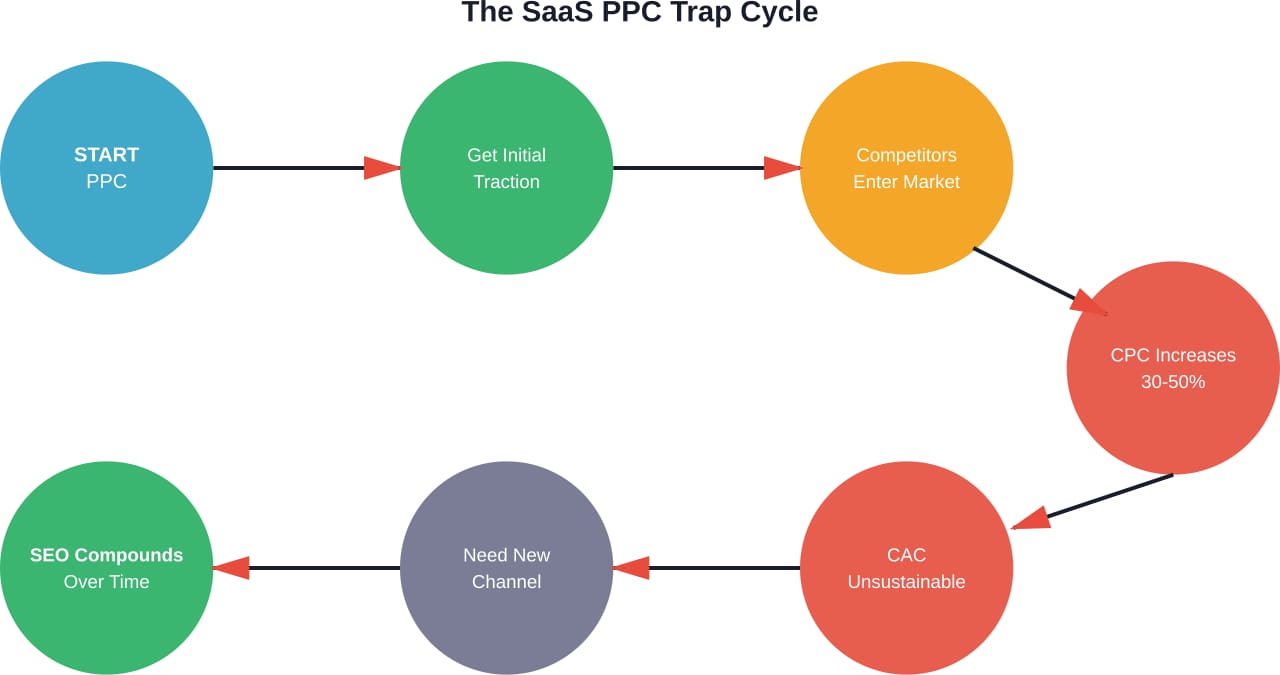
SEO works differently. It’s slower to start but compounds over time. Content published today can drive traffic for years. Each article builds authority that strengthens the entire domain.
The companies that dominate their categories—HubSpot, Ahrefs, Semrush—invested heavily in SEO from early stages. They built content moats that competitors struggle to overcome.
The Four Pillars of SaaS SEO in 2026
Modern SaaS SEO rests on four interconnected pillars. Neglect one, and the entire strategy weakens.
| Focus Area | Primary Impact |
|---|---|---|
| Technical SEO | Site architecture, speed, crawlability | Foundation for all other efforts |
| On-Page SEO | Content optimization, keyword targeting | Relevance and ranking signals |
| Off-Page SEO | Link building, brand mentions | Authority and trust signals |
| GEO | AI search visibility, citations | Visibility in AI-powered search |
Technical SEO: The Foundation
Technical SEO gets overcomplicated in most discussions. For the 90% of SaaS companies running standard websites, it’s straightforward.
Start with site architecture. Search engines need to discover and understand pages efficiently. A clean hierarchy helps: homepage → category pages → individual posts/features.
Page speed matters more than ever. Core Web Vitals remain ranking factors, but their real impact shows in user experience. Slow pages lose visitors before content even loads.
Mobile responsiveness isn’t optional. Most B2B research now happens on mobile devices, even for enterprise software decisions.
Security fundamentals apply too. HTTPS is standard. Yet surprisingly, a surprising number of sites, over 6%, redirect HTTPS to HTTP—an immediate trust and ranking penalty.
On-Page Optimization: Content That Ranks
On-page SEO determines whether content ranks for target keywords. But keyword stuffing died years ago.
Modern on-page optimization focuses on search intent. What does someone actually want when they search “kubernetes security tools”? Are they learning, comparing options, or ready to buy?
Match content format to intent. Informational queries need educational guides. Commercial intent calls for comparison pages. Navigational searches want direct product information.
Structural elements still matter. Title tags, meta descriptions, headers (H1, H2, H3) help search engines understand content hierarchy. But write for humans first. If a title sounds robotic for the sake of keywords, it’s wrong.
Off-Page SEO: Building Authority
Links remain a primary ranking factor. But the game has shifted from quantity to quality.
One link from a respected industry publication carries more weight than fifty directory listings. Google’s algorithms have gotten sophisticated at identifying manipulative link schemes.
Brand mentions matter too. When authoritative sites mention a SaaS product without linking, it still signals relevance and trust.
According to Semrush research by Kevin Indig, the top 10% of most-cited pages across AI platforms have “much less traffic, rank for fewer keywords, and get fewer total backlinks” than typical SEO winners.
Generative Engine Optimization: The New Frontier
AI search platforms—ChatGPT, Perplexity, Google’s AI Overviews—represent a fundamental shift. These systems don’t just rank pages. They synthesize information and generate answers.
GEO focuses on making content citable by AI systems. This means clear, authoritative information structured for easy extraction.
Key GEO strategies include:
- Structured data markup to help AI parse information
- Clear definitions and explanations
- Statistical data and research findings AI can reference
- Authoritative author credentials and citations
According to Google’s February 2026 Discover core update (announced February 5, 2026), Google Discover now places greater emphasis on locally relevant content (particularly content from the user’s country) and prioritizes more useful, high-quality, and worthwhile articles over clickbait or low-value material.
SaaS Keyword Research: Finding the Right Opportunities
Generic keyword research advice doesn’t work for SaaS. The approach needs to match the business model and buyer journey.
The Problem-Aware vs. Solution-Aware Distinction
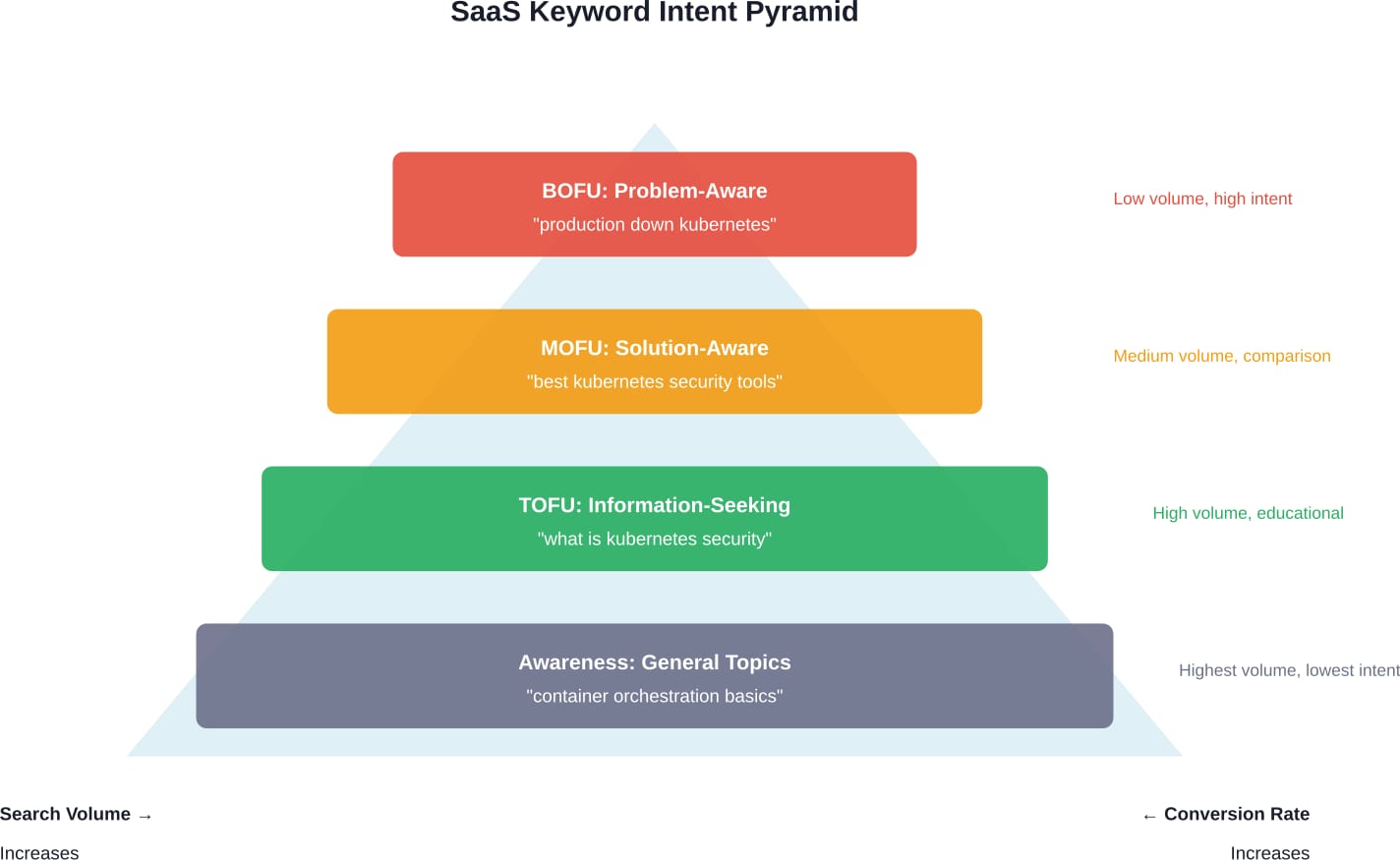
Most SaaS keyword strategies fail because they target solution-aware keywords exclusively. These are terms like “best project management software” or “CRM comparison.”
But prospects start to be problem-aware. They search “how to track team tasks” or “why sales pipeline visibility matters.” These queries have lower volume but higher potential value.
Someone searching at 2am because production is down isn’t browsing. They need a solution now. Problem-aware content at bottom-of-funnel (BOFU) stages converts fastest.
Niche Over Volume
Here’s the thing though—high search volume keywords often disappoint. A term with 10,000 monthly searches sounds great until realizing it’s too broad to convert.
Niche keywords with 10-50 monthly searches frequently outperform. They’re specific, indicating clear intent. Someone searching “kubernetes security audit automation for financial services” knows exactly what they need.
These long-tail keywords also face less competition. Ranking for them is faster and more realistic for newer SaaS companies.
Keyword Research Process
Start by mapping customer pain points. What keeps potential users awake? What problems do they complain about?
Use tools like Ahrefs, Semrush, or Google Keyword Planner to find related terms. But don’t stop at keyword volume. Analyze search intent.
Look at what currently ranks. If Google shows comparison articles for a keyword, it’s solution-aware. If it shows educational content, it’s informational.
Check keyword difficulty scores, but don’t let high scores deter completely. A well-executed content piece can outrank weaker competitors even for difficult terms.
Create a keyword map: assign keywords to specific pages. Avoid keyword cannibalization—multiple pages competing for the same term.
Content Strategy for SaaS Companies
Content drives SaaS SEO. But not all content performs equally.
Content Types That Actually Work
Educational guides remain essential. These target top-of-funnel (TOFU) keywords and build awareness. They won’t convert immediately, but they establish authority.
Comparison pages convert strongly. When someone searches “Product A vs Product B,” they’re close to a decision. Create honest comparisons—even if a competitor wins on certain features, transparency builds trust.
Feature pages need SEO love too. Dedicate individual pages to each major feature. Explain the problem it solves, how it works, and who benefits most.
Case studies and customer stories provide social proof. They rank for “[use case] success story” queries and help prospects envision results.
Template and tool pages offer immediate value. “Free project timeline template” or “SEO audit tool” pages attract users who later convert to paid plans.
The AI Content Question
AI-generated content has gone mainstream. Tools help create content volumes that were previously impossible.
But there’s a catch. AI tends toward generic, surface-level content. Without human expertise and editing, it blends into the noise.
Use AI as a starting point, not a finished product. Let it draft outlines, suggest angles, or fill in background information. Then add unique insights, proprietary data, or expert analysis that only a human with domain knowledge can provide.
Google’s core updates continue emphasizing helpful, reliable content created for people. Content that reads like it came from a template—whether human or AI-written—struggles to rank.
Content Structure Best Practices
Start with a clear value proposition. The introduction should immediately tell readers what they’ll learn and why it matters.
Use short paragraphs. Walls of text scare readers away. Two to three sentences per paragraph maintains readability.
Break up content with subheadings. They help readers scan and find relevant sections. They also help search engines understand content structure.
Include visual elements. Screenshots, diagrams, and charts make concepts clearer and increase time on page.
Add internal links naturally. When mentioning related topics, link to other relevant content on the site. This helps SEO and keeps readers engaged.
End with clear calls to action. Whether it’s signing up for a trial, downloading a resource, or reading related content, guide readers to the next step.
Technical SEO for SaaS Websites
Technical SEO can sound intimidating. For enterprise sites with millions of pages, it genuinely gets complex. For most SaaS websites, it’s manageable.
Site Structure and Crawlability
Search engines discover content by crawling links. A logical site structure makes this efficient.
Keep important pages close to the homepage. Every click deeper reduces page authority. Aim for a shallow hierarchy where key pages are accessible within three clicks.
Use XML sitemaps to help search engines find all pages. Submit these through Google Search Console.
Check for crawl errors regularly. Broken links, 404 pages, and redirect chains waste crawl budget and hurt user experience.
Page Speed Optimization
According to Google’s documentation on Core Web Vitals, page performance metrics directly impact user experience and search rankings.
Three core metrics matter most:
- Largest Contentful Paint (LCP): How quickly the main content loads. Target under 2.5 seconds.
- Interaction to Next Paint (INP): How fast the page responds to user interaction. Target under 200 milliseconds.
- Cumulative Layout Shift (CLS): How stable the layout remains during loading. Target under 0.1.
Improve these metrics by optimizing images, minimizing JavaScript, using browser caching, and choosing fast hosting.
Mobile Optimization
Mobile-first indexing means Google primarily uses the mobile version for ranking. Even B2B SaaS sites must perform flawlessly on mobile.
Test mobile usability in Google Search Console. Fix issues like clickable elements too close together, text too small, or content wider than the screen.
Avoid intrusive interstitials. Pop-ups that cover content frustrate users and can trigger ranking penalties.
Structured Data Markup
Schema markup helps search engines understand content context. For SaaS sites, relevant schemas include:
- Organization schema for company information
- Product schema for software offerings
- Review schema for customer testimonials
- FAQ schema for question-answer content
- Article schema for blog posts
Implement JSON-LD format, which Google recommends. Test markup using Google’s Rich Results Test tool.
Link Building Strategies for SaaS
Link building remains critical. But spammy tactics backfire faster than ever.
What Actually Works in 2026
Creating linkable assets tops the list. These are resources so valuable that other sites naturally want to reference them.
Original research and data studies work incredibly well. Publish industry surveys, benchmark reports, or trend analyses. Others will cite these findings.
Comprehensive guides become reference resources. The “ultimate guide to [topic]” format attracts links when done with genuine depth.
Free tools generate links organically. A calculator, assessment, or utility that solves a real problem will earn backlinks as people share it.
Outreach That Doesn’t Annoy
Outreach gets a bad reputation because most of it is terrible. Generic “I noticed your article” emails fool no one.
When reaching out, offer genuine value. If requesting a link, explain specifically why it benefits their readers—not why it helps SEO.
Broken link building works. Find broken links on relevant sites, create content that replaces the dead resource, and suggest it as an alternative.
Guest posting remains viable on quality sites. But the bar is high. Only pitch truly excellent content to reputable publications in the industry.
Relationship Building Over Transactions
Long-term relationship building beats one-off link requests.
Engage with industry influencers on social media. Comment thoughtfully on their content. Share their work.
Participate in relevant communities. Reddit, niche forums, and Slack groups offer opportunities to provide value and build reputation.
Sponsor industry events or podcasts. These generate brand awareness and often include backlinks.
Collaborate with complementary SaaS companies. Co-create content, webinars, or resources that benefit both audiences.
Adapting to AI Search Platforms
AI search represents the biggest shift in search behavior since mobile. Companies that adapt early gain significant advantages.
How AI Search Changes Discovery
Traditional search shows ten blue links. Users click through to websites. AI search generates synthesized answers, often without clicks.
According to Semrush data, searches are getting longer and more complex now that users get concrete answers instead of sifting through multiple results. People aren’t typing fragments like “CRM software pricing.” They’re entering long-tail terms that are full of questions: “What’s the best CRM for a 50-person sales team with Salesforce integration and activity tracking?”
This creates both challenges and opportunities. The challenge: less click-through traffic. The opportunity: being cited in AI responses builds massive brand awareness.
Optimizing for AI Citations
Make content easily extractable. AI systems parse structured information more effectively than unstructured narrative.
Use clear definitions. When explaining concepts, state them explicitly: “X is [definition].” This helps AI cite accurate information.
Include statistics and data points. AI responses frequently reference specific numbers. Make these easy to find and properly sourced.
Establish author credentials. AI systems consider source authority. Author bios with relevant expertise strengthen content credibility.
Create comprehensive resources. AI platforms tend to cite detailed, authoritative content over shallow pieces.
Measuring AI Search Impact
Tools like Semrush now offer AI traffic dashboards. These estimate visits from AI platforms.
According to Semrush’s AI Traffic dashboard, Webflow’s site got an estimated 64.3K visits from AI platforms in August. This is a small portion of the site’s overall traffic (about 0.7% of the 9.2 million visits Traffic Analytics estimates).
Track brand mentions in AI responses. Regularly query AI platforms with relevant questions and note when they cite or recommend the product.
Monitor citation sources. Understanding which content pieces AI systems reference helps inform future content strategy.
Measuring SaaS SEO Success
Vanity metrics look good in reports but don’t pay bills. Focus on metrics that connect to business outcomes.
Key Metrics That Matter
| What It Measures | Why It Matters |
|---|---|---|
| Organic traffic | Visitors from search engines | Foundation metric, but not enough alone |
| Keyword rankings | Position for target terms | Leading indicator of traffic potential |
| Organic conversions | Sign-ups or trials from organic traffic | Direct business impact |
| Pages per session | User engagement depth | Indicates content quality and relevance |
| Backlink growth | New referring domains | Authority building over time |
| Organic revenue | Revenue attributed to organic search | Ultimate success measure |
Attribution Challenges
SaaS sales cycles complicate attribution. Someone might discover the brand through organic search, return via direct traffic, and convert after a sales call.
Use multi-touch attribution models that credit multiple touchpoints. First-click attribution shows how prospects discover the brand. Last-click shows what closes deals.
Track assisted conversions in Google Analytics. These show how often organic search played a role even if it wasn’t the final touchpoint.
Setting Realistic Expectations
SEO is slow. Anyone promising first-page rankings in thirty days is selling snake oil.
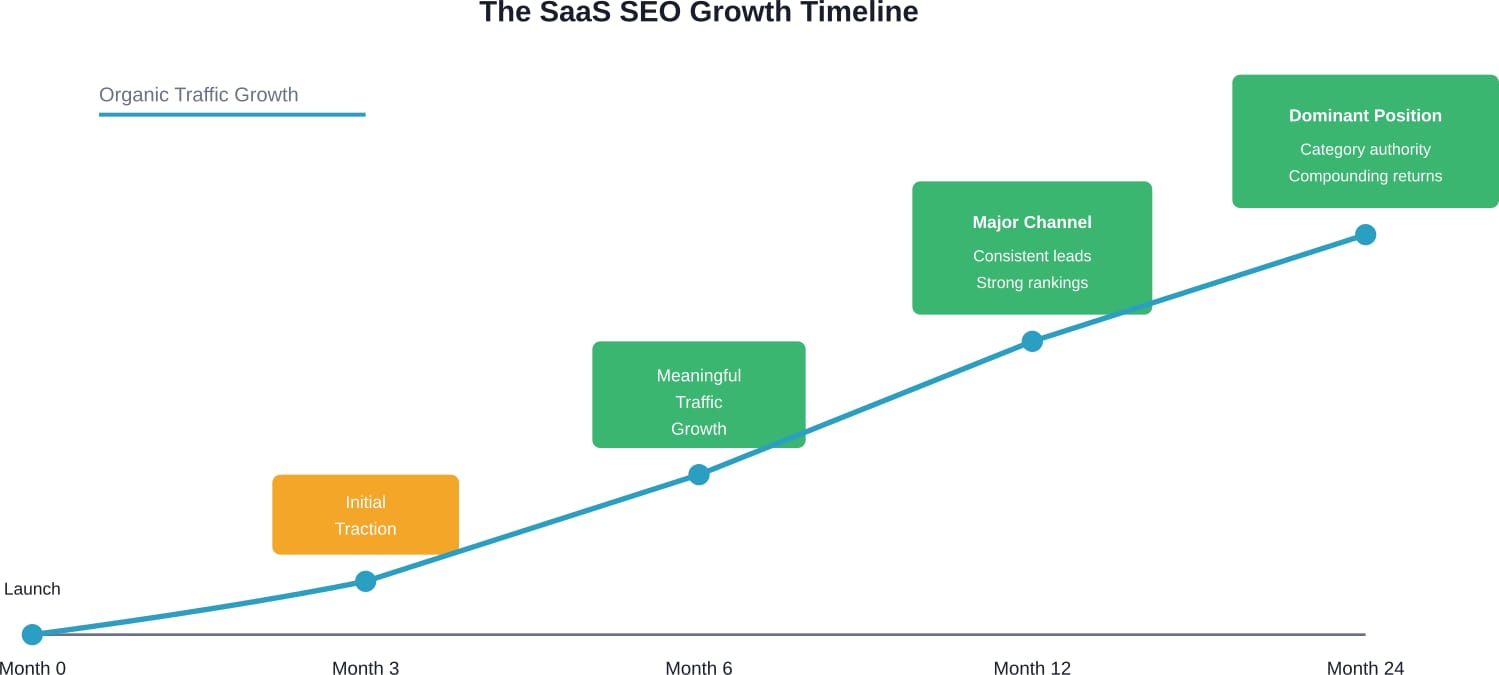
Realistic timelines look like this: three to six months to see initial traction, six to twelve months for significant traffic growth, twelve to twenty-four months for SEO to become a major channel.
Content compounds. An article might generate minimal traffic initially, then gradually climb rankings and drive consistent traffic for years.
Common SaaS SEO Mistakes to Avoid
Learning from others’ mistakes saves time and money.
Targeting the Wrong Keywords
Chasing high-volume keywords without considering intent wastes resources. A keyword with 50,000 monthly searches means nothing if those searchers want something different than what the product offers.
Match keywords to the actual target audience. A project management tool for construction teams shouldn’t target generic “project management” keywords dominated by software development content.
Neglecting Technical Foundations
Publishing great content on a broken site is like building a house on a weak foundation.
Fix technical issues before scaling content production. Otherwise, even excellent content underperforms.
Ignoring User Experience
SEO and user experience aren’t separate. Google’s algorithms increasingly reward sites that genuinely serve users well.
Aggressive pop-ups, slow loading, and confusing navigation hurt both conversions and rankings.
Copying Competitors Without Strategy
Seeing what competitors rank for provides insights. But blindly copying their content strategy rarely works.
Different companies have different strengths, resources, and audiences. Develop a unique angle rather than rehashing existing content.
Expecting Overnight Results
Impatience kills SEO programs. Companies abandon strategies too early, right before they would have seen results.
Commit to at least twelve months before evaluating success or failure. SEO requires consistent effort over time.
Building a Sustainable SEO Program
One-time optimization doesn’t work. Sustainable SEO requires ongoing commitment.
Resource Allocation
For most SaaS companies, SEO should represent a significant portion of marketing budget once Product-Market Fit is established.
Early-stage startups might allocate less initially while validating the market. Growth-stage companies often increase investment as SEO proves ROI.
Decide between in-house, agency, or hybrid approaches. In-house provides control and deep product knowledge. Agencies offer expertise and bandwidth. Many companies use a hybrid: in-house strategist plus agency execution.
Content Production Cadence
Consistency beats sporadic bursts. Publishing two quality articles weekly outperforms publishing ten articles one month and then nothing for three months.
Set realistic production goals based on resources. Better to commit to one excellent article per week and maintain it than to promise five and burn out.
Continuous Improvement
SEO never finishes. Rankings fluctuate. Competitors improve. Google updates algorithms.
Schedule regular content audits. Review older posts, update statistics, refresh examples, and improve quality.
Monitor rankings weekly. Spot drops early and investigate causes.
Stay informed about industry changes. Follow Google Search Central, SEO publications, and thought leaders.
Boost Your SaaS SEO with Expert Support
If you’re building a SaaS SEO strategy for 2026 and want concrete results rather than theory, consider how expert execution can support your goals. Lengreo offers dedicated SEO and AI-SEO services tailored to SaaS companies, combining traditional search optimization with targeted lead generation and outreach. Their approach includes auditing your current visibility, refining content and technical setup, and aligning your online presence with how buyers search and compare software today.
This means you get support not just for rankings but for attracting qualified traffic and converting it into leads — all alongside your broader SaaS marketing plan.
👉 Ready to improve your SaaS visibility and lead flow? Contact Lengreo for a consultation.
Conclusion: Building Sustainable Growth Through SEO
SaaS SEO in 2026 requires more sophistication than ever before. The fundamentals remain—technical excellence, quality content, authoritative backlinks—but execution has evolved.
AI search platforms, increasingly complex search behavior, and sophisticated algorithms demand adaptation. Companies that treat SEO as an afterthought will struggle. Those that invest strategically from early stages build sustainable competitive advantages.
The most successful SaaS companies share common traits. They start SEO early, before relying exclusively on paid channels. They target problem-aware keywords that match actual customer pain points. They create genuinely helpful content rather than churning out generic articles.
They balance the four pillars—technical SEO, on-page optimization, off-page authority building, and generative engine optimization. They measure what matters, focusing on conversions and revenue rather than vanity metrics.
Most importantly, they commit for the long term. SEO compounds. Content published today generates traffic for years. Each quality article strengthens domain authority and makes future content more effective.
The companies dominating search results didn’t get there overnight. They invested consistently over months and years. They built content moats that competitors struggle to overcome.
Start now. Map customer pain points. Identify keyword opportunities. Fix technical foundations. Publish helpful content consistently. Build relationships that earn quality backlinks.
The earlier the start, the stronger the position when competitors catch on. SEO might be slow, but it’s one of the most reliable channels for building a sustainable SaaS business.
Ready to build a SaaS SEO strategy that drives results? Start by auditing current technical foundations, mapping target keywords to buyer journey stages, and committing to consistent, high-quality content production. The investment compounds over time—but only if you start.