Executive Summary
Pay-for-performance SEO sounds risk-free but often leads to short-term ranking manipulations, misaligned incentives, and long-term penalties. Agencies focus on easy wins rather than sustainable growth, frequently using questionable tactics that violate Google’s guidelines. Businesses need transparent, sustainable SEO strategies that build genuine authority and drive actual revenue, not just temporary rankings.
The pitch sounds perfect: only pay when you see results. No risk, no upfront investment, and your agency partner shares the pressure to perform.
But here’s the thing—pay-for-performance SEO creates exactly the wrong incentives for everyone involved. And those misaligned incentives can quietly destroy your online presence while you think you’re being smart with your budget.
According to a recent pricing survey, only 6% of agencies use this pricing model, often combining it with other approaches. There’s a reason the vast majority avoid it: the model fundamentally conflicts with how search engines actually work.
What Pay-for-Performance SEO Actually Means
Performance-based SEO turns the traditional agency relationship upside down. Instead of paying monthly retainers for ongoing work, clients pay only when specific metrics are achieved.
Common payment structures include:
- $500-$550 for ranking positions #1-2 for specific keywords
- $400-$450 for positions #3-4
- Lower amounts for positions #5-6
- Per-conversion fees tied to organic traffic goals
The model appears to transfer all risk from client to agency. No results? No payment. Sounds like the holy grail of marketing accountability.
But that surface-level appeal masks deeper problems that emerge once the campaign starts running.
Why Agencies Offer Performance-Based SEO
Most legitimate agencies avoid this model entirely. So who offers it, and why?
Sometimes it’s newer agencies trying to break into a competitive market. They need clients and use performance pricing as their differentiator. These agencies often lack the experience to understand what they’re promising.
Other times, agencies know exactly what they’re doing—and it’s not good. They’ve built systems to game short-term rankings using tactics that violate search engine guidelines. They collect their fees quickly, then disappear before the penalties hit.
Real talk: established agencies with strong track records don’t need performance pricing to win clients. Their results speak for themselves.
The Five Critical Problems with Pay-for-Performance SEO
1. Wrong Metrics Get Prioritized
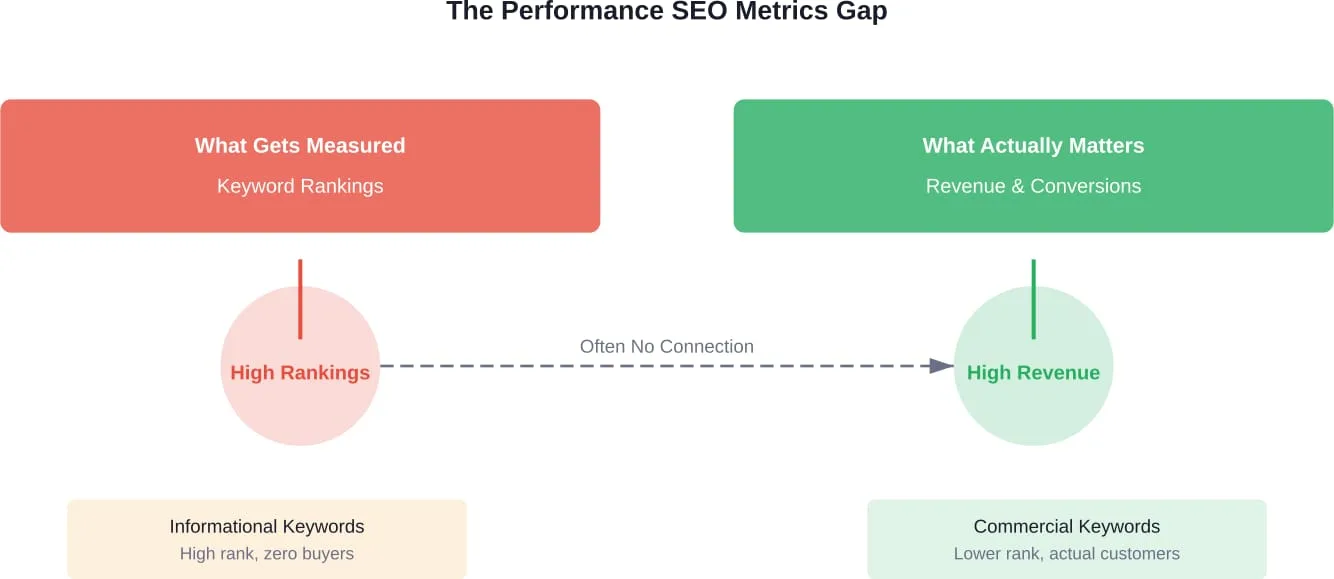
When payment depends on rankings, agencies optimize exclusively for rankings. Not traffic quality. Not conversions. Not revenue.
One documented case shows a company paying $1,150 monthly for improved rankings. They achieved top positions for multiple keywords. The result? Zero new customers.
Why? Every keyword was informational: “what is project management software,” “project management tips for beginners,” “free project management tools.” People searching these terms wanted information or free alternatives, not to buy software.
The agency delivered exactly what the contract specified—rankings. Just not rankings that generated revenue.
2. Short-Term Tactics Dominate
Google’s ranking systems are designed to reward helpful, reliable content created for people. According to Google’s official guidance on creating people-first content, automated systems prioritize information created to benefit users.
But performance-based contracts create time pressure. Agencies need quick wins to trigger payment.
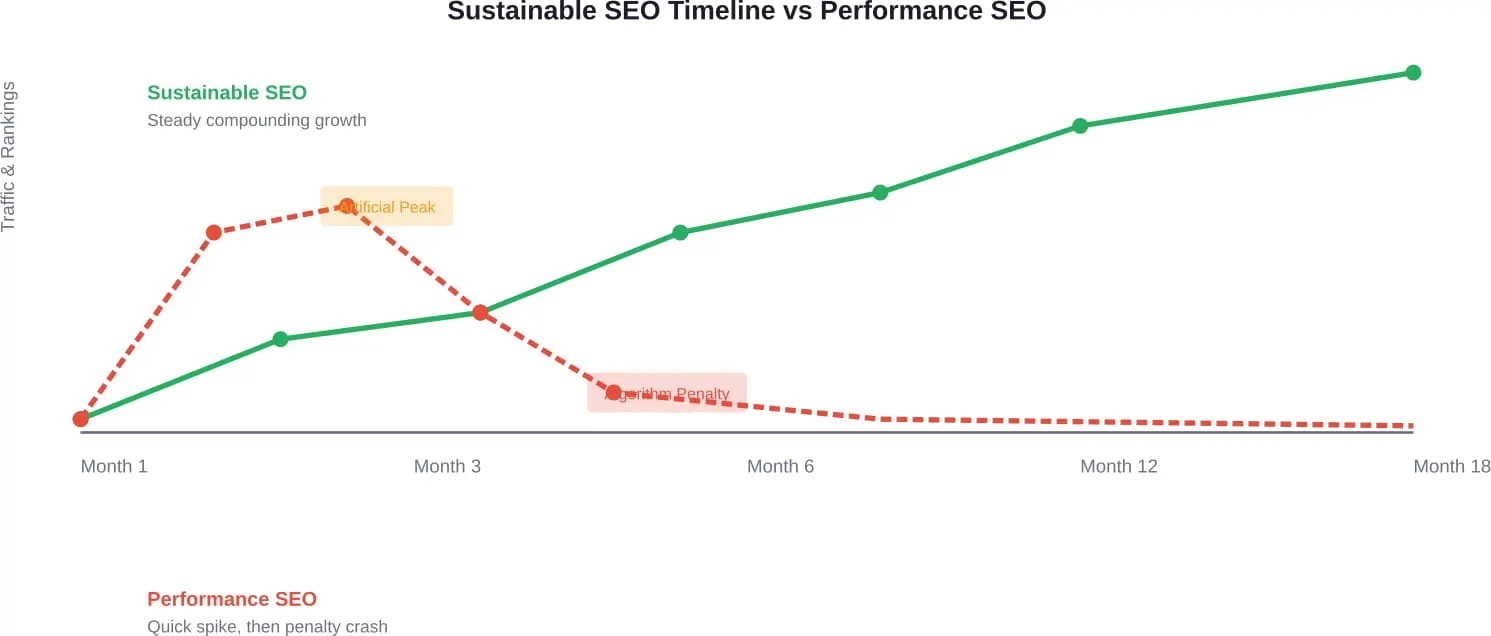
That pressure leads to shortcuts: keyword stuffing, low-quality link schemes, content farms, private blog networks, and other manipulative tactics. These might boost rankings temporarily, but they violate Google’s guidelines.
When the inevitable algorithm update hits, rankings collapse. Except the agency already collected their fees and moved on.
3. Misaligned Risk Distribution
Performance pricing appears to shift risk entirely to the agency. In reality, it creates asymmetric risk that hurts clients.
The agency’s downside is limited: they waste some time on a campaign that doesn’t convert to payment. They move on to the next client.
The client’s downside is catastrophic: their domain gets penalized, losing years of accumulated authority. Recovery takes months or years and requires significant investment. Some sites never fully recover.
One penalty can wipe out an entire business’s organic visibility. That’s not risk-free for anyone except the agency.
4. Cherry-Picking Easy Wins
Smart performance-based agencies carefully select which clients and keywords they’ll work with. They target low-competition keywords where rankings are easier to achieve.
These aren’t necessarily the keywords that drive business value. They’re just easier to rank for within the payment timeframe.
Meanwhile, the difficult-but-valuable keywords get ignored. Competitive commercial terms that could generate significant revenue require months of sustained effort. Performance contracts don’t incentivize that patience.
5. Transparency Disappears
Traditional SEO engagements include detailed reporting: what work was done, which strategies are being tested, how algorithms changes affected performance, what adjustments are being made.
Performance-based arrangements often lack this transparency. The agency’s methods become a black box. Clients see rankings move (or not) but don’t understand the underlying work.
When clients eventually want to understand their SEO foundation or transition to another agency, they discover there is no foundation. Just temporary manipulations that evaporate once the tricks stop working.
| Factor | Pay-for-Performance SEO | Sustainable SEO |
|---|---|---|
| Payment Structure | Only when rankings achieved | Monthly retainer for ongoing work |
| Timeline to Results | 30-90 days (temporary wins) | 6-12 months (lasting growth) |
| Primary Metric | Keyword rankings | Revenue and conversions |
| Tactics Used | Often shortcuts and manipulation | White-hat strategies aligned with guidelines |
| Transparency | Black box approach | Detailed reporting and strategy documentation |
| Long-Term Value | Minimal or negative | Compounding asset growth |
| Penalty Risk | High | Very low |
Get Clear SEO Terms Before You Sign Anything
Pay-for-performance SEO can sound simple, but the details usually get messy fast – what counts as “performance,” who chooses the keywords, and what happens if rankings move but revenue does not. Lengreo works on SEO programs where the work is defined up front (technical fixes, on-page changes, content, links) and progress is tracked against agreed metrics, which is useful if you are comparing performance-based offers. If you are unsure whether a pay-for-performance deal is actually fair, they can help you sanity-check the scope and measurement.
Ready To Pressure-Test A Pay-For-Performance SEO Offer?
Talk with Lengreo to:
- Review the contract terms (KPIs, keyword lists, exclusions, timelines)
- Map “performance” to real business outcomes (pages, intent, leads)
- Build a safer alternative plan with clear deliverables and reporting
👉 Start by requesting a consultation through Lengreo’s website.
The Hidden Contract Dangers
Performance-based SEO contracts contain landmines that clients often miss during the excitement of “risk-free” positioning.
Vague Success Definitions
What counts as achieving a ranking? Appearing on page one for that keyword once? Maintaining the position for a day? A week? A month?
Contracts often define success loosely enough that agencies can claim victory from brief, temporary ranking improvements.
Geographic and Device Manipulation
Search results vary dramatically by location and device. A keyword might rank #3 in one city and #18 in another.
Performance contracts sometimes specify rankings without clearly defining the testing parameters. The agency demonstrates a ranking that exists only under specific, limited conditions while the client’s actual customers see completely different results.
Long Lock-In Periods
Some contracts require lengthy commitments even under performance pricing. Clients can’t exit even when they realize the rankings being achieved don’t drive business value.
Others include automatic renewals or penalties for early termination that weren’t apparent during the initial sales conversation.
Ownership and Access Issues
When agencies build links, create content, or make technical changes, who owns those assets? Performance contracts frequently leave ownership ambiguous.
Clients who try to leave discover the agency controls critical elements: the link profile lives on agency-owned domains, content is licensed not owned, technical implementations require ongoing agency access.
When Performance Pricing Might Work
Look, the model isn’t universally terrible. Rare scenarios exist where performance-based structures make sense.
Hybrid models that combine base retainers with performance bonuses can align incentives better. The base fee covers legitimate ongoing work while bonuses reward exceptional results.
Very specific, limited engagements—like optimizing a single landing page or fixing particular technical issues—might work with performance pricing if the scope is clearly bounded.
But pure pay-for-rankings models? Those create too many problems and too many perverse incentives.
What Sustainable SEO Actually Looks Like
Effective SEO is fundamentally about building valuable assets over time. Google’s ranking systems, according to their official documentation, consider hundreds of billions of pages and other content to present the most relevant and useful results.
Competing in that environment requires sustained effort across multiple dimensions:
Content That Serves User Intent
Not just content that includes keywords. Content that genuinely answers questions, solves problems, and provides value to people searching specific queries.
This requires understanding the full customer journey: awareness stage searches, consideration stage searches, decision stage searches. Different content serves different intents.
Technical Foundation
Site architecture that search engines can effectively crawl and index. Fast loading times. Mobile optimization. Proper schema markup. Clean URL structures.
These foundational elements don’t produce immediate ranking jumps. They create the infrastructure that allows everything else to work properly.
Genuine Authority Building
Earning links from relevant, authoritative sources through creating content worth referencing. Building brand recognition so people search for your business directly. Establishing expertise that other sites want to cite.
This takes time. Months, sometimes years. But it compounds.
Continuous Optimization
Testing, measuring, adjusting. What’s working? What isn’t? Which pages are close to ranking breakthroughs? Where are users dropping off?
SEO isn’t a project with a clear endpoint. Search algorithms evolve constantly—Google makes numerous improvements to its ranking systems regularly. Competitors adjust their strategies. User behavior shifts.
Effective SEO adapts continuously based on data and results.
The Real Metrics That Matter
Rankings are a means to an end. They’re not the end itself.
Effective SEO measurement focuses on key categories including audience quality, engagement and behavior, and conversions. Are visitors likely to become customers? Are they finding needed information? Is organic traffic translating to business outcomes?
For ecommerce sites, revenue per organic visitor matters far more than rankings. If organic conversion rates fall significantly below industry benchmarks—which place B2B ecommerce conversion rates around 1.8%—that indicates a mismatch between intent, content, and expectations.
For lead generation businesses, qualified lead volume and lead quality determine success. A thousand visitors who never convert are worthless compared to fifty visitors who become sales opportunities.
For content publishers, engagement metrics like time on page, pages per session, and return visitor rates indicate whether content resonates with audiences.
Professional SEO agencies track these business metrics alongside traditional SEO indicators. Rankings provide context but don’t define success.
How to Evaluate SEO Agencies Properly
If performance-based pricing is a red flag, what should businesses look for instead?
Case Studies with Business Outcomes
Not just “we increased rankings by 200%.” Look for “we increased organic revenue by 100% over 12 months” or “we reduced cost per acquisition by 40% while tripling lead volume.”
Business outcome case studies demonstrate the agency understands what actually matters.
Transparent Methodology
Agencies should clearly explain their approach: how they conduct keyword research, their content strategy, their link building philosophy, their technical SEO process.
Vague promises or unwillingness to discuss specific tactics suggest problematic methods.
Realistic Timelines
Anyone promising first-page rankings in 30 days is lying or planning to use risky tactics. Legitimate SEO takes time—usually 6-12 months before significant results emerge.
Agencies should set appropriate expectations rather than overselling what’s possible.
Detailed Reporting
What metrics will be tracked? How often will reporting occur? What level of detail and analysis will be provided?
Effective reporting combines benchmarking with careful measurement to understand which strategies work and when pivots are needed.
Strategic Alignment
Does the agency ask probing questions about business goals, target customers, competitive positioning, and revenue models? Or do they immediately jump to keywords and rankings?
Strategic agencies start with business understanding before making tactical recommendations.
Red Flags to Avoid
Beyond performance-based pricing, several warning signs indicate problematic agencies:
- Guaranteed rankings: No one can guarantee specific rankings. Google’s algorithms are too complex and change too frequently.
- Proprietary secret methods: Legitimate SEO follows established best practices. “Secret techniques” usually mean guideline violations.
- Immediate results promises: SEO takes time. Period.
- Focus exclusively on rankings: Rankings without business context are meaningless.
- Vague contract terms: Everything should be clearly defined in writing.
- Pressure to sign quickly: Legitimate agencies don’t need high-pressure sales tactics.
The Federal Trade Commission enforces consumer protection laws that prevent fraud, deception and unfair business practices. While FTC enforcement primarily targets consumer-facing businesses, the principles apply: deceptive marketing practices and misleading promises create legal and ethical problems regardless of the industry.
Building an Internal SEO Strategy
Some businesses choose to develop SEO capabilities internally rather than hiring agencies. This approach has merit but requires realistic assessment of resources and expertise.
Successful internal SEO requires:
- Dedicated personnel with legitimate SEO expertise
- Executive support and appropriate budget allocation
- Cross-functional collaboration with content, development, and marketing teams
- Commitment to continuous learning as algorithms and best practices evolve
- Proper tools for keyword research, rank tracking, technical audits, and analytics
The biggest advantage of internal SEO is deep business knowledge and alignment. Internal teams inherently understand the product, customers, and strategic priorities.
The biggest disadvantage is limited perspective. Internal teams can develop blind spots or fall behind on industry developments without external input.
Many successful businesses use hybrid approaches: internal teams handle day-to-day execution while specialized agencies provide strategic guidance, technical expertise, and outside perspective.
The Investment Mindset Shift
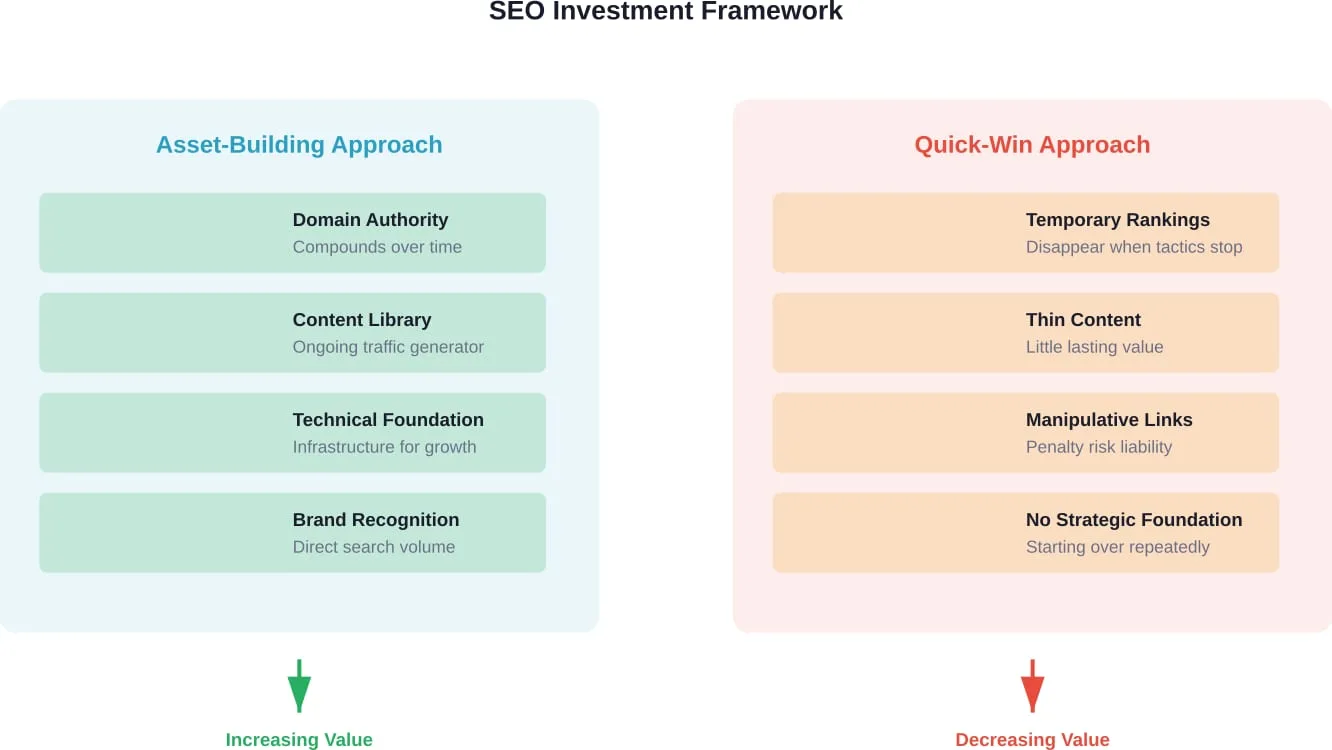
Perhaps the fundamental problem with performance-based SEO is the mindset it reflects: treating SEO as an expense to minimize rather than an investment to optimize.
Performance pricing appeals to businesses trying to reduce risk and control costs. Those are reasonable goals. But SEO isn’t primarily a cost control problem—it’s a growth opportunity.
Companies that view SEO as building long-term assets approach it completely differently. They ask: What will this investment be worth in three years? How will it compound? What competitive advantages will it create?
This mindset shift changes everything: the metrics that matter, the tactics that make sense, the timelines that are acceptable, and the agencies that are suitable partners.
Conclusion: Choose Strategy Over Shortcuts
Pay-for-performance SEO sounds appealing because it appears to eliminate risk. In reality, it often creates risk by incentivizing short-term manipulation over sustainable strategy.
The agencies that offer pure performance pricing either don’t understand what they’re promising or know exactly what they’re doing—and it’s not good. Legitimate agencies with strong track records don’t need performance gimmicks to attract clients.
Effective SEO requires viewing search optimization as building long-term assets rather than chasing quick wins. That means accepting that results take time, focusing on business outcomes rather than vanity metrics, and partnering with agencies that prioritize transparency and sustainable methods.
Rankings matter. But they’re a means to an end, not the end itself. The businesses that succeed with SEO understand this distinction and build strategies accordingly.
Ready to implement sustainable SEO that drives actual business results? Focus on finding agency partners who understand your business, communicate transparently, deliver measurable outcomes, and build strategies designed to compound over years rather than spike temporarily then disappear.
The truth about pay-for-performance SEO is simple: if it sounds too good to be true, it probably is. And the long-term cost of short-term thinking can be catastrophic for your online visibility.