SEO looks simple from the outside. Write some content, add a few keywords, wait for traffic. In reality, that’s where many small businesses go wrong.
Most SEO mistakes don’t come from laziness or bad intentions. They come from following outdated advice, copying competitors without context, or trying to shortcut a process that doesn’t really have shortcuts. The result is usually the same: slow growth, poor rankings, and frustration that builds over time.
This article breaks down the most common mistakes small business owners make when using SEO, why they hurt performance, and what actually works instead. No buzzwords, no hacks, just practical insight based on how search works today.
Why SEO Fails Small Businesses More Often Than It Should
Most SEO problems small businesses face are not caused by bad decisions. They come from reasonable decisions made with incomplete information.
Small business owners are constantly exposed to conflicting advice. One source says to publish more content. Another says content length does not matter. One tool pushes keyword density. Another says ignore keywords entirely. When guidance changes every few months, it is easy to default to whatever sounds simplest or fastest.
There is also a scale problem. Most SEO advice is written for either large companies with dedicated teams or solo creators chasing traffic. Small businesses sit in the middle. They need SEO to generate leads, not page views. They need results without endless experimentation. Yet much of the advice they follow was never designed for that reality.
What makes this especially tricky is that SEO rarely breaks outright. Pages still load. Rankings still exist. Traffic may even grow slightly. But growth stalls long before it becomes meaningful. By the time frustration sets in, the real issues are buried under months of small missteps.
Understanding where SEO usually goes wrong is the first step toward making it work. The mistakes below are not edge cases. They are patterns that show up across industries, budgets, and experience levels. Fixing them does not require tricks or insider knowledge. It requires clarity, restraint, and a focus on what actually moves the business forward.
How Lengreo Builds Real Growth SEO for Small Businesses
We see the same SEO mistakes over and over, often made by capable teams with good intentions. Pages are published but never revisited. Keywords are chosen without context. Traffic grows, but leads do not. That gap between effort and outcome is usually where things fall apart.
At Lengreo, we treat SEO as a growth system, not a checklist. Our work starts with understanding how your business actually makes money, who your real buyers are, and where search can support that process. From there, we build SEO strategies that connect visibility to action, not just rankings to reports.
We focus heavily on foundations. That means proper audits, clean site structure, and keyword research grounded in intent, not assumptions. It also means content that reflects how people really search and decide, not content written to satisfy algorithms. SEO only works when it aligns with how users think and behave.
Execution matters just as much as strategy. We refine pages, improve local visibility, strengthen authority through link building, and track performance beyond surface metrics. Traffic is useful, but qualified leads, conversions, and pipeline impact are what define success for us.
Most importantly, we integrate into the process instead of working around it. SEO does not live in isolation. It touches sales, content, design, and decision-making. When those pieces move together, SEO stops being unpredictable and starts becoming a reliable channel for long-term growth.
The Most Common SEO Mistakes That Hold Small Businesses Back
Most SEO problems small business owners face do not come from doing nothing. They come from doing the wrong things consistently, often based on advice that sounds logical but does not hold up in practice.
These mistakes usually build up over time. A shortcut here, an assumption there, a task left unfinished because it did not seem urgent. None of them feel critical on their own. Together, they slow growth, weaken visibility, and make SEO feel unpredictable or disappointing.
The sections below break down the most common SEO mistakes small business owners make today. Each one explains not just what goes wrong, but why it happens and how to correct it without overcomplicating the process. Think of this as a practical checklist for fixing what quietly limits results before it turns into a bigger problem.
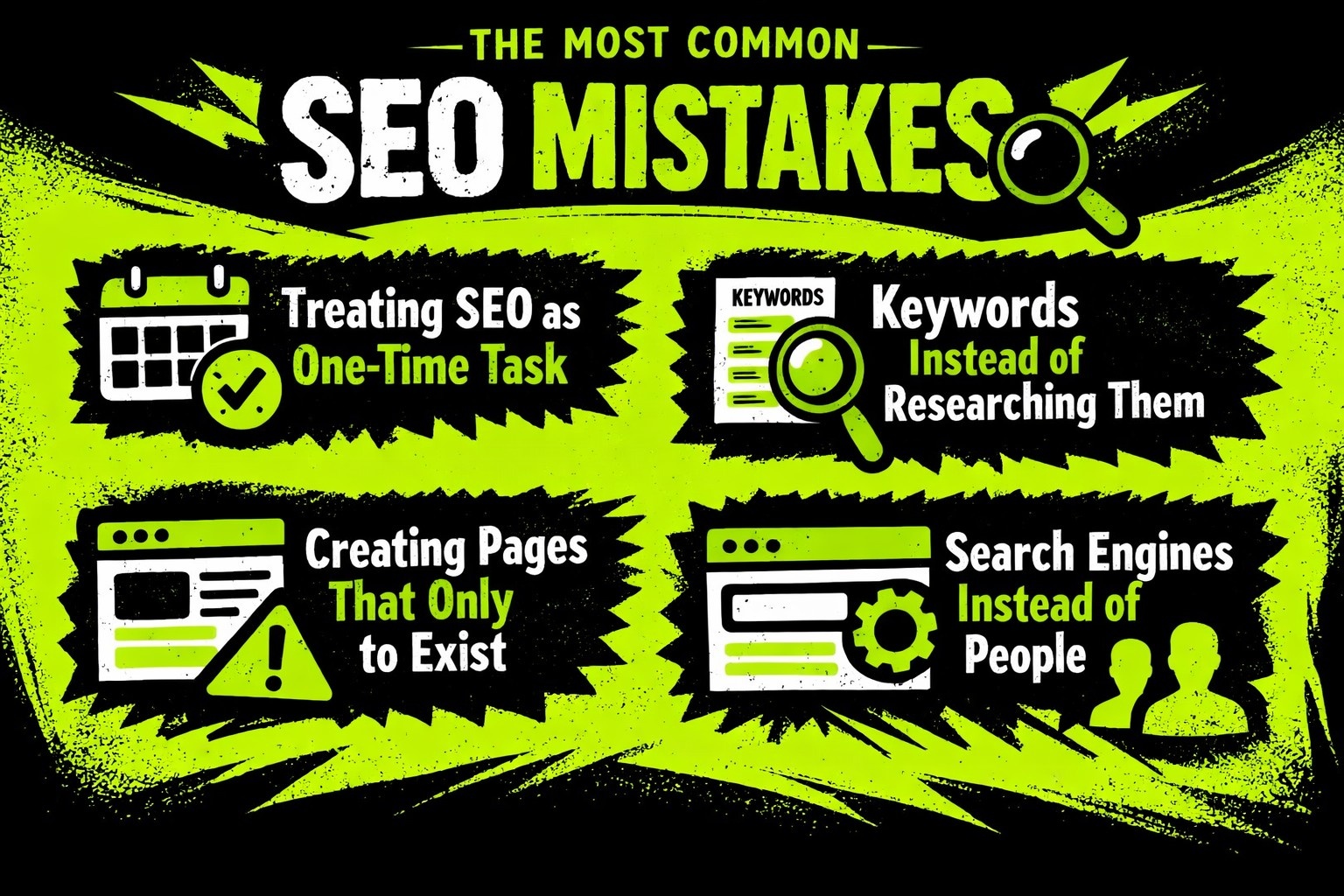
Mistake 1: Treating SEO as a One-Time Task
One of the most damaging assumptions is believing SEO has an end point.
Many small businesses launch a website, optimize a few pages, maybe publish some blog posts, and then move on. They expect rankings to hold simply because the work was done once. In reality, SEO behaves more like maintenance than construction.
Search results change constantly. Competitors publish new content. Google updates how it evaluates relevance and quality. User behavior shifts. When SEO is not revisited, even solid pages slowly lose ground.
What to Do Instead
Think of SEO as an ongoing system. That does not mean constant overhauls, but it does mean regular check-ins. Review rankings, update content that has gone stale, and look for pages that are slipping before they fall off completely. Consistency matters more than intensity.
Mistake 2: Guessing Keywords Instead of Researching Them
Keyword guessing is incredibly common, even among experienced business owners.
The logic usually sounds reasonable. If you offer a service, surely people search for that service using obvious words. The problem is that obvious words are rarely the best ones. They are either too broad, too competitive, or disconnected from how customers actually search.
Another issue is focusing on volume alone. High search volume looks attractive, but it often hides low intent. Someone searching a generic term may be researching, browsing, or comparing, not buying.
What to Do Instead
Start with intent, not volume. Look for phrases that signal a problem, a decision, or a location. Long-tail keywords often bring fewer visitors but better ones. Use research tools to validate assumptions, then narrow your focus to keywords you realistically have a chance to rank for and convert from.
Mistake 3: Creating Pages That Exist Only to Exist
Many small business websites have pages that technically exist but do very little.
They might list services in bullet points with a phone number at the bottom. Or reuse the same paragraph across multiple locations with only the city name changed. These pages are rarely helpful to users, and search engines recognize that.
Thin content does not fail loudly. It fails quietly by never ranking, never attracting links, and never driving engagement.
What to Do Instead
Every page should answer a real question or solve a real problem. Service pages should explain what happens, who it is for, and why it matters. Location pages should reflect actual local relevance, not just geography. Depth matters, but usefulness matters more than word count alone.
Mistake 4: Writing for Search Engines Instead of People
Some SEO mistakes come from trying too hard.
Keyword stuffing, awkward phrasing, and repetitive language usually start with good intentions. The idea is to make sure search engines understand the topic. The result is often content that feels unnatural and hard to read.
Modern search systems are much better at understanding context than they used to be. Over-optimization no longer helps and can actively hurt engagement, which feeds back into performance.
What to Do Instead
Write the way you would explain the topic to a real customer. Use natural language, vary phrasing, and focus on clarity. Keywords should appear because they belong there, not because you are trying to hit a number. If a sentence sounds strange when read aloud, it probably is.
Mistake 5: Ignoring Internal Linking Completely
Internal links are one of the simplest SEO tools, yet they are often overlooked.
Without internal links, pages become isolated. Search engines struggle to understand which pages matter most. Users have fewer paths to explore related content. Authority does not flow where it should.
Some sites link randomly. Others barely link at all. Both approaches limit potential.
What to Do Instead
Link intentionally. Connect related services, supporting blog content, and important conversion pages. Use descriptive anchor text that explains what the linked page is about. Think in terms of helping the reader navigate, not just boosting rankings.
Mistake 6: Overlooking Technical SEO Until Something Breaks
Technical SEO rarely gets attention until something goes wrong.
Pages stop indexing. Rankings drop suddenly. The site loads slowly. At that point, fixes become reactive and stressful. Many small businesses are not aware of technical issues because they are invisible on the surface.
Problems like broken links, redirect chains, duplicate pages, or mobile usability issues quietly accumulate.
What to Do Instead
Run regular technical checks, even if they are basic. Use tools that show crawl errors, indexing status, and site performance. Make sure your site is secure, mobile-friendly, and accessible. Technical SEO does not need to be perfect, but it does need to be functional.
Mistake 7: Treating Local SEO as an Afterthought
For small businesses that serve specific areas, local SEO is often the highest-impact channel. Yet it is frequently underdeveloped.
Some businesses set up a Google Business Profile once and never touch it again. Others ignore reviews, leave details incomplete, or allow inconsistent information across platforms.
Local visibility is not automatic. It has to be maintained.
What to Do Instead
Keep local listings accurate and active. Encourage genuine customer reviews and respond to them. Use location-specific content where it makes sense. Local SEO works best when it reflects real-world presence, not just keywords.
Mistake 8: Chasing Traffic Instead of Measuring Results
Traffic numbers can be misleading.
It is easy to celebrate growth in visits while ignoring whether those visits turn into inquiries, calls, or sales. Some pages attract attention but no business value. Others quietly generate leads with modest traffic.
SEO should support business goals, not vanity metrics.
What to Do Instead
Track actions that matter. Form submissions, calls, downloads, and qualified leads. Understand which pages contribute to revenue and which do not. Use traffic as context, not the final measure of success.
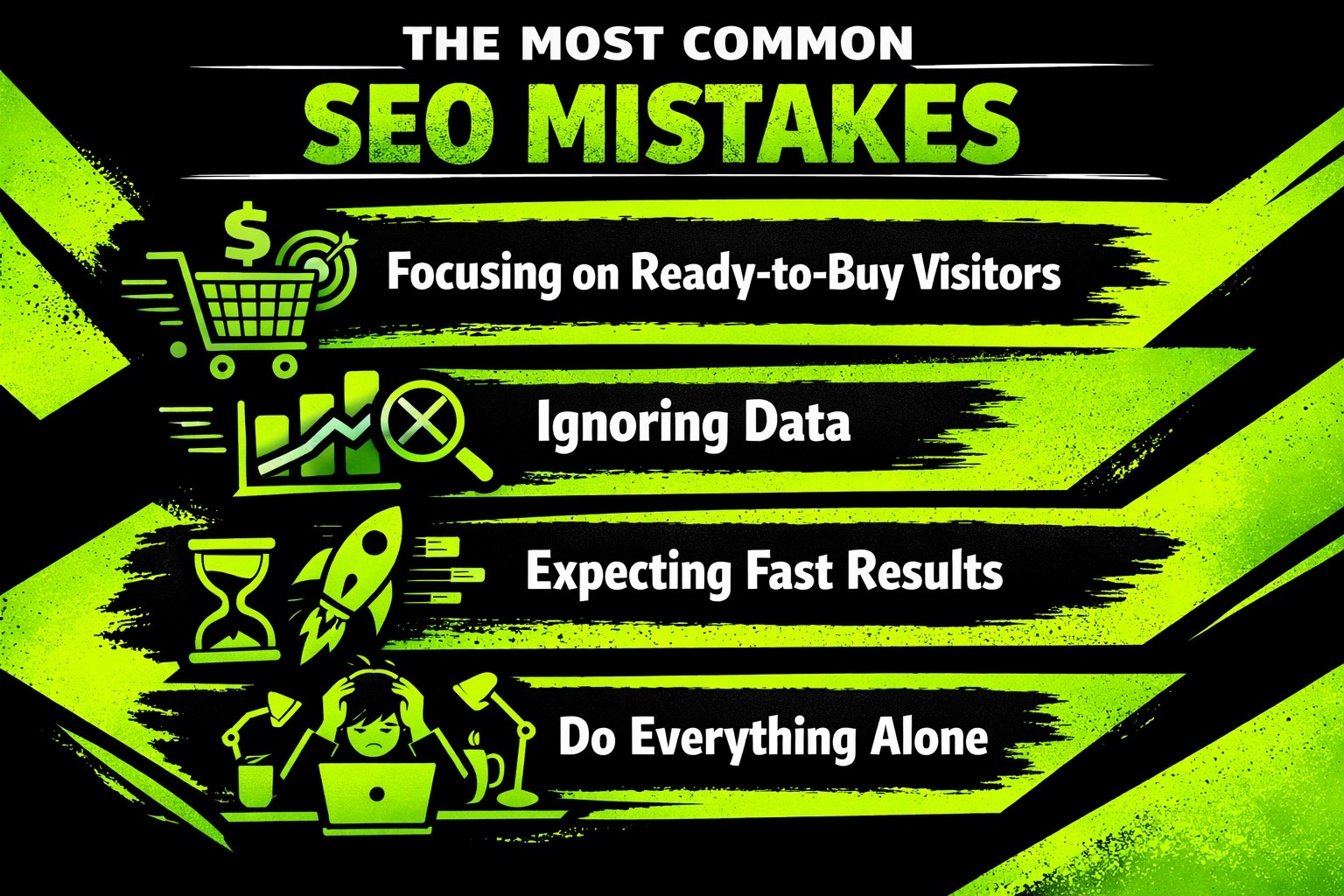
Mistake 9: Only Focusing on Ready-to-Buy Visitors
Not every visitor is ready to convert immediately.
Many SEO strategies focus entirely on bottom-of-funnel keywords, missing the opportunity to build trust earlier in the journey. This limits long-term growth and makes performance fragile.
When only immediate conversions are tracked, valuable engagement signals are ignored.
What to Do Instead
Map content to different stages of awareness. Educational content builds familiarity. Comparison content builds confidence. Service pages close the gap. Track meaningful engagement across stages to understand how SEO supports the full funnel.
Mistake 10: Ignoring Data or Looking at the Wrong Data
Data is often either overwhelming or underused.
Some small business owners never check analytics. Others look at dashboards daily but do not know what to act on. Both situations lead to poor decisions.
SEO data only helps when it informs changes.
What to Do Instead
Focus on a small set of meaningful metrics. Rankings for priority keywords, organic leads, page performance, and technical health. Review trends over time, not day-to-day noise. Use data to adjust direction, not to panic.
Mistake 11: Expecting Fast Results From a Slow Channel
SEO takes time. This is not a secret, but it is often underestimated.
When results do not appear quickly, strategies are abandoned too early or replaced with shortcuts. This resets progress and creates frustration.
The slow nature of SEO is also its strength. Gains compound when work is consistent.
What to Do Instead
Set realistic expectations. Early months focus on foundation. Middle months build visibility. Later months deliver momentum. Judge progress over quarters, not weeks. Patience paired with execution outperforms urgency without direction.
Mistake 12: Trying to Do Everything Alone
SEO is broad. Content, technical setup, links, local visibility, tracking, and strategy all intersect. Many small business owners attempt to manage all of it alongside running the business itself.
The result is usually partial execution across too many areas.
What to Do Instead
Decide where your time is best spent. Learn enough to make informed decisions, then delegate or outsource execution where needed. Good SEO support should clarify priorities, not add complexity
Final Thoughts
SEO does not fail because it is ineffective. It fails when it is misunderstood.
Most mistakes small business owners make are not dramatic. They are small decisions repeated over time. Guessing instead of researching. Publishing instead of updating. Measuring activity instead of outcomes.
The good news is that these mistakes are fixable. Often without rebuilding everything from scratch. By approaching SEO as a system rather than a tactic, small businesses can turn it into one of the most reliable sources of long-term growth.
Search rewards those who invest thoughtfully, stay consistent, and focus on real value. When SEO is treated that way, it stops feeling like a gamble and starts behaving like an asset.