


Quick Summary: Service industry marketing focuses on building trust, demonstrating value, and nurturing relationships rather than selling physical products. The most effective strategies include optimizing Google Business Profile, leveraging customer reviews and testimonials, creating educational content, implementing local SEO tactics, and using targeted email campaigns. According to the American Marketing Association, 90% of organizations utilize content marketing while 80% of consumers prefer custom content, making these approaches essential for service businesses looking to stand out in competitive markets.
Marketing a service business isn’t the same as marketing products. There’s nothing to hold, no packaging to admire, no before-and-after photos that tell the whole story.
Instead, service businesses sell expertise, reliability, and outcomes. That requires a different playbook.
The challenge? Service businesses face unique obstacles. Prospects can’t test-drive what they’re buying. They’re often making decisions based on trust alone. And in competitive markets, standing out means proving value before the first dollar changes hands.
But here’s the thing—the service industry is growing. According to the Bureau of Labor Statistics, employment for advertising, promotions, and marketing managers is projected to grow 6% from 2024 to 2034, with 26,100 employment change over the decade. That growth reflects increasing demand for sophisticated marketing across service sectors.
This guide breaks down 26 actionable marketing ideas specifically designed for service businesses. These aren’t theoretical concepts. They’re strategies being used right now by successful service companies across industries.
Understanding Service Business Marketing Fundamentals
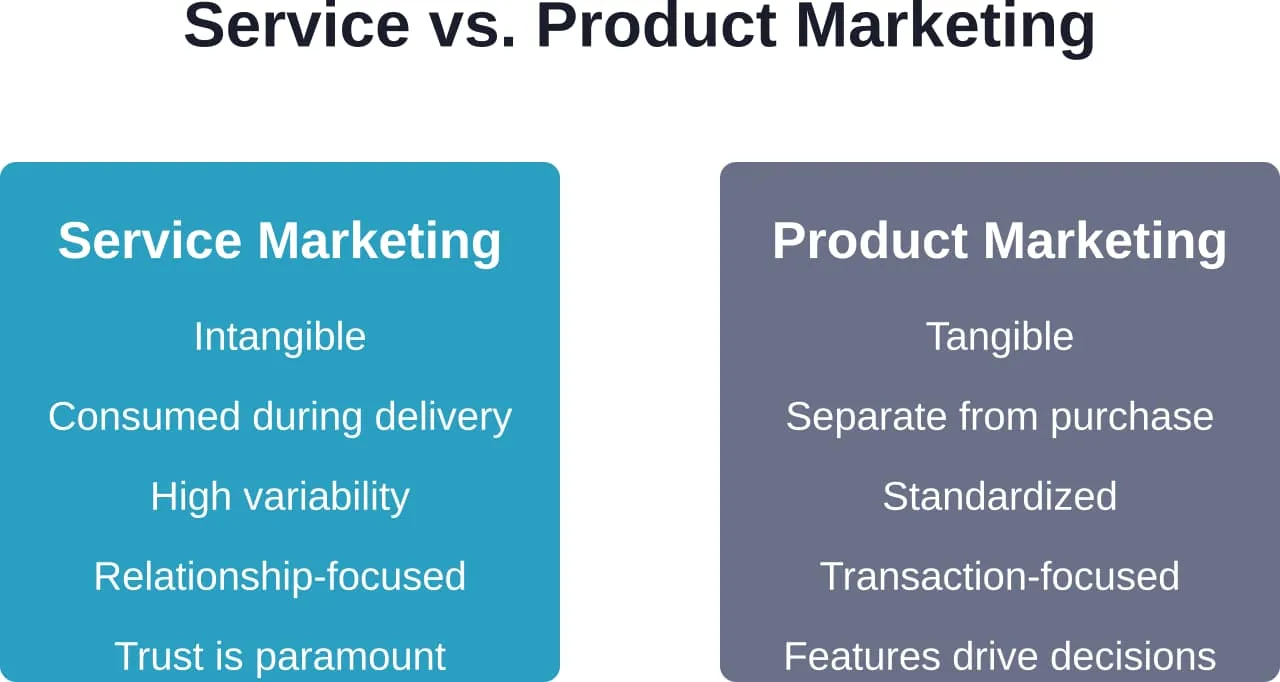
Service marketing operates under different rules than product marketing. Physical goods have tangible attributes—size, color, materials. Services exist only in delivery.
That intangibility creates specific marketing challenges. Prospects struggle to evaluate quality before purchase. Price comparison becomes the default decision metric when differentiation isn’t clear. And without physical inventory, scaling often means adding labor, which complicates growth.
Successful service marketing addresses these challenges head-on. It makes the intangible tangible through case studies, testimonials, and process documentation. It builds trust through consistency and transparency. And it focuses on relationships rather than transactions.
What Makes Service Marketing Different
Services are consumed as they’re produced. A haircut happens in real-time. Consulting advice has value only when applied. This simultaneity means customer experience and service delivery are inseparable.
Services are also perishable. An unfilled appointment slot represents lost revenue that can’t be recaptured. A plumber’s available Tuesday at 2 PM has zero value once 2 PM passes.
And services are variable. Two haircuts from the same stylist won’t be identical. Two consulting engagements will produce different results. Managing this variability—and customer expectations around it—becomes a marketing function.
Organize Service Industry Marketing With Lengreo
Service businesses need marketing that clearly explains offerings, locations, processes, and contact options. Lengreo helps connect website development, SEO, paid ads, content, lead generation, appointment setting, and tracking into one practical setup.
This approach makes it easier for customers to understand services and for teams to measure which channels are driving real inquiries.
Need a Better Setup for Customer Inquiries?
Lengreo can help with:
- refining service, location, and contact pages
- setting up SEO and paid campaigns
- tracking forms, calls, and inquiry sources
- supporting content and lead generation workflows
👉 Contact Lengreo to discuss your marketing setup.
Digital Marketing Strategies for Service Businesses
Digital channels offer service businesses unprecedented reach and targeting capabilities. But throwing money at ads without strategy wastes budget fast.
The most effective digital strategies combine multiple touchpoints. Prospects rarely convert on first contact. They research, compare, reconsider. Meeting them across channels builds familiarity and trust.
1. Optimize Your Google Business Profile
For local service businesses, Google Business Profile isn’t optional. It’s the first impression most prospects get.
A complete profile includes current hours, accurate contact information, high-quality photos, and service descriptions. But here’s what separates good from great: regular updates and active engagement.
Post weekly updates about projects, team news, or industry tips. Respond to every review within 24 hours. Add photos of completed work monthly. Google rewards active profiles with better visibility.
2. Implement Local SEO Tactics
Local search dominates service business marketing. Someone searching “plumber near me” has immediate intent. Ranking for those searches drives qualified leads.
Local SEO starts with consistency. Business name, address, and phone number must match exactly across every online directory—Google, Yelp, Facebook, industry directories, everywhere.
Build location-specific content. A roofing company serves multiple cities? Create dedicated pages for each, with unique content addressing local concerns. Mention neighborhood names, local landmarks, regional weather patterns.
Earn local backlinks through community involvement. Sponsor local events, join the chamber of commerce, partner with complementary businesses. Each legitimate local link signals relevance to search engines.
3. Create Educational Content
Content marketing works exceptionally well for service businesses. According to the American Marketing Association, 90% of organizations utilize content marketing, and 80% of consumers prefer custom content.
Educational content serves multiple purposes. It demonstrates expertise, answers prospect questions, and provides value before asking for business.
Focus on questions prospects actually ask. What problems are they trying to solve? What concerns do they raise during sales calls? Turn those into blog posts, videos, or downloadable guides.
An HVAC company might create content around “how to choose the right air conditioner size” or “signs your furnace needs replacement.” A marketing consultant could write about “calculating marketing ROI” or “building a marketing budget.”
4. Leverage Email Marketing
Email remains an important channel for service business marketing.
For service businesses, email excels at nurturing relationships. Many services aren’t purchased frequently. A homeowner might need a plumber once every few years. Staying top-of-mind through valuable email content means being remembered when need arises.
Segment email lists based on service interest, customer status, or engagement level. Send maintenance reminders to past customers. Share educational content with prospects. Announce promotions to high-engagement subscribers.
5. Use Social Media Strategically
Social media effectiveness varies by platform and audience. Social media effectiveness varies by demographic, with different age groups showing different engagement patterns.
Choose platforms where the target audience actually spends time. LinkedIn dominates B2B service marketing. Facebook works well for local services targeting homeowners. Instagram suits visually-oriented services like landscaping or interior design.
According to the American Marketing Association, many social media marketers state that building an active community is critical for success. That means engagement matters more than follower count. Respond to comments, answer questions, participate in relevant groups.
Share behind-the-scenes content showing the service delivery process. Post customer success stories. Offer quick tips related to the service area. Make the feed valuable, not just promotional.
6. Invest in Video Marketing
Video humanizes service businesses in ways text can’t match. Prospects see the team, watch the process, hear the expertise.
Simple videos work. Office tours, team introductions, process explanations, customer testimonials—none require Hollywood production values. Smartphone video with good lighting and clear audio suffices.
Post videos on YouTube for long-term discoverability. YouTube functions as a search engine, with people actively seeking solutions. A well-optimized “how to” video can generate leads for years.
Traditional Marketing That Still Works
Digital dominates marketing conversations, but traditional tactics still drive results for service businesses. Especially in local markets.
7. Develop Strategic Partnerships
Partnerships with complementary businesses create referral streams. A real estate agent partners with home inspectors, mortgage brokers, and moving companies. An accountant partners with lawyers and financial advisors.
Effective partnerships provide mutual value. Don’t just ask for referrals—give them. Track which partners send business and prioritize reciprocation.
8. Attend Networking Events
Industry conferences, chamber meetings, and trade shows still generate quality connections. Face-to-face interaction builds relationships faster than digital contact.
Attend with clear goals. How many meaningful conversations? How many follow-up appointments scheduled? Collecting business cards accomplishes nothing without follow-through.
9. Implement Direct Mail Campaigns
Direct mail works when targeted properly. Mass mailers generate poor returns. But targeted campaigns to specific neighborhoods or past customers can surprise.
A landscaping company mailing recent home buyers in specific ZIP codes reaches prospects with immediate need. An HVAC company sending maintenance reminders to past customers books appointments.
Track results rigorously. Use unique phone numbers or promo codes to measure response rates. Test different offers, formats, and targeting criteria.
10. Sponsor Local Events
Sponsorship builds brand awareness in the community. Youth sports teams, charity events, school programs—sponsorship gets the business name visible while supporting worthwhile causes.
Choose sponsorships aligned with the target market. A family-focused service business sponsors Little League. A B2B service sponsors chamber events or industry conferences.
Building Trust Through Social Proof
Service businesses live or die on reputation. Prospects buying intangible services rely heavily on social proof—evidence that others received value.
11. Collect and Showcase Customer Reviews
Reviews influence purchase decisions more than any marketing message. Prospects trust other customers over business claims.
Make requesting reviews part of the standard process. After successful service completion, ask satisfied customers to share their experience. Make it easy—send direct links to Google, Facebook, or industry review sites.
Respond to every review, positive or negative. Thank customers for positive feedback. Address concerns in negative reviews professionally, showing prospects that problems get resolved.
12. Create Detailed Case Studies
Case studies make abstract services concrete. They show the process, the solution, and the results in specific, tangible terms.
Effective case studies follow a simple structure: the client’s problem, the approach taken, the solution delivered, and the measurable results achieved.
Include specifics. Numbers, timelines, challenges overcome. Generic case studies convince no one. Specific details build credibility.
13. Display Professional Certifications
Certifications signal expertise and professionalism. They show investment in skills and adherence to industry standards.
Display relevant certifications prominently on the website, in the office, and in marketing materials. Explain what they mean—prospects don’t automatically know why a particular certification matters.
14. Publish Client Testimonials
Testimonials work best when specific. “Great service!” says nothing. “They responded within two hours and fixed our emergency plumbing issue for $200 less than we expected” tells a story.
Video testimonials outperform text. Seeing and hearing satisfied customers creates stronger connection than reading quotes.
Include testimonials throughout the website—not just on a dedicated testimonials page. Relevant testimonials on service pages reinforce specific value propositions.
| Social Proof Type | Trust Impact | Implementation Difficulty | Best Use Case |
|---|---|---|---|
| Customer Reviews | Very High | Low | All service businesses |
| Video Testimonials | Very High | Medium | High-value services |
| Case Studies | High | Medium | B2B and complex services |
| Certifications | Medium | High | Technical or regulated services |
| Awards | Medium | High | Competitive markets |
| Client Logos | Medium | Low | B2B services |
Customer Retention Marketing
Acquiring new customers costs significantly more than retaining existing ones. Yet many service businesses focus entirely on acquisition.
15. Launch a Referral Program
Satisfied customers often gladly refer friends—if asked. Referral programs formalize and incentivize the process.
Effective referral programs reward both parties. The existing customer gets a discount or bonus for referring. The new customer gets an introductory offer.
Make the mechanics simple. Complicated point systems or unclear rewards kill participation. “Refer a friend, you both get $50 off” requires no explanation.
16. Create a Customer Loyalty Program
Loyalty programs encourage repeat business. They work especially well for services with recurring need—maintenance services, consulting retainers, personal services.
Structure programs around desired behaviors. Reward frequent purchases, referrals, reviews, or social media engagement.
17. Send Regular Maintenance Reminders
Many services require periodic maintenance or renewal. Proactive reminders keep customers engaged and prevent them from seeking alternatives.
HVAC companies remind customers about seasonal tune-ups. Accountants remind clients about quarterly estimated taxes. Marketing consultants remind clients about annual strategy reviews.
Automated reminders based on service history ensure no customer gets forgotten.
18. Provide Exceptional Customer Service
This seems obvious, but execution varies wildly. Exceptional service means responding quickly, solving problems proactively, and exceeding expectations consistently.
Service quality is the most powerful marketing tool available. No amount of advertising overcomes poor service. But exceptional service generates word-of-mouth marketing that money can’t buy.
Website Optimization for Service Businesses
The website functions as the central hub for most marketing efforts. Every other marketing activity should drive traffic here.
19. Create Clear Service Pages
Each service offered deserves a dedicated page with detailed information. What’s included, what problems it solves, what results customers can expect, and what it costs.
Vague service descriptions frustrate prospects. They want specifics before reaching out. Detailed service pages answer questions and filter unqualified leads.
20. Add Strong Calls to Action
Every page needs a clear next step. “Call now,” “Schedule a consultation,” “Request a quote”—whatever moves prospects forward.
Make CTAs prominent and specific. “Contact us” is weak. “Schedule your free 30-minute strategy session” tells prospects exactly what they’re getting.
21. Implement Live Chat
Live chat captures prospects at peak interest. Someone browsing the website right now has immediate intent. Chat lets them ask questions and book appointments without leaving the site.
Even basic chatbots that answer common questions and collect contact information improve conversion rates.
22. Optimize for Mobile
More than half of website traffic comes from mobile devices. Sites that don’t work well on phones lose prospects immediately.
Mobile optimization means fast loading, easy navigation, and clickable phone numbers. No pinching or zooming required.
Advertising Strategies for Service Businesses
Paid advertising accelerates results when organic strategies take time to build momentum.
23. Run Google Local Service Ads
Google Local Service Ads appear at the very top of search results for service-related queries. They show the business name, rating, and phone number with a “Google Guaranteed” badge.
These ads work on a pay-per-lead model—businesses only pay when someone contacts them through the ad. For qualified local service businesses, they often generate the best ROI of any advertising channel.
24. Use Facebook and Instagram Ads
Social media advertising offers sophisticated targeting options. Target by location, demographics, interests, and behaviors.
Influencer marketing represents a growing area of marketing investment.
Test different ad formats—image ads, video ads, carousel ads. Different formats resonate with different audiences.
25. Try Retargeting Campaigns
Most website visitors don’t convert on first visit. Retargeting keeps the business visible as they continue researching.
Retargeting ads appear on other sites after someone visits the business website. They serve as reminders and bring prospects back when they’re ready to decide.
26. Explore Industry-Specific Platforms
Many industries have specialized advertising platforms. Home services can advertise on Angi or HomeAdvisor. Legal services have Avvo. Healthcare has Healthgrades.
These platforms attract prospects with specific intent. Someone browsing Angi actively seeks service providers. That intent often justifies premium advertising costs.
Measuring Marketing Effectiveness
Marketing without measurement wastes resources. Service businesses need clear metrics to evaluate what’s working.
Track lead sources. Where do inquiries come from? Google, referrals, social media, ads? Knowing which channels generate leads helps allocate budget effectively.
Measure conversion rates. What percentage of leads become customers? Low conversion suggests problems with pricing, sales process, or lead quality.
Calculate customer acquisition cost. Total marketing spend divided by new customers acquired. This metric determines which marketing activities are cost-effective.
Monitor customer lifetime value. How much does the average customer spend over their entire relationship with the business? High lifetime value justifies higher acquisition costs.
The American Marketing Association emphasizes setting SMART goals—specific, measurable, achievable, relevant, and time-bound. For example, instead of “increase website traffic,” set a goal to “increase website traffic by 30% and generate 500 sales within three months through targeted social media ads.”
Common Marketing Mistakes to Avoid
Even well-intentioned marketing efforts fail when common mistakes derail them.
- Trying everything at once spreads resources too thin. Better to execute three strategies excellently than ten strategies poorly. Choose tactics aligned with business goals and audience preferences.
- Neglecting existing customers while chasing new ones represents short-term thinking. Retention marketing often delivers better ROI than acquisition.
- Inconsistent messaging confuses prospects. The website says one thing, social media says another, ads say something else. Consistent positioning across all channels builds stronger brand recognition.
- Ignoring negative reviews or feedback damages reputation. Address concerns professionally and publicly. Prospects watching the response learn whether problems get resolved.
- Setting unrealistic timelines creates disappointment. SEO takes months to show results. Content marketing requires consistent effort over time. Paid ads deliver faster results but require ongoing investment. Align expectations with reality.
Getting Started With Service Marketing
Twenty-six strategies might feel overwhelming. Where should a service business start?
- Begin with fundamentals. Claim and optimize the Google Business Profile. Get the website mobile-friendly and conversion-optimized. Request reviews from satisfied customers. These basics cost little and impact results immediately.
- Then add one or two additional strategies based on available resources and target audience preferences. A B2B service might prioritize LinkedIn and content marketing. A local service might focus on local SEO and direct mail.
- Test, measure, and adjust. Marketing isn’t set-it-and-forget-it. What works today might stop working tomorrow. Markets change. Competitors adapt. Continuous improvement beats static strategy.
According to the Bureau of Labor Statistics, the median annual wage for marketing managers was $161,030 in May 2024, while the median annual wage for advertising and promotions managers was $126,960 in May 2024. These figures reflect the value organizations place on effective marketing leadership.
But service businesses don’t need six-figure marketing managers to succeed. They need consistent execution of proven strategies aligned with business goals and customer needs.
Taking Action on Service Marketing
The service industry continues growing, with the Bureau of Labor Statistics projecting 26,100 employment change for advertising, promotions, and marketing managers from 2024 to 2034. That growth reflects increasing recognition of marketing’s importance.
But marketing success doesn’t require massive budgets or complex strategies. It requires understanding customer needs, communicating value clearly, and delivering exceptional service consistently.
Start with the fundamentals. Optimize Google Business Profile. Build a mobile-friendly website. Request customer reviews. Create valuable content. These foundational tactics cost little but generate significant impact.
Then expand strategically. Add tactics aligned with business goals and customer preferences. Test, measure, refine. Marketing is iterative—continuous improvement beats perfect planning.
The service businesses that thrive aren’t necessarily those with the biggest marketing budgets. They’re the ones that understand their customers deeply, communicate value effectively, and execute consistently.
That combination—customer understanding, clear communication, consistent execution—beats flashy campaigns every time. The 26 ideas outlined here provide a roadmap. The execution is up to individual businesses.
Ready to upgrade service business marketing? Start with one strategy today. Implement it fully. Measure results. Then add the next. That’s how sustainable marketing success gets built—one strategic decision at a time.