


Quick Summary: Effective senior living marketing combines digital strategies (local SEO, targeted ads, authentic reviews) with community engagement (educational events, family tours, referral programs) to reach both seniors and adult children. According to AARP, 75% of adults 50-plus prefer to age in place, but 44% expect to move eventually, creating a significant market for communities that address housing costs, maintenance concerns, and lifestyle needs. Success requires understanding the dual audience—seniors seeking community and adult children researching care options—while building trust through transparency and authentic storytelling.
Marketing senior living communities means navigating a unique challenge: reaching two distinct audiences simultaneously. The prospective resident wants comfort, independence, and social connection. Their adult children need reassurance about safety, care quality, and value.
That dual focus shapes everything from website content to event planning. And with demographic shifts accelerating—America’s first baby boomers turning 80 by decade’s end—the market opportunity is substantial. But so is the competition.
The communities that thrive understand something fundamental: trust matters more than flash. Families researching senior living options are making deeply emotional decisions during stressful transitions. They’re not shopping for amenities; they’re seeking peace of mind.
Understanding the Senior Living Market Landscape
Recent AARP research reveals a striking contradiction in senior preferences. While 75% of adults 50-plus prefer single-family homes, 44% expect to relocate at some point. That gap between preference and reality creates the market senior living communities serve.
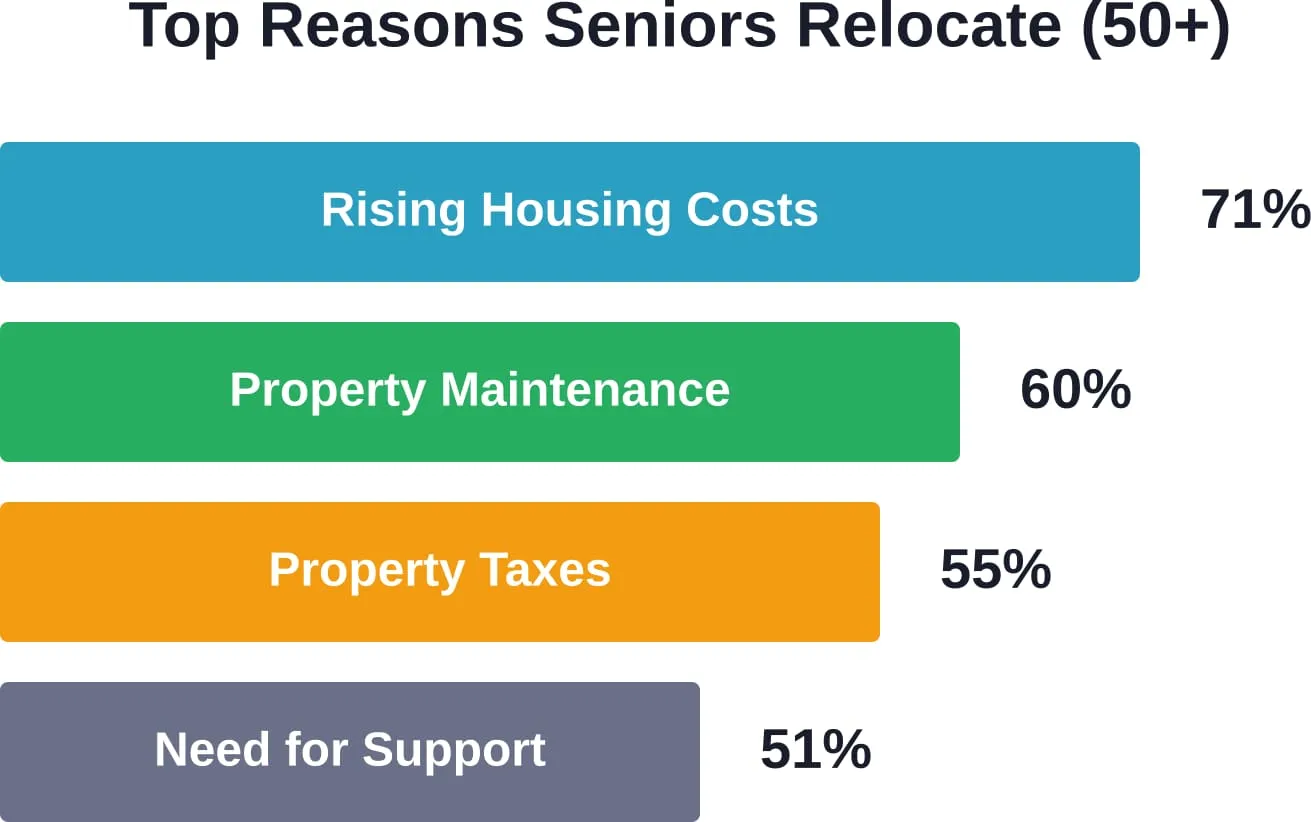
What drives that eventual move? Financial reasons dominate. According to AARP data, financial reasons drive senior relocations, including rising housing costs, property maintenance concerns, and property taxes.
Here’s what that means for marketing: communities that position themselves as solutions to specific pain points—not just “nice places to live”—connect more effectively with prospects actively considering a move.
Among assisted living residents, 70% are women and 30% are men, with over half aged 85 and above and 31% in the 75-84 age bracket.
But marketing rarely targets those residents directly. Adult children—typically in their 50s and 60s—conduct most of the initial research and drive facility selection decisions. That creates a generational marketing challenge: messages must resonate with both the decision-maker and the future resident.
Building a Strong Digital Foundation
Senior living marketing starts with a website that serves two masters: search engines and anxious family members. Both demand clarity, speed, and credibility.
Local SEO: The Non-Negotiable Starting Point
Most senior living searches include geographic qualifiers: “assisted living near me,” “memory care in [city],” “retirement communities [county].” That local intent means Google Business Profile optimization is fundamental.
Claim and complete every section. Upload recent photos monthly. Respond to every review within 24 hours. Post weekly updates about events, tours, or community news. Google rewards active profiles with better visibility in the local pack—those three listings that appear above organic results.
On the website itself, create location pages for every nearby city, neighborhood, or suburb families might search from. Each page should answer: “How do I get my parents into [community name] from [their current city]?” Include driving times, proximity to hospitals, and connections to local landmarks.
Website Design That Converts Browsers Into Tours
The average senior living website visit lasts 90 seconds. In that window, visitors need three things: proof of quality, clarity on cost, and an easy path to schedule a tour.
Put tour scheduling above the fold on every page. Not hidden in a form—a prominent button with a calendar link or phone number. According to industry analyses, friction at the tour-scheduling step kills more leads than any other factor.
Display authentic resident photos and testimonials prominently. Stock photography of impossibly active seniors undermines trust. Real residents, staff, and spaces build it. Recent research from Harvard Business School shows marketers often misjudge senior preferences—most adults feel 15-20% younger than their chronological age and reject stereotypical “elderly” imagery.
| Website Element | Why It Matters | Common Mistake |
|---|---|---|
| Tour Booking CTA | Primary conversion action for 80% of visitors | Buried in footer or requiring form completion first |
| Pricing Transparency | Cost concerns drive 71% of senior relocations | “Contact us for pricing” creates immediate barrier |
| Google Reviews Display | Third-party validation builds trust faster than claims | Featuring only 5-star reviews triggers skepticism |
| Mobile Responsiveness | Adult children research primarily on mobile devices | Desktop-only design or slow mobile load times |
Address pricing directly, even if complete transparency isn’t feasible. A starting range (“Independent living from $X monthly”) sets expectations and filters out prospects outside budget constraints. Communities that hide pricing entirely lose qualified leads who assume costs exceed their range.
Reviews and Reputation Management
Positive reviews function as social proof; negative reviews become sales objections. Both require active management.
Encourage satisfied families to leave Google reviews through gentle, systematic requests. After move-in milestones—30 days, 90 days, six months—send a personal note thanking them and mentioning that sharing their experience helps other families. Include a direct link to the review page.
Respond to negative reviews with empathy and specificity. Acknowledge the concern, explain (briefly) what happened, describe corrective action taken. Never argue or get defensive. Future prospects reading the exchange are evaluating how the community handles problems—because problems will inevitably arise.
Content Marketing That Educates and Attracts
Families researching senior living options have questions before they’re ready to tour. Content marketing intercepts those questions early in the decision journey, building trust and authority long before a phone call.
Blog Topics That Actually Drive Traffic
Create content around real search queries. Use Google’s autocomplete feature: type “how to choose assisted living” or “when is memory care needed” and note the suggested completions. Those are actual searches from actual prospects.
Strong evergreen topics include:
- How to know when a parent needs assisted living (addresses timing anxiety)
- What to look for during a senior living tour (prepares prospects to evaluate competitors)
- How to pay for assisted living without Medicaid (solves the biggest objection)
- Memory care vs. assisted living: understanding the differences (clarifies service levels)
- Helping a parent transition to senior living (addresses emotional resistance)
Each article should be comprehensive—1,500 to 2,500 words—and genuinely helpful. The goal isn’t immediate conversion; it’s positioning the community as a trustworthy resource. When that family is ready to tour, they’ll remember who answered their questions.
Video Content That Showcases Community Life
Video tours remove mystery and reduce anxiety. Families want to see dining rooms during meals, activity spaces during programs, and apartments in realistic condition—not staged perfection.
Produce short (60-90 second) clips covering:
- A typical day in the community from a resident perspective
- Staff introductions with care team members explaining their roles
- Resident testimonials discussing why they chose this community
- Apartment walkthroughs of different floor plans
- Event highlights from recent activities or celebrations
Authentic beats polished. Smartphone footage of real residents enjoying an activity outperforms professionally shot b-roll of actors. Post videos on YouTube, embed them on the website, and share across social channels.
Marketing Events That Generate Qualified Leads
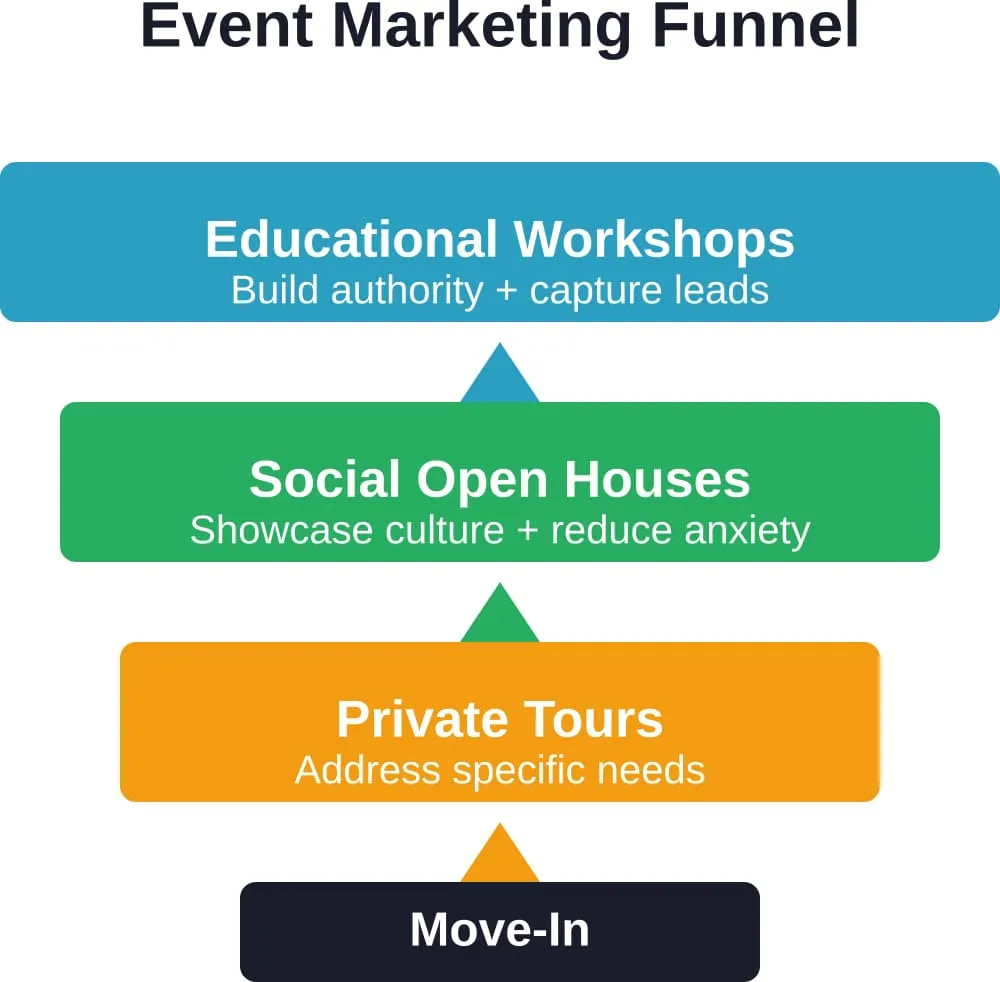
In-person events serve dual purposes: they bring prospects onto the property and give current residents something to look forward to. The best events accomplish both while showcasing community culture.
Educational Workshops: Positioning as Expert Resource
Host educational sessions on topics relevant to families exploring options. Partner with local estate attorneys, financial planners, geriatric care managers, or healthcare providers to add credibility.
Strong workshop topics:
- Estate planning essentials for aging adults
- Medicare and Medicaid: navigating senior healthcare coverage
- Fall prevention strategies for aging in place
- Understanding dementia: early signs and care options
Promote through local libraries, senior centers, churches, and Facebook event listings. Keep presentations educational, not promotional. The community’s role is hosting and facilitating—building goodwill and capturing attendee contact information for follow-up.
Social Events: Demonstrating Community Culture
Open houses, seasonal celebrations, and entertainment events invite prospects to experience the community atmosphere firsthand. These work best when current residents are visibly engaged and welcoming.
Schedule events during times when the community naturally buzzes with activity—after lunch when residents gather in common areas, or during regular programming like fitness classes or craft sessions.
Make it easy for families to attend by offering multiple tour times, providing refreshments, and eliminating registration barriers. “Drop by anytime between 1-4 PM” works better than “RSVP required for the 2:00 tour.”
Community Partnership Events
Sponsor or host events that serve the broader local senior population—not just prospects. Blood drives, health screenings, or charity fundraisers demonstrate community investment while generating positive local press.
These grassroots efforts build long-term brand recognition. When a family eventually needs senior living, they remember the community that hosted the Alzheimer’s Association walk or provided meeting space for caregiver support groups.
Paid Advertising Strategies That Deliver ROI
Organic reach takes time to build. Paid advertising accelerates visibility and fills the pipeline while content marketing and SEO mature.
Google Ads: Capturing High-Intent Searches
Search ads target prospects actively looking for solutions. Focus on high-intent keywords: “assisted living near [city],” “memory care [neighborhood],” “senior apartments [zip code].”
Set up location-based campaigns with tight geographic targeting—typically a 15-20 mile radius around the facility. Broader targeting wastes the budget on families too far away to realistically consider the community.
One industry case study cited a Google Ads campaign achieving a cost per lead of $63.00 for an assisted living facility. That’s remarkably efficient—senior living lead generation typically runs $200-300 per qualified prospect through traditional channels.
The key: extremely specific ad copy and landing pages. An ad for “memory care” should send clicks to a memory care-specific landing page with relevant content, not the homepage. Match message to search intent at every step.
Facebook and Instagram: Building Awareness Among Adult Children
Social media ads excel at reaching adult children (ages 45-65) researching options for parents. Detailed targeting options allow filtering by age, location, interests, and behaviors like “caring for elderly parents.”
Creative that performs well includes:
- Resident testimonial videos with emotional storytelling
- Virtual tour invitations with event details
- Educational content offers (“Download our Senior Living Decision Guide”)
- Staff spotlights humanizing the care team
Use lead forms directly within Facebook to reduce friction. Asking someone to click through to a website, navigate to a contact form, and complete fields creates multiple abandonment points. Native lead forms capture information without leaving the platform.
Retargeting: Staying Top-of-Mind During Long Decision Cycles
Senior living decisions rarely happen quickly. Families tour multiple communities, discuss options, and often wait months before making a move. Retargeting ads keep your community visible throughout that extended consideration period.
Set up pixel-based retargeting for website visitors, showing them follow-up ads across Google Display Network and social platforms. Rotate creative to avoid ad fatigue—alternate between testimonials, virtual tours, special offers, and educational content.
Referral Programs and Partnership Development
Word-of-mouth recommendations carry disproportionate weight in senior living decisions. Families trust referrals from healthcare providers, friends, and current residents more than any advertising message.
Professional Referral Networks
Build relationships with hospital discharge planners, social workers, geriatric care managers, and estate attorneys. These professionals regularly advise families navigating transitions and wield significant influence over placement decisions.
Provide referral partners with resources that make recommendations easier: updated availability lists, printable community brochures, virtual tour links, and direct contact information for admissions staff. Make it effortless for them to suggest your community.
Host quarterly lunch-and-learn sessions for professional partners. Update them on community news, introduce new staff members, and reinforce quality-of-care messaging. Relationships deepen through consistent, personal contact—not just occasional phone calls when census drops.
Family and Resident Referral Incentives
Current residents and their families are the most credible advocates. Formalize referral programs that reward them for introductions.
Structure incentives carefully. Monetary rewards can feel transactional; consider alternatives like rent credits, community event sponsorships in the referrer’s name, or charitable donations to organizations they support.
Most importantly: ask. Many satisfied families would happily recommend the community if prompted, but don’t think to do so unprompted. Include referral requests in resident newsletters, during family council meetings, and at anniversary celebrations.
Get More Senior Living Leads With Lengreo
Marketing ideas for senior living should help connect the right audience with the right service at the moment they are ready to ask questions. Lengreo can help senior living businesses create a more structured path from awareness to qualified inquiry.
For senior living campaigns, Lengreo can support:
- SEO for stronger online visibility
- Content marketing
- PPC campaign management
- Lead generation support
- LinkedIn and email outreach
- Appointment setting with qualified prospects
👉Reach out to Lengreo to get more qualified leads for your senior living business.
Measuring What Matters: Marketing Metrics for Senior Living
Not all marketing metrics deserve equal attention. Focus measurement on activities that directly influence occupancy.
| Metric | Why It Matters | Target Benchmark |
|---|---|---|
| Cost Per Lead | Measures acquisition efficiency across channels | $200-$500 depending on care level |
| Lead-to-Tour Conversion | Indicates lead quality and sales follow-up effectiveness | 30-40% of qualified leads should tour |
| Tour-to-Move-In Conversion | Reveals competitive positioning and closing ability | 20-30% of tours should convert |
| Average Sales Cycle Length | Helps forecast occupancy and plan marketing spend | 45-90 days typical for assisted living |
Track lead sources meticulously. Require sales staff to ask every inquiry: “How did you hear about us?” Assign tracking phone numbers to different campaigns. Use UTM parameters on all digital ads to identify traffic sources in Google Analytics.
That attribution data reveals which marketing investments generate actual move-ins versus which produce low-quality leads that never convert. Shift budget toward channels delivering qualified prospects at acceptable cost-per-acquisition.
Addressing the Unique Challenge of Memory Care Marketing
Memory care marketing requires additional sensitivity. Families researching dementia care are often in crisis—experiencing caregiver burnout, safety incidents, or rapid cognitive decline.
Almost half (44 percent) of assisted living residents are diagnosed with Alzheimer’s or dementia, surpassing the rate among nursing home residents (41 percent). Memory care has evolved from a niche service to a core offering for most senior living communities.
Marketing messages should emphasize safety, specialized training, and family support rather than amenities. Families need reassurance that their loved one will be secure, engaged appropriately, and treated with dignity despite cognitive impairment.
Offer dedicated memory care tours separate from general assisted living tours. The physical environment, staffing ratios, and programming differ significantly. Families evaluating memory care need to see those specific features and meet specialized staff.
Common Marketing Mistakes Senior Living Communities Make
Certain missteps appear repeatedly across the industry. Avoiding these accelerates marketing effectiveness.
Treating Every Lead Like It’s Paying You $10,000
Because that’s essentially what they are. Whether a lead costs $10 through organic search or $1,000 through paid advertising, each represents substantial investment. Follow up immediately—within one hour of inquiry if possible.
Speed-to-contact dramatically impacts conversion rates. Families researching senior living typically reach out to multiple communities simultaneously. The first to respond often gets the tour.
Marketing to Seniors Instead of Their Adult Children
While the senior will live in the community, adult children ages 45-65 drive most placement decisions. Marketing messages, channels, and timing should reflect their media consumption habits and information needs.
That means digital-first strategies. Adult children research online during lunch breaks and evenings, scrolling through reviews, comparing pricing, and watching virtual tours. Optimize for their behavior, not their parent’s.
Neglecting Current Resident Experience
The best marketing is excellent care that generates organic referrals and positive reviews. No amount of advertising compensates for poor resident satisfaction.
Regularly survey residents and families. Address concerns promptly. Celebrate positive feedback publicly. Happy residents become marketing assets; dissatisfied ones become reputational liabilities.
Inconsistent Follow-Up on Tours
A prospect who toured but didn’t move in yet isn’t a dead lead—they’re in consideration mode. Structured follow-up nurtures them toward decision.
Send a thank-you email within 24 hours of the tour. Follow up by phone three days later. Add them to a monthly newsletter. Invite them to upcoming events. Maintain contact until they explicitly opt out or choose a competitor.
Building a Marketing Calendar That Stays Consistent
Marketing effectiveness compounds over time. Consistency matters more than occasional heroic efforts.
Create a 12-month calendar that plans:
- Monthly events (alternate between educational workshops and social gatherings)
- Weekly social media posting schedules
- Quarterly email campaigns to prospects and referral sources
- Monthly blog content publication
- Seasonal advertising pushes (fall and spring typically see higher move-in rates)
Assign clear ownership for each activity. Marketing succeeds when someone is specifically accountable for execution and results.
Adapting Marketing to Different Senior Living Levels
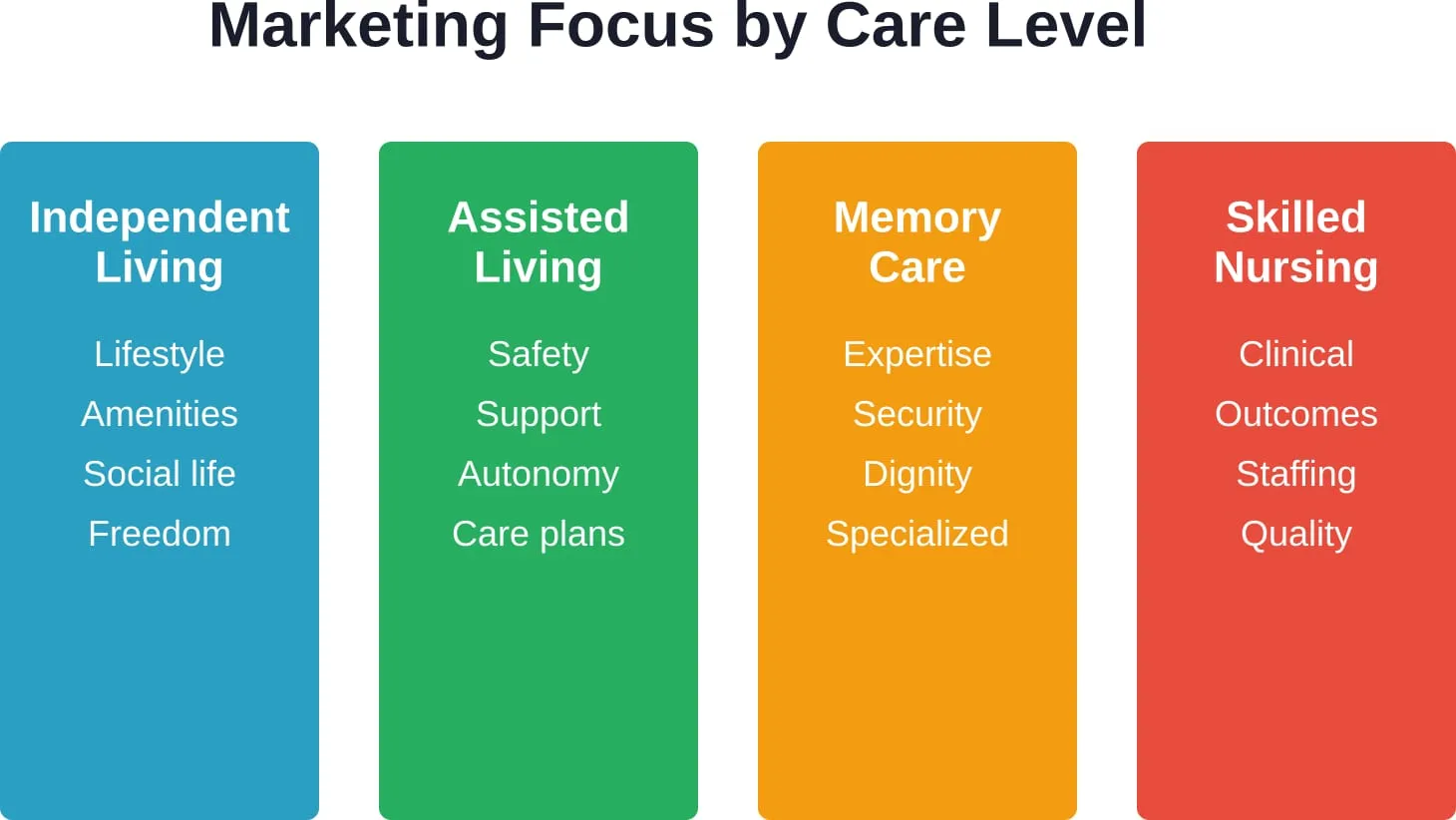
Independent living, assisted living, memory care, and skilled nursing each serve distinct needs and require tailored messaging.
Independent Living: Lifestyle and Community
Market independence, activity, and social connection. Residents are healthy, active, and seeking maintenance-free living with built-in community.
Emphasize amenities, dining options, social calendar, and freedom from home maintenance. Photography should showcase residents enjoying activities, not receiving care.
Assisted Living: Safety Plus Independence
Balance messaging between continued autonomy and available support. Families need reassurance that help is available when needed without making residents feel institutionalized.
Highlight personalized care plans, staff availability, medication management, and aging-in-place capabilities. The promise: remaining independent as long as possible with safety net support.
Memory Care: Specialized Expertise
Emphasize staff training in dementia care, secure environment design, specialized programming, and family support resources. Address the fear that the person they love will be treated like a diagnosis rather than an individual.
Skilled Nursing: Clinical Quality and Compassion
Focus on medical expertise, rehabilitation outcomes, staffing ratios, and quality ratings. Families researching skilled nursing often have immediate need following hospitalization—they’re evaluating clinical competence first.
Moving Forward: Creating Your Marketing Action Plan
The senior living communities that thrive in 2026 and beyond will master the balance between digital efficiency and human connection. Families researching care options demand transparent information online, but they make final decisions based on how a community makes them feel during tours.
Start with the fundamentals: a fast, mobile-friendly website optimized for local search, active Google Business Profile management, and systematic review generation. Those foundational elements support everything else.
Layer in content marketing that positions the community as a helpful resource rather than a salesperson. Answer real questions. Address genuine concerns. Build trust before asking for tours.
Add paid advertising strategically to accelerate visibility while organic reach builds. Test channels, track conversions rigorously, and shift budget toward what actually generates move-ins.
Then invest in the human elements that digital strategies can’t replace: community events that let prospects experience the atmosphere firsthand, referral relationships built on genuine partnership, and resident care so excellent it generates organic word-of-mouth recommendations.
The market opportunity is substantial. According to AARP’s 2024 Home and Community Preferences Survey, 64% of adults 18-plus are currently happy with their community resources, but 50% don’t think it will continue to meet their needs as they age. That gap represents millions of future senior living prospects.
Communities that combine digital sophistication with authentic human connection will capture that market. The ones still relying on yellow pages and word-of-mouth alone will struggle.
The choice is clear: adapt to how families research senior living today, or accept declining occupancy as competitors evolve faster. Start with one new channel or tactic this quarter. Measure results. Refine. Repeat. Consistent incremental improvement compounds into sustained competitive advantage.
Your future residents are searching right now. Make sure they find you.