

Quick Summary: Private schools need strategic marketing to compete for enrollment in 2026. The most effective approaches include building an SEO-optimized website, creating educational content, leveraging social media and video, optimizing local search presence, implementing email nurturing campaigns, hosting community events, and encouraging reviews—all while working within tight budget constraints that most smaller institutions face.
Private school enrollment held steady at 4.7 million students through fall 2021, but the competitive landscape has shifted dramatically. While enrollment in other religious schools increased by 8 percent from 2019–20 to 2021–22, Catholic schools saw a 4 percent decrease during the same period. The number of K–12 private schools dropped 3 percent, from about 30,500 in 2019–20 to 29,700 in 2021–22.
What does this mean for your institution? Competition is fierce. Families are researching more carefully, comparing options online, and expecting professional digital experiences before they ever schedule a campus tour.
And here’s the kicker—most private schools don’t have the marketing budgets of major brands. Recent data from the National Association of Independent Schools (NAIS) suggests that schools with fewer than 101 students face the steepest challenge: 61 percent experienced enrollment declines. For schools with 101-200 students, the split was 55 percent declining versus 43 percent growing.
But small doesn’t mean powerless. The right marketing strategies can level the playing field without draining resources. Here’s what actually works.
Build a High-Quality, SEO-Optimized Website That Converts
Parents start their search on Google. If they can’t find your school—or if your site looks outdated—they’ll move on to competitors before you ever get a chance to showcase what makes your community special.
An effective school website needs three things: speed, mobile optimization, and clear pathways to action. Pages should load quickly on mobile devices. Navigation should be intuitive on smartphones, since most searches happen on mobile devices.
The homepage should answer the fundamental question immediately: what makes this school different? Buried mission statements and vague “excellence in education” claims won’t cut it. Show, don’t just tell.
Technical SEO Basics That Matter
Search engine optimization isn’t optional anymore. Local parents searching for “private elementary school near me” or “best Catholic high school in [city]” should find your institution on the first page of results.
Start with location-specific keywords throughout your site content, page titles, and meta descriptions. Create dedicated pages for each program level (preschool, elementary, middle school, high school) and for distinctive offerings like STEM programs, language immersion, or special needs support.
Claim and optimize your Google Business Profile. This free tool puts your school on Google Maps and in local search results. Keep it updated with accurate hours, photos, and responses to reviews.
Create Valuable Educational Content That Parents Actually Want
Content marketing works because it builds trust before families ever contact you. According to research cited across multiple marketing sources, 77 percent of consumers trust referrals from people they know—but educational content from the school itself runs a close second.
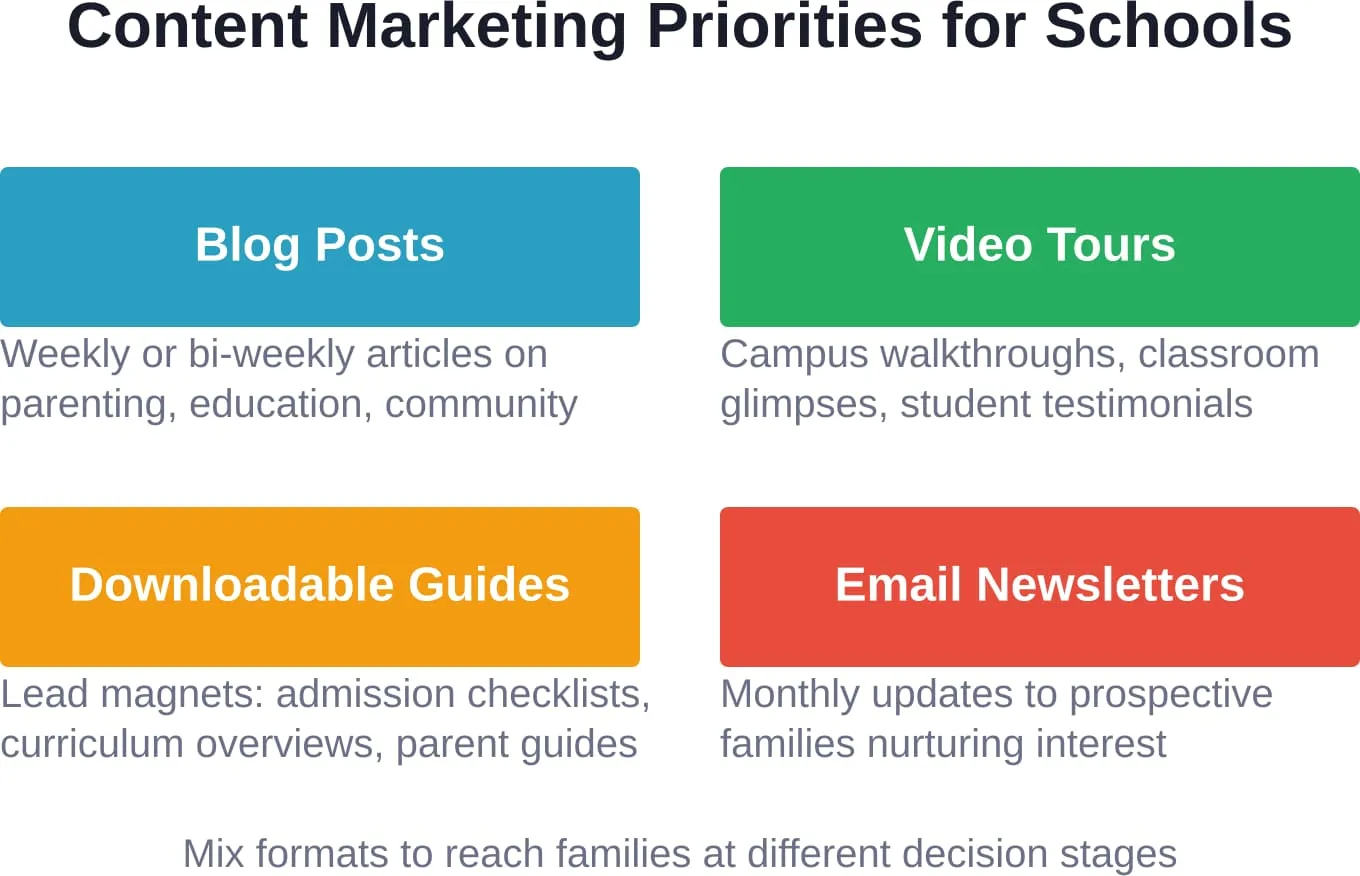
Blog posts, guides, and resources position your school as an educational authority. Topics should address real parent concerns: how to prepare children for kindergarten, navigating learning differences, choosing the right high school, college preparation timelines, or balancing academics with extracurriculars.
Make it practical, not promotional. A guide titled “10 Questions to Ask on Any School Tour” demonstrates confidence and expertise. Parents will remember which school helped them, even if the content itself was neutral.
Video Content Opens Doors
Video marketing showcases school culture in ways text simply can’t. Virtual tours let families explore campuses from home. Classroom footage shows teaching methods in action. Student and alumni testimonials provide authentic peer perspectives that resonate with both children and parents.
The platform matters less than consistency. YouTube works well because it’s the second-largest search engine and provides free hosting. Short clips can be repurposed for Instagram Reels, Facebook posts, and website galleries.
Keep production simple. Smartphone footage with good lighting and clear audio outperforms overproduced content that feels staged. Authenticity wins.
Leverage Social Media to Build Community Connection
Social media for private schools isn’t about going viral—it’s about staying visible to families already considering your institution and demonstrating the vibrancy of your community.
Facebook remains the primary platform for parent audiences. School pages should share student achievements, event announcements, classroom highlights, and behind-the-scenes glimpses. Instagram works well for visual storytelling: photos from science fairs, art projects, athletic competitions, and campus life.
Here’s what community discussions reveal: consistency beats frequency. Posting three times per week on a regular schedule builds better engagement than daily posts that disappear for weeks when staff gets busy.
Tag parents (with permission), celebrate teachers, highlight student work. The goal is to make current families so enthusiastic that they naturally share content—extending your reach into their personal networks where word-of-mouth influence is strongest.
Optimize for Local Search and Online Reviews
Private schools compete locally. Most families won’t consider institutions more than 20 minutes from home, which makes local search optimization critical.
Google Business Profile is the foundation. Complete every section: accurate address, phone number, website link, business hours, detailed description, and categories. Upload high-quality photos regularly to keep the profile fresh and engaging.
Reviews directly impact enrollment decisions. Parents read them, trust them, and base initial impressions on them. Encourage satisfied families to leave honest reviews on Google, Facebook, and education-specific platforms.
Respond to every review, positive and negative. Thank families for positive feedback. Address concerns in negative reviews professionally, taking conversations offline when appropriate. This demonstrates responsiveness and care—qualities prospective families want to see.
| Platform | Primary Benefit | Update Frequency |
|---|---|---|
| Google Business Profile | Appears in local map searches and review aggregators | Weekly photos; respond to reviews within 48 hours |
| Facebook Page | Largest parent audience; event promotion and community building | 3-5 posts per week; daily monitoring |
| Visual storytelling; reaches younger parents and students | 3-4 posts/week; daily Stories | |
| YouTube | Long-form video hosting; searchable tour and program content | 2-4 videos per month |
| Alumni engagement; faculty recruitment; institutional credibility | 1-2 posts per week |
Implement Email Marketing and Lead Nurturing
Families rarely enroll immediately after discovering a school. The decision process takes months, sometimes years. Email marketing keeps your institution top-of-mind throughout that journey.
Start by capturing leads through website forms: tour requests, information downloads, event registrations, newsletter signups. Every interaction is an opportunity to begin a relationship.
Segment lists by interest level and grade level. Families inquiring about preschool need different content than those researching high school. Tailor messages accordingly.
Automated nurture sequences work well for schools with limited staff time. A basic sequence might include: immediate welcome email with key information, follow-up highlighting unique programs, invitation to upcoming open house, student success stories, deadline reminders as application periods approach.
Keep emails conversational. Share stories, not sales pitches. The goal is to build relationships and trust, not to pressure.
Host Open Houses and Community Events
Nothing replaces the experience of visiting campus, meeting teachers, and feeling the school culture firsthand. Open houses and events turn digital interest into real engagement.
Traditional evening open houses still work, but consider diversifying: weekend family events, grade-specific information sessions, shadow day programs where prospective students attend classes, or community service events that welcome potential families to participate alongside current students.
Virtual options expand reach. Live-streamed Q&A sessions with the head of school, virtual classroom visits, or Zoom information sessions accommodate families with scheduling constraints or those in early research phases.
Promote events across all channels: email, social media, website homepage, Google Business Profile updates. Make registration simple with one-click forms.
Follow up quickly after events. Send thank-you emails within 24 hours, include next steps, and invite continued conversation.
Targeted Advertising on Limited Budgets
Paid advertising amplifies organic efforts, but small private schools often lack substantial marketing budgets. The key is precision over scale.
Facebook and Instagram ads allow geographic targeting down to specific zip codes and demographic filters including parent status, household income, and interests. This precision means small budgets go further by reaching only the most relevant audiences.
Google Search ads capture high-intent traffic—families actively searching for private schools. Start with local keywords and school-specific terms. Even modest budgets of a few hundred dollars monthly can generate meaningful inquiries.
Retargeting ads work exceptionally well for schools. When someone visits your website but doesn’t submit an inquiry, retargeting keeps your school visible as they browse other sites. These reminder ads have higher conversion rates because they target warm leads already familiar with your institution.
Test small, measure carefully, and scale what works. Track cost per lead and cost per enrollment, not just clicks or impressions.
Encourage Reviews and Word-of-Mouth Referrals
Word-of-mouth remains the most powerful marketing channel for private schools. Personal recommendations from trusted friends and neighbors carry more weight than any advertisement.
The challenge is that satisfied families don’t automatically share their experiences publicly. Schools need to make it easy and provide gentle prompts:
- Create a simple review request process: After positive interactions—successful parent-teacher conferences, great school events, graduation—send a friendly email thanking families and asking if they’d be willing to share their experience on Google or Facebook. Include direct links.
- Showcase testimonials on your website: Video testimonials from current parents are particularly compelling. Written quotes work too, especially when they address specific concerns prospective families typically have.
- Implement a formal referral program: Offer modest incentives—tuition credits, recognition, priority placement for siblings—when current families refer new enrollments. Track referrals so you can thank families properly.
Reach More Private School Prospects With Lengreo
Marketing ideas for private schools should help families, partners, or relevant business contacts understand the value of the school and move toward inquiry. Lengreo can help private education businesses structure their marketing around clearer targeting and consistent follow-up.
For private school marketing, Lengreo can support:
- SEO for search visibility
- Content marketing support
- PPC campaign management
- B2B lead generation
- LinkedIn and email outreach to selected contacts
- Appointment setting with qualified prospects
👉Reach out to Lengreo to create a clearer lead generation process for your private school.
Marketing Budget Realities for Small Private Schools
How much should a school spend on marketing? Industry benchmarks suggest allocating 1 to 10 percent of the overall budget, but that range is wide because needs vary dramatically based on enrollment goals and competitive positioning.
Schools with stable enrollment and strong retention might allocate toward the lower end. Institutions seeking growth or facing declining numbers need to invest more aggressively.
Real talk: most small private schools operate on shoestring marketing budgets. Staff wear multiple hats. The admission director handles marketing. The head of school manages social media. The administrative assistant updates the website.
That resource constraint actually clarifies priorities. Focus on high-impact, low-cost strategies first: optimize the website, claim the Google Business Profile, start basic social media posting, implement email capture and nurturing, encourage reviews.
These tactics require time more than money—and they build the foundation that makes paid advertising more effective when budget allows.
| Marketing Tactic | Relative Cost | Time Investment | Impact Level |
|---|---|---|---|
| Website optimization | Low to Medium | High (initial setup) | Critical |
| Google Business Profile | Free | Low (monthly updates) | High |
| Social media organic | Free | Medium (3-5 hours/week) | Medium to High |
| Email marketing | Low | Medium (setup + weekly) | High |
| Content/blog posts | Low | High (research + writing) | Medium (long-term) |
| Paid search ads | Medium to High | Medium (setup + monitoring) | Medium to High |
| Professional video | Medium to High | High (production) | High |
Measuring What Actually Matters
Vanity metrics are tempting but misleading. Social media likes and website traffic feel good but don’t pay tuition bills. Focus on metrics that connect directly to enrollment.
Track inquiry volume—how many families request information or schedule tours each month. Monitor inquiry sources so you know which marketing channels are actually generating leads. Calculate conversion rates from inquiry to application to enrollment.
Website analytics should focus on behavior, not just visits. How many visitors reach key pages like admissions information, tuition details, or tour request forms? Where do they drop off?
For paid advertising, cost per lead matters more than cost per click. A campaign generating cheap clicks but no inquiries is a waste. Better to pay more per click if those clicks convert to actual prospective families.
Survey new families during enrollment: how did they first hear about the school? What influenced their decision? This qualitative feedback reveals which marketing efforts actually drive enrollment.
Retention Is Marketing Too
Enrollment marketing doesn’t stop once families enroll. Retention is often overlooked but critically important—especially for small schools where losing even a few families significantly impacts budget and viability.
Happy current families become walking advertisements. They leave positive reviews, refer friends, and defend the school’s reputation in community conversations. Unhappy families do the opposite, and their criticism reaches prospective families through those same channels.
Regular parent communication, transparent administration, responsive handling of concerns, and consistent delivery on promises all contribute to retention. These aren’t traditionally considered marketing activities, but they shape reputation and word-of-mouth.
Calculate retention rates annually. If attrition is high, address the underlying issues before investing more in new student recruitment. It’s far more cost-effective to keep current families than to replace them.
Looking Forward: Trends Shaping Private School Marketing
The private school landscape continues shifting. Remote work has given families more geographic flexibility, expanding the pool of potential students for some schools while increasing competition for others. Public school enrollment decreased between fall 2019 and fall 2021, pushing some families to reconsider private options.
Digital-first marketing is now table stakes, not optional. Families expect to find comprehensive information online, complete virtual tours from their phones, and communicate via email or text rather than phone calls.
Personalization matters more as competition intensifies. Generic marketing messages get ignored. Families want to know specifically how your school will meet their child’s unique needs—whether that’s learning support, gifted programming, language instruction, or values alignment.
Authenticity trumps polish. Professional marketing materials still matter, but families increasingly value authentic glimpses into daily school life—casual photos, student-created content, unscripted teacher moments—over perfectly staged promotional videos.
Conclusion: Start With What You Can Control
Private school marketing doesn’t require massive budgets or specialized expertise—it requires consistency, authenticity, and strategic focus on the tactics that actually drive enrollment.
Start with the foundations: an optimized website that converts visitors, a claimed and updated Google Business Profile, regular social media presence showing authentic school life, and systems to capture and nurture inquiries via email. These low-cost tactics build visibility and credibility.
Layer in content creation—blog posts, videos, guides—that positions the school as an educational authority. Host events that bring prospective families to campus. Encourage reviews and referrals from satisfied current families.
When budget allows, supplement organic efforts with targeted paid advertising to reach specific local audiences. But don’t mistake spending for strategy—small schools often outperform larger competitors by focusing resources on differentiation and community rather than trying to outspend everyone.
The private school landscape is competitive, but the schools that thrive are those that clearly articulate their unique value, meet families where they are (online), and deliver on promises so well that current families become enthusiastic advocates.
Ready to strengthen your school’s marketing strategy? Start by auditing your current digital presence—website, Google Business Profile, social media, review profiles—and identifying the highest-impact improvements. Small, consistent steps build momentum that compounds over time into sustained enrollment growth.