

Quick Summary: Flight schools in 2026 need to focus on discovery flight conversions, targeted landing pages per rating, Google Business Profile optimization, and building strong referral pipelines. Data shows most students require 60-75 hours of training, and with median commercial pilot wages at $122,670, marketing should emphasize career outcomes alongside the passion for flying.
Flight training isn’t cheap. Most private pilot students need 60 to 75 hours of actual training time, well above the FAA minimum of 40 hours. That means prospective students are looking at months of commitment and significant investment before they earn their certificate.
So how do flight schools fill seats when the barrier to entry is this high? The answer isn’t flashy advertising or expensive campaigns. It’s strategic, conversion-focused marketing that meets students where they are and guides them through each stage of the decision process.
Here’s what actually works in 2026, backed by data from the FAA, industry reports, and schools that have grown enrollment by triple digits in just two years.
The Discovery Flight Is Your Top-of-Funnel Priority
Discovery flights are the single most effective conversion tool a flight school has. But too many schools treat them as an afterthought. If booking a discovery flight requires three clicks, a phone call, or filling out a long form, prospective students will bounce.
Make it dead simple. Add a prominent “Book Discovery Flight” button above the fold on your homepage. Link it to an online scheduler or a streamlined contact form with three fields maximum: name, email, preferred date range.
Here’s the thing though—the discovery flight itself is where conversion happens. Use it to showcase not just the thrill of flying, but the professionalism of your instructors, the condition of your fleet, and the pathway from zero hours to certificate.
After the flight, follow up within 24 hours. Send a thank-you email with next steps, pricing transparency, and a limited-time discount on the first block of training hours. Speed matters here. Enthusiasm fades fast.
Increase Flight School Inquiries With Lengreo
Flight schools need marketing that clearly explains programs, training schedules, certifications, and contact paths. Lengreo aligns website pages, SEO, paid ads, content, lead generation, appointment setting, and tracking into one organized system to make it easier to attract prospective students and measure results.
Need More Student Inquiries?
Lengreo can help with:
- improving program, schedule, and contact pages
- setting up SEO and paid traffic campaigns
- tracking forms, calls, and lead sources
- supporting content and lead generation workflows
👉 Contact Lengreo to discuss your marketing setup.
Create a Landing Page for Every Certificate and Rating
One generic “Courses” page doesn’t cut it anymore. Prospective students searching for “commercial pilot training” have different goals than someone searching for “private pilot license.” They need different information, different timelines, and different cost breakdowns.
Build separate landing pages for each major certificate and rating your school offers: Private Pilot, Instrument Rating, Commercial Certificate, Multi-Engine, CFI. Each page should include:
- Specific hourly requirements and typical completion time
- Total cost estimate (flight hours, ground school, examiner fees, materials)
- Career outcomes or next steps after completion
- Testimonials from students who completed that exact rating at your school
- Clear call-to-action to book an intro flight or schedule a consultation
FAA data shows the flight hour requirement for a private pilot certificate is 40 hours minimum, or 35 hours at an approved school. But here’s the reality: most students need 60 to 75 hours. Don’t hide that. Transparency builds trust.
Google Business Profile: Sort It Out Today
If your flight school’s Google Business Profile isn’t fully optimized, you’re leaving enrollments on the table. This is the first thing prospective students see when they search “flight school near me” or your school’s name.
Update your profile with:
- Accurate hours of operation
- High-quality photos of your aircraft, facilities, and instructors in action
- A complete description with keywords like “flight training,” “pilot school,” your aircraft types, and the certificates you offer
- A booking link or phone number in the primary CTA slot
- Regular posts (weekly) about student milestones, aircraft updates, or upcoming events
And reviews. Reviews matter more than almost anything else. Research shows photos are viewed and remembered many times more than text, but reviews drive the decision to actually contact you.
Build a Review Pipeline That Runs on Autopilot
Most flight schools wait passively for reviews—but a proactive system drives more credibility and enrollments.
Automate Review Requests After Key Milestones
Send automated emails after milestones such as a first solo flight, checkride pass, or certificate earned. Include a direct link to leave a Google review to minimize friction.
Offer Initial Incentives
If needed, provide a small incentive to jumpstart the process—such as 5% off the next block of hours for submitting a review. Once momentum builds, reviews will flow naturally as part of your school’s culture.
Leverage Social Proof
Students trust reviews from other students more than marketing copy. A school with 80+ recent five-star reviews will likely outperform a competitor with a fancier website but only a dozen reviews.
Named Instructors with Real Credentials
“Meet our team—passionate about aviation” tells prospective students nothing. What does tell them something:
Dan — 4,500 hours, ATPL, grade 1 instructor. 15 years on Cessna 172 and PA28, multi-engine rated, instrument examiner.
List your instructors by name, with specific credentials: total hours, certificates held, aircraft types, years instructing, and any examiner designations. Include a photo and a one-paragraph bio focused on teaching philosophy and specialties.
This does two things. First, it reassures students they’re learning from experienced professionals. Second, it helps you attract better instructors—top CFIs want to work at schools that showcase their expertise.
Open House Events and Learn to Fly Month
One Saturday a month, open your doors. Offer short 30- to 60-minute ground school sessions on topics like “How to Become a Pilot” or “What to Expect in Your First Flight Lesson.” Schedule an airline pilot or corporate pilot to speak for 20-30 minutes with Q&A. Offer air tours or intro flights at a discounted rate.
May is traditionally Learn to Fly Month, backed by industry organizations like FSANA. It’s the perfect time to run a concentrated campaign: social media posts, local ads, email blasts to your list, and partnerships with local airports or aviation businesses.
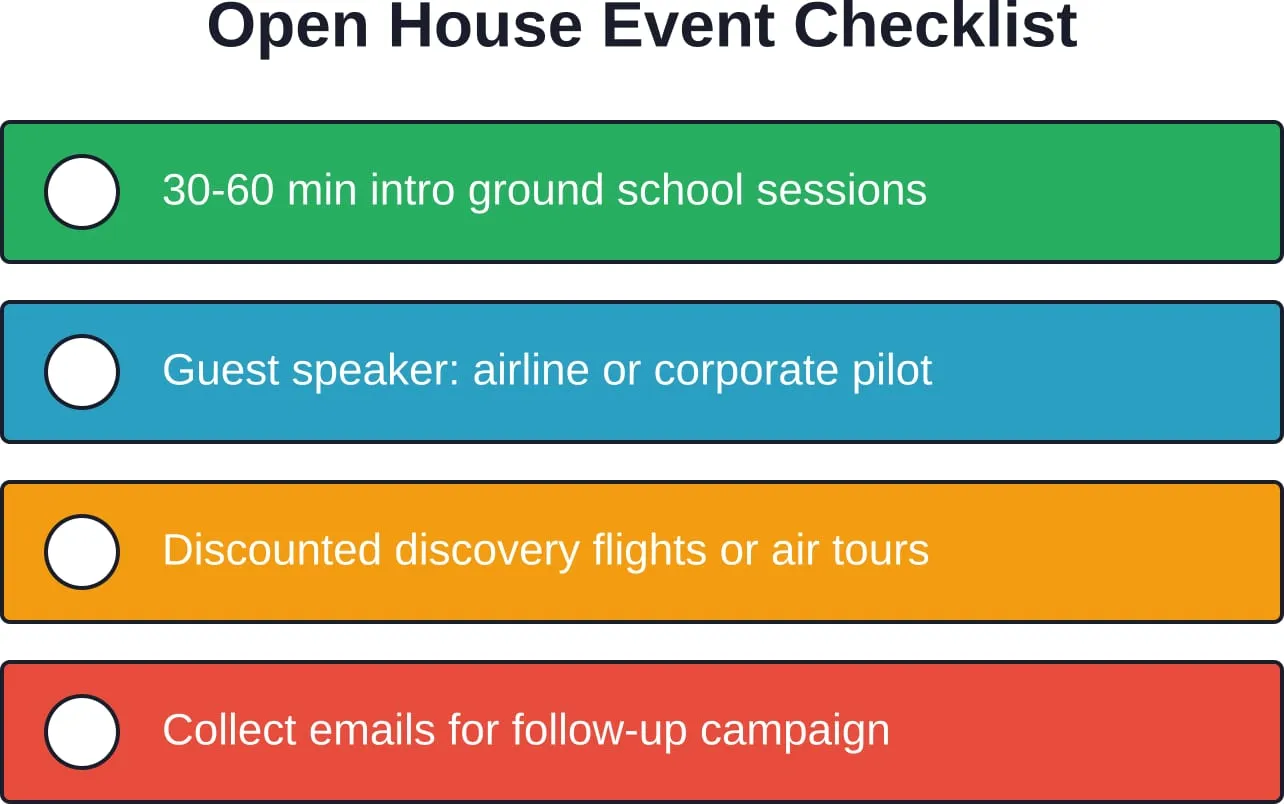
The goal isn’t just attendance. It’s collecting contact information—emails, phone numbers—for follow-up. Most people won’t commit on the spot. But if you follow up within a week with a personalized email and a clear next step, conversion rates jump.
Social Media: Content That Actually Converts
Social media for flight schools isn’t about posting airplane photos every day. It’s about telling stories that prospective students see themselves in.
Post about:
- Student milestones: first solo, checkride passes, certificate earned (with permission and photos)
- Instructor spotlights with their story and credentials
- Behind-the-scenes: pre-flight checks, maintenance, ground school sessions
- Career outcomes: where your graduates are flying now
- Quick tips: aviation terminology, what to expect in training, how to prepare for the written exam
Photos matter. Research from AOPA confirms that photos are viewed and remembered many times more than text. Ask students to post pictures from recent fly-outs or cross-country trips. Repost (with credit) and tag your school.
Facebook and Instagram are still the primary platforms for flight schools in 2026. LinkedIn works if you’re targeting career changers or professionals looking into aviation as a second career. TikTok and YouTube Shorts can work for younger demographics, but only if you’re consistent—one viral video won’t sustain enrollment.
Email Marketing: Nurture Leads Over Time
Flight training is a major commitment. New customers rarely commit on a whim. According to AOPA, it takes several contact points before someone books a discovery flight, and several more before they enroll.
Build an email list and segment it:
- Leads who haven’t booked a discovery flight yet
- Leads who flew but didn’t enroll
- Current students
- Alumni
Send a monthly newsletter with updates, student stories, industry news, and a clear CTA. For cold leads, automate a drip campaign: email 1 introduces your school, email 2 explains the training process, email 3 shares testimonials, email 4 offers a limited-time discount on discovery flights.
Keep emails short—three paragraphs max. Use a conversational tone. Always include one clear action: book a flight, read a blog post, follow on social, refer a friend.
Financing and Scholarships: Remove the Barrier
Cost is the number one obstacle for prospective pilots. Private pilot training typically costs $10,000–$15,000 when factoring in 60-75 hours of flight time, and commercial training can exceed $80,000 at some schools.
If you offer financing, promote it everywhere: homepage, course pages, discovery flight confirmation emails. Partner with lenders who specialize in aviation financing and can approve students quickly.
List scholarships your students are eligible for: AOPA scholarships, EAA Young Eagles, Women in Aviation, local aviation groups. Even if your school doesn’t fund the scholarship, helping students find money builds goodwill and removes friction.
| Financing/Scholarship Type | Typical Amount | Best For |
|---|---|---|
| AOPA Flight Training Scholarships | $2,500–$10,000 | Private and advanced ratings |
| EAA Young Eagles Scholarships | $500–$11,000 | Students aged 15-18 |
| Aviation lender financing | Up to $150,000 | Career-track students (commercial/CFI) |
| GI Bill (Post-9/11) | Covers approved programs | Veterans and eligible dependents |
Referral Programs: Turn Students Into Advocates
Current students are some of your best marketers. A formal referral program incentivizes them to bring in new students while rewarding their loyalty.
Offer Meaningful Rewards
Provide rewards such as $200 off the next invoice or two free flight hours for each new student referred who completes their first block of training.
Make Referrals Easy
Give students a unique referral link or a set of branded cards to share. Track referrals in your system and ensure prompt reward fulfillment.
Leverage Word-of-Mouth
Word-of-mouth remains the number one driver of enrollment. Discussions in aviation communities, such as Reddit, consistently highlight in-person recommendations as the top factor in choosing a flight school, outweighing social media presence or online advertising.
Track What Works and Double Down
Marketing without measurement is guesswork. Use a simple spreadsheet or CRM to track where every new student came from: Google search, referral, social media, open house event, paid ad, walk-in.
At the end of each quarter, look at your numbers. If 40 percent of new students came from referrals, invest more in your referral program. If discovery flight no-show rates are high, add SMS reminders or a small deposit requirement.
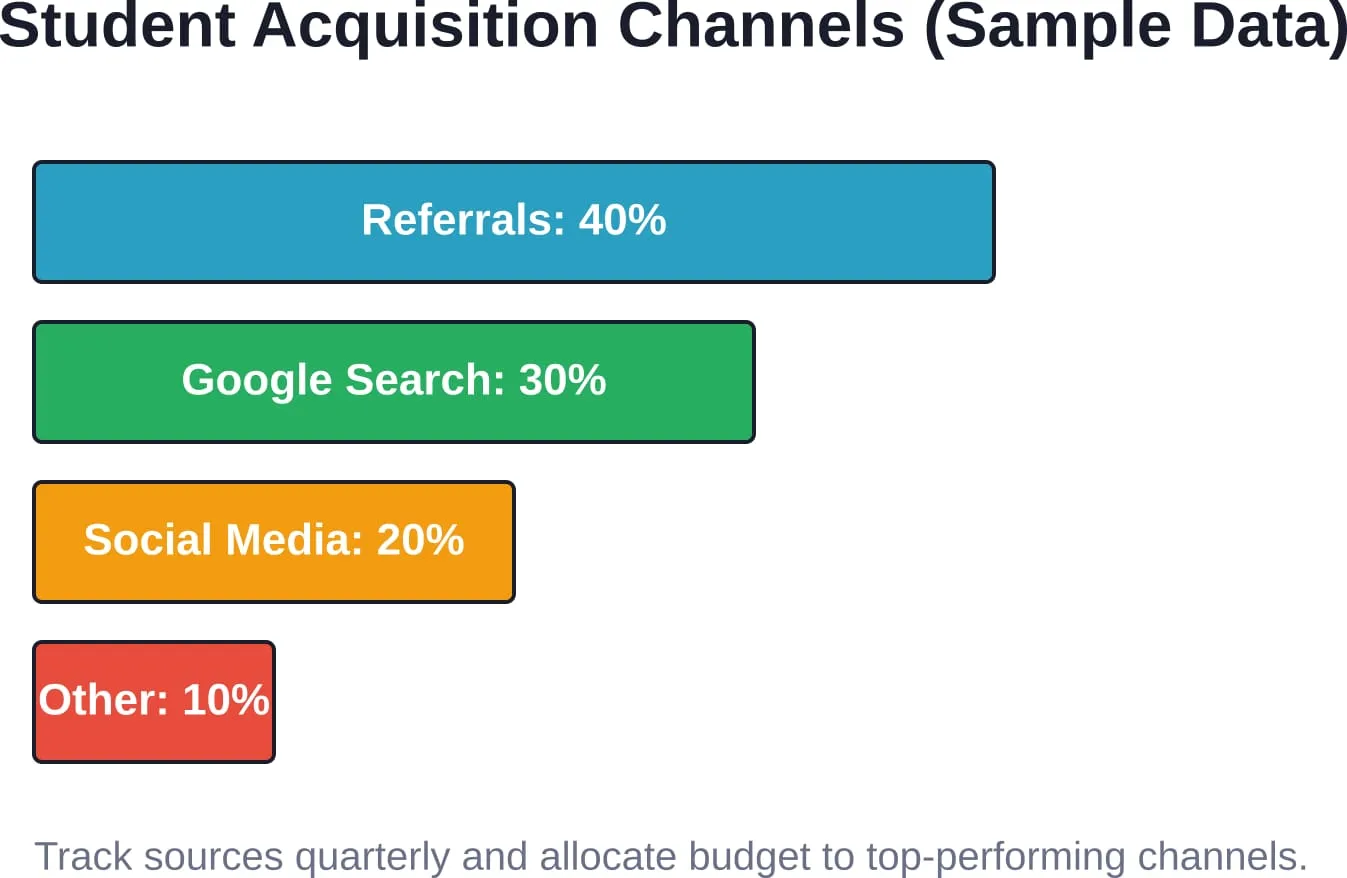
Don’t spread your budget thin trying to be everywhere. Focus on the two or three channels that actually drive enrollments for your school, and optimize relentlessly.
The Pilot Hiring Landscape in 2026
Marketing gets easier when the career outlook is strong. The Bureau of Labor Statistics reports that the median annual wage for commercial pilots was $122,670 in May 2024, and for airline pilots it was $226,600 in May 2024. Projected employment growth is 4 percent from 2024-2034, with 6,700 total employment change.
Major airlines hired 1,716 pilots in January and February 2024 alone—down from 2,256 in early 2023 and 2,082 in early 2022, but still robust. Schools that partner with airlines or provide clear pathways to regional and major carriers have a massive marketing advantage.
Promote those partnerships front and center. If your graduates are getting hired by SkyWest, Endeavor Air, or United, say so. Include testimonials from alumni who are flying for airlines now. Show the pipeline from zero hours to right seat at a regional in 18-24 months.
What We Stopped Recommending
Not every marketing tactic ages well. Here’s what flight schools should deprioritize in 2026:
- Local print ads: Expensive, low ROI, hard to track
- Generic Facebook ads without landing pages: Clicks don’t convert without a clear next step
- Overinvesting in TikTok or YouTube: Unless you can commit to weekly content, sporadic posts won’t move the needle
- Ignoring mobile: Over 60 percent of web traffic is mobile; if your site isn’t mobile-optimized, you’re losing leads
Focus on fundamentals: discovery flights, SEO, Google Business Profile, referrals, email. Master those before experimenting with new channels.
Key Takeaways for Flight School Owners
Flight school marketing in 2026 isn’t about big budgets or flashy campaigns. It’s about removing friction, building trust, and staying top-of-mind through consistent touchpoints.
Prioritize the discovery flight experience. Build landing pages for every rating. Optimize your Google Business Profile. Collect reviews systematically. Showcase instructor credentials. Host regular open houses. Nurture email leads over time. Track what works and double down.
Schools that do these things consistently—according to industry reports, some schools have grown significantly in recent years—prove that disciplined, student-focused marketing works.
The demand is there. According to Bureau of Labor Statistics data, there were 93,670 airline pilots employed in May 2023, with the majority working in scheduled air transportation. The industry needs pilots. Your job is to make it easy for prospective students to choose your school, take the first step, and stay through certificate completion.