


Quick Summary: Fitness studio marketing thrives on hyper-local visibility, community-driven referrals, and authentic social proof. Studios that combine founding member offers, strategic partnerships with complementary local businesses, and exceptional first-visit experiences consistently outperform competitors in retention and acquisition. Retail revenue and personalized content round out a sustainable growth strategy.
Breaking into a crowded fitness market requires more than just good equipment and enthusiastic trainers. The difference between a studio that limps along at 40 members and one that hits 200 in its first year often comes down to a handful of smart marketing choices made early.
Here’s the thing though—fitness studio marketing isn’t about blasting generic ads across every platform. It’s about building trust in a specific geographic radius, creating word-of-mouth momentum, and delivering experiences so good that members bring their friends.
This guide walks through the marketing ideas that consistently move the needle for fitness studios, backed by industry data and real examples from operators who’ve scaled from zero to full capacity.
Define What Makes Your Studio Different
Before spending a dollar on marketing, nail down what separates your studio from the 24-hour big-box gym down the street and the boutique spin studio around the corner. That’s the unique value proposition, and it’s the foundation everything else builds on.
Most studios default to vague language: “community-focused,” “results-driven,” “welcoming environment.” But those phrases describe every fitness business. Real differentiation gets specific.
Look at what already exists locally. If three yoga studios dominate the area, a fourth generic yoga offering won’t break through. But a studio focused exclusively on post-injury recovery yoga for athletes over 40? That’s a clear lane.
The best unique value propositions answer three questions in one sentence: who it’s for, what problem it solves, and what makes the approach different. “High-intensity interval training for busy parents who need effective 30-minute workouts before 7 AM” tells a story. “Get fit, feel great” doesn’t.
Test messaging with early prospects before locking it in. The language that resonates in conversations—the phrases people repeat back when describing the studio to friends—should shape all marketing copy.
Manage Fitness Studio Marketing With Lengreo
Fitness studios need marketing that clearly presents classes, memberships, trainers, schedules, and contact options. Lengreo helps connect website development, SEO, paid ads, content, lead generation, appointment setting, and tracking into one cohesive system.
This setup makes it easier for studios to attract members and measure which channels generate real inquiries.
Need More Membership Inquiries?
Lengreo can help with:
- improving class, membership, and booking pages
- setting up local SEO and paid campaigns
- tracking calls, forms, and lead sources
- supporting content and lead generation workflows
👉 Contact Lengreo to discuss your marketing setup.
Own Local Search and Directory Listings
When someone searches “yoga studio near me” or “personal training [neighborhood name],” appearing in the top three results is non-negotiable. Local search optimization determines whether potential members find the studio or scroll past to competitors.
Start with Google Business Profile. Claim the listing, fill out every field completely, and upload high-quality photos of the space, equipment, and classes in action. Studios with complete profiles and regular updates rank higher than bare-bones listings.
Encourage early members to leave reviews and respond to every single one within 24 hours. Prospective members read reviews obsessively—industry reports suggest trust in online testimonials drives purchase decisions for the majority of consumers. If a studio has three reviews from six months ago, it looks inactive.
Beyond Google, claim listings on Yelp, Apple Maps, Bing Places, and fitness-specific directories like ClassPass, Mindbody, and local wellness guides. Consistent name, address, and phone number across all platforms signals legitimacy to search algorithms.
For studios just launching, list trainer credentials, certifications, and social media accounts prominently. When the business itself lacks review history, showcasing the expertise of individual instructors builds credibility.
Build Social Proof Before Opening Day
Studios that generate buzz before opening doors consistently outperform those that wait until they’re ready to sell memberships. Pre-launch social media activity creates anticipation and seeds the audience that’ll drive early revenue.
- Document the build-out process: construction updates, equipment arriving, staff introductions, behind-the-scenes training sessions. People love origin stories, and showing the journey from concept to reality makes followers feel invested.
- Create Instagram and Facebook accounts 8-12 weeks before opening. Post 3-4 times weekly with a mix of facility progress, trainer spotlights, fitness tips, and local neighborhood content. Tag local businesses, use location hashtags, and engage with nearby complementary accounts (nutritionists, physical therapists, wellness shops).
- Run a countdown campaign in the final two weeks. Tease special offers, showcase testimonials from beta testers, and share opening day details. The goal is to enter launch week with 300-500 engaged local followers who’ve been primed to sign up.
One data point worth noting: Crunch Fitness saw visits rise 30% and membership sales increase 5.6% from February to March 2021 by adapting marketing creative to regional regulations—masked imagery in mask-mandate areas, maskless in others. Localization matters.
Structure Irresistible Founding Member Offers
Founding member programs solve two problems at once: they generate early cash flow and create a core group of brand advocates who’ll refer friends.
The best founding offers provide meaningful discounts in exchange for commitment. A common structure: founding members lock in rates 20-30% below standard pricing permanently, as long as they maintain continuous membership. That “locked rate for life” framing creates urgency—miss the deadline and pay more forever.
Add perks beyond pricing: priority class booking, exclusive founding member events, or input on studio decisions (class schedule, music playlists, equipment purchases). Making early members feel like insiders strengthens emotional investment.
Limit founding memberships to a specific number or deadline. Scarcity drives action. “Only 50 founding memberships available” or “Offer ends opening day” converts fence-sitters.
But here’s the catch: founding offers only work if the studio delivers exceptional experiences from day one. Discounted members who get mediocre service won’t refer anyone. They’ll just churn at slightly lower rates than regular members.
Turn Members Into a Referral Engine
Referral programs remain the highest-ROI marketing channel for fitness studios. Members who join through referrals stick around longer and spend more than those acquired through ads.
The simplest structure: give both the referring member and the new member a reward. A free month for the referrer and 20% off the first month for the friend works well. Some studios offer class packs, merchandise, or account credits instead of free months.
But generic referral programs often underperform because members forget they exist. Make referrals easy and visible. Provide shareable digital passes members can text to friends—”Give a friend a free week at [Studio Name]”—with unique tracking codes.
Prompt referrals at high-satisfaction moments: after a personal record, milestone visit (10th class, 50th class), or compliment to a trainer. That’s when members feel most enthusiastic about the experience.
Buddy passes and “bring a friend” events work particularly well for fitness studios. Offering a free partner workout or guest pass for a specific week removes the friction of committing to a tour or intro session. Friends work out together, and the existing member serves as a built-in accountability partner.
Track referral sources religiously. If three members generate 15 referrals while everyone else generates zero, figure out what those three have in common and create more people like them.
Partner With Complementary Local Businesses
Strategic local partnerships help the studio reach the right audience without relying on paid advertising. The key is finding businesses that share your target demographic but aren’t direct competitors.
Identify Strong Partnership Candidates
Good candidates include physical therapy clinics, chiropractic offices, nutritionists, healthy restaurants, juice bars, athletic apparel shops, wellness spas, and corporate offices with wellness programs.
Set Up Cross-Promotion and Referral Exchanges
Create arrangements where both businesses benefit. The studio can display flyers and business cards from the partner, and the partner can do the same. Referral exchanges work well—for example, the chiropractor recommends the studio for strength training, and the studio recommends the chiropractor for injury recovery.
Focus on Corporate Partnerships
Corporate contracts can bring significant membership growth. Many companies offer wellness stipends or subsidized fitness memberships. Reach out to HR departments with corporate membership packages or lunch-and-learn workshops—one partnership can deliver 20–50 members at once.
Co-Host Events With Partners
Joint events, such as a nutrition seminar with a local dietitian, a mobility workshop with a physical therapist, or a recovery station at a charity 5K, put the studio in front of aligned audiences in a natural, non-salesy context.
Run Hyper-Targeted Paid Advertising
Paid ads work for fitness studios when they’re laser-focused on a tight geographic area and specific audience. Broad targeting burns budget without results.
For local studios, Facebook and Instagram ads offer the best combination of targeting precision and cost-effectiveness. Define the audience by location (1-3 mile radius), age range, and interests (fitness, healthy living, specific workout styles).
Ad creative matters more than budget size. Videos showcasing real classes, members working out, and trainer personalities outperform static images. User-generated content—members posting about their workouts—provides the most authentic creative and can be repurposed with permission.
Lead magnet offers convert better than direct membership pitches. “Free first class” or “7-day trial pass” gets clicks; “Join today” gets ignored. Capture contact information in exchange for the free offer, then nurture those leads through email and retargeting.
For studios just starting out, a modest ad budget of $300-500 per month focused on a single compelling offer typically generates 30-60 leads. Conversion from lead to member depends entirely on the follow-up process and first-visit experience.
Google Ads work well for studios with unique offerings. Someone searching “prenatal yoga near me” or “powerlifting gym [city]” has high intent. For generic terms like “gym near me,” competition drives costs too high for most independent studios.
Capture Email and SMS From Day One
Building owned communication channels prevents reliance on rented platforms like social media. Email and SMS lists let studios reach members and prospects directly without algorithm interference or ad costs.
- Capture contact information at every opportunity: website visitors (pop-up offering a free workout guide), front desk walk-ins, event attendees, social media followers (link-in-bio lead magnet), and partner business referrals.
- Send regular valuable content, not just promotions. Weekly emails mixing fitness tips, member spotlights, upcoming events, and occasional special offers maintain engagement. Studios that only email when they want something see open rates crater.
- SMS works particularly well for time-sensitive communications: class cancellations, schedule changes, flash promotions, and event reminders. Keep texts short and infrequent—once or twice monthly unless urgent.
- Segment lists based on member status: active members, lapsed members, trial users who didn’t convert, and prospects who haven’t visited yet. Tailored messaging for each group performs significantly better than one-size-fits-all blasts.
Create Content That Demonstrates Expertise
Content marketing builds authority and improves search visibility—but only if it provides real value. Generic fitness tips copied from other sources won’t engage your audience or drive results.
Focus on Targeted Expertise
Center content on the studio’s specific skills and the audience’s real questions. For example, a studio specializing in strength training for women over 50 could create content about menopause-related training adjustments, bone density concerns, and safe progression protocols. This demonstrates expertise that is both relevant and credible.
Choose Effective Content Formats
Consistently effective formats include:
- Blog posts optimized for local search terms (e.g., “best personal training in [neighborhood]”)
- YouTube or Instagram videos showing proper exercise form
- Before-and-after member transformation stories
- Q&A sessions with trainers
Repurpose Content Strategically
Maximize output by reusing content. One long-form blog post can become a video script, an Instagram carousel, daily tips, and an email newsletter section—getting more mileage from a single idea.
Track Performance and Optimize
Monitor which content drives the most website traffic, social engagement, and trial signups. Focus on creating more of what resonates and reduce efforts on content that underperforms. This ensures your content strategy is efficient and results-driven.
Host Community Events and Pop-Ups
In-person events showcase the studio experience to prospects in a low-pressure environment while strengthening existing member relationships.
Effective event ideas: free outdoor workouts in a local park, charity fundraiser classes (donate the proceeds), milestone celebrations (studio anniversary party), fitness challenges with prizes, and educational workshops on injury prevention or nutrition basics.
Pop-up classes in unexpected locations—corporate office lobbies, farmers markets, festivals—introduce the studio to people who might never walk through the door otherwise. Partner with event organizers to set up a small demo area with branded signage and sign-up sheets.
Make every event a lead capture opportunity. Collect contact information from participants and follow up within 48 hours with a special attendee-only offer.
Member-only social events (no workout component) build community beyond fitness. Game nights, potlucks, or group outings to local events strengthen relationships that keep members engaged long-term.
Perfect the First Visit Experience
All the marketing in the world means nothing if the first visit disappoints. Studios get one chance to convert a trial user into a paying member.
- The first impression starts before arrival. Confirmation emails should include clear directions, parking instructions, what to bring, and what to expect. Remove uncertainty.
- Staff should greet every new visitor by name, provide a quick tour, and explain class structure or equipment use before jumping in. The goal is to make newcomers feel welcomed, not lost and intimidated.
- During the workout, trainers should check in with new faces multiple times—offering form corrections, modifications, and encouragement. That personal attention differentiates small studios from impersonal big-box gyms.
- After the session, follow up immediately. Have staff or trainers ask for feedback while the endorphins are still flowing. That’s the moment to present membership options and handle objections.
- Automated email sequences nurture trial users who don’t convert immediately. Send workout tips, member testimonials, and limited-time offers over the following two weeks. Many conversions happen days after the first visit, not during it.
Add Retail Revenue Streams
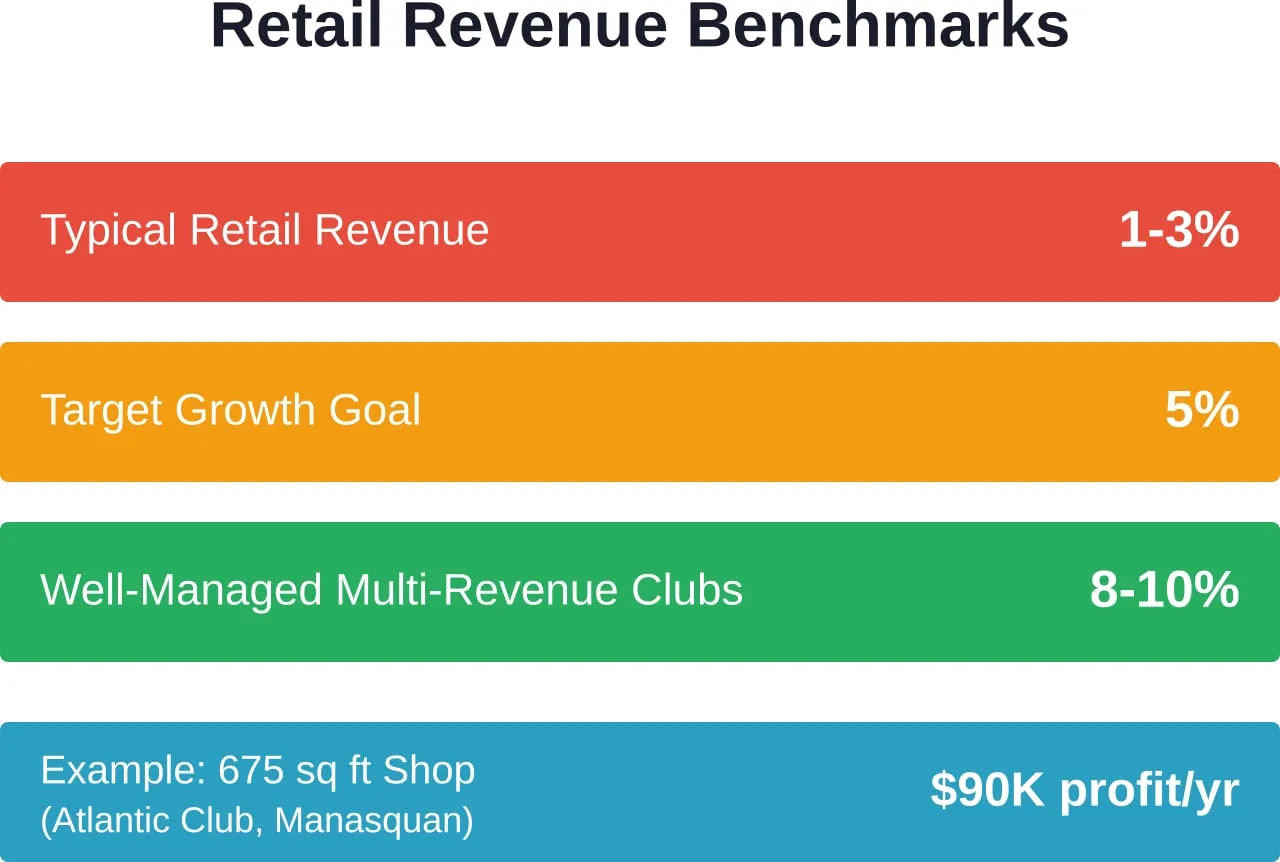
Retail products provide non-dues revenue while enhancing member experience. Studios don’t need massive retail operations to see meaningful income.
According to 2017 IHRSA Profiles of Success, the Pro-Shop/Retail category yields a median margin of 16.5% for all clubs; 15.5% for multipurpose clubs; and 20% for fitness-only clubs. For facilities that are part of a chain: 22.6%; for independent clubs: 12.7%. A 675-square-foot boutique shop at one mid-sized facility generated approximately $90,000 annual net profit.
High-margin product categories worth stocking: branded apparel (shirts, water bottles, bags), recovery tools (foam rollers, resistance bands, massage balls), supplements and protein powders, and healthy snacks for post-workout convenience.
Keep inventory lean. Start with 10-15 SKUs focused on items members actually request. Test what sells before expanding. The goal is supplementary income, not running a full retail operation.
Position retail strategically near checkout or in high-traffic areas. Impulse purchases drive significant volume—members grabbing a protein bar or resistance band on their way out add up over time.
Leverage Personalization and Member Data
Generic, one-size-fits-all communication frustrates modern consumers. Research shows that only 22% of customers feel satisfied with the personalization they receive from businesses.
Use Member Data to Create Personalized Experiences
Fitness studios have a natural advantage—they know member goals, attendance patterns, class preferences, and progress metrics. The key is putting this data into action.
Simple Personalization Tactics
- Send birthday messages with a small gift or discount
- Recognize milestones, such as the 50th class attended
- Provide personalized workout recommendations based on class history
- Launch targeted re-engagement campaigns for members showing declining attendance
Segment Communications by Member Behavior
- New members: Onboarding content and community integration
- Long-term members: Challenges and advanced programming
- Lapsed members: Re-engagement offers addressing reasons for leaving
Celebrate Progress Publicly
Track individual progress and share improvements (with permission). Before-and-after transformations, strength gains, and consistency streaks provide social proof and make members feel valued.
Use Technology to Automate Personalization
Modern fitness management software enables much of this automation. Collecting data without acting on it misses the opportunity—personalization only works when insights translate into meaningful member interactions.
Build Retention Into Marketing Strategy
Acquisition gets attention, but retention determines profitability. Studios spending heavily on new member marketing while ignoring retention end up on a treadmill—constantly replacing churned members just to maintain headcount.
Research from Gallup on employee wellbeing offers a parallel for fitness member engagement. According to Gallup’s analysis, adults thriving in all five wellbeing elements report 41% fewer unhealthy days, are 65% less likely to be involved in workplace accidents, and are 81% less likely to seek a new employer. Applied to fitness, this suggests members who thrive in all dimensions of their fitness journey stay engaged and committed.
Address retention through regular check-ins, goal-setting sessions, and progress tracking. Members who feel seen and supported stay longer than those who drift in anonymously.
Create accountability structures: workout buddies assigned to new members, small group challenges, and private online communities (Facebook groups or Discord servers) where members connect outside class.
Monitor at-risk signals: declining attendance, missed class bookings without rescheduling, and complaints or negative feedback. Proactive outreach when these patterns emerge prevents churn.
Measure What Matters
Tracking vanity metrics feels productive but doesn’t drive decisions. Instagram follower count means nothing if those followers never visit. Focus on metrics tied directly to business outcomes.
| Metric Category | What to Track | Why It Matters |
|---|---|---|
| Acquisition | Cost per lead, trial-to-member conversion rate, source of new members | Determines which marketing channels deliver ROI |
| Retention | Monthly churn rate, average member lifetime, attendance frequency | Retention drives profitability more than acquisition |
| Engagement | Classes per member per month, member satisfaction scores, referrals generated | Engaged members stay longer and refer others |
| Revenue | Revenue per member, non-dues revenue percentage, payment collection rate | Shows financial health beyond member count |
Calculate customer acquisition cost by dividing total marketing spend by new members acquired. If spending $1,000 monthly and gaining 20 members, acquisition cost is $50 per member. Compare that to lifetime value—if average member stays 18 months at $150/month, lifetime value is $2,700. A 50:1 LTV:CAC ratio is healthy.
Review metrics monthly and adjust strategy quarterly. Marketing that worked six months ago might underperform now as market conditions shift.
Adapt Marketing to Regional Context
Cookie-cutter marketing ignores local culture, regulations, and competitive dynamics. What works in Brooklyn won’t necessarily work in suburban Texas.
During 2021, Crunch Fitness demonstrated localized marketing by adapting creative to regional regulations. From February to March 2021, visits rose 30% and membership sales increased 5.6%, as reported in IHRSA’s Fitness Industry Roundup (May 2021).
Study local competitor positioning. If every studio emphasizes intensity and challenge, positioning around sustainability and injury prevention creates differentiation. If everyone markets to young professionals, targeting retirees or teens opens underserved segments.
Align messaging with regional values. Health-conscious communities respond to science-backed training methodologies. Blue-collar areas often prioritize affordability and no-nonsense results. Match the tone to the audience.
Seasonal patterns vary by region. Ski resort towns see winter fitness interest spike; beach communities peak in spring. Time campaigns accordingly rather than following generic “New Year, New You” playbooks.
Common Mistakes That Kill Studio Marketing
Understanding what not to do matters as much as knowing what works. These mistakes appear repeatedly in struggling studios.
- Inconsistent posting schedules. Sporadic social media activity—radio silence for weeks then five posts in two days—signals disorganization. Audiences tune out. Consistency beats volume.
- Selling before relationship building. Leading every interaction with “sign up now” pitches repels prospects. Provide value first through free content, trials, and community connection. Sales follow trust.
- Ignoring negative feedback. One-star reviews left unanswered suggest the studio doesn’t care. Addressing criticism publicly and resolving issues privately demonstrates accountability.
- Copying competitor messaging verbatim. If marketing sounds identical to three other studios, nothing differentiates the offering. Authentic voice and specific positioning attract better-fit members.
- Over-reliance on single channels. Studios depending entirely on Instagram or only paid ads face disaster when algorithm changes or budget constraints hit. Diversified marketing across owned, earned, and paid channels provides stability.
- No follow-up systems. Capturing leads means nothing without structured follow-up. Trial users who don’t hear from anyone after their free class won’t convert by osmosis. Automation and accountability ensure no one falls through cracks.
Scale Marketing With Growth Stages
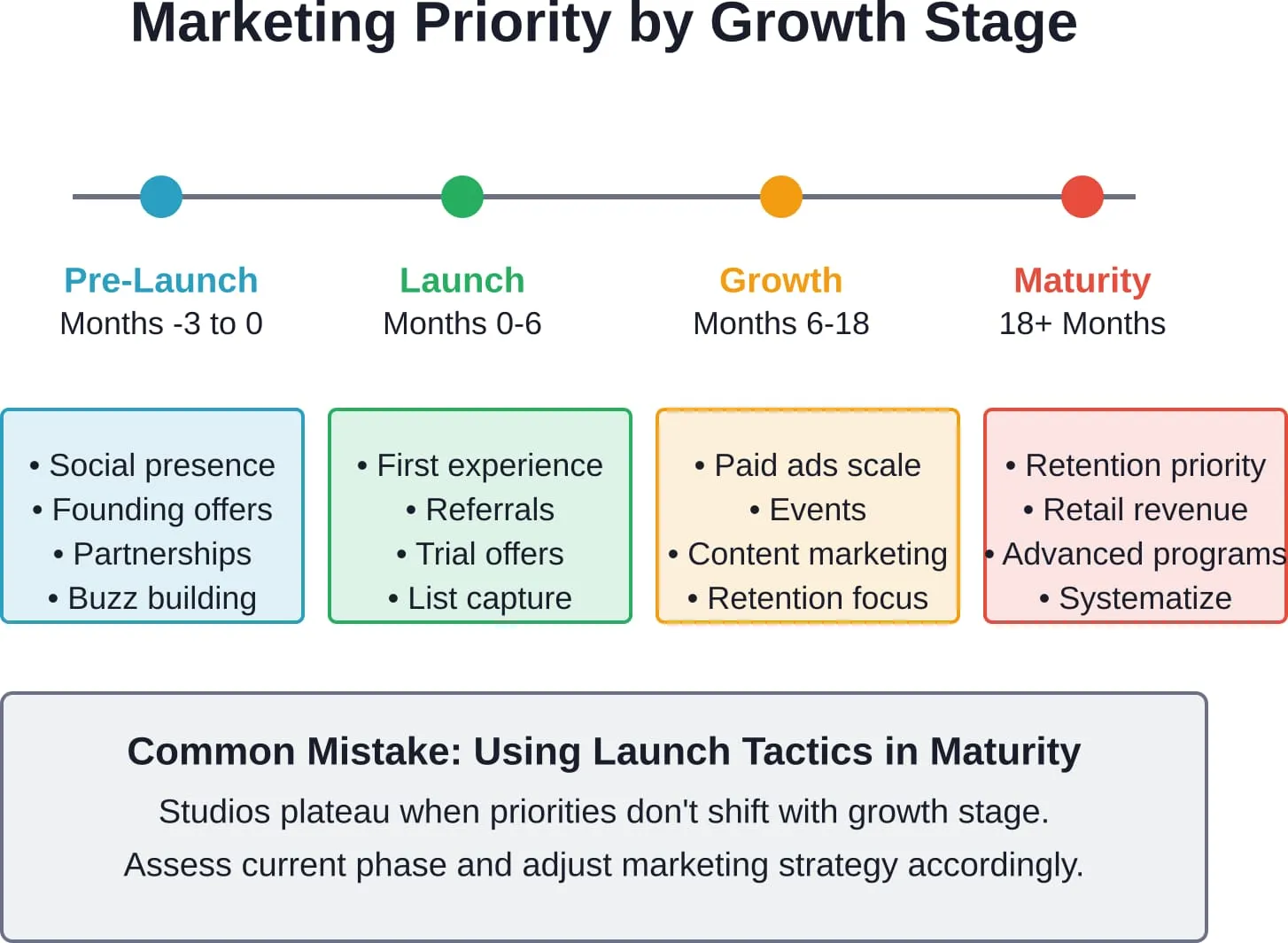
Marketing priorities shift as studios mature. Month one demands different tactics than year three.
- Pre-launch (months -3 to 0): Build social media presence, secure founding members, establish local partnerships, create Google Business Profile, generate pre-opening buzz.
- Launch phase (months 0-6): Focus intensely on first-visit experience, activate referral programs, maintain founding member satisfaction, capture email/SMS contacts, run targeted paid ads for trial offers.
- Growth phase (months 6-18): Scale paid advertising based on proven creative, expand partnership network, host regular community events, launch content marketing, implement retention campaigns.
- Maturity phase (18+ months): Optimize retention over acquisition, develop retail revenue streams, create advanced member programming (challenges, specialized workshops), systematize processes for consistent quality.
Many studios plateau by continuing launch-phase tactics when they need maturity-phase strategies. Assess which stage applies and adjust accordingly.
Conclusion
Marketing a fitness studio successfully comes down to getting a few core things right: knowing exactly who you serve, making it easy for happy members to bring friends, showing up consistently in the local community, and delivering experiences worth talking about.
The studios that struggle typically chase every tactic without mastering the fundamentals. They jump to paid ads before establishing referral systems. They obsess over Instagram follower counts while neglecting Google reviews. They market aggressively but deliver mediocre first visits.
Real talk: marketing doesn’t fix a bad product. But when the studio experience genuinely transforms members’ lives, strategic marketing accelerates growth that would otherwise take years.
Start with the highest-leverage tactics—referrals, local search optimization, founding member offers, and exceptional service—then layer in additional channels as revenue grows. Track what works, cut what doesn’t, and reinvest savings into proven winners.
The fitness industry rewards studios that build genuine community connections over those chasing viral moments. Focus on the 100 people in your neighborhood who need exactly what you offer rather than trying to appeal to everyone within 10 miles.
Ready to implement these strategies? Pick three tactics from this guide, implement them consistently for 90 days, and measure results. Consistency beats complexity every time.