


Quick Summary: Charter schools face increasing competition for enrollment and must use strategic marketing to stand out. Effective marketing combines digital strategies like SEO and social media with community engagement and authentic storytelling. Between fall 2010 and fall 2021, charter school enrollment more than doubled from 1.8 million to 3.7 million students, making strong marketing essential to attract families in this growing sector.
Charter schools operate in a fundamentally different reality than traditional district schools. While district schools draw students from designated attendance zones, charter schools must actively recruit every single student. That’s not just a minor operational difference—it’s a complete shift in how schools think about their relationship with families.
The numbers tell part of the story. Charter school enrollment jumped from 1.8 million to 3.7 million students between fall 2010 and fall 2021, according to data from the National Center for Education Statistics. During that same period, the proportion of all public schools that were charter schools increased from 5 to 8 percent.
But here’s the thing: growth doesn’t mean the work gets easier. As charter schools have expanded, so has competition. Families now have more educational options than ever—public, private, magnet, hybrid, and online learning. Standing out requires more than a good reputation or word-of-mouth referrals.
Understanding the Charter School Marketing Landscape
Marketing feels uncomfortable for many educators. The entire concept seems to run counter to the mission-driven nature of education. Yet research from the Peabody Journal of Education found that marketing has become a very common strategy among charter schools, particularly those facing pressure from accountability measures and charter renewal requirements.
The competitive environment varies dramatically by location. In the District of Columbia, charter schools enrolled 45 percent of all public school students as of fall 2021. Arizona followed with 20 percent charter enrollment. States like these create intensely competitive markets where effective marketing isn’t optional—it’s essential for survival.
Real talk: some schools have more resources than others. Charter schools generally operate on tighter budgets than traditional district schools, receiving by one estimate only about 80 percent of the per pupil amount received by district schools, according to Brookings Institution research. That funding gap means marketing dollars must work harder and smarter.
What Families Actually Want
Before diving into tactics, charter schools need to answer one critical question: why would families choose this school over the alternatives?
The answer can’t be vague promises about “excellence” or “innovation.” Families want specifics. What does a typical day look like? What teaching philosophy guides the classrooms? What results has the school actually achieved?
University of California, Berkeley researchers analyzed charter school marketing materials using computational text analysis and found that charter schools’ advertising patterns contribute to race- and class-based segregation by targeting different communities differently. Schools positioned differently based on their market hierarchy and the demographics they served.
Build Charter School Marketing With Lengreo
Charter school marketing needs clear pages, search visibility, and inquiry paths that make admissions easier for families to understand. Lengreo helps connect website development, SEO, paid ads, content, tracking, and lead generation into one setup.
Need a Clearer Way to Get Admission Inquiries?
Lengreo can help with:
- improving admissions, program, and contact pages
- setting up SEO and paid traffic campaigns
- tracking forms, calls, and campaign performance
- supporting content and lead generation work
👉 Contact Lengreo to discuss your marketing setup.
Digital Marketing Strategies That Actually Work
Sites that show up on the first Google search results page get 91.5% of traffic share. If a charter school isn’t ranking on page one for relevant local searches, prospective families probably won’t find it.
Optimize for Local Search
Google My Business represents the lowest-hanging fruit in charter school marketing. Setting up and maintaining an accurate profile costs nothing but time.
The profile should include current hours, accurate location information, photos of the facility, and regular updates about school events and achievements. Encourage current families to leave honest reviews—According to research, 77% of consumers trust referrals from people they know, and online reviews serve as digital word-of-mouth.
Local SEO goes beyond Google My Business. The school website needs location-specific content that helps search engines understand geographic relevance. That means mentioning the neighborhood, nearby landmarks, and the communities served throughout the site content.
Build a Website That Converts Visitors to Applicants
The website serves as the school’s digital front door. Families form impressions within seconds of landing on the homepage.
One charter school (Bronx Arts) working with BCS Interactive saw a 203% year-over-year increase in website visits after implementing strategic improvements. Their “apply now” landing page received 8,780 views and generated 756 “apply now” call or form completions in a single enrollment cycle.
What made the difference? Clear navigation, prominent calls-to-action, fast load times, and mobile optimization. The application process needs to be absurdly simple—every additional click or form field loses applicants.
| Website Element | What Works | What Doesn’t Work |
|---|---|---|
| Homepage | Clear value proposition, prominent “Apply Now” button, authentic student photos | Generic stock photos, buried application link, jargon-heavy language |
| About Pages | Specific teaching philosophy, measurable outcomes, staff bios with personality | Vague mission statements, no data, formal headshots only |
| Application Process | Mobile-friendly forms, progress indicators, multiple contact options | PDF-only applications, unclear deadlines, no follow-up communication |
| News/Blog Section | Regular updates, student achievements, classroom stories | Outdated content, administrative announcements only |
Create Content That Answers Real Questions
Families searching for schools ask specific questions: What’s the curriculum like? How does transportation work? What happens if my child needs extra support?
A blog or resource section that addresses these questions serves double duty. It provides value to prospective families while building search engine authority. Content should focus on answering questions rather than promoting the school—the credibility and trust built through helpful information ultimately drives enrollment better than direct sales pitches.
Video content performs particularly well. According to SOLVED Consulting, 89% of marketers agree that video testimonials are the best way to advertise. Short videos showing actual classroom activities, student interviews, and parent testimonials create emotional connections that text alone can’t achieve.
Social Media Strategy for Charter Schools
Social media can feel like a time sink without a clear strategy. The key is choosing platforms where target families actually spend time and posting content that provides value rather than constant self-promotion.
Facebook remains dominant for reaching parents in most demographics. Facebook ads allow precise geographic and demographic targeting, making them cost-effective for charter schools with limited budgets.
Instagram works well for visual storytelling—classroom activities, student artwork, athletic achievements, and behind-the-scenes glimpses of school life. The platform skews younger, making it useful for reaching parents of elementary and middle school students.
Here’s what the posting calendar might look like:
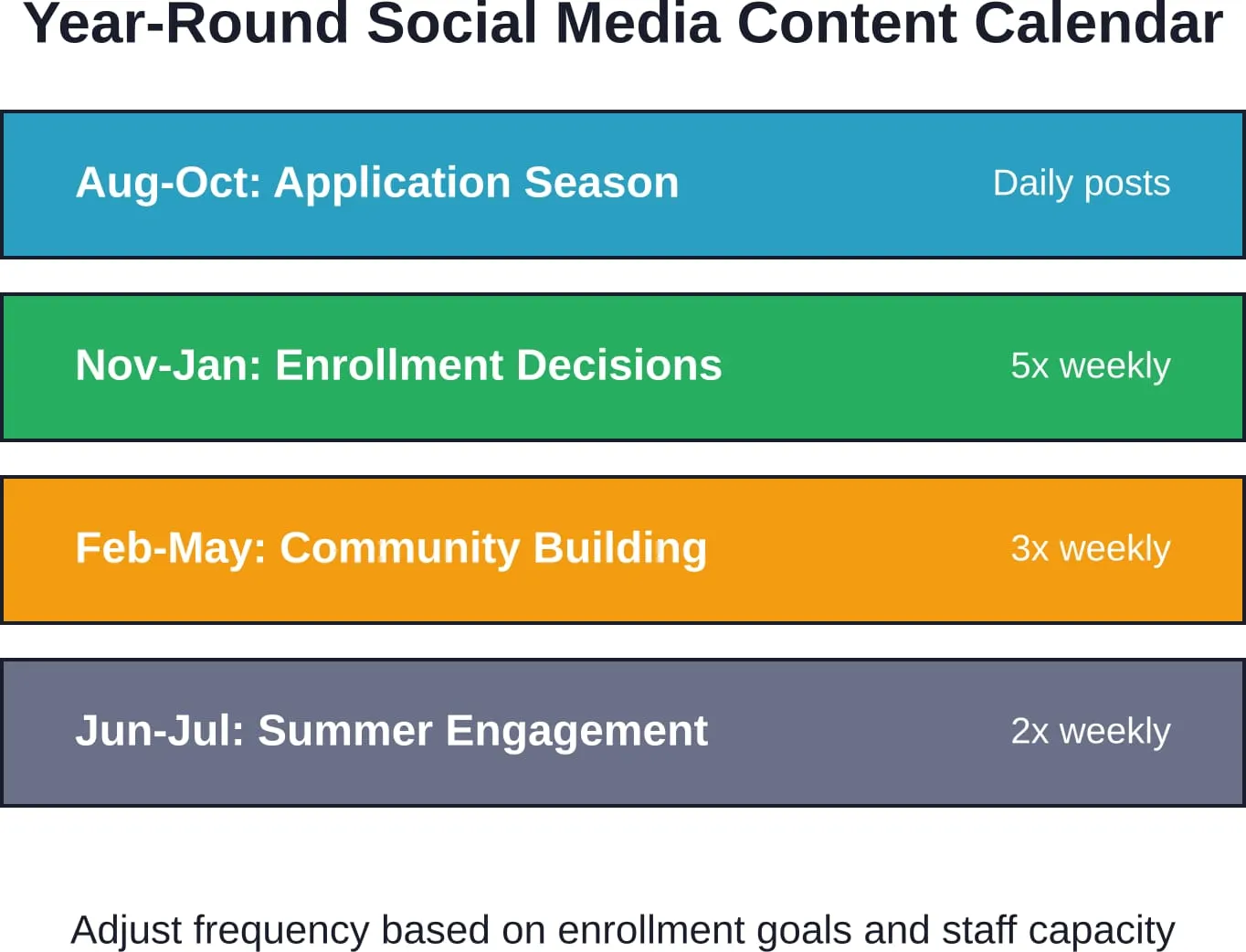
The content mix matters as much as posting frequency. Share student achievements, staff spotlights, academic programs, extracurricular activities, and community events. Respond promptly to comments and messages—social media is social, after all.
Community Engagement Beyond Digital Channels
Digital marketing reaches far, but it can’t replace face-to-face community connections. Many families still discover schools through local events, partnerships, and personal recommendations.
Partner with Community Organizations
Libraries, community centers, youth sports leagues, and faith organizations all connect with families in the school’s target demographic. These partnerships provide opportunities for visibility without appearing overtly commercial.
Offering free workshops on homework help, reading strategies, or college preparation builds goodwill while demonstrating the school’s expertise. These events attract families who might not actively be searching for a new school but remain open to better options.
Host Open Houses That Actually Engage
Traditional school tours often follow a predictable script: walk through empty hallways, peek into classrooms, listen to administrative presentations.
That’s not what this is about. Effective open houses let families experience what it actually feels like to be part of the school community. Current students serve as tour guides. Teachers demonstrate actual lessons. Parents of current students share honest experiences, both challenges and successes.
The goal isn’t to present a perfect polished image—it’s to give families an authentic preview of daily life at the school.
Build a Referral Program
Current families represent the most credible marketing asset any school possesses. Their recommendations carry more weight than any advertisement.
Some schools create formal referral programs with small incentives—priority registration for school events, recognition in newsletters, or modest tuition credits where legally permitted. But incentives aren’t necessary. Most satisfied families happily recommend their school when asked.
The key is making it easy. Provide shareable social media content, printable flyers for community boards, and simple talking points families can use when discussing the school with neighbors and friends.
Measuring Marketing Effectiveness
Marketing without measurement wastes resources. Charter schools need to track which strategies actually drive enrollment inquiries and completed applications.
| Metric | How to Track | What It Tells You |
|---|---|---|
| Website Traffic | Google Analytics | Are people finding the site? Which sources drive traffic? |
| Application Starts vs. Completions | Application platform analytics | Where families drop off in the enrollment process |
| Social Media Engagement | Platform insights | Which content resonates with the audience |
| Event Attendance | Registration tracking | Which outreach events attract prospective families |
| Source of Enrollment | Application form question | Which marketing channels convert to enrollment |
Track enrollment sources by adding a simple question to the application: “How did you first hear about our school?” The answers reveal which marketing investments produce actual results versus which just create activity.
Common Marketing Mistakes to Avoid
Even well-intentioned marketing efforts can backfire. Here are pitfalls to watch for.
Inconsistent Messaging
When the website emphasizes academic rigor but social media focuses entirely on athletics, families receive mixed signals about what the school actually prioritizes. All marketing channels should communicate a consistent identity and value proposition.
Neglecting Current Families
Schools sometimes become so focused on recruiting new students that they neglect communication with current families. That’s backwards. Satisfied current families create word-of-mouth marketing that no advertising budget can match. Dissatisfied families create negative word-of-mouth that sabotages even the best marketing campaigns.
Copying Competitor Strategies Without Adaptation
What works for one charter school won’t necessarily work for another. Schools serve different communities, offer different programs, and possess different strengths. Marketing should highlight what makes each school genuinely distinctive rather than mimicking competitors.
Overpromising and Underdelivering
Marketing that creates unrealistic expectations sets up families for disappointment. The goal is attracting families who will thrive at the school as it actually exists—not creating an idealized image that reality can’t support.
Looking Ahead: Marketing in 2026 and Beyond
The charter school sector continues evolving. Between school years 2010–11 and 2021–22, the percentage of all public schools that were charter schools increased from 5 to 8 percent. That growth shows no signs of stopping.
But wait. Growth creates both opportunities and challenges. More charter schools mean more competition for students. Families have more choices, which raises expectations for transparency, communication, and demonstrated results.
Successful marketing will increasingly depend on authentic storytelling backed by genuine results. Families can see through generic promises and stock-photo perfection. They want real stories from real students and families.
The schools that thrive will be those that build marketing around three core principles: clarity about what makes them distinctive, consistency across all communication channels, and authenticity in how they present themselves to prospective families.