


Quick Summary: Aviation professionals can boost visibility and revenue through specialized marketing strategies including targeted digital advertising, SEO-optimized websites, strategic partnerships, content marketing, and leveraging industry events. Success requires understanding the unique aviation buyer journey, building trust through expertise, and maintaining consistent engagement across channels where decision-makers spend time.
Standing out in aviation isn’t like marketing consumer products. The industry operates with longer sales cycles, stricter regulations, and buyers who demand expertise before they commit. Whether running a flight school, charter operation, FBO, or working as an independent CFI or mechanic, the challenge remains the same: how do you reach the right people and convert interest into revenue?
The aviation market is expanding. That growth creates opportunities, but it also means competition is intensifying.
Here’s the thing though—traditional marketing approaches often fall flat in aviation. Buyers expect precision, safety credentials, and proven track records. They’re not impulse shoppers browsing social media feeds. They’re corporate decision-makers, aspiring pilots researching training options, or aircraft owners seeking maintenance providers they can trust.
This guide covers practical marketing ideas that aviation professionals are using right now to fill seats, book charters, and grow their businesses.
Why Aviation Marketing Demands a Different Approach
Aviation isn’t a mass-market industry. The sales process involves significant financial commitments, safety considerations, and regulatory compliance. A corporate executive booking a charter flight for $200,000+ annually needs different messaging than someone buying a consumer product.
Industry data shows that aviation load factors are expected to reach 83.8% in 2026, which means competition for those remaining seats is fierce. Flight schools, charter operators, and maintenance facilities can’t rely on walk-in traffic or impulse purchases.
The buyer journey is longer. Prospects research extensively, compare options, read reviews, verify credentials, and often consult with advisors before making decisions. Marketing needs to support that entire journey—not just capture attention in the moment.
According to the FAA’s Workforce & Education Division, strengthening the aerospace workforce pipeline depends on stakeholder engagement. For aviation businesses, that means building relationships with educational institutions, industry organizations, and community partners—not just running ads.
Define Your Target Audience with Precision
Generic marketing messages don’t convert in aviation. An aircraft mechanic offering specialized maintenance services needs to speak directly to aircraft owners and operators, not casual flyers browsing vacation options.
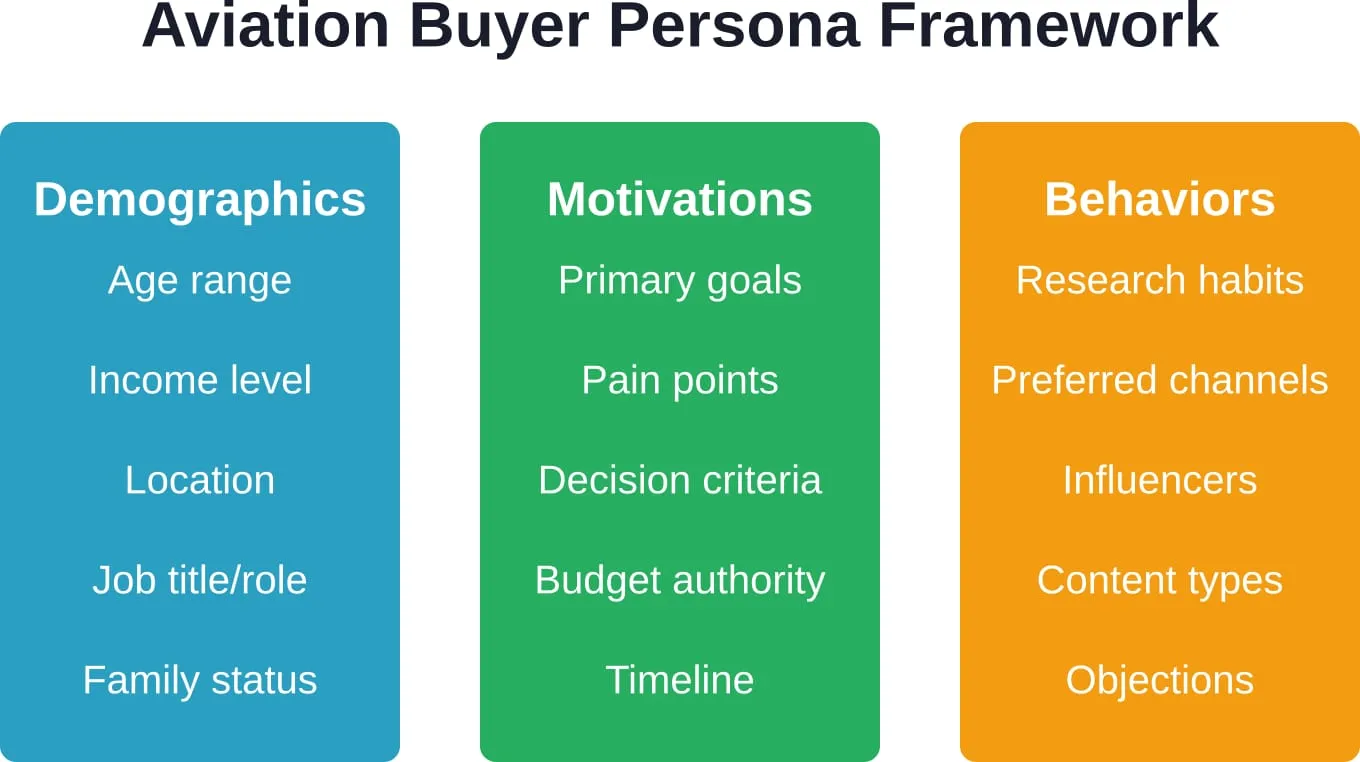
Start by creating detailed buyer personas. One aviation marketing case study documented a buyer persona for charter services: Evan Mitchell, 45, COO of a mid-to-large corporation, married with two children, living in an upscale Kansas City suburb, with income over $200,000 annually. His values: efficiency, luxury, privacy, reliability.
That level of detail matters. It shapes everything from ad targeting to website copy to the channels you invest in. A corporate executive isn’t scrolling TikTok looking for charter flights. They’re on LinkedIn, reading industry publications, and networking at business aviation events.
For flight schools, the persona looks different. Prospective students might be college-aged career-changers, professionals seeking a pilot rating for personal use, or international students researching U.S. training programs. Each segment requires different messaging, offers, and channels.
Organize Aviation Professional Marketing With Lengreo
Aviation professionals need marketing that presents services, certifications, training programs, and contact options clearly. Lengreo helps connect website pages, SEO, paid campaigns, content, lead generation, appointment setting, and tracking into a cohesive setup.
This ensures that prospects can quickly understand offerings and submit inquiries.
Need a Better Setup for Client Inquiries?
Lengreo can help with:
- improving service, program, and contact pages
- setting up SEO and paid traffic campaigns
- tracking forms, calls, and lead sources
- supporting content and lead generation workflows
👉 Contact Lengreo to discuss your marketing setup.
Build a Conversion-Optimized Website
An aviation business website needs to do more than look professional—it must convert visitors into leads. Many aviation websites fall short due to vague messaging, buried contact information, and generic “about us” pages that fail to establish credibility.
Create Specific Service Pages
Flight schools should avoid generic “training” pages. Dedicated pages for private pilot certification, instrument rating, commercial licenses, and multi-engine training should be created, each optimized for the specific searches prospects are performing. Rating-specific pages dramatically outperform generic program pages for search intent like “instrument rating [city name].”
Highlight Instructor Credentials
Instructor bios should establish credibility. Compare:
- Weak: “Meet our team—passionate about aviation.”
- Strong: “Dan—4,500 hours, ATPL, grade 1 instructor. 15 years on Cessna 172 and PA28, multi-engine rated, instrument examiner.”
The second approach immediately reassures prospects that they’re learning from qualified professionals.
Include Clear Calls-to-Action
Every service page should guide visitors toward the next step: schedule a discovery flight, request a quote, or book a consultation. Don’t make prospects hunt for contact information.
Optimize Website Speed
Aviation prospects often research on mobile devices between meetings or while traveling. A slow-loading site loses leads before content even loads, so ensure fast performance across all devices.
Leverage SEO for Long-Term Visibility
Search engine optimization drives consistent traffic without ongoing ad spend. When someone searches “flight school near me” or “aircraft maintenance [city],” appearing in top results captures high-intent prospects.
Local SEO is critical for aviation businesses serving specific geographic areas. Claim and optimize the Google Business Profile. Complete every section: services offered, hours, photos, service area. Encourage satisfied customers to leave reviews—responses to those reviews signal engagement to search algorithms.
Create content that answers specific questions prospects are searching for. A charter operator might publish articles like “How Much Does It Cost to Charter a Private Flight from [City A] to [City B]?” or “What to Expect During Your First Charter Flight.” These target long-tail keywords with clear commercial intent.
According to IATA, effective revenue management in aviation involves understanding forecasting and pricing strategies. Applying that same analytical approach to SEO means tracking which keywords drive traffic that actually converts—not just vanity metrics like page views.
Run Targeted Digital Advertising Campaigns
Digital advertising allows precise targeting that traditional methods cannot match. For aviation businesses, this precision is critical—flight schools or maintenance facilities only need to reach audiences actively interested in aviation services.
Leverage Search Ads for High-Intent Prospects
Google Ads are ideal for high-intent searches. Prospective students searching for “helicopter flight training [city]” or “aircraft maintenance facility” are actively researching, allowing ads to capture attention at the moment it matters.
Use Professional Targeting on Social Platforms
Facebook and LinkedIn ads excel at reaching audiences based on professional criteria. Charter operators can target corporate executives by job title, company size, and industry, while flight schools can reach people who have shown interest in aviation careers or searched pilot training topics recently.
Retarget Interested Prospects
Retargeting campaigns re-engage visitors who didn’t convert. For example, someone who viewed the instrument rating course page but didn’t schedule a discovery flight can see follow-up ads featuring student success stories or limited-time promotions.
Test and Optimize Continuously
Track which ad copy, visuals, and targeting parameters deliver the lowest cost per lead and highest conversion rates. Success in aviation marketing comes from systematic optimization rather than creative brilliance.
Segment Email Marketing for Maximum Engagement
Segmented email campaigns can dramatically improve open and click-through rates. Case studies show targeted segments achieving 41.9% open rates, with optimized follow-up campaigns reaching up to 35.2% open rates and measurable engagement improvements.
Engage Through Email Marketing
Email remains one of the highest-ROI marketing channels for aviation businesses. It allows direct communication with prospects and customers, building relationships over time.
Segment email lists based on where prospects are in the buyer journey. A flight school might segment: initial inquiries who haven’t scheduled a discovery flight, discovery flight participants who haven’t enrolled, current students, and alumni. Each segment receives messaging tailored to their stage.
The same charter operator case study mentioned earlier demonstrated the power of segmentation. Targeted email segments achieved 41.9% open rates compared to 29.7% for general campaigns—a 41% improvement just from better segmentation.
Email content should provide value, not just promotional offers. Share safety updates, industry news, pilot tips, maintenance reminders, or behind-the-scenes looks at operations. Position the business as a trusted resource, not just a vendor.
Automation handles repetitive communications efficiently. When someone schedules a discovery flight, an automated sequence can send pre-flight preparation information, post-flight follow-up, and enrollment information over several weeks—maintaining engagement without manual effort.
Create High-Value Content Marketing
Content marketing builds authority and captures organic traffic over time. Aviation businesses that consistently publish helpful content establish themselves as industry experts.
Video content performs particularly well. Aircraft walkarounds, instructor introductions, student testimonials, safety briefings, or maintenance process explanations give prospects insight into operations and build trust. According to industry analyses, mobile-first video content effectively engages aviation audiences.
Case studies showcase real results. A maintenance facility might publish: “How Predictive Maintenance Reduced Unscheduled Events [by a measurable percentage].” That specific, data-driven story resonates more than generic claims about quality service. The 30% reduction figure cited here comes from documented aviation industry results.
Blog posts targeting specific questions capture search traffic. Topics like “How Long Does It Take to Get a Private Pilot License?” or “What Maintenance is Required for [Aircraft Type]?” answer questions prospects are actively searching.
The FAA’s workforce development initiatives emphasize education and connection to aerospace careers. Aviation businesses can contribute by publishing career guidance content, salary information, and pathway explanations—positioning themselves as resources for aspiring professionals.
Build Strategic Industry Partnerships
Aviation operates as an interconnected ecosystem. Strategic partnerships allow businesses to expand reach, increase credibility, and create mutual value.
Partner With Complementary Aviation Businesses
Flight schools can collaborate with aviation maintenance facilities, aircraft rental companies, or aviation insurance providers. Cross-referrals benefit both parties: maintenance facilities recommend flight schools to aircraft owners seeking to improve their skills, while flight schools refer students to the facility for aircraft maintenance needs.
Leverage Industry Associations
Organizations like the NBAA (National Business Aviation Association) provide networking and visibility opportunities. Through events, speaking engagements, and platforms like NBAA Connect, aviation service providers can reach qualified buyers, vendors, and partners.
Collaborate With Educational Institutions
Partnerships with universities or business schools strengthen workforce pipelines and generate leads. For example, a charter operator can offer executive MBA students exposure to business aviation operations, building awareness among future corporate decision-makers.
Align With FAA and Workforce Initiatives
The FAA emphasizes collaboration with industry, educational institutions, and community organizations to support and strengthen the aerospace workforce. Participation in these initiatives provides visibility, credibility, and access to emerging talent for aviation businesses.
Maximize Social Media Strategically
Social media can be highly effective for aviation marketing, but success depends on strategy rather than mere presence. Different platforms serve different purposes depending on your business type and target audience.
LinkedIn for B2B Connections
LinkedIn is ideal for B2B aviation services. Charter operators, maintenance facilities, and aviation technology companies can reach corporate decision-makers, operations managers, and industry professionals. Share thought leadership content, industry insights, and company updates to build credibility.
Instagram for Visual Storytelling
Instagram works well for visually-driven content. Flight schools can showcase student success stories, aircraft photos, and behind-the-scenes training. Charter operators can highlight destinations, aircraft interiors, and customer experiences. The platform skews younger, making it valuable for reaching aspiring pilots.
YouTube for Long-Form Authority
YouTube allows aviation businesses to establish expertise through tutorials, training videos, safety briefings, and aircraft reviews. Content remains available long-term, accumulating views and reinforcing authority in the industry.
Facebook for Local Engagement
Facebook helps aviation businesses engage with local communities. Regional flight schools, FBOs, and maintenance facilities can connect with nearby prospects through local groups, event promotions, and community interactions. The platform’s older demographic aligns well with aircraft owners and established professionals.
Align Platforms With Audience Behavior
According to IATA trends, digital transformation is reshaping aviation marketing. Social media is just one component—platform choices should match where your target audience actually spends time to maximize effectiveness.
Attend and Leverage Industry Events
Aviation trade shows, conferences, and regional forums provide concentrated access to prospects and partners. Events like NBAA-BACE connect thousands of business aviation professionals in one location.
The 2026 NBAA White Plains Regional Forum, held Wednesday, May 20 at White Plains Airport (HPN), included exhibits, aircraft displays, and keynote speakers including NBAA President and CEO Ed Bolen. These events attract decision-makers actively seeking solutions—making them high-value marketing opportunities.
Exhibiting at events requires investment, but ROI can be substantial. Prepare specific goals: collect X qualified leads, demonstrate new services to Y prospects, schedule Z follow-up meetings. Measure results against those goals, not just booth traffic.
Speaking opportunities position businesses as thought leaders. Presenting at regional forums or industry conferences establishes expertise and generates leads from audience members facing the challenges discussed.
Even without exhibiting or speaking, attending events provides networking value. Conversations in hallways, at receptions, or during aircraft displays often generate more qualified leads than formal booth interactions.
Track, Measure, and Optimize Performance
Aviation marketing requires the same analytical rigor as aviation operations. Track metrics that matter: cost per lead, lead-to-customer conversion rate, customer acquisition cost, and lifetime customer value.
Google Analytics reveals which marketing channels drive website traffic that actually converts. A charter operator might discover that organic search generates fewer total visits than social media, but converts at 5x the rate. That insight should shift budget allocation.
CRM systems track the complete customer journey. When someone first inquires, what happens? How many touchpoints occur before conversion? Which follow-up messages get responses? Data answers these questions—eliminating guesswork.
According to IATA’s analysis of revenue management, aviation’s narrow profit margins demand constant refinement. The same principle applies to marketing. Small improvements compound: a 10% increase in conversion rate combined with a 10% reduction in cost per lead creates 21% better ROI overall.
A/B testing identifies what actually works. Test email subject lines, ad copy, landing page layouts, call-to-action buttons—any variable that might affect conversion. Let data, not assumptions, guide decisions.
| Metric | What It Measures | Target Range | Optimization Priority |
|---|---|---|---|
| Cost Per Lead | Marketing spend divided by leads generated | $50-$500 depending on service | High |
| Lead Conversion Rate | Percentage of leads that become customers | 5-15% for aviation services | High |
| Customer Acquisition Cost | Total cost to acquire one customer | Varies by lifetime value | High |
| Website Conversion Rate | Percentage of visitors who complete goals | 2-5% for lead generation | Medium |
| Email Open Rate | Percentage of recipients who open emails | 30-45% for segmented lists | Medium |
| Email Click Rate | Percentage who click email links | 0.5-2% depending on offer | Medium |
Common Aviation Marketing Mistakes to Avoid
Even experienced aviation professionals make predictable marketing mistakes. Recognizing them prevents wasted budget and missed opportunities.
- Mistake 1: Generic messaging. “Quality service” and “experienced team” don’t differentiate. Every competitor makes the same claims. Specific credentials, measurable results, and unique processes actually persuade.
- Mistake 2: Neglecting mobile optimization. Corporate executives research charter options on phones between meetings. Pilots compare flight schools on tablets. Websites that don’t work flawlessly on mobile devices lose those prospects immediately.
- Mistake 3: Ignoring follow-up. Research shows most aviation purchases require multiple touchpoints over weeks or months. Generating a lead then failing to follow up systematically wastes the acquisition cost.
- Mistake 4: Copying consumer marketing tactics. Aviation isn’t retail. Flashy creative and emotional appeals work less effectively than credibility, specificity, and proof. Testimonials from named customers with verifiable results outperform generic stock photos and motivational copy.
- Mistake 5: Underinvesting in content. Aviation prospects research extensively before contacting providers. Businesses with thin websites and minimal content lose to competitors publishing helpful resources. One high-quality piece of content that ranks well in search results can generate leads for years.
Future Trends Shaping Aviation Marketing
Aviation marketing continues evolving alongside industry changes. Several trends are reshaping how aviation professionals reach customers.
- Digital transformation accelerates across aviation. According to IATA’s analysis of emerging trends, digital transformation and new regulations are among ten key factors reshaping the industry. Marketing must adapt—prospects expect seamless online booking, digital documentation, and instant communication.
- Artificial intelligence enhances targeting and personalization. AI tools analyze prospect behavior to predict which leads are most likely to convert, what messaging resonates, and when to follow up. Early adopters gain efficiency advantages.
- Sustainability messaging grows more important. With aviation focused on decarbonization and environmental impact reduction, prospects increasingly consider sustainability practices when selecting providers. Marketing that authentically communicates environmental initiatives resonates with eco-conscious customers.
- Workforce challenges create marketing opportunities. Aviation businesses that effectively market career pathways, training programs, and advancement opportunities will attract talent while building brand awareness.
- Personalization expectations increase. Generic mass marketing becomes less effective as prospects expect tailored experiences. Segmented campaigns, personalized landing pages, and customized follow-up sequences become standard rather than advanced tactics.
Conclusion
Marketing for aviation professionals isn’t about creativity or trends—it’s about systematic execution of strategies proven to reach decision-makers and convert them into customers. The aviation industry’s unique characteristics demand specialized approaches that build credibility, demonstrate expertise, and support longer sales cycles.
Success comes from understanding the specific audience, optimizing every touchpoint in the buyer journey, and measuring what actually drives results. Whether running a flight school, charter operation, maintenance facility, or working as an independent professional, the fundamentals remain consistent: be found where prospects search, communicate value clearly, build trust through proof, and follow up persistently.
The aviation market continues growing, creating opportunities for professionals who market effectively. Start with the strategies outlined here, track results rigorously, and optimize based on data. Small improvements compound over time into significant competitive advantages.
Ready to elevate your aviation marketing? Pick one strategy from this guide and implement it this week. Measure results, refine the approach, then add the next strategy. Consistent execution beats perfect planning every time.