


Quick Summary: Marketing strategies for artificial intelligence in 2026 center on personalization, automation, and data-driven decision-making. Organizations are deploying AI for customer segmentation, content generation, predictive analytics, and conversational experiences. Recent data shows that 60.4% of companies began using AI in marketing within the past year, with 85% reporting significantly increased productivity. The key to success lies in selecting the right AI applications, ensuring governance compliance, and measuring ROI through systematic testing.
Artificial intelligence has moved from experimental novelty to essential infrastructure in modern marketing. Management consultancy McKinsey estimates that generative AI might add as much as USD 4.4 trillion to the global economy annually, with marketing applications representing a significant portion of that value.
But here’s the thing—throwing AI at marketing problems doesn’t automatically produce results. The difference between organizations that see tangible returns and those that don’t comes down to strategic deployment, governance, and a clear understanding of what today’s AI can actually do.
This guide walks through practical marketing ideas for artificial intelligence, backed by recent data from MIT Sloan Management Review, Berkeley’s California Management Review, and implementations at companies from Bank of America to Unilever.
The Current State of AI Marketing Adoption
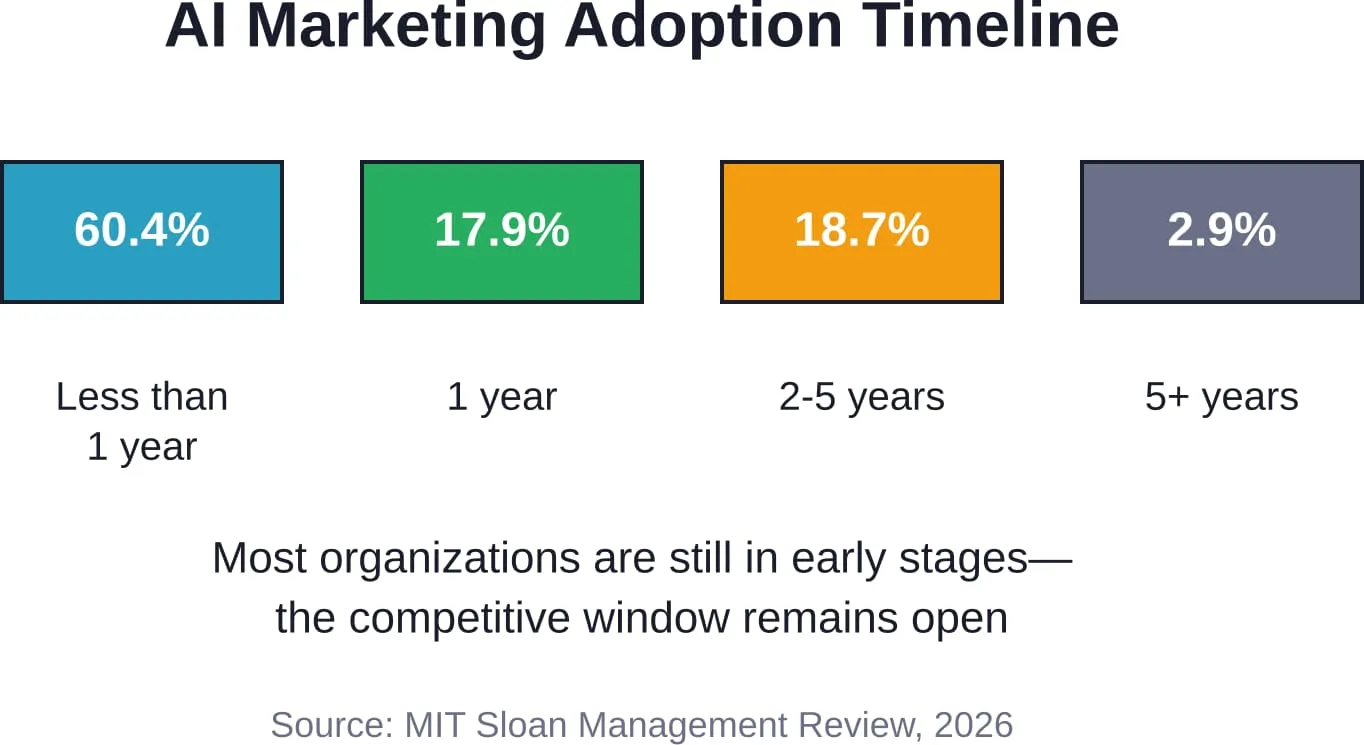
AI adoption in marketing has accelerated dramatically over the past two years. According to research published by MIT Sloan Management Review, 60.4% of companies have used AI in marketing for less than one year, while 17.9% have used it for exactly one year. Only 18.7% have two to five years of experience, and a mere 2.9% have been working with AI in marketing for more than five years.
This means the competitive landscape remains relatively level—most organizations are still in early stages.
The productivity gains are real. Data from California Management Review shows that 71% of marketers now use generative AI weekly or more frequently. Among those users, with 85% reporting significantly increased productivity. That’s not incremental improvement; that’s a fundamental shift in how marketing work gets done.
As of 2024, McKinsey reports that AI adoption across the global business landscape reached 72%. Marketing represents one of the fastest-growing application areas, alongside customer service and software development.
Strategic AI Marketing Applications That Deliver ROI
The highest-value AI marketing applications fall into several distinct categories. Not all will be relevant to every organization, but understanding the full landscape helps marketing leaders prioritize investments.
Personalization at Scale
AI-powered personalization goes far beyond inserting a customer’s name into an email subject line. Modern systems analyze behavioral data, purchase history, browsing patterns, and contextual signals to deliver genuinely relevant experiences.
Bank of America’s virtual assistant has completed 2 billion exchanges with clients, with 98% of interactions resulting in customer answers in under 44 seconds. That’s personalization delivering measurable value—faster resolution, lower support costs, and higher satisfaction.
Walmart’s app users leveraging AI-powered recommendations spend 25% more on average than non-users, driven largely by personalized shopping experiences.
The key is moving beyond simple segmentation to true individualization. AI systems can now process enough variables to treat each customer as a segment of one, adjusting messaging, offers, and timing based on predicted propensity to engage or convert.
Content Generation and Optimization
Generative AI has transformed content workflows. What used to take hours now takes minutes. But the best implementations don’t replace human creativity—they augment it.
Research from MIT Sloan Management Review found that LLM hybrids recovered 77% of themes identified by human analysts in consumer research, missing only 23%. That’s good enough for initial drafts, competitive analysis, and research acceleration.
Practical content applications include:
- Generating multiple ad variations for A/B testing
- Creating first drafts of blog posts and social media content
- Producing product descriptions at scale
- Localizing content for different markets and languages
- Optimizing headlines and calls-to-action based on predicted performance
The workflow that works: AI generates options, humans select and refine. Don’t publish AI-generated content without editorial oversight, but don’t start from a blank page when AI can get you 70% of the way there in seconds.
Predictive Analytics and Customer Intelligence
AI excels at pattern recognition in large datasets—exactly what marketing needs for forecasting and optimization.
Modern AI analytics tools are evolving beyond one-off queries. Multiple specialized AI agents can collaborate in agentic workflows, continuously uncovering insights. For example, one agent might monitor campaign metrics and notice a 15% drop in sign-ups. It could then autonomously trigger another agent to investigate the root cause, which might discover a 10% overall conversion rate decline concentrated in a 15% conversion drop in Europe, specifically a 25% organic search conversion decline driven by recent algorithm changes.
That level of continuous analysis used to require dedicated analytics teams working full-time. Now it happens automatically.
Predictive applications include:
- Lead scoring based on likelihood to convert
- Churn prediction allowing proactive retention campaigns
- Lifetime value forecasting for customer acquisition investment decisions
- Inventory optimization for e-commerce
- Budget allocation across channels based on predicted ROI
Conversational AI and Customer Service
Chatbots have existed for years, but modern conversational AI powered by large language models represents a qualitative leap.
These systems can handle complex, multi-turn conversations, understand intent, access relevant knowledge bases, and escalate to human agents when appropriate. They’re not replacing customer service teams—they’re handling routine inquiries so humans can focus on complex, high-value interactions.
The best conversational AI implementations focus on specific, well-defined use cases rather than trying to handle everything. Start with FAQ responses, order status inquiries, or appointment scheduling—areas where the questions are predictable and the required information is structured.
Marketing Automation and Workflow Optimization
AI-powered marketing automation goes beyond scheduled email sequences. Modern systems make decisions dynamically based on customer behavior and predicted outcomes.
This includes:
- Dynamic campaign orchestration across email, SMS, push notifications, and ads
- Automated bid management for paid search and social campaigns
- Real-time budget reallocation based on performance
- Triggered messaging based on behavioral signals
- Automated reporting and anomaly detection
The ROI compounds over time. While not purely marketing, the principle applies—AI removes friction from repetitive processes, freeing resources for strategic work.
Optimize Your Marketing Setup With Lengreo
AI companies need marketing that explains products, services, and solutions clearly while generating qualified leads. Lengreo connects website development, SEO, paid ads, content, lead generation, appointment setting, and tracking into a single cohesive system.
This setup ensures prospects can quickly understand offerings and take the next step.
Need More Qualified Inquiries?
Lengreo can help with:
- refining service, solution, and contact pages
- setting up SEO and paid campaigns
- tracking forms, calls, and lead sources
- supporting content and lead generation workflows
👉 Contact Lengreo to discuss your marketing setup.
Building an Effective AI Marketing Strategy
Random AI experiments rarely deliver sustainable value. The organizations seeing real returns follow a systematic approach.
Start With the Problem, Not the Technology
Too many AI initiatives begin with “We need to use AI” rather than “We need to solve this problem.” That’s backwards.
Effective AI deployment starts by identifying the highest-impact marketing challenges:
- Where are manual processes creating bottlenecks?
- Which decisions are currently made with insufficient data?
- What customer experiences are inconsistent or unscalable?
- Which campaigns have unclear or unpredictable performance?
Once problems are clear, the right AI applications become obvious.
Adopt a Value-Discipline Framework
Research from IMD suggests that AI often works as designed but fails commercially. Leaders need a value-discipline framework that shows how to turn AI investment into measurable ROI.
The framework asks three questions:
- What value discipline drives our strategy? Are we competing on operational excellence (lowest cost), product leadership (best product), or customer intimacy (best total solution)? AI applications should align with that core strategy.
- What AI capabilities support that discipline? Operational excellence benefits from automation and efficiency AI. Product leadership benefits from innovation and R&D AI. Customer intimacy benefits from personalization and relationship AI.
- How do we measure AI’s contribution to our value discipline? Define metrics that tie AI performance directly to strategic goals, not just technical benchmarks.
Organizations that skip this strategic alignment end up with AI projects that deliver technical success but business failure.
Establish Governance Early
The National Institute of Standards and Technology (NIST) released an AI Risk Management Framework designed to cultivate trust in AI technologies and promote innovation while mitigating risk. As of December 2025, the White House issued executive orders establishing a national policy framework for artificial intelligence, directing federal agencies to prevent a patchwork of conflicting state regulations.
Marketing leaders can’t ignore governance. AI systems that violate privacy regulations, produce discriminatory outcomes, or spread misinformation create legal liability and reputational damage far exceeding any operational benefit.
NIST guidelines emphasize that policies, processes, procedures, and practices related to mapping, measuring, and managing AI risks must be in place, transparent, and implemented effectively. Legal and regulatory requirements involving AI should be understood, managed, and documented.
Practical governance steps include:
- Documenting what AI systems are in use and what decisions they inform
- Establishing human review for high-stakes decisions
- Testing AI outputs for bias, accuracy, and alignment with brand values
- Creating clear data policies that comply with privacy regulations
- Building escalation paths when AI systems behave unexpectedly
IEEE standards emphasize four conditions for building trusted AI systems: effectiveness (does it work?), competence (does it work reliably?), accountability (can we explain decisions?), and transparency (do stakeholders understand how it works?).
These aren’t abstract principles—they’re practical requirements for sustainable AI marketing programs.
Get Big Value From Smaller Efforts
When MIT Sloan senior lecturers sought examples of enterprises achieving major transformations using generative AI, they didn’t find any. What they found instead: smart leaders getting big value from targeted, smaller efforts.
The lesson? Don’t wait for the perfect enterprise-wide AI transformation. Start with focused use cases that deliver measurable value quickly.
The best starting points share common characteristics:
- Well-defined inputs and outputs
- Clear success metrics
- Limited scope reducing implementation complexity
- Fast feedback loops enabling rapid iteration
- Low risk if the experiment fails
Examples include generating ad variations for testing, summarizing customer feedback, creating first-draft social posts, or scoring leads based on engagement patterns.
Success in these smaller efforts builds organizational confidence, develops internal capabilities, and generates budget for larger initiatives.
Practical AI Marketing Ideas by Function
Different marketing functions benefit from different AI applications. Here’s what works where.
Content Marketing
AI accelerates content creation without sacrificing quality when used correctly.
- Idea generation: Use AI to generate 20 blog post ideas on a topic in seconds. Pick the best three and develop them with human expertise.
- Outline creation: AI can structure long-form content, identifying logical sections and key points to cover.
- First drafts: Generate initial drafts that capture 70-80% of what’s needed, then edit for accuracy, brand voice, and strategic messaging.
- SEO optimization: AI tools analyze top-ranking content and suggest keywords, headings, and structural improvements.
- Repurposing: Turn a webinar transcript into a blog post, social media snippets, and email content automatically.
The workflow that works: AI generates raw material, humans provide strategy, judgment, and brand voice.
Paid Advertising
AI has transformed paid media from manual campaign management to automated optimization.
- Creative testing: Generate dozens of ad variations with different headlines, images, and calls-to-action. Let AI identify winning combinations.
- Audience discovery: AI analyzes conversion data to identify unexpected audience segments worth targeting.
- Bid optimization: Automated bidding adjusts in real-time based on conversion probability, time of day, device type, and hundreds of other signals.
- Budget allocation: AI reallocates spend across campaigns, ad sets, and channels based on predicted ROI.
- Anomaly detection: AI flags sudden performance changes that require human investigation.
Platforms like Google Ads and Meta already include sophisticated AI—the key is understanding how to configure them for business goals.
Email Marketing
Email remains one of marketing’s highest-ROI channels, and AI makes it more effective.
- Send-time optimization: AI predicts when each recipient is most likely to open and engage, scheduling delivery individually.
- Subject line testing: Generate multiple subject line options and predict performance before sending.
- Dynamic content: Insert different product recommendations, offers, or messaging for each recipient based on predicted interest.
- Segmentation: AI identifies micro-segments based on behavioral patterns that humans wouldn’t spot manually.
- Churn prediction: Flag subscribers at risk of disengaging and trigger re-engagement campaigns automatically.
Customer Research and Insights
AI transforms research from a months-long process to continuous insight generation.
- Survey analysis: Process thousands of open-ended responses to identify themes and sentiment automatically.
- Social listening: Monitor brand mentions, competitor activity, and industry conversations at scale.
- Competitive intelligence: Track competitor pricing, positioning, content strategy, and campaign activity automatically.
- Customer interviews at scale: California Management Review research describes using generative AI to create “digital twins” of customer segments—LLMs trained on customer data that respond to research questions as customers would. While these recovered 77% of themes identified by human analysis, they enable faster, cheaper initial research.
- Trend identification: AI spots emerging patterns in search behavior, social conversations, and purchase data before they become obvious.
SEO and Search Marketing
AI is reshaping how consumers search, and brands must adapt to remain discoverable.
Research from MIT Sloan Management Review warns that as AI platforms transform search behavior, brands that don’t adapt risk becoming invisible to potential customers. When users ask ChatGPT or Perplexity for recommendations instead of searching Google, traditional SEO becomes less relevant.
- Answer engine optimization: Structure content to answer specific questions that AI assistants might be asked.
- Entity building: Establish clear associations between your brand and relevant topics, use cases, and solution categories.
- Conversational content: Create content that matches natural language queries, not just keyword phrases.
- Structured data: Implement schema markup so AI systems can parse and understand site content.
- Authority building: Earn mentions in authoritative sources that AI systems reference when answering queries.
The shift from traditional search to AI-mediated discovery is happening now. Brands need strategies for both.
Measuring AI Marketing Performance
AI initiatives fail when they lack clear success metrics. Technical teams celebrate model accuracy while business leaders wonder where the ROI is.
The solution: define business metrics before deployment.
Leading vs. Lagging Indicators
Lagging indicators measure ultimate outcomes—revenue, customer lifetime value, market share. They’re important but slow to change.
Leading indicators predict future outcomes and respond faster to changes—engagement rates, lead quality scores, conversion rates by segment, customer satisfaction.
Effective AI measurement tracks both. Leading indicators show whether the system is working as expected. Lagging indicators show whether it’s delivering business value.
Practical Metrics by Use Case
Match metrics to the specific AI application:
| AI Application | Key Metrics | Success Threshold |
|---|---|---|
| Content generation | Time saved, output volume, edit rate | 50%+ time reduction |
| Personalization | Click-through rate, conversion rate, revenue per user | 15%+ lift vs. control |
| Lead scoring | Conversion rate of high-scored leads, false positive rate | 2x conversion vs. unsorted |
| Chatbots | Resolution rate, escalation rate, satisfaction score | 70%+ resolution without escalation |
| Predictive analytics | Forecast accuracy, decision impact, cost avoided | 80%+ forecast accuracy |
| Ad optimization | Cost per acquisition, return on ad spend, conversion rate | 20%+ efficiency gain |
The threshold column represents realistic targets based on industry benchmarks, not guarantees.
The Attribution Challenge
AI often works behind the scenes, making attribution difficult. Personalization engines, predictive models, and optimization algorithms don’t generate direct conversions—they improve the effectiveness of other channels.
Solutions include:
- Holdout groups that don’t receive AI-powered experiences, allowing comparison
- Before-and-after analysis measuring performance pre- and post-deployment
- Incremental testing that isolates AI’s specific contribution
- Proxy metrics that correlate with business outcomes even if causation is unclear
Perfect attribution is impossible. Good-enough attribution is sufficient for investment decisions.
Common AI Marketing Mistakes and How to Avoid Them
Organizations make predictable mistakes when deploying AI for marketing. Knowing them helps avoid expensive failures.
Mistake 1: Expecting AI to Replace Strategy
AI executes strategy faster and at greater scale. It doesn’t create strategy.
Marketers still need to understand customer psychology, competitive positioning, brand differentiation, and value propositions. AI can inform those decisions with better data, but it can’t make them.
Solution: Use AI as a tool that amplifies human expertise, not a replacement for it.
Mistake 2: Deploying Without Clean Data
AI models are only as good as the data they train on. Garbage in, garbage out remains true.
Organizations with fragmented customer data, inconsistent tagging, or poor data hygiene will get unreliable AI outputs no matter how sophisticated the algorithms.
Solution: Audit data quality before major AI investments. Fix foundational data problems first.
Mistake 3: Ignoring the Learning Curve
AI systems improve over time as they process more data and receive feedback. Initial performance often disappoints.
Organizations that judge AI projects based on week-one results often abandon initiatives just as they’re starting to deliver value.
Solution: Plan for a learning period. Define minimum viable performance for launch, then measure improvement velocity.
Mistake 4: Over-Automating High-Stakes Decisions
AI should inform decisions, not make them—especially for high-stakes scenarios involving brand reputation, large budgets, or sensitive customer interactions.
Fully automated systems that operate without human oversight create risk. When something goes wrong, it goes wrong at scale.
Solution: Build human review into workflows for consequential decisions. Reserve full automation for low-stakes, high-volume scenarios.
Mistake 5: Chasing Shiny Objects
Every few months, new AI capabilities generate hype. Organizations feel pressure to adopt the latest technology regardless of business fit.
This leads to scattered efforts, vendor fatigue, and skepticism when the shiny new tool doesn’t transform the business.
Solution: Evaluate new AI capabilities against existing priorities. Does this solve a real problem or just seem cool?
The Future of AI in Marketing
Predicting technology futures is risky business. But certain trends seem likely based on current trajectories.
From Search to Answer Engines
The shift from traditional search engines to AI-powered answer engines fundamentally changes how consumers discover brands. When users ask ChatGPT for product recommendations instead of Googling, they see one answer, not ten blue links.
Brands need strategies for becoming the answer AI systems provide. That means building authority, earning citations from trusted sources, and structuring content for AI comprehension.
Hyper-Personalization Becomes Table Stakes
Today, personalization provides competitive advantage. Soon, it’ll be the minimum expectation.
Consumers already experience personalized recommendations on Netflix, Spotify, and Amazon. They’ll expect the same everywhere else.
Organizations that still send batch-and-blast emails or show the same website to everyone will seem outdated.
Agentic Workflows Replace Static Automation
Current marketing automation follows pre-programmed rules. Send this email three days after signup. Show this ad to people who visited the pricing page.
Agentic AI systems make dynamic decisions based on real-time context. They set their own goals, choose tactics, monitor results, and adjust strategy autonomously.
Marketers will shift from configuring automation workflows to defining objectives and constraints, letting AI figure out the how.
Multimodal AI Enables Richer Experiences
Current AI models process text, images, or audio separately. Emerging multimodal models understand all formats simultaneously.
This enables experiences where users can show AI a photo and ask questions about it, have natural conversations that include visual elements, or generate video content from text descriptions.
Marketing becomes more interactive, visual, and personalized.
Regulatory Frameworks Mature
As of March 2026, the White House unveiled a National AI Legislative Framework, signaling that federal AI regulation is coming. The executive order from December 2025 already directed agencies to prevent conflicting state laws from creating compliance complexity.
Marketers should expect clearer rules around data use, algorithm transparency, and consumer rights. Organizations that build ethical AI practices now will have easier compliance later.
Getting Started: A Practical Implementation Roadmap
Theory is useful. Execution is what matters. Here’s a step-by-step approach for organizations beginning or accelerating AI marketing adoption.
Phase 1: Assessment and Planning (Weeks 1-4)
- Step 1: Inventory current AI use. Many organizations already use AI in marketing platforms without realizing it. Document what’s already in place.
- Step 2: Identify pain points. Where do manual processes create bottlenecks? Which decisions lack sufficient data? What customer experiences are inconsistent?
- Step 3: Prioritize use cases. Evaluate potential AI applications based on impact, feasibility, and strategic alignment.
- Step 4: Define success metrics. For each priority use case, specify the business metrics that will determine success.
- Step 5: Assess data readiness. Does the organization have the data quality, volume, and accessibility needed for priority use cases?
- Step 6: Establish governance. Create basic policies for AI use, data handling, and decision rights before deployment.
Phase 2: Pilot Projects (Weeks 5-16)
- Step 7: Select initial use case. Choose something with clear value, manageable scope, and fast feedback loops.
- Step 8: Choose technology. Evaluate vendors or platforms based on capabilities, integration requirements, and cost.
- Step 9: Implement pilot. Deploy to a limited audience or use case, maintaining manual alternatives as backup.
- Step 10: Monitor closely. Track both technical performance (is it working?) and business performance (is it valuable?).
- Step 11: Gather feedback. Talk to users, review edge cases, and document surprises.
- Step 12: Iterate rapidly. Make weekly adjustments based on data and feedback.
Phase 3: Scale and Expand (Weeks 17-52)
- Step 13: Document learnings. What worked? What didn’t? What would we do differently next time?
- Step 14: Expand successful pilots. Gradually increase scope, audience, or application breadth.
- Step 15: Launch second use case. Apply lessons learned to a new AI application.
- Step 16: Build internal capabilities. Train marketing teams on AI tools, concepts, and best practices.
- Step 17: Refine governance. Update policies based on real-world experience with AI deployments.
- Step 18: Measure ROI. Calculate actual return on AI investments, comparing performance to pre-AI baseline.
- Step 19: Plan strategic expansion. Move from tactical AI use to strategic integration into core marketing processes.
This phased approach reduces risk, builds capabilities progressively, and generates momentum through early wins.
Real-World Examples: What Actually Works
Concrete examples help translate concepts into action. Here are recent AI marketing implementations with documented results.
- Bank of America: Virtual assistant completed 2 billion customer exchanges, with 98% of interactions resulting in customer answers in under 44 seconds. The AI handles routine inquiries, freeing human agents for complex issues.
- Walmart: App users leveraging AI-powered recommendations spend 25% more than non-users. The system analyzes purchase history, browsing behavior, and contextual signals to suggest relevant products.
- Vanguard Group: Achieved significant AI ROI through programming productivity improvements and system development life cycle reductions. While not purely marketing, similar efficiency gains apply to marketing technology development.
Conclusion: AI Marketing Is a Journey, Not a Destination
AI marketing has moved decisively from future speculation to present reality. Organizations across industries are deploying AI for personalization, automation, analytics, and customer experience—and seeing measurable returns.
But success requires more than adopting the latest tools. It demands strategic thinking about what problems AI should solve, governance frameworks that manage risk, systematic measurement that connects AI performance to business outcomes, and organizational capabilities that let humans and AI work effectively together.
The competitive window remains open. With 60.4% of companies having used AI in marketing for less than one year, most organizations are still in early stages. First-mover advantage matters less than getting implementation right.
Start with focused use cases that deliver clear value. Build governance early. Measure systematically. Learn from failures. Scale successes.
The organizations that master AI marketing won’t be those with the fanciest technology. They’ll be those that use AI strategically to solve real problems, deliver genuine customer value, and build sustainable competitive advantages.
That work starts now.