Quick Summary: Magento SEO in 2026 requires careful technical configuration, strategic URL management, and performance optimization to compete effectively. While Magento offers powerful capabilities, its complexity demands deep platform knowledge to avoid common pitfalls like duplicate content from faceted navigation and slow page speeds that hurt rankings.
Magento ranks third with 8% of the distribution of eCommerce usage for online stores. Major brands continue choosing it for one simple reason: flexibility. But here’s the thing—that flexibility comes with complexity that can make or break search engine performance.
The platform has never lacked SEO capability. The real challenge? Configuration. Most teams underestimate what it takes to get Magento’s SEO settings right and maintain them over time.
This guide covers what actually matters for Magento SEO in 2026—the technical configurations that move the needle, the common mistakes that tank rankings, and the strategic decisions that separate high-performing stores from struggling ones.
What Makes Magento SEO Different
Magento isn’t like Shopify or WooCommerce when it comes to search optimization. The platform gives complete control over nearly every SEO element, which sounds great until teams realize that “control” means “responsibility.”
Out of the box, Magento creates problems that hurt search performance. Faceted navigation generates thousands of duplicate URLs. Category filters spawn parameter-heavy pages. Product sorting options multiply indexable variations. All of this happens automatically unless configured otherwise.
The platform’s technical foundation is solid—it just needs the right setup. URL structure is fully customizable. Metadata can be templated or individually crafted. Canonical tags, robots directives, and XML sitemaps are all configurable at granular levels.
But that configurability is exactly why so many Magento stores struggle. Default settings aren’t optimized for search engines. They’re built for functionality first, SEO second.
Get Magento SEO Support From Lengreo
Magento SEO usually needs more than keyword work on its own. Lengreo offers SEO services that include website audits, optimizations, keyword research, competitor analysis, link building, and content planning. The company also provides website development services, which can be useful when SEO improvements depend on changes to site structure, implementation, or technical fixes.
Need Help With Magento SEO?
Lengreo can help with:
- SEO audits and optimization
- keyword research and competitor analysis
- link building
- content strategy and planning
- website development support
👉 Contact Lengreo to discuss your Magento SEO requirements.
Critical Technical Configuration
Getting Magento’s core SEO settings right isn’t optional. These configurations form the foundation everything else builds on.
URL Structure and Rewrites
Magento generates URLs based on product and category keys. Without proper configuration, these URLs can be messy, lengthy, or littered with unnecessary parameters.
Clean URL structure starts in the admin panel. Navigate to Stores > Configuration > General > Web and enable “Use Web Server Rewrites.” This removes “index.php” from all URLs—a basic but essential step.
For product URLs, decide whether to include the category path. Shorter URLs (example.com/product-name) generally perform better than nested ones (example.com/category/subcategory/product-name). Magento allows both, but the choice affects internal linking structure and crawl efficiency.
Category URL keys should be short, descriptive, and include primary keywords naturally. Avoid auto-generated keys that include unnecessary words or product IDs.
Handling Faceted Navigation
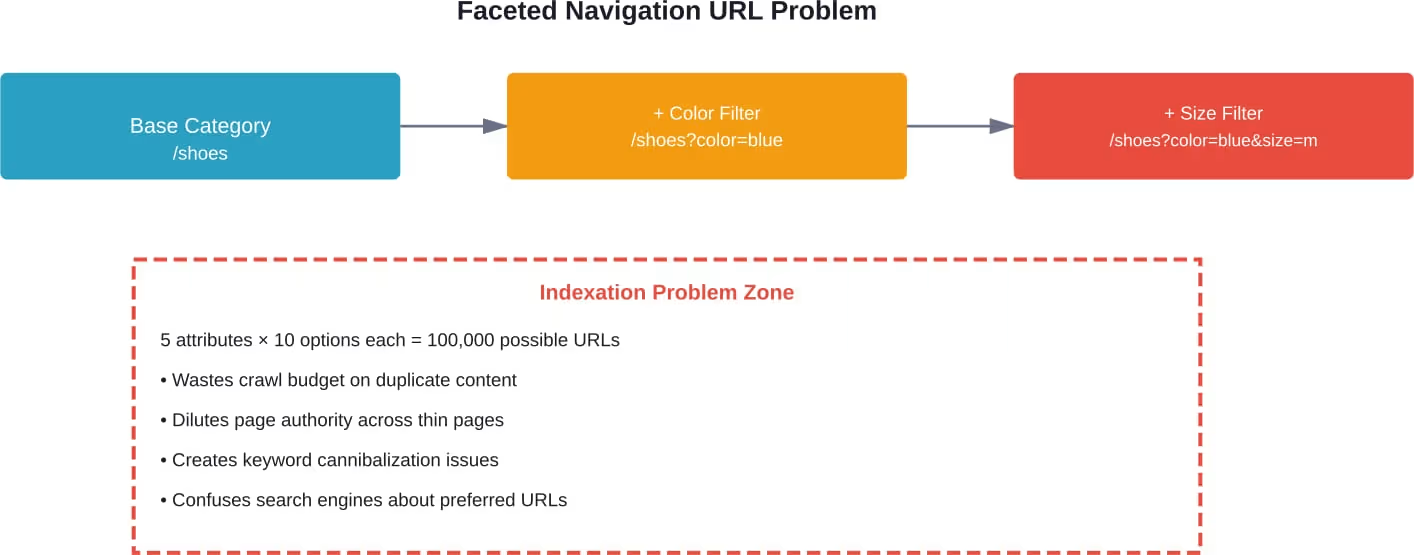
This is where most Magento stores lose control of their indexation. Layered navigation creates unique URLs for every filter combination. A store with five filterable attributes—color, size, price, material, brand—can generate millions of URLs.
If someone filters by “Blue,” then adds “Size M,” then adds “Price $50-$100,” Magento creates a new URL for each step. Search engines try to crawl all of them, wasting crawl budget on thin, duplicate content.
The solution requires multiple layers of defense. First, set proper canonical tags that point filtered pages back to the base category URL. Second, use the robots meta tag to noindex filter combinations while keeping the main category indexed.
Magento’s native tools handle basic cases, but complex stores need extensions or custom development to manage sophisticated filtering scenarios.
XML Sitemap Strategy
Magento generates XML sitemaps automatically, but default settings rarely produce optimal results. The native sitemap includes everything—every product, every category, every CMS page—without priority differentiation.
Strategic sitemap configuration means telling search engines which pages matter most. High-value category pages should appear with higher priority values. Product pages for best-sellers deserve prominence over low-stock items.
Large catalogs need sitemap splitting. A store with 50,000 products shouldn’t dump them all in one XML file. Break sitemaps into logical segments: categories, products, CMS pages. Some implementations create separate sitemaps for different product types or collections.
Update frequency matters too. Dynamic categories with frequent inventory changes should be crawled more often than static informational pages. Configure generation schedules that match content update patterns.
Page Speed and Performance
Magento’s reputation for slow page speeds isn’t unfair. The platform is resource-intensive by design, handling complex catalogs and extensive customization. But slow isn’t inevitable with proper optimization.
Since Google uses mobile-first indexing and smartphones account for around 78% of global retail traffic, mobile speed performance takes priority. Core Web Vitals—Largest Contentful Paint, First Input Delay, and Cumulative Layout Shift—directly impact rankings.
Server and Hosting Considerations
Magento demands more server resources than lighter platforms. Shared hosting rarely provides adequate performance. Dedicated or cloud infrastructure becomes necessary for stores with significant traffic or large catalogs.
Server configuration includes enabling full-page caching, configuring Varnish for HTTP acceleration, and implementing Redis for session and cache storage. These aren’t optional enhancements—they’re baseline requirements for acceptable speed.
Content Delivery Networks (CDNs) distribute static assets geographically, reducing latency for users far from the origin server. For stores with international customers, CDN implementation is essential.
Front-End Optimization
Image optimization delivers significant performance gains for most Magento stores. Product images often comprise a substantial portion of page weight. WebP format with appropriate compression and lazy loading can significantly reduce image payload without visible quality loss.
JavaScript bundling and minification reduce the number of HTTP requests. Magento’s built-in merging can help, but often custom optimization is needed to achieve strong performance scores.
Critical CSS techniques inline only the styles needed for above-the-fold content, deferring the rest. This improves perceived load time even when total page weight remains unchanged.
| Optimization Area | Impact Level | Implementation Difficulty | Typical Speed Gain |
|---|---|---|---|
| Full-page caching | High | Medium | Significant improvement |
| Image optimization | High | Low | 30-50% weight reduction |
| CDN implementation | Medium-High | Low | 30-60% faster globally |
| Database optimization | Medium | Medium-High | 15-30% faster queries |
| Code profiling/cleanup | Variable | High | 20-100% depending on issues |
Content Architecture and Internal Linking
Magento’s category structure determines how search engines understand site hierarchy and how authority flows through internal links. Poor architecture creates orphaned pages, weak crawl paths, and missed ranking opportunities.
Category Hierarchy Planning
Shallow category structures generally outperform deep ones. Keep important products within three clicks of the homepage when possible. Every additional level adds another crawl hop and dilutes link equity.
Category names should target commercially relevant keywords. Instead of generic “Men’s Clothing,” consider more specific categories like “Men’s Running Shoes” or “Men’s Winter Jackets” that match actual search behavior.
Avoid creating too many categories. A store with 500 categories and 1,000 products has an architecture problem. Each category needs enough products to provide value, and each product needs a clear primary category.
Internal Linking Strategy
Strategic internal linking guides crawlers to high-value pages and reinforces topical relevance. Beyond Magento’s automatic category-product links, manual linking from content pages creates powerful signals.
Product descriptions should link to related products and relevant categories using descriptive anchor text. Category descriptions should link to subcategories and featured products. Blog posts and guides should link to applicable product pages.
Link equity concentration matters. Homepage links carry more weight than deep-page links. Use that authority strategically by linking to categories and products that need ranking boosts.
Product Page Optimization
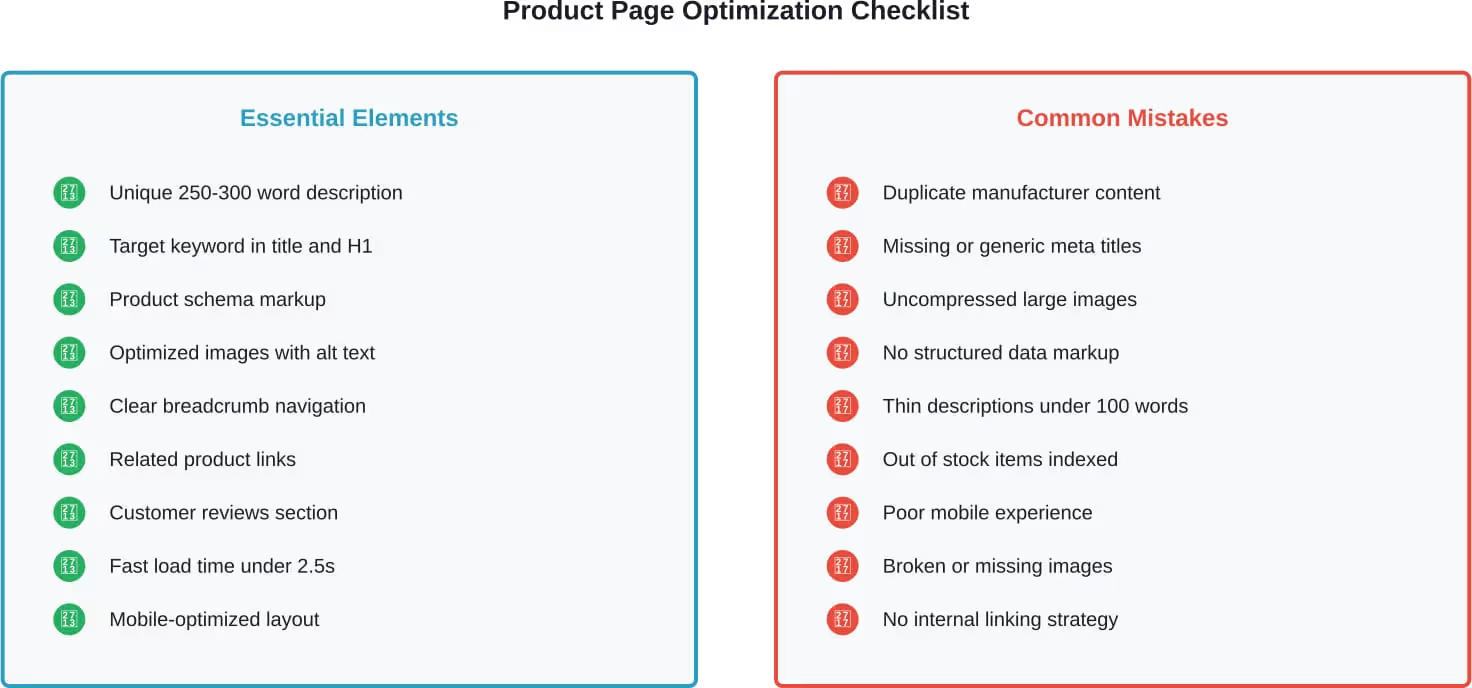
Product pages generate revenue, making them the highest-priority pages for optimization. Yet many Magento stores use thin, manufacturer-provided descriptions that don’t support search visibility.
Unique Product Descriptions
Manufacturer descriptions appear on hundreds of other sites selling the same products. Search engines have no reason to rank duplicated content. Original descriptions are non-negotiable for competitive product SEO.
Effective product descriptions incorporate target keywords naturally while providing genuine value. They answer questions shoppers actually have: What problem does this solve? Who is it for? How does it compare to alternatives?
Length matters for competitive keywords. A 50-word description rarely outranks a comprehensive 300-word description that covers features, benefits, specifications, and use cases.
Product Structured Data
Without structured data, products won’t show prices, availability, or ratings in search results. That’s a significant disadvantage against competitors who have implemented proper schema markup.
Magento supports structured data through native features and extensions. Product schema should include name, description, SKU, brand, price, currency, availability, and aggregate ratings when applicable.
Review schema adds star ratings to search snippets, dramatically improving click-through rates. Even stores with relatively low rankings can capture clicks through prominent review displays.
Common Magento SEO Mistakes
Certain problems appear repeatedly across Magento implementations. Recognizing these patterns helps avoid predictable failures.
Duplicate Content Issues
Beyond faceted navigation, duplicate content emerges from multiple sources in Magento. Products assigned to multiple categories can be accessed through different URLs. Sorting options and pagination create variations. Session IDs sometimes append to URLs.
Canonical tags should consolidate duplicate variations to a single preferred URL. Product pages should canonicalize to one primary category path. Sorted and filtered views should point back to the base category.
Some duplication requires robots.txt exclusions. Parameter-based URLs that serve no SEO value can be blocked from crawling entirely, preserving crawl budget for valuable pages.
Crawl Budget Waste
Large Magento catalogs can exhaust crawl budgets quickly if search engines spend time on low-value pages. One case showed nearly 80% of crawl budget consumed by filter pages and parameter variations rather than actual product and category pages.
Log file analysis reveals where search engine bots spend their time. If Googlebot is crawling thousands of filter combinations instead of new products, the site’s crawl budget allocation needs correction through canonical tags, robots directives, and parameter handling.
Indexation Control Problems
Allowing search engines to index everything creates noise. Out-of-stock products, administrative pages, customer account sections, and filter combinations all dilute the quality signals search engines see.
Strategic noindex implementation keeps low-value pages out of search results while maintaining necessary functionality. The goal isn’t maximum indexed pages—it’s maximum quality indexed pages.
Magento SEO Extensions Worth Considering
While Magento’s native capabilities are extensive, extensions can streamline complex configurations and add functionality that would otherwise require custom development.
SEO Suite Extensions
Comprehensive SEO extensions typically bundle multiple features: automated meta tag templates, rich snippet markup, canonical tag management, redirect handling, and sitemap enhancements.
These tools work best for teams without deep Magento development resources. They provide admin interfaces for configurations that would otherwise require code changes or database modifications.
However, extensions add code overhead. Each extension potentially impacts page speed and increases maintenance complexity. Evaluate whether the functionality gained justifies the performance cost.
Specialized Tools
Specific problems sometimes need targeted solutions. HTML sitemap generators improve internal linking. Redirect management extensions handle URL migrations cleanly. Image optimization tools automatically compress and convert formats.
The key is selectivity. Installing ten extensions to handle tasks that could be accomplished with three creates unnecessary bloat. Prioritize extensions that solve significant problems efficiently.
Mobile Optimization Priorities
Mobile-first indexing means Google predominantly uses the mobile version of content for ranking. Desktop performance still matters, but mobile performance matters more.
Responsive Design Verification
Magento themes should be responsive by default, but customizations sometimes break mobile layouts. Test all critical pages—categories, products, checkout—on actual mobile devices, not just browser responsive mode.
Common mobile issues include touch targets too close together, text too small to read, horizontal scrolling, and forms difficult to complete on small screens. These problems hurt both rankings and conversions.
Mobile Speed Optimization
Mobile networks have higher latency than broadband connections, making page weight optimization more critical. Images that load acceptably on desktop can cripple mobile performance.
Adaptive image serving delivers smaller images to mobile devices while maintaining full resolution for desktop. This requires server-side detection or responsive image techniques but produces substantial mobile speed improvements.
Content Strategy for Magento Stores
Product and category pages form the foundation, but content marketing amplifies visibility and captures informational search traffic that product pages can’t rank for.
Category Description Optimization
Many Magento stores leave category descriptions empty or fill them with 50 words of generic text. This represents missed opportunities for ranking and internal linking.
Substantial category descriptions—300 to 500 words—allow targeting of broader keywords while supporting subcategory and product links. They establish topical authority and provide contextual signals search engines use for relevance determination.
Place descriptions above product listings when possible. Below-the-fold content still has value, but above-the-fold positioning provides stronger signals and better user experience.
Blog Integration
Informational content attracts visitors earlier in the buying cycle. Guides, comparisons, how-to articles, and buying advice rank for high-volume keywords that product pages can’t target effectively.
Blog posts should link naturally to relevant categories and products. A guide about “Choosing Running Shoes” links to running shoe categories. A comparison article links to the specific products being compared.
This creates crawl paths from frequently updated content to product pages while building topical relevance across the domain.
Technical Monitoring and Maintenance
Magento SEO isn’t a one-time setup. Platform updates, catalog changes, and search algorithm shifts require ongoing monitoring and adjustment.
Regular Technical Audits
Quarterly technical audits catch problems before they significantly impact rankings. Check for new duplicate content issues, broken links, redirect chains, XML sitemap errors, and structured data validation.
Tools like Screaming Frog, Sitebulb, or enterprise platforms provide comprehensive crawls that identify technical problems. Regular audits establish baselines for comparison, making it easier to spot new issues.
Performance Monitoring
Page speed degrades over time as new features get added and code accumulates. Monthly speed tests on key templates—homepage, category, product—track performance trends.
Core Web Vitals tracking through Google Search Console shows real-world performance data from actual visitors. These metrics directly influence rankings, making them essential monitoring points.
| Monitoring Area | Frequency | Tools | Key Metrics |
|---|---|---|---|
| Technical crawl health | Quarterly | Screaming Frog, Sitebulb | Indexable pages, duplicates, broken links |
| Page speed | Monthly | PageSpeed Insights, WebPageTest | LCP, FID, CLS scores |
| Indexation status | Monthly | Google Search Console | Indexed pages, coverage issues |
| Rank tracking | Weekly | SEMrush, Ahrefs, custom | Target keyword positions |
| Structured data | Quarterly | Rich Results Test | Schema validation, errors |
International and Multi-Store SEO
Magento’s multi-store capabilities support international expansion, but configuration determines whether separate stores help or hurt SEO.
Hreflang Implementation
Stores targeting different countries or languages need hreflang tags to tell search engines which version to show in which locations. Without proper hreflang, search engines might display the wrong language version to users or treat translations as duplicate content.
Magento can generate hreflang tags, but configuration requires mapping store views to language and region codes correctly. Each page needs hreflang annotations pointing to all language variations, including a self-referential tag.
Domain Structure Decisions
International stores face domain structure choices: subdirectories (example.com/uk/), subdomains (uk.example.com), or separate country-code domains (example.co.uk). Each approach has SEO implications.
Subdirectories consolidate all authority to one domain but may send mixed signals about geographic targeting. Country-code domains provide clear geographic signals but fragment authority. Subdomains fall between these extremes.
No single answer fits all cases. The choice depends on brand recognition, market strategy, and resource availability for managing multiple domains.
When Magento SEO Becomes Impractical
Not every store should run on Magento. The platform’s complexity and resource requirements don’t make sense for all use cases.
Signs Migration Might Be Better
Small catalogs—under 500 products—rarely need Magento’s capabilities. The overhead of managing the platform outweighs the benefits. Lighter platforms deliver better performance with less effort.
Teams without dedicated development resources struggle with Magento maintenance. The platform assumes technical expertise for configuration, customization, and troubleshooting. Stores lacking that expertise face ongoing challenges.
Budget constraints create problems too. Proper Magento hosting, development, and maintenance require significant investment. Underfunded implementations produce slow, poorly optimized stores that underperform simpler alternatives.
Alternative Platforms
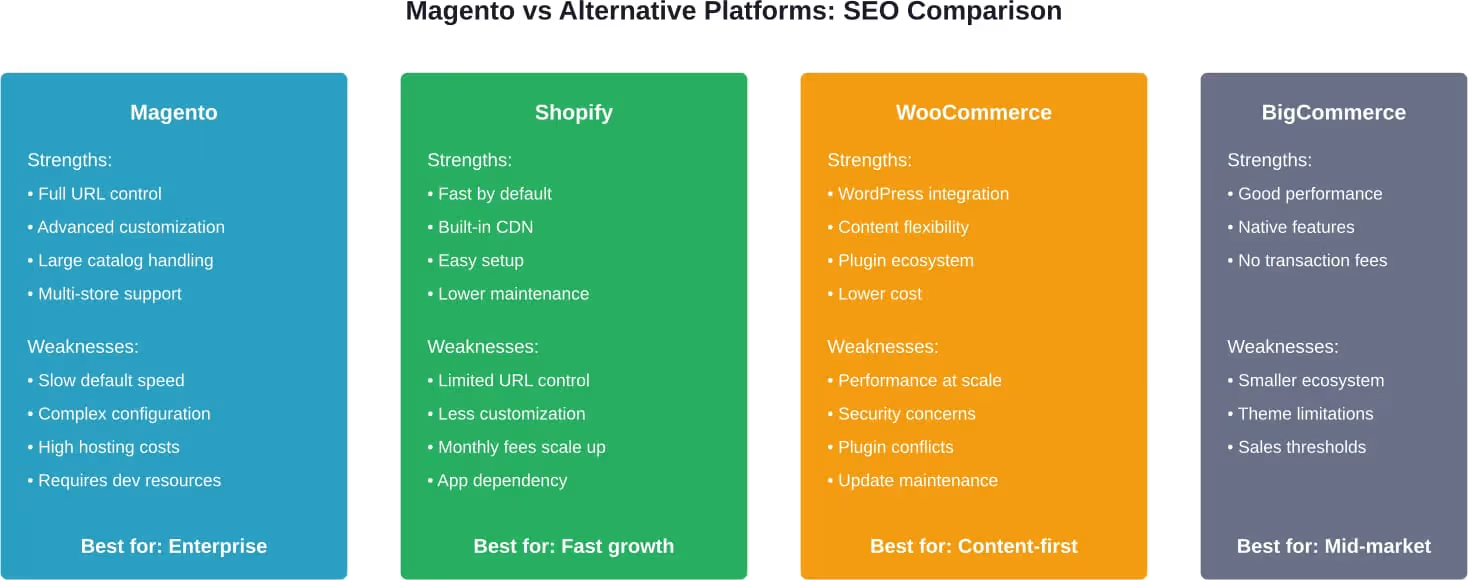
Shopify provides faster setup, better default performance, and lower technical barriers. For stores where platform flexibility isn’t critical, Shopify often delivers stronger SEO results with less effort.
WooCommerce suits stores already invested in WordPress, offering middle-ground flexibility without Magento’s complexity. BigCommerce provides enterprise features with SaaS simplicity.
As noted in authoritative Magento SEO guidance, platform choice should match business requirements, technical resources, and growth trajectory rather than following trends or competitor choices.
Getting Professional Help
Magento’s complexity often justifies hiring specialists rather than managing optimization internally. The question becomes when to bring in outside expertise and what to look for.
When to Hire a Magento SEO Agency
Teams lacking Magento-specific experience benefit from agencies that understand the platform’s peculiarities. Generic SEO knowledge doesn’t translate directly—Magento requires platform-specific configuration knowledge.
Significant migrations or redesigns represent high-risk moments where expert guidance prevents costly mistakes. URL structure changes, platform upgrades, or catalog reorganizations can destroy rankings if handled incorrectly.
Stores that have implemented basic SEO but plateau in rankings often need specialized audits to identify technical problems or missed opportunities that internal teams can’t see.
Evaluating Agency Expertise
Real Magento SEO expertise shows in specific technical knowledge. Ask about canonical tag strategies for faceted navigation, crawl budget management for large catalogs, and structured data implementation approaches.
Case studies should show measurable results—organic traffic growth, ranking improvements for competitive keywords, or conversion rate increases from SEO-driven traffic. Vague success stories without numbers indicate limited actual impact.
References from similar-sized stores in similar industries provide the most relevant validation. An agency that’s successfully optimized enterprise fashion retailers probably understands challenges facing a growing apparel brand.
Measuring Magento SEO Success
Effective measurement separates productive optimization from busy work. Track metrics that connect to business outcomes, not vanity numbers.
Key Performance Indicators
Organic traffic from non-branded keywords indicates whether SEO is expanding market reach. Branded traffic growth often comes from marketing efforts unrelated to search optimization.
Keyword rankings for target terms show whether optimization work produces visibility gains. Track rankings for commercial keywords—product names, category terms, buying intent phrases—not just informational keywords.
Conversion rate from organic traffic reveals whether SEO brings qualified visitors. Traffic growth without conversion improvement suggests keyword targeting or landing page problems.
Attribution Considerations
Last-click attribution undervalues SEO’s contribution. Customers research extensively before purchasing, often discovering brands through organic search but converting through direct traffic or other channels later.
Multi-touch attribution models provide more accurate pictures of SEO’s role in customer acquisition. First-click attribution shows how many customers discovered the brand through organic search, even if they converted elsewhere.
Conclusion
Magento remains a powerful ecommerce platform, but SEO success requires understanding its complexity and committing to proper configuration. The platform’s flexibility is both strength and liability—it enables sophisticated optimization but demands technical expertise to implement effectively.
Stores that invest in proper URL structure, control indexation strategically, optimize performance aggressively, and maintain technical health see strong results. Those that treat Magento as a plug-and-play solution without platform-specific optimization struggle against lighter, faster competitors.
The question isn’t whether Magento can rank well—it can. The question is whether a business has the resources, expertise, and commitment to optimize it properly. For stores that do, Magento provides capabilities that drive sustainable organic growth. For those that don’t, simpler alternatives often deliver better results with less effort.
Start with the technical fundamentals covered in this guide. Address faceted navigation, implement proper canonical tags, optimize page speed, and build comprehensive category content. Monitor results, adjust based on data, and don’t hesitate to get expert help when internal resources hit their limits.
The ecommerce landscape continues evolving, but search engine optimization principles remain consistent: technical excellence, quality content, and user-focused design. Apply those principles within Magento’s framework, and the platform becomes a competitive advantage rather than an optimization obstacle.