


Quick Summary: Local SEO statistics for 2026 reveal that 46% of Google searches have local intent, while AI search visibility is now 30x harder to achieve than traditional rankings. Businesses with complete Google Business Profiles and 4+ star ratings dominate local results, yet 58% of businesses still don’t optimize for local search. Reviews, mobile optimization, and proximity remain the top three ranking factors driving local visibility.
Local search has transformed from a nice-to-have into a business survival requirement. And the numbers prove it.
But here’s the thing: while most businesses chase traditional SEO rankings, the game has quietly shifted. AI search engines now recommend only 1% to 11% of local businesses, creating a massive visibility gap that most companies don’t even know exists.
The data from 2026 tells a compelling story about where local search is headed and which businesses will dominate. Let’s break down the statistics that actually matter.
The State of Local Search Behavior in 2026
Local search isn’t just growing. It’s dominating how people discover and evaluate businesses.
According to BrightLocal research citing Google data from 2018, 46% of all Google searches include local intent. That’s nearly half of every query typed into the search bar. For small to medium-sized businesses, this represents the single largest opportunity for qualified traffic.
But the search behavior itself has evolved. People aren’t just looking for information anymore. They’re forming complete opinions before visiting a website or walking through a door.
The typical local search journey now includes scanning a Google Business Profile, comparing reviews, browsing photos, and reading whatever context the search engine provides. Many customers make decisions in these moments without ever clicking through to a website.
And voice search? As of the beginning of 2026, voice queries account for over 50% of all local searches. People talk differently than they type, which means businesses need to optimize for conversational, question-based queries instead of just short keywords.
Here’s what makes this shift critical: organic search remains the dominant path to discovery. According to data from the UNC School of Medicine’s web analytics for 2025, nearly 76% of all sessions originated from Google search, while combined social media referrals accounted for roughly 1% of sessions.
Social media isn’t driving local discovery. Search engines are. And businesses that ignore this reality are losing customers every single day.
Get Local SEO Help From Lengreo
Local SEO statistics are useful for context, but the practical question is how to act on them. Lengreo provides Local SEO as part of its SEO offering, along with link building, keyword research, website audits, and content planning. For businesses that need local search work tied to wider growth goals, the company also offers strategy consulting and lead generation services.
Looking for Local SEO support?
Lengreo can help with:
- Local SEO
- link building
- keyword research
- website audits and optimizations
- content strategy
👉 Contact Lengreo to discuss local SEO priorities and next steps for 2026.
The Google Business Profile Dominance
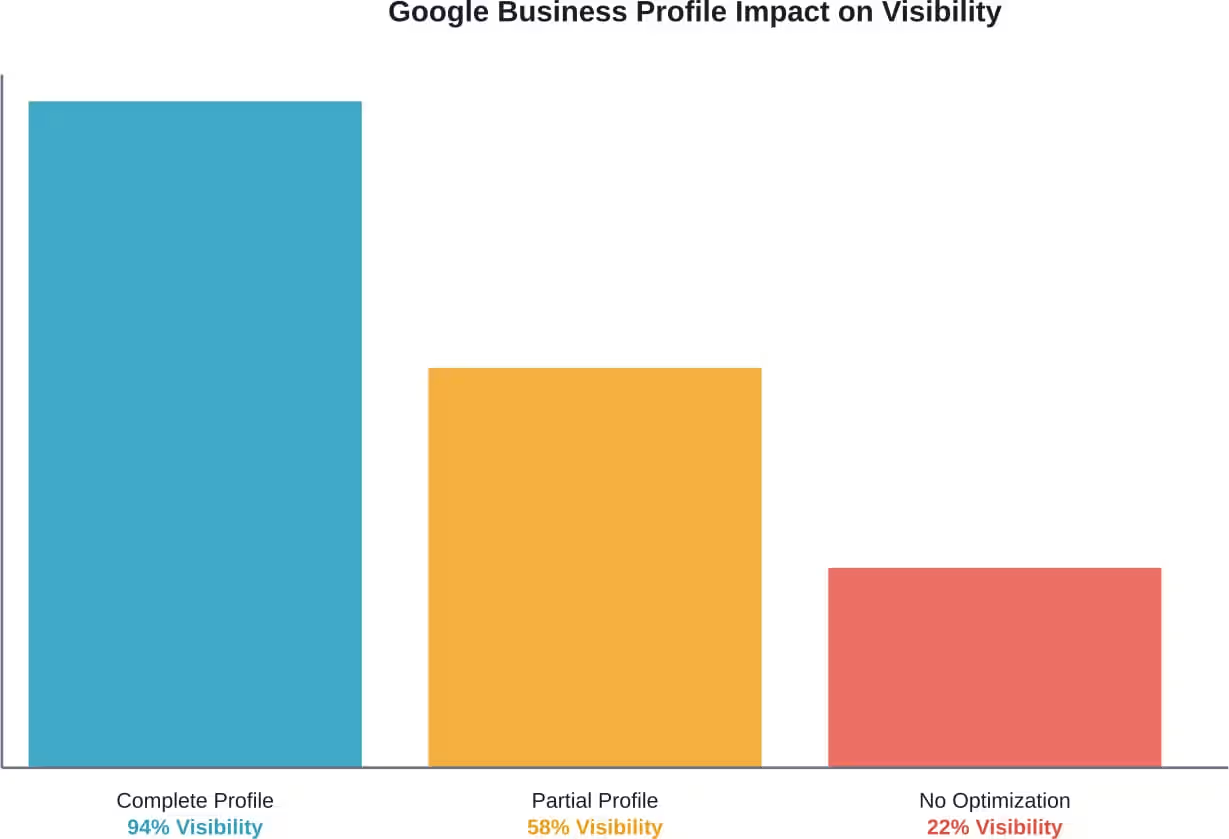
Google Business Profile optimization has become non-negotiable for local visibility. The statistics prove this beyond any doubt.
Yet despite the overwhelming importance, 58% of businesses don’t optimize for local search, and only 30% have a local SEO plan in place, according to ReviewTrackers data cited by Semrush. This creates a massive opportunity for businesses willing to invest in proper optimization.
Meanwhile, 94% of high-performing brands have a set local marketing strategy according to the Brand Beacon Report (2024). The gap between winners and losers isn’t about luck. It’s about strategy.
Interestingly, 56% of business owners manage local SEO themselves rather than hiring specialists. This DIY approach often leads to incomplete optimization, leaving visibility on the table.
Complete profiles perform dramatically better than partial ones. Businesses that fill out every section, add photos regularly, post updates, and respond to reviews see significantly higher rankings. Google’s algorithm rewards completeness because it correlates with better user experiences.
The ranking factors themselves haven’t changed dramatically, but their weights have shifted. Proximity, relevance, and prominence remain the three pillars. But prominence, which includes review quantity, ratings, and engagement, has grown more influential as AI systems try to predict which businesses will satisfy searchers.
The AI Search Visibility Challenge
Here’s where things get uncomfortable for most businesses.
According to Search Engine Land data from January 28, 2026, AI local visibility is up to 30x harder than ranking in Google. That’s not a typo. Thirty times harder.
The data shows that AI assistants recommend only 1% to 11% of locations, creating a massive gap between traditional Google rankings and AI visibility. Across industries, fewer than half of the brands that lead in Google local visibility also appear among the most visible brands in AI results.
In retail specifically, only 45% of the top 20 brands by traditional local search visibility overlapped with the top 20 brands most frequently recommended by AI, according to SOCi’s 2026 local visibility index.
What’s causing this dramatic difference? AI systems evaluate businesses through different criteria than traditional search algorithms. They prioritize structured data, consistent information across sources, and signals that indicate trustworthiness and authority.
Meanwhile, Google AI Overviews have reached 2 billion monthly users according to Semrush’s 26 AI SEO Statistics for 2026. Google AI Mode has 100 million users in the US and India combined and is available in more than 200 countries and territories.
The growth trajectory is stunning. According to Semrush’s 2025 data, AI search traffic increased 527% year over year. This isn’t a distant future concern. It’s happening right now.
And here’s the critical part: Google’s organic search market share remains close to 90% according to Search Engine Land’s January 2026 analysis. Google isn’t being replaced. It’s evolving. Businesses need to win in both traditional search and AI-powered results.
Reviews: The Make-or-Break Factor
If there’s one local SEO statistic that should change business behavior immediately, it’s this: consumer expectations for reviews have reached new heights.
According to BrightLocal’s Local Consumer Review Survey 2026, published February 11, 2026, star ratings and recency matter more than ever. There’s been a sharp increase in customers only using businesses with 4.5+ stars.
The way people read reviews is changing fast too. Consumers are looking beyond text reviews, with AI tools like ChatGPT surging into third place as a method for evaluating businesses.
As BrightLocal’s Co-founder and CEO Myles Anderson noted, “Reviews are stable, sticky, and more important than ever.” The data from their 2026 survey shows that the value of reviews hasn’t declined. It’s intensified.
Reviews impact rankings directly through Google’s prominence factor. But they also influence behavior at every stage of the customer journey. A prospect sees your star rating in the map pack. They scan recent reviews for red flags. They look for specific mentions of what they care about.
Poor reviews don’t just hurt rankings. They kill conversions even when businesses do rank well. According to Search Engine Land analysis in February 2026, a local HVAC company case study showed traffic drop 22% year over year, yet revenue increased 31% because of improved conversion quality.
Quality beats quantity. But reviews influence both.
| Star Rating | Consumer Behavior | Impact on Conversions |
|---|---|---|
| 4.5+ stars | High trust, minimal hesitation | Strong positive impact |
| 4.0-4.4 stars | Generally accepted, some comparison | Moderate positive impact |
| 3.5-3.9 stars | Skepticism, heavy review reading | Neutral to slight negative |
| Below 3.5 stars | Avoidance, seek alternatives | Strong negative impact |
Mobile and Voice Search Statistics
Mobile devices dominate local search behavior, and the statistics reflect this reality.
Mobile-first indexing isn’t a future consideration anymore. It’s the default. Google crawls and indexes the mobile version of content first, then considers the desktop version as supplementary.
For local businesses, this matters because local searches happen predominantly on mobile devices. People search for “near me” queries, directions, hours, and phone numbers while they’re already on the move or making immediate decisions.
The voice search projection that over 50% of local searches will be voice-based by 2026 has massive implications. Voice queries are longer, more conversational, and question-focused.
Instead of typing “plumber boston,” people ask “who’s the best plumber near me?” or “what plumbers are open right now?” Optimization needs to account for natural language patterns.
Technical factors matter more in the mobile context too. Click-to-call functionality has a high impact on rankings with easy implementation. Map integration is equally important. Mobile-responsive images and page speed influence both rankings and user experience.
A slow-loading mobile site doesn’t just frustrate users. It actively hurts visibility because Google’s algorithm factors page experience into rankings.
The Local SEO Strategy Gap
The most surprising statistic isn’t about technology or algorithms. It’s about business strategy.
Remember: 58% of businesses don’t optimize for local search, and only 30% have a local SEO plan. This means the majority of local businesses are competing with one hand tied behind their backs.
Meanwhile, 94% of high-performing brands have a set local marketing strategy. The correlation is obvious. Strategy separates winners from everyone else.
What does an effective local SEO strategy include? Based on the Search Engine Land 90-day sprint framework published February 12, 2026, it spans GBP fundamentals, reviews, and service pages.
The framework emphasizes sprints rather than endless optimization. Businesses get better results from focused 90-day pushes that deliver measurable improvements than from vague ongoing efforts.
But here’s what’s interesting: according to Search Engine Land analysis published March 24, 2026, SEO’s biggest threat isn’t algorithm changes or AI disruption. It’s internal organizational issues.
AI overreliance, fragmented data, and poor collaboration quietly undermine SEO performance. Teams that don’t communicate, departments that work in silos, and organizations that expect AI tools to replace strategy all struggle regardless of their tactical execution.
What Actually Drives Local Rankings
Let’s cut through the noise and focus on what Google’s algorithm actually weighs for local rankings.
According to Google’s official support documentation on improving local ranking, three factors dominate: relevance, distance, and prominence.
- Relevance measures how well a business matches what someone is searching for. This depends on complete and accurate business information. Categories matter. Business descriptions matter. Service listings and attributes all feed into relevance calculations.
- Distance considers how far each potential result is from the location term used in a search. If someone searches for “coffee shop downtown boston,” businesses in that specific area rank higher. Proximity can’t be changed, but it explains why the same business ranks differently for searches from different locations.
- Prominence refers to how well-known a business is. Google’s algorithm considers information across the web, including links, articles, directories, and reviews. Review count, star rating, and review recency all factor into prominence. So do citation consistency and the overall digital footprint.
Some factors carry more weight than others depending on context. For highly localized queries (“pizza delivery near me”), distance dominates. For broader service searches (“best personal injury lawyer”), prominence often matters more.
But here’s what businesses often miss: these factors work together. A business with perfect relevance but poor prominence won’t rank well. A prominent business that’s far from the searcher’s location will lose to closer competitors.
The optimization challenge is building strength across all three factors simultaneously.
Critical Metrics That Actually Matter in 2026
Many businesses track the wrong local SEO metrics and make bad decisions as a result.
According to Search Engine Land’s analysis published February 19, 2026, several traditional metrics should be retired because they don’t prove ROI or guide strategy effectively.
Average position, for example, doesn’t tell the whole story. A business can rank #1 for dozens of searches that never convert. Meanwhile, ranking #3 for high-intent queries can drive significantly more revenue.
Domain authority is another misleading metric. It’s a third-party score, not a Google ranking factor. Chasing higher DA numbers doesn’t necessarily improve visibility or conversions.
So what should businesses track instead?
- Revenue from organic local traffic is the ultimate metric. Everything else supports this. Tools can attribute sales, calls, and form submissions back to specific search queries and landing pages.
- Conversion rate by traffic source reveals which channels and queries drive quality traffic. A thousand visitors who bounce in three seconds don’t help. A hundred visitors who convert at 8% transform a business.
- Phone calls and direction requests from Google Business Profile are direct measures of local intent and action. These interactions represent high-value prospects.
- Review velocity and rating trends predict future performance. Consistent positive reviews signal healthy customer experience and feed the prominence algorithm.
- Visibility in AI search results is becoming critical. Tracking whether and how often AI assistants recommend a business reveals the new frontier of local discovery.
| Outdated Metric | Better Alternative | Why It Matters |
|---|---|---|
| Average Position | Revenue per ranking keyword | Measures actual business impact |
| Total Traffic | Conversion rate by source | Quality over quantity |
| Domain Authority | Share of local visibility | Competitive positioning |
| Backlink count | Relevant citation consistency | Local signals matter more |
| Keyword rankings | GBP actions (calls, directions) | Tracks actual user intent |
The Multi-Location Challenge
Businesses with multiple locations face exponentially more complex local SEO challenges.
Each location needs its own Google Business Profile with accurate, location-specific information. Cookie-cutter descriptions don’t work. Google’s algorithm detects duplicate content and penalizes it.
Service pages need to be genuinely unique for each location. This means different content, local area information, neighborhood context, and specific staff or features. The effort scales quickly: ten locations require ten unique sets of pages.
Review generation becomes more difficult too. Businesses need systems to request reviews at each location without violating Google’s policies against incentivized or fake reviews.
Citation management multiplies the workload. Every directory listing needs correct information for every location. One wrong phone number or outdated address in a major directory can confuse Google’s algorithm and hurt rankings across the board.
The Brand Beacon Report data showing that 94% of high-performing brands have local marketing strategies suggests that multi-location success requires centralized strategy with localized execution. Corporate teams set standards, provide tools, and monitor compliance. Local teams execute with autonomy to adapt to their specific markets.
Technical SEO Foundations for Local Visibility
Local SEO isn’t just about Google Business Profile optimization. Technical foundations matter enormously.
Schema markup for local businesses helps Google understand and display business information accurately. LocalBusiness schema should include name, address, phone number, business hours, and geo-coordinates. Service area businesses need additional markup to specify their coverage zones.
Site speed affects both rankings and user experience, especially on mobile devices. Slow sites frustrate users and signal poor quality to Google’s algorithm. Core Web Vitals, which measure loading performance, interactivity, and visual stability, directly influence rankings.
Mobile responsiveness isn’t optional. Google’s mobile-first indexing means the mobile version of a site is the primary version for ranking purposes. Businesses with poor mobile experiences simply don’t rank well anymore.
Internal linking structure helps Google understand site hierarchy and content relationships. Service pages should link to location pages. Location pages should link to relevant content. The architecture should be logical and crawlable.
XML sitemaps for location pages ensure Google discovers and indexes every important page. Robots.txt files should allow access to all public pages while blocking admin areas or duplicate content.
These technical factors work quietly in the background, but they’re non-negotiable for competitive local rankings.
Content Strategy for Local Search
Content remains one of the most controllable factors in local SEO, yet many businesses get it wrong.
Location pages need genuine substance. Not just addresses and phone numbers. Each page should explain what makes that location unique, describe the service area, feature local team members, include neighborhood-specific information, and incorporate natural mentions of the city and surrounding areas.
Service pages should address local context. A roofing company in Florida needs different content than one in Colorado because the services, materials, and common problems differ by climate and local building codes.
Blog content that addresses local questions builds topical authority. “Best neighborhoods for families in Austin” or “How to prepare your Chicago home for winter” target location-specific searches while demonstrating expertise.
Customer stories and case studies provide social proof while naturally incorporating location information. Featuring completed projects in specific cities builds relevance for those geographic areas.
FAQ content that answers common local questions captures voice search queries and featured snippet opportunities. These often start with “who,” “what,” “when,” “where,” and “how” — exactly the patterns voice searchers use.
The key is making content genuinely useful rather than keyword-stuffed. Google’s algorithm has become sophisticated enough to recognize thin content designed only for rankings.
The Competitive Reality in 2026
Local search competition has intensified, and the data reveals why.
Most businesses still don’t optimize properly, which creates opportunity. But among businesses that do compete seriously, the bar has risen substantially.
Complete Google Business Profiles are table stakes, not differentiators. Regular posts, fresh photos, quick review responses — these are minimum requirements to compete, not secret advantages.
The businesses winning in local search distinguish themselves through consistency and depth. They don’t just set up profiles. They maintain them. They don’t just collect reviews. They systematically generate fresh reviews month after month.
AI visibility adds a new competitive dimension that most businesses haven’t even begun to address. With only 45% overlap between traditional search leaders and AI recommendation leaders in retail, early movers have a significant advantage.
The technical sophistication required has increased too. Schema markup, Core Web Vitals optimization, and proper mobile implementation separate serious competitors from businesses just going through the motions.
According to Search Engine Land’s January 2026 analysis, Google’s organic search market share remains close to 90%. Traditional search still dominates. But the trajectory toward AI-powered discovery is clear, and businesses that wait to adapt will find themselves playing catch-up in an increasingly difficult environment.
What Businesses Should Do Right Now
The statistics reveal clear priorities for businesses serious about local visibility.
First, audit the Google Business Profile. Is every section complete? Are photos current? Do posts go out regularly? Are reviews being responded to within 24 hours? Fix gaps immediately.
Second, implement a systematic review generation process. Don’t wait for reviews to happen organically. Build review requests into customer service workflows, follow-up emails, and point-of-sale interactions. Make leaving a review as easy as possible.
Third, ensure technical foundations are solid. Run a Core Web Vitals test. Verify schema markup is implemented correctly. Check mobile responsiveness on actual devices. These technical factors directly influence rankings.
Fourth, develop location-specific content that actually helps local searchers. Generic content doesn’t build relevance. Detailed, location-focused pages and posts do.
Fifth, start monitoring AI search visibility. Use tools that track whether and how often businesses appear in AI-generated recommendations. The gap between traditional search and AI visibility won’t close by accident.
Sixth, establish a formal local SEO strategy with clear metrics, timelines, and accountability. The 94% of high-performing brands with strategies didn’t succeed by accident. They succeeded through deliberate planning and execution.
The businesses that treat local SEO as a one-time project will lose to competitors who treat it as an ongoing competitive advantage.
The Bottom Line on Local SEO Statistics
The numbers don’t lie. Local search dominates how people discover businesses, yet most businesses don’t optimize properly.
46% of searches have local intent. AI visibility is 30x harder than traditional rankings. 94% of top performers have strategies while only 30% of average businesses do. Reviews matter more than ever, with consumers demanding 4.5+ stars.
The businesses winning in local search aren’t lucky. They’re strategic. They optimize Google Business Profiles completely. They generate reviews systematically. They build technical foundations properly. They create genuinely useful local content. And they track metrics that actually matter.
The gap between winners and everyone else will only widen as AI search continues growing and consumer expectations keep rising. Businesses that wait to implement proper local SEO won’t just miss opportunities. They’ll become invisible while competitors capture their potential customers.
The data is clear. The question is whether businesses will act on it or continue hoping that visibility happens by accident.
Start with the fundamentals. Build a complete Google Business Profile. Implement systematic review generation. Fix technical issues. Create location-specific content. Monitor both traditional search and AI visibility. Measure revenue, not vanity metrics.
Local search isn’t getting easier. But for businesses willing to execute properly, the opportunity has never been bigger.