


SEO tracking sounds simple on paper. Check rankings, watch traffic, report growth. In reality, it’s easy to overtrack, misread signals, or focus on numbers that look good but say very little about real progress.
Good SEO tracking isn’t about monitoring everything. It’s about knowing what to watch, when to watch it, and how to connect those signals to actual outcomes: leads, sales, visibility, or authority. Once that clicks, tracking stops feeling like busywork and starts guiding decisions instead of reacting to noise.
This article walks through how to track SEO in a way that stays grounded, useful, and tied to what actually moves the needle.
Why Most SEO Tracking Feels Overwhelming
SEO tools make it easy to measure everything. That’s both a gift and a trap.
Between rankings, impressions, clicks, sessions, backlinks, page speed, crawl stats, engagement metrics, and now AI visibility, it’s easy to confuse activity with progress. Many teams track far more than they can realistically interpret.
When that happens, two things usually follow:
First, reports turn into data dumps. Numbers are listed, charts are stacked, but insight gets lost.
Second, people start reacting emotionally to small changes – a ranking drop here, a traffic dip there, without understanding whether it actually matters.
Good SEO tracking isn’t about reducing data. It’s about reducing confusion.
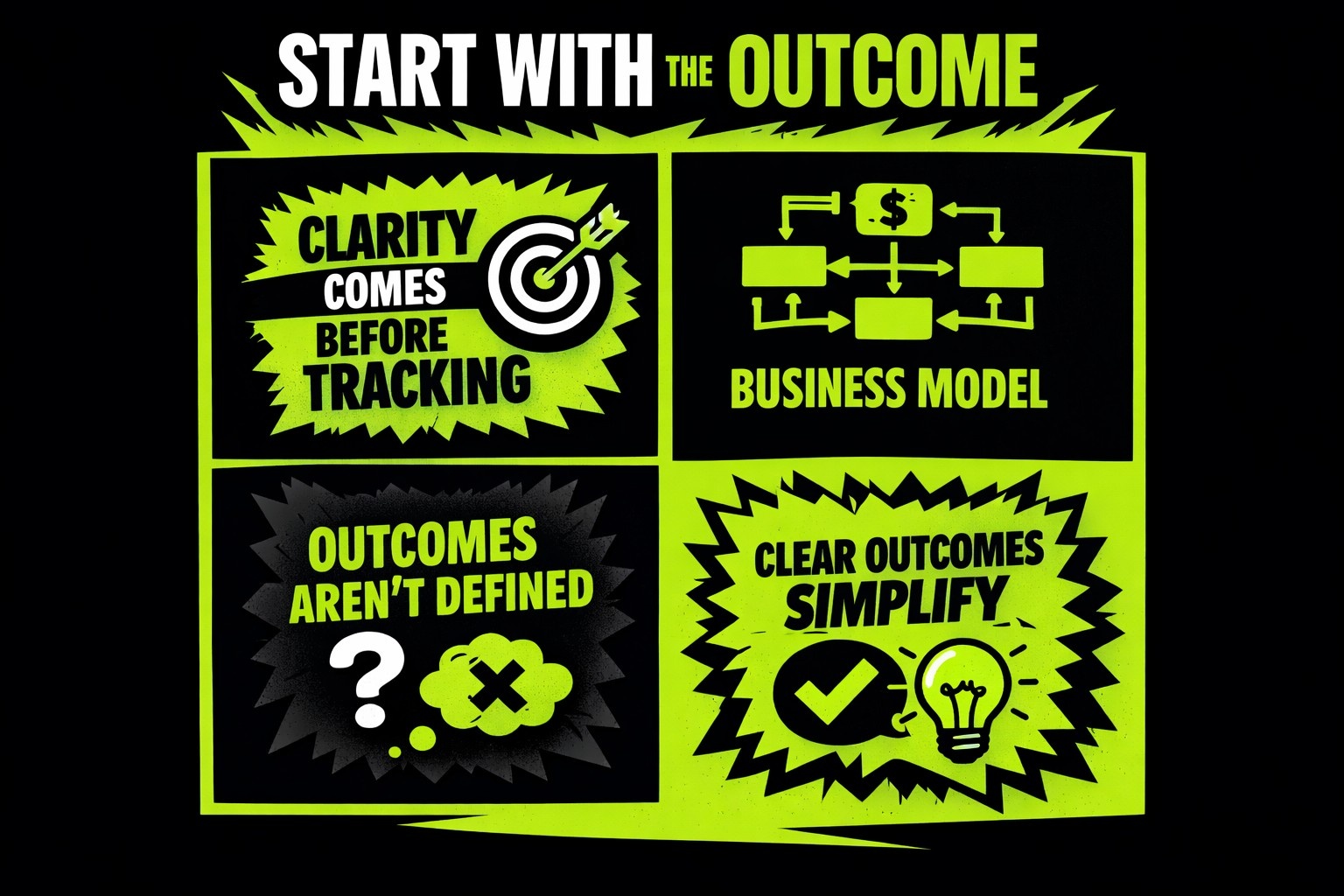
Start With the Outcome, Not the Metrics
Why Clarity Comes Before Tracking
Before choosing a single KPI, you need clarity on one thing: what is SEO supposed to achieve here?
It sounds obvious, yet this step is often skipped. Teams jump straight into tools, dashboards, and reports without agreeing on what success actually looks like. When that happens, tracking becomes mechanical rather than meaningful.
SEO doesn’t exist in isolation. It supports a business goal, and that goal should guide everything you measure.
SEO Goals Depend on the Business Model
There is no universal set of “correct” SEO metrics. What matters depends entirely on how the business works.
- For a SaaS product, SEO often supports demo requests, free trials, or product sign-ups.
- For ecommerce, the focus is usually revenue generated from organic sessions.
- For content-heavy sites, visibility, repeat visits, and brand searches tend to matter most.
- For local businesses, success may come down to phone calls, form submissions, or requests for directions.
Tracking all of these at once rarely helps. Tracking the ones that align with the business does.
What Happens When Outcomes Aren’t Defined
When outcomes aren’t clear, tracking turns generic. You end up measuring whatever the tool shows by default rather than what the business actually needs to grow.
Reports look busy, but they don’t answer real questions. Decisions become reactive instead of intentional.
How Clear Outcomes Simplify Everything Else
Once the outcome is clear, metrics naturally fall into place.
You stop asking, “What should we track?” and start asking, “What tells us whether we’re moving closer to the goal?” That shift alone removes a lot of noise and makes SEO tracking far more useful.
Turning SEO Outcomes Into Measurable Growth With Lengreo
Once outcomes are clearly defined, the next challenge is execution. This is where many SEO strategies lose focus. Metrics get tracked, reports get shared, but the connection to real business impact slowly fades.
At Lengreo, we treat SEO tracking as a continuation of strategy, not a separate reporting exercise. Everything we measure is tied back to the original goal, whether that’s qualified leads, demand generation, or long-term visibility in competitive niches. We don’t chase surface-level growth or vanity numbers. We focus on signals that show whether SEO is actually supporting how the business grows.
Our approach is deliberately practical. We align tracking with how companies sell, generate pipeline, and build trust over time. That means connecting organic visibility to conversions, understanding how search contributes across the funnel, and accounting for modern search behavior, including AI-driven results and zero-click visibility.
Because we work as an extension of our clients’ teams, transparency matters. We keep tracking frameworks clear, reporting focused, and insights actionable. The goal isn’t to overwhelm stakeholders with data, but to give them confidence in what’s working, clarity on what needs adjustment, and a reliable way to see how SEO contributes to measurable growth.
Organic Traffic: Useful, but Only With Context
Organic traffic is often treated as the headline metric for SEO success. It’s important, but it’s also easy to misread.
Traffic growth alone doesn’t tell you whether SEO is working well. It tells you whether visibility is increasing. That’s not the same thing as value.
To make organic traffic meaningful, you need to look at where it’s coming from and what happens next.
Break it down by:
- Landing pages, not just total sessions
- Brand versus non-brand searches
- Informational versus commercial intent
- New visitors versus returning ones
A spike in traffic to low-intent blog posts might look great on a graph while doing nothing for the business. Meanwhile, a smaller increase to product or service pages might matter far more.
Traffic should always be read alongside behavior and outcomes. On its own, it’s just movement.

Rankings: Track Direction, Not Drama
Keyword rankings are one of the fastest ways to lose perspective.
Positions change constantly. Algorithms update. Competitors move. Personalization plays a role. Treating every ranking shift as a signal leads to overreaction.
Instead of obsessing over individual keywords, focus on patterns:
- Are important pages gaining or losing visibility overall?
- Are more keywords entering the top 10 over time?
- Are ranking improvements aligning with traffic and engagement changes?
Rank tracking works best when it’s grouped by topic or page, not isolated to single terms. The goal isn’t to win one keyword – it’s to own a space.
Used this way, rankings become a health indicator, not a stress trigger.
Click-Through Rate as a Reality Check
Click-through rate often gets overlooked, but it quietly answers an important question: does our result look relevant to searchers?
If a page ranks well but attracts few clicks, the problem is rarely the content itself. More often, it’s the promise being made in the search results. A title that doesn’t match intent, a description that feels vague or generic, or a page ranking for queries it wasn’t designed to answer can all suppress clicks, even when rankings look solid.
CTR isn’t a success metric on its own. It’s a diagnostic one. It shows where expectations and reality don’t line up, which is often where the fastest and simplest improvements are hiding.
Conversions: Where SEO Proves Its Value
At some point, SEO needs to justify itself. Conversions are where that happens.
What counts as a conversion depends on the site. It might be a purchase, a form submission, a phone call, or a specific interaction that signals real intent. What matters most is defining those actions clearly and tracking them consistently over time.
Once conversions are in place, SEO tracking becomes far more grounded. Traffic without conversions raises questions about intent or targeting, while stable traffic paired with rising conversions usually points to better alignment between content, search intent, and user needs. On the other hand, ranking gains that don’t translate into conversions often signal that attention is focused in the wrong place.
SEO doesn’t succeed by attracting everyone. It succeeds by attracting the right people and guiding them toward meaningful action.
Engagement Metrics That Actually Mean Something
Metrics like time on page, bounce rate, and scroll depth are often dismissed as vanity numbers. They shouldn’t be.
They don’t tell you whether SEO is successful, but they do tell you whether content is doing its job. When engagement is low on pages that are meant to educate, persuade, or guide users, it usually points to a deeper issue. That might be a weak introduction that fails to pull readers in, a structure that’s hard to follow, slow loading times that interrupt the experience, or content that simply misses the search intent it’s trying to serve.
High engagement doesn’t guarantee success on its own, but consistently low engagement is rarely harmless. It’s a signal that something isn’t working as intended and deserves a closer look.
These metrics are most useful when they help you ask better questions, not when they’re used to pass judgment or chase arbitrary benchmarks.
Backlinks: Measure Influence, Not Volume
Backlinks still matter, but simply counting them rarely leads to better decisions. A growing total can look impressive while adding very little real value.
Where Links Come From Matters More Than How Many You Have
The source of a backlink says far more than the number itself. Links from relevant, trusted sites carry more weight than dozens of low-quality mentions. Tracking should focus on the quality and relevance of referring domains, not just link volume.
Which Pages Those Links Support
Not all links are equally useful. Backlinks that point to key commercial pages or important authoritative content tend to have a much stronger impact than links scattered across less relevant URLs. Understanding where link equity flows helps explain why some pages perform better than others.
How You Compare to Competitors
Backlink tracking also works best in context. Looking at gaps between your backlink profile and your competitors’ profiles can reveal missed opportunities, especially when similar pages are ranking higher with stronger link support.
Spotting Sudden Changes That Need Attention
Sudden link losses often signal problems worth investigating. They may point to technical issues, removed content, or lost partnerships that affect visibility more than slow, natural fluctuations.
Backlinks aren’t trophies to collect. They provide context for authority and help explain visibility, but they don’t define success on their own.

Why Too Many Dashboards Hurt More Than Help
Dashboards are meant to simplify. Often, they do the opposite.
When every metric gets equal space, none of them stand out. Reports become visual noise instead of decision tools.
A good SEO dashboard answers three things clearly:
- What changed since the last period
- Why it likely changed
- What action might be needed
If a dashboard can’t support that conversation, it’s doing too much.
Automation saves time. Interpretation creates value.
Tracing SEO Over Time Instead of Chasing Weekly Changes
SEO works on a longer timeline than most reporting cycles allow.
Daily or weekly tracking often creates false urgency. Month-over-month and year-over-year views reveal what actually matters.
Short-term tracking is useful for spotting technical problems or sudden drops. Long-term tracking is what shows strategy paying off.
If your tracking cadence makes SEO feel unstable, it’s probably too granular.
SEO Tracking in an AI-Driven Search Landscape
Search is changing, and tracking needs to evolve with it.
Many searches now end without a click. AI overviews, featured snippets, and instant answers often satisfy intent immediately, which can reduce traffic even as overall visibility increases. That shift can make traditional SEO metrics feel misleading if they’re read in isolation.
This doesn’t mean SEO is less valuable. It means success looks different. Appearing in AI-generated answers, showing up consistently across SERP features, and seeing growth in branded searches all point to rising familiarity and trust. Even when users don’t click right away, repeated exposure helps establish authority and keeps your brand top of mind.
Being cited again and again builds recognition. Over time, that recognition turns into demand. In this environment, SEO tracking is as much about presence and visibility as it is about traffic.
Reporting SEO Without Putting People to Sleep
SEO reports fail when they try to impress instead of explain. Long tables, endless charts, and dense terminology may look thorough, but they often hide the point rather than reveal it.
Most stakeholders don’t want every metric you can track. They want clarity. They want to understand whether things are moving in the right direction and why.
Good SEO reporting does a few things consistently:
- Focuses on a small set of meaningful KPIs that reflect real progress
- Explains what changed since the last reporting period and why it likely changed
- Connects metrics to business outcomes, not just SEO activity
- Avoids unnecessary technical detail that distracts from the message
Charts should support the story, not replace it. A visual without context rarely helps on its own. If someone can’t understand a report without narration or a follow-up meeting, that’s usually a sign it needs editing.
Conclusion: Track What Helps You Decide
SEO tracking doesn’t need to be overwhelming. It becomes that way when metrics are collected without intention and reports are built without context.
When you start with clear outcomes, choose metrics that actually reflect progress, and review them on the right cadence, tracking stops feeling like a chore. It becomes a decision-making tool. You see what’s working, where alignment is off, and what deserves attention next.
The goal isn’t to watch every number move. It’s to understand direction, spot meaningful change, and avoid reacting to noise. SEO works best when tracking supports judgment instead of replacing it.
Track less. Interpret more. And always tie the data back to what the business actually needs to grow.