


Timing matters in content creation. Publishing an article about a trending topic at the right moment can generate thousands of views, while the same article published a week later might struggle to attract even a fraction of that traffic.
But here’s the challenge: how do professionals identify what people are searching for right now, before those keywords become saturated with competition?
The answer lies in understanding how to use Google’s own tools to spot emerging search patterns. This guide walks through the proven methods for discovering trending keywords that can drive immediate traffic.
Understanding What Makes a Keyword “Trending”
A trending keyword isn’t just popular. It’s experiencing a significant surge in search volume over a specific time period.
According to Google Trends, a breakout search term means it grew by more than 5000% in the requested time period. These explosive growth patterns signal opportunities for content creators who move quickly.
The key distinction? Static keywords maintain consistent search volume, while trending keywords show sharp upward trajectories. That spike indicates heightened interest, often triggered by news events, cultural moments, or seasonal factors.
Method 1: Using Google Trends for Real-Time Discovery
Google Trends remains the most powerful free tool for identifying trending keywords. The platform provides access to a largely unfiltered sample of actual search requests made to Google, anonymized and aggregated to show interest patterns.
Accessing the Trending Now Feature
The Trending Now page provides near real-time updates, often refreshing within minutes (with timestamps showing the exact last refresh), making it ideal for spotting emerging searches quickly.
From this page, several filtering options become available:
- Explore trending searches across 100+ countries and regions
- Filter by recency—past 4 hours, 24 hours, 48 hours, or 7 days
- View trend charts showing search volume trajectories
- Check trend status to see if queries are still active or have ended
The trend chart displays how a query’s volume has changed over the selected time frame. The default view shows the last 24 hours, but adjusting this window reveals different patterns.

Filtering by Category and Region
When searching for a keyword with multiple meanings, category filters provide crucial context. Searching for “jaguar” without specifying whether the animal or car manufacturer is intended produces mixed results.
Geographic filtering matters equally. Darker shades on the regional map indicate where a term has higher search probability. These visual cues reveal whether a trend is global or concentrated in specific markets.
Method 2: Leveraging Google Ads Keyword Planner
While Google Trends shows momentum, Keyword Planner reveals search volume and competition levels. The combination of both tools creates a complete picture.
Keyword Planner can be accessed without entering billing information by selecting ‘Expert Mode’ during setup and choosing ‘Create an account without a campaign’.
Discovering New Keyword Ideas
The tool generates keyword suggestions based on seed terms or website URLs. Entering broad terms yields better results than overly specific phrases.
For example, entering “wedding” produces more relevant suggestions than “wedding venues for small weddings.” The tool performs better with general concepts that it can expand upon.
| Feature | Google Trends | Keyword Planner |
|---|---|---|
| Real-time data | Updates every 10 minutes | Monthly updates |
| Search volume numbers | Relative interest (0-100 scale) | Monthly average estimates |
| Historical data | Provides historical search data | Limited historical view |
| Competition metrics | Not provided | Low/Medium/High ratings |
| Cost to use | Completely free | Free with account setup |
Filtering for Actionable Keywords
Keyword Planner allows filtering based on competition level, impression share, and bid estimates. Setting filters to show keywords where bids under a specific amount may reach the top of the page helps identify less competitive opportunities.
Google Keyword Planner search volume data is updated monthly, drawing from recent data (typically the last 7–10 days) while incorporating seasonality and current market fluctuations.
This proves especially valuable during volatile market conditions.
Advanced Techniques for Trend Validation
Spotting a trending keyword represents only the first step. Validating whether that trend has staying power determines whether creating content makes strategic sense.
Double-Checking Trend Sustainability
Some trends spike and disappear within hours. Others indicate the beginning of sustained interest.
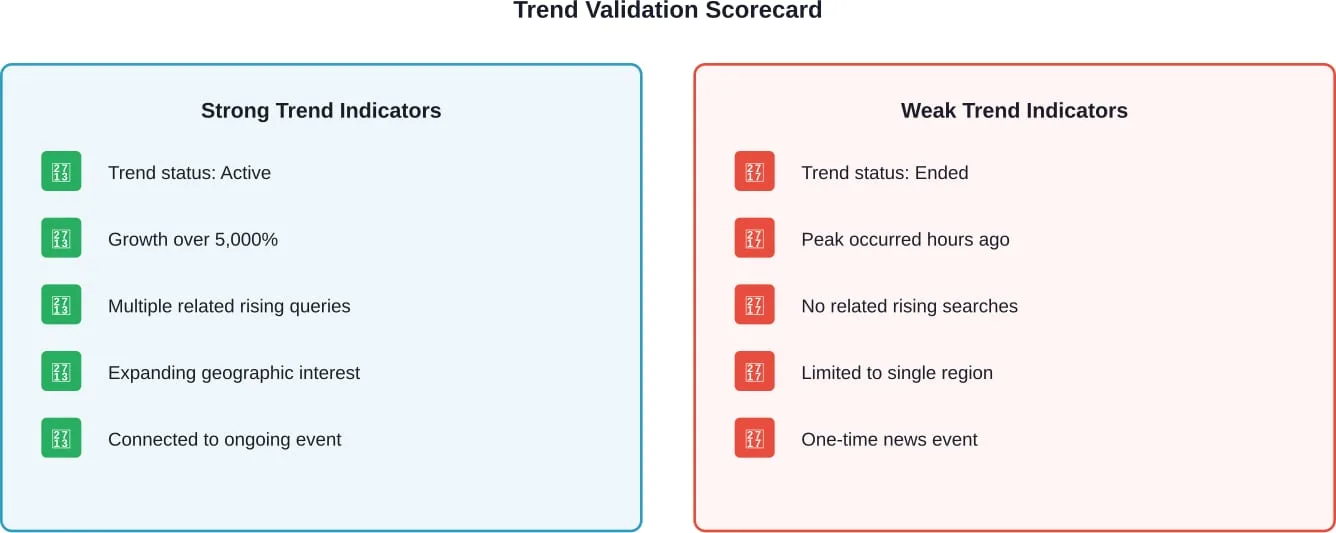
Look for these signals when validating trends:
- Trend status showing “Active” rather than “Ended”
- Multiple related queries also showing upward trajectories
- Regional interest expanding rather than contracting
- Connection to ongoing events rather than one-time occurrences
The trend breakdown feature shows how queries have been trending over different time windows. A keyword trending for 7 days offers more opportunity than one that peaked 4 hours ago.
Finding Related Trending Keywords
Once a trending keyword is identified, related queries often reveal additional opportunities. Google Trends displays both “Top” and “Rising” related queries.
Rising queries matter more for trend hunting. These show searches with the highest growth in frequency, often indicating breakout terms before they reach peak popularity.
Practical Workflow for Daily Keyword Hunting
Successful trend identification requires consistent monitoring rather than occasional checks. Here’s a practical daily workflow:
Start each morning by visiting the Google Trends Trending Now page. Set the time filter to “Past 24 hours” and geographic location to target markets. Scan for trends marked as Active with strong upward trajectories.
For promising keywords, switch to the full Google Trends search interface. Enter the keyword and examine the interest over time graph. Look for sustained growth rather than single spikes.
Export the related queries data. Both Top and Rising sections provide value, but Rising queries deserve priority attention.
Cross-reference promising keywords in Keyword Planner. Check competition levels and search volume estimates. Keywords showing “Low” competition with rising trends offer ideal opportunities.
But wait. Not every trending keyword suits every content strategy.
Turning Trends into Search Wins with Lengreo
When we work with trending keywords at Lengreo, we treat them like a moving target, not a one-time spike to chase. Our job is to spot what is actually gaining momentum, check whether it has a reason to stick around, and then translate that into a page that can rank and convert. In practice, that means pairing velocity with the less exciting (but necessary) work: technical checks, on-page fixes, and making sure the site can actually capture demand when it shows up.
We usually start with a quick marketing audit and a keyword research pass that looks at intent, regional demand, and what competitors are already publishing. If the trend looks real, we map it into a content plan and decide what format fits the window—a fast response page, a deeper guide, or a cluster that can keep bringing traffic after the initial wave fades. This is also where we connect the dots between SEO and the rest of the funnel, because a keyword can trend all day and still be useless if it attracts the wrong audience.
And because not every business can wait for organic results alone, we often run SEO in parallel with paid ads or outbound-style lead generation, depending on the goal. Some teams want pure traffic growth, others want qualified conversations, and the workflow changes based on that. We keep the process transparent and practical, with regular check-ins and reporting that shows what moved, what did not, and what we are changing next.
Matching Trends to Content Strategy
A keyword might be trending, but that doesn’t automatically make it relevant. Strategic alignment matters more than raw search volume.
Evaluate each trending keyword against these criteria:
- Audience relevance: Does the trend connect to topics the target audience cares about? A trending celebrity news story might generate searches, but if the content focuses on B2B software, the audience overlap is minimal.
- Content feasibility: Can quality content be produced quickly enough to capitalize on the trend? Some trends require immediate response, while others allow more time for thorough research and creation.
- Brand alignment: Does the topic fit within the established content themes and brand voice? Chasing every trend dilutes brand identity over time.
| Trend Type | Response Speed | Content Approach |
|---|---|---|
| Breaking news | Within 2-4 hours | Brief summary, key facts, quick analysis |
| Emerging topic | Within 24 hours | Comprehensive guide, how-to content |
| Seasonal trend | 1-2 weeks ahead | In-depth resource, complete coverage |
| Industry shift | Ongoing coverage | Series of articles, evolving analysis |
Common Mistakes to Avoid
Many content creators make predictable errors when hunting for trending keywords.
The first mistake? Confusing search volume with trend velocity. A keyword with 100,000 monthly searches isn’t necessarily trending if that volume remains constant. Meanwhile, a keyword growing from 100 searches to 5,000 searches represents a genuine trend worth attention.
Another pitfall involves ignoring trend endings. Google Trends marks when trends end, yet some creators continue publishing content on concluded trends. That previously ended trend may re-emerge, but timing new content to ended trends wastes resources.
Overlooking regional variations also limits success. A keyword might trend globally while remaining obscure in specific target markets, or vice versa. Always filter by relevant geographic regions.
Start Hunting for Trending Keywords Today
Finding trending keywords on Google doesn’t require expensive tools or complex technical skills. The combination of Google Trends for momentum detection and Keyword Planner for volume validation provides everything needed to identify opportunities before competitors.
The key? Consistent daily monitoring combined with strategic filtering and validation. Not every trending keyword deserves content creation, but the right trends at the right time can drive significant traffic surges.
Start by visiting Google Trends right now. Set filters for the target region and past 24 hours. Identify three trending keywords that align with the content strategy. Then validate them using the techniques covered in this guide.
Those few minutes of daily trend hunting can make the difference between content that struggles to find an audience and articles that capture traffic at exactly the right moment.