Quick Summary: An SEO competitive analysis involves researching competitors’ keyword strategies, backlink profiles, content performance, and technical implementations to identify opportunities for improving search rankings. This systematic approach reveals keyword gaps, content weaknesses, and strategic advantages competitors have secured, enabling data-driven optimization decisions that can dramatically improve organic visibility.
Search rankings don’t exist in a vacuum. Every position gained is often one lost by someone else. That’s why understanding what competitors are doing—and what’s working for them—is fundamental to any serious SEO strategy.
An SEO competitive analysis provides the intelligence needed to make strategic decisions rather than guessing. It reveals which battles are worth fighting, where opportunities lie hidden, and how resources should be allocated for maximum impact.
According to Moz, competitive analysis works as a powerful research strategy to identify strengths, weaknesses, and potential opportunities based on ranking factors known to be important. This guide breaks down the complete process into actionable steps.
What Is an SEO Competitive Analysis?
An SEO competitive analysis is the systematic process of evaluating competitors’ search engine optimization strategies to identify strengths, weaknesses, and opportunities. This research examines keyword targeting, content approaches, backlink profiles, technical implementations, and overall search visibility.
The goal isn’t simply to copy what competitors are doing. It’s to understand the competitive landscape well enough to make informed strategic decisions.
This type of analysis differs from general competitive research by focusing specifically on organic search performance factors. While broader business analysis might examine pricing, customer service, or product features, SEO competitive analysis zeroes in on elements that influence search rankings.
Why Competitive Analysis Matters for SEO
With two-thirds of all clicks going to the first five organic search results, understanding how competitors secured those positions becomes essential. The data reveals which strategies actually work in a specific industry rather than relying on generic best practices.
Competitive analysis also helps set realistic expectations. If every competitor has 500+ referring domains, ranking without a substantial link-building effort becomes unlikely. If competitors publish 10,000-word guides, shorter content probably won’t compete effectively.
Beyond setting benchmarks, this research uncovers genuine opportunities. Competitors often leave gaps—keywords they haven’t targeted, questions they haven’t answered, audiences they haven’t addressed. These gaps represent the easiest paths to gaining visibility.
Identifying Your True SEO Competitors
Business competitors and SEO competitors aren’t always the same. A company might dominate the market but have weak search visibility. Conversely, an informational site with no products might rank for every important keyword in an industry.
True SEO competitors are sites that consistently appear in search results for keywords that matter to a business. They’re competing for the same search visibility, even if they’re not competing for the same customers.
Methods for Finding SEO Competitors
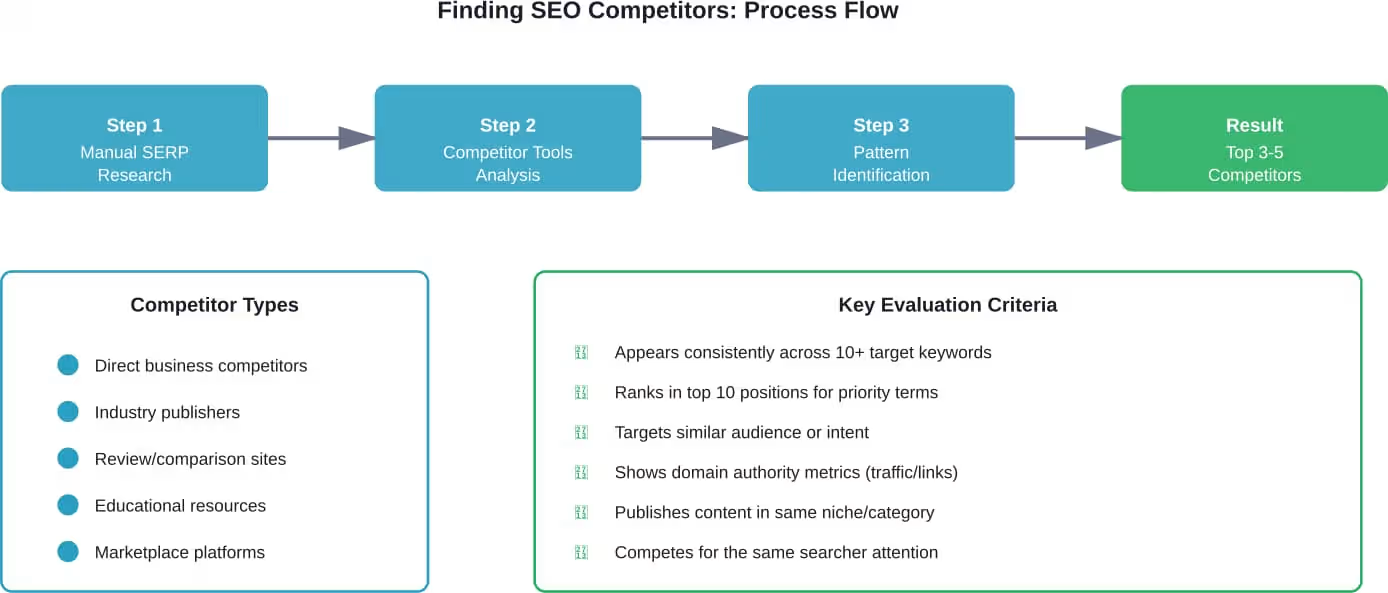
The most straightforward approach is manual SERP review. Search for 10-15 important keywords and note which domains appear repeatedly in the top 10 results. Sites that appear consistently across multiple queries are primary SEO competitors.
SEO tools accelerate this process. Platforms like Semrush, Moz, and Ahrefs offer competitor discovery features that analyze domain overlap. Enter a domain, and these tools identify other sites targeting similar keywords.
Look for patterns in the results. If the same five domains dominate rankings across core keywords, those are the competitors that matter most. Trying to analyze 20+ competitors dilutes focus—concentrate on the 3-5 most significant threats.
Don’t ignore unexpected competitors. Publishers, review sites, and informational resources often rank for commercial keywords. Even though they’re not direct business competitors, they’re capturing search visibility and need to be analyzed.
Conducting Competitor Keyword Analysis
Keywords form the foundation of search visibility. Understanding which keywords competitors target—and how successfully—reveals the strategic priorities shaping their SEO efforts.
This analysis should identify two critical elements: keywords competitors rank for that a site doesn’t, and keywords where competitors have achieved strong positions while a site lags behind.
Extracting Competitor Keywords
Most SEO platforms include keyword research tools that can extract the full keyword portfolio for any domain. Enter a competitor’s domain and the tool returns thousands of keywords they rank for, along with positions, search volumes, and estimated traffic.
But raw data isn’t immediately useful. The process requires filtering and prioritization. Focus on keywords that align with business goals and have meaningful search volume. A competitor might rank for 50,000 keywords, but only 500 might be relevant.
Look specifically for keyword gaps—terms where competitors rank on page one but a site doesn’t rank at all or appears beyond the top 20. These represent the clearest opportunities because competitors have already validated that rankings are achievable.
According to Semrush, examining competitors’ keyword strategies can reveal patterns in how they’ve structured their content and what search intent they’re addressing. These patterns often matter more than individual keywords.
Analyzing Keyword Difficulty and Opportunity
Not all keyword gaps are worth pursuing. Some keywords might be too competitive given current domain authority. Others might have low search volume or weak commercial intent.
Evaluate each opportunity based on several factors: search volume, ranking difficulty, traffic potential, and alignment with content capabilities. Keywords with 500-2,000 monthly searches often provide the best opportunity-to-effort ratio.
Long-tail keywords deserve special attention. According to Siteimprove, 60% of the pages ranking in the top 10 Google results are three or more years old, making established high-volume keywords difficult to crack. Long-tail variations often have less competition while still delivering qualified traffic.
| Keyword Type | Search Volume | Competition Level | Strategic Value | Time to Rank |
|---|---|---|---|---|
| Head Terms | 10,000+ | Very High | High visibility but broad intent | 12-24+ months |
| Body Keywords | 1,000-10,000 | High to Medium | Balanced traffic and specificity | 6-12 months |
| Long-tail | 100-1,000 | Low to Medium | Specific intent, higher conversion | 3-6 months |
| Question-based | 50-500 | Low | Featured snippet opportunities | 2-4 months |
Analyzing Competitor Content Strategies
Content quality and approach significantly influence rankings. Analyzing what competitors publish reveals standards needed to compete and gaps that could be exploited.
This goes beyond simply noting that competitors write blog posts. The analysis should examine content depth, structure, multimedia usage, update frequency, and how well content addresses search intent.
Content Depth and Format Analysis
Start by examining top-performing competitor content. What formats do they use? How long are their articles? How do they structure information?
According to research cited by Semrush, posts with at least one image receive twice as much traffic as text-only posts. They also get 30% more shares and 25% more backlinks. Visual content integration has become a significant ranking factor.
Content structure matters too. According to Semrush research, at least 44% of posts with a simple structure (i.e., that use H2 & H3) perform well in terms of traffic and engagement. Competitors who follow clear hierarchical structures often outperform those with poorly organized content.
Look at comprehensive guides versus shorter articles. If competitors consistently publish 3,000+ word guides for important keywords, matching or exceeding that depth becomes necessary to compete.
Identifying Content Gaps
Even successful competitors miss opportunities. Content gap analysis reveals topics competitors haven’t covered, questions they haven’t answered, or angles they haven’t explored.
Review competitor keyword lists for topics that have search volume but no corresponding content. These represent publishing opportunities where competition might be lighter.
Check which questions appear in “People Also Ask” boxes for target keywords. If competitors haven’t explicitly answered these questions, creating content that does can capture featured snippets and additional visibility.
Geographic, demographic, or use-case gaps also exist. Competitors might focus on enterprise customers while neglecting small businesses, or cover beginner topics while ignoring advanced applications.
Performing Competitor Backlink Analysis
Backlinks remain one of the strongest ranking signals. Understanding competitor backlink profiles reveals how they’ve built authority and where link-building opportunities might exist.
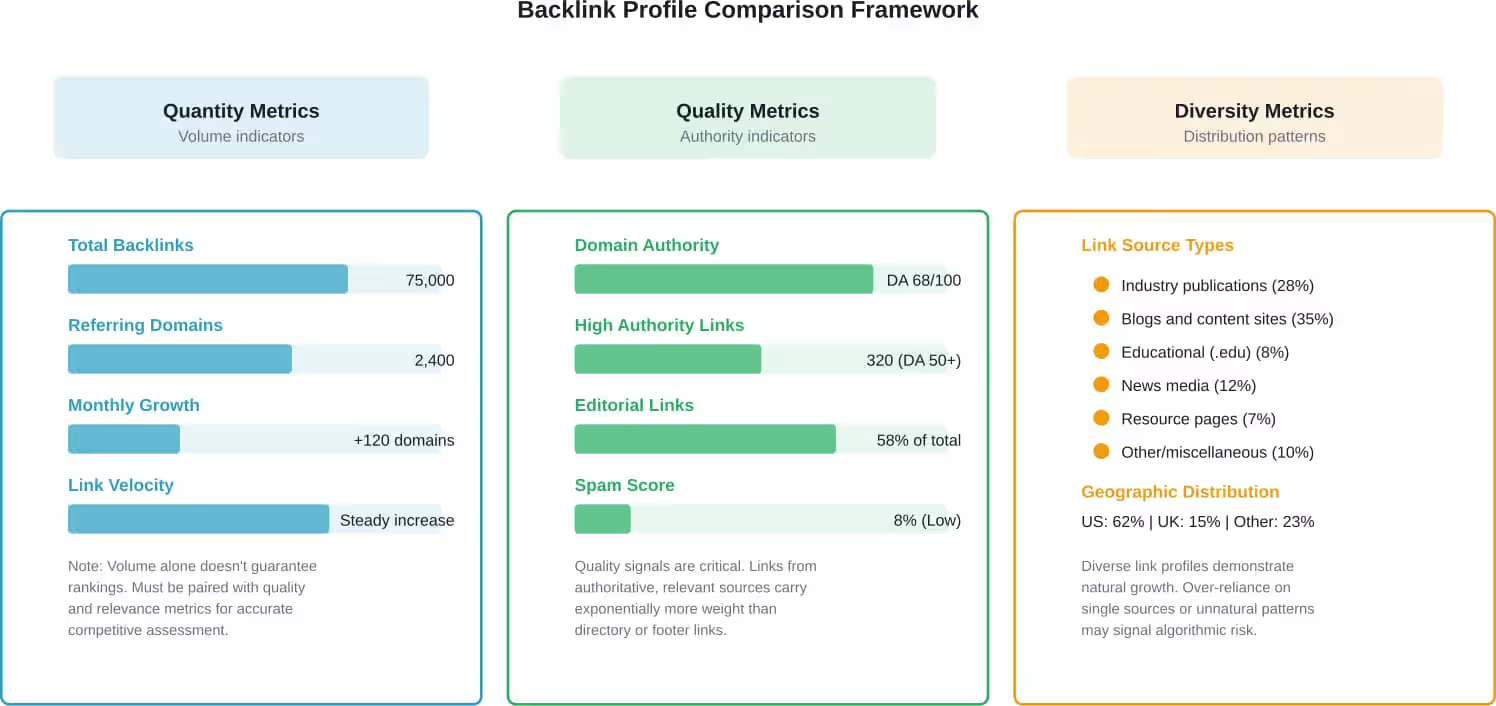
This analysis examines both quantity and quality. A competitor might have 10,000 backlinks, but if they’re all from low-authority directories, they matter less than 500 high-quality editorial links.
Evaluating Backlink Profiles
SEO tools provide detailed backlink data for any domain. Key metrics include total referring domains, total backlinks, domain authority or rating, and the diversity of link sources.
Look at the growth trajectory. Has a competitor’s backlink profile grown steadily over years, or did they experience sudden spikes? Steady growth usually indicates organic link acquisition, while spikes might reveal specific link-building campaigns or viral content.
Examine the types of sites linking to competitors. Are they getting links from industry publications, educational institutions, government sites, or primarily blogs and directories? Higher-authority link sources typically correlate with stronger rankings.
Moz emphasizes that competitive backlink analysis should focus on identifying link opportunities rather than just counting links. Where are competitors getting links that a site isn’t?
Finding Link Opportunities
The most valuable insight from backlink analysis is discovering link sources that favor competitors. If three competitors all have links from the same industry directory or resource page, that’s a target worth pursuing.
Look for patterns in how competitors earn links. Do they publish original research that attracts links? Create tools or calculators? Sponsor events? Guest post on specific publications?
Identify broken or outdated links pointing to competitor content. If a high-authority site links to a competitor’s outdated resource, suggesting updated content from another site can earn that link.
Technical SEO Competitive Analysis
Technical implementation affects how search engines crawl, index, and rank content. Analyzing competitor technical SEO reveals standards and potential advantages or weaknesses.
This component examines site architecture, page speed, mobile optimization, structured data implementation, and crawlability. Technical excellence alone doesn’t guarantee rankings, but technical problems definitely prevent them.
Site Performance Comparison
Page speed has become increasingly important as a ranking factor. Pages should aim for a Good Core Web Vitals status, specifically a Largest Contentful Paint (LCP) of 2.5 seconds or less, according to Google’s updated 2024-2025 performance standards.
Use tools like Google PageSpeed Insights or GTmetrix to evaluate competitor load times. If competitors consistently deliver sub-2-second load times while a site takes 5+ seconds, that performance gap likely affects rankings.
Mobile optimization matters equally. Check how competitor sites render on mobile devices. Do they use responsive design? Are fonts readable without zooming? Do buttons and links have adequate touch targets?
Structured Data and Technical Implementation
Structured data doesn’t directly influence rankings but can significantly affect click-through rates by enabling rich results. Analyze whether competitors implement schema markup for reviews, products, FAQs, or articles.
Check technical fundamentals like XML sitemaps, robots.txt configuration, canonical tags, and hreflang implementation for international sites. These elements affect how efficiently search engines process a site.
Site architecture matters too. How do competitors organize content? What’s their internal linking structure? How deep in the site hierarchy is important content buried?
SERP Feature Analysis
Modern search results include far more than traditional blue links. Featured snippets, People Also Ask boxes, video carousels, image packs, and knowledge panels all capture visibility and clicks.
Analyzing which competitors capture these SERP features—and for which queries—reveals opportunities to increase visibility beyond traditional ranking improvements.
Featured Snippet Opportunities
Featured snippets appear above traditional results, capturing significant click share. Identify keywords where competitors have secured featured snippets, then analyze their content format.
Most featured snippets come from list formats, tables, or concise paragraph answers. If a competitor holds a snippet with a 50-word definition, creating a clearer, more comprehensive answer with better formatting can capture that position.
Look for keywords where no one has secured a featured snippet yet. These represent opportunities to gain position zero before competition intensifies.
Understanding SERP Intent
Search intent varies dramatically by keyword. Some queries trigger e-commerce results, others informational articles, still others videos or local packs.
Analyze the SERP layout for target keywords. If Google shows mostly product pages, publishing a blog post won’t rank well. If video results dominate, creating video content becomes essential.
Notice which competitors appear across multiple SERP features for the same query. This multi-format presence dramatically increases their total visibility.
| SERP Feature | Typical Trigger | Content Format Required | Competitive Difficulty |
|---|---|---|---|
| Featured Snippet | Question queries, definitions | Clear answers, lists, tables | Medium – content quality dependent |
| People Also Ask | Informational queries | Comprehensive Q&A content | Low to Medium |
| Video Carousel | How-to, tutorial queries | Video content on YouTube | Medium – production dependent |
| Image Pack | Visual product/comparison queries | High-quality images with alt text | Low to Medium |
| Knowledge Panel | Entity/brand queries | Strong brand signals, Wikipedia | High – authority dependent |
Tracking and Monitoring Competitor Changes
Competitive analysis isn’t a one-time project. Competitors continuously adjust their strategies, publish new content, and earn new links. Regular monitoring ensures awareness of these changes.
Set up systems to track competitor rankings, new content publication, backlink acquisition, and technical changes. This ongoing intelligence informs strategic adjustments.
Establishing Monitoring Systems
Most SEO platforms include rank tracking for competitor domains. Configure tracking for 20-50 of the most important keywords, monitoring both owned rankings and competitor positions.
Set up content alerts using tools like Google Alerts or RSS feeds to know when competitors publish new content. This allows quick analysis of their content strategy shifts.
Monitor backlink growth using tools that provide regular reports on new links competitors acquire. Sudden link acquisition might reveal successful campaigns worth studying or replicating.
Quarterly Competitive Reviews
Comprehensive competitive analyses should be conducted quarterly. This frequency balances staying current without creating analysis paralysis.
Each quarterly review should assess changes in competitor keyword portfolios, significant content additions, backlink profile growth, technical improvements, and SERP feature capture.
Document findings and track metrics over time. This historical perspective reveals long-term trends that might not be apparent from snapshot analysis.
Turn Competitive Analysis Into Growth
SEO competitive analysis is essential, and LENGREO helps turn competitor data into actionable strategies that improve rankings and market positioning. Understanding gaps in content, backlinks, and structure gives you a clear path to outperform others.
- competitor benchmarking
- keyword gap analysis
- content opportunities
If you want to outperform competitors and grow organic traffic, get a free consultation with LENGREO.
Common Competitive Analysis Mistakes
Several pitfalls can undermine competitive analysis efforts. Awareness of these mistakes helps avoid wasted time and misleading conclusions.
Analyzing Too Many Competitors
Trying to track 15-20 competitors dilutes focus and creates overwhelming data volumes. Concentrate on the 3-5 most significant competitors who consistently rank for priority keywords.
Secondary competitors can be monitored less intensively, but detailed analysis should focus where it matters most.
Copying Without Understanding Context
Seeing a competitor succeed with a strategy doesn’t mean it will work elsewhere. Context matters enormously—they might have brand recognition, existing authority, or audience relationships that can’t be replicated.
Understand why something works before attempting to replicate it. Extract principles rather than copying tactics.
Ignoring Smaller Competitors
Market leaders aren’t always SEO leaders. Smaller competitors sometimes execute better SEO strategies despite having fewer resources. They might provide better models for achievable tactics.
Look for competitors punching above their weight—those ranking well despite smaller domains or fewer resources. Their strategies often reveal efficiency opportunities.
Analysis Without Action
The biggest mistake is conducting thorough analysis but never implementing insights. Competitive analysis only provides value when findings inform actual strategic decisions and tactical execution.
Every analysis should conclude with specific action items prioritized by potential impact and resource requirements.
Tools for SEO Competitive Analysis
Various platforms offer competitive analysis capabilities. While no single tool provides everything, several core platforms cover most needs.
Comprehensive SEO Platforms
Tools like Semrush, Ahrefs, and Moz provide end-to-end competitive analysis features including keyword research, backlink analysis, rank tracking, and site auditing. These platforms offer the most complete competitive intelligence.
According to Moz, the SEO Competitive Analysis Certification provides frameworks and on-demand videos to guide users through systematic competitor research.
Backlinko provides guidance on AI + SEO competitor analysis, evaluating competitors’ keyword targeting, backlink profiles, content strategies, brand awareness, and overall SEO tactics to reverse engineer their successes.
Free and Budget Tools
Google Search Console provides limited competitive insight but shows which queries drive traffic and how positions change over time. This free tool offers baseline data for tracking progress.
Manual SERP analysis costs nothing beyond time. Regular searches for target keywords reveal competitor positions, content approaches, and SERP features without requiring paid tools.
Browser extensions like MozBar or SEOquake provide quick on-page metrics when reviewing competitor content, showing page authority, links, and other factors without leaving the browser.
Translating Analysis Into Strategy
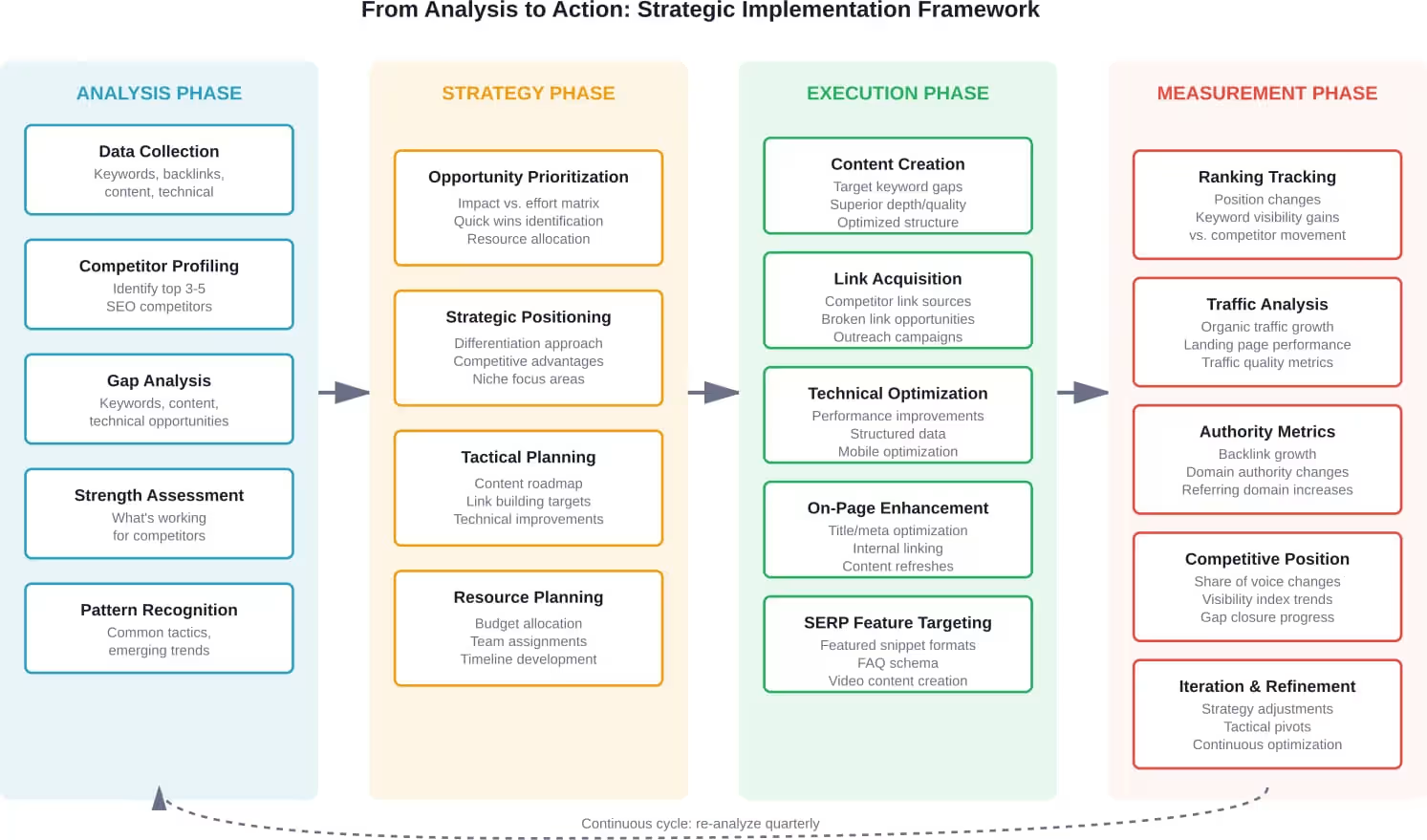
Raw competitive data becomes valuable only when translated into actionable strategy. The final step connects findings to specific tactics and priorities.
Creating a Competitive Strategy Document
Synthesize analysis findings into a strategic document outlining key insights, identified opportunities, and recommended actions. This document should answer several questions clearly.
What are competitors doing that’s working? Which of their tactics should be adopted or adapted? Where are they weak or missing opportunities? What differentiates their approach from others?
Prioritize opportunities based on potential impact versus effort required. Quick wins with moderate impact should be executed first to build momentum.
Building Implementation Roadmaps
Convert strategic recommendations into tactical roadmaps with specific tasks, owners, timelines, and success metrics. Without this operational translation, even brilliant insights remain unrealized.
Group tactics into themes—content creation, technical optimization, link building, etc.—then assign resources accordingly. Some initiatives will be ongoing while others are discrete projects.
Set measurement criteria for each initiative. How will success be defined? What metrics will be tracked? When will progress be reviewed?
Conclusion
SEO competitive analysis transforms guesswork into strategy. By systematically researching competitor keywords, content approaches, backlink profiles, and technical implementations, clear opportunities emerge that would otherwise remain hidden.
The process isn’t about copying what competitors do. It’s about understanding the competitive landscape well enough to make informed decisions about where to compete, how to differentiate, and which tactics deserve investment.
According to research from authoritative sources like Moz and Backlinko, competitive analysis works as a powerful research strategy that identifies specific opportunities for competitive advantage. This intelligence-driven approach consistently outperforms generic best practices.
Start with identifying true SEO competitors through SERP analysis. Extract and analyze their keyword portfolios to find gaps and opportunities. Evaluate their content strategies to understand what depth and formats are necessary to compete. Examine backlink profiles to discover link sources and understand authority levels. Assess technical implementation to ensure standards are met or exceeded.
Translate these findings into prioritized action plans. Focus on 3-5 primary competitors rather than trying to analyze everyone. Conduct deep analyses quarterly while monitoring key metrics monthly. Most importantly, ensure insights drive actual tactical execution rather than remaining theoretical.
The competitive landscape constantly evolves. Maintaining regular analysis cycles ensures awareness of competitor moves, emerging threats, and new opportunities as they develop.
Ready to start analyzing SEO competitors? Begin by identifying the 3-5 domains that consistently appear in search results for the most important keywords. That’s the foundation for everything else.