


Overview: A topical map SEO is a strategic framework that organizes website content by clustering related topics around core themes, establishing topical authority and improving search rankings. Completing a topical map involves identifying main topics, researching subtopics, structuring content clusters, mapping existing pages, and implementing internal linking strategies. This comprehensive approach aligns content with user intent and search engine expectations, creating a semantic network that demonstrates expertise.
Search engines aren’t looking for pages anymore. They’re looking for expertise.
Google’s automated ranking systems prioritize helpful, reliable information created to benefit people, according to Google’s official documentation. That means scattered blog posts and keyword-stuffed pages won’t cut it. What works is demonstrating comprehensive knowledge across an entire topic area—and that’s exactly what a topical map delivers.
The concept isn’t new. Moz noted that Google’s Hummingbird update marked a shift away from keyword stuffing and towards the importance of quality and relevance. The advice then? Create content in clusters and link them together. That advice has only become more critical as search evolves toward semantic understanding and entity recognition.
But here’s the thing—knowing you need topical authority is different from actually building it. Most websites approach content haphazardly, creating individual articles without a master plan. The result? Orphaned content, weak internal linking, and zero topical authority.
This guide walks through the complete process of building and implementing a topical map that actually works. No fluff, just the tactical steps backed by what’s working across high-ranking sites right now.
What Is a Topical Map in SEO?
A topical map is a strategic content framework that organizes information around core topics and their related subtopics. Think of it as a blueprint that shows how all content on a website connects through semantic relationships.
The structure typically follows a hub-and-spoke model. Core topics (pillars) sit at the center, with supporting subtopics branching out like spokes on a wheel. Each piece of content addresses a specific aspect of the broader theme while linking back to related content.
Here’s why this matters: search engines evaluate websites based on their demonstrated expertise in specific topic areas. According to Moz, topical authority represents how comprehensively a site covers a subject and how well search engines understand that coverage. A properly structured topical map makes this relationship crystal clear.
The benefits extend beyond rankings. Well-structured topic clusters improve site organization, make internal linking systematic rather than random, and help scale content effectively. Research shows that well-structured topic clusters improve search rankings, validating what SEO practitioners have observed for years.
Why Topical Maps Matter More in 2026
The search landscape has fundamentally shifted. Google’s introduction of AI Mode and the rise of large language models have changed how search engines evaluate and rank content.
Search Engine Journal reports that semantic similarity, topical depth, and context now matter more than optimization for specific keyword phrases. For example, a query like “most reliable Bluetooth headphones under $100” packs context far beyond the words themselves—and search engines now understand that context.
The AI shift reshapes search in several ways. First, embedding vectors rather than keywords determine visibility. Second, user queries are becoming more conversational and context-dependent. Third, search results increasingly prioritize sites with demonstrated topical breadth and depth.
Entity linking has also become critical. A case study showed that properly defining service entities using schema markup resulted in a 25% increase in clicks for non-branded queries featuring the “assisted living” entity. This demonstrates how semantic clarity translates directly to performance.
Real talk: if your content strategy still centers on individual keyword targets rather than comprehensive topic coverage, you’re already behind.
Build a Topical Map for Long Term SEO Growth
A topical map structures content around core themes and subtopics. Lengreo builds keyword clusters based on search intent and competition. The structure supports internal linking and authority growth. This improves long term ranking stability.
Ready to Create a Structured SEO Content Plan?
Talk with Lengreo to:
- define core topics and keyword clusters
- build a clear content hierarchy
- align articles with search intent
👉 Start with a topical SEO strategy session with Lengreo.
Step 1: Identify Your Core Topic
Everything starts with choosing the right main topic. This isn’t about picking something you’d like to rank for—it’s about identifying a topic that aligns with business goals, audience needs, and your capacity to provide genuine expertise.
Start by asking three questions. First, what does your business actually do? Second, what problems do your customers need solved? Third, what topics can you cover with genuine authority rather than surface-level content?
The intersection of these three questions is your sweet spot. A local accounting firm shouldn’t try to dominate all of business finance. But small business tax strategies? That’s specific, relevant, and defensible.
Evaluating Topic Viability
Not every topic makes sense as a core pillar. Some lack search volume. Others are too broad to tackle comprehensively. Still others might have search volume but no business value.
Assess each potential core topic against these criteria:
| Criterion | What to Look For | Red Flags |
|---|---|---|
| Search Demand | Consistent monthly searches for main topic and subtopics | Fewer than 100 total monthly searches across all variations |
| Business Relevance | Direct connection to products, services, or customer needs | Topic attracts traffic that never converts |
| Competitive Landscape | Mix of competitors and ranking opportunities | Completely dominated by Wikipedia and government sites |
| Content Depth | Enough subtopics to create 15-30+ pieces of content | Topic so narrow it only supports 3-4 articles |
| Expertise Match | Subject aligns with team knowledge and experience | Requires expertise you don’t have and can’t acquire |
Most sites should start with 2-4 core topics maximum. Going broader dilutes authority. Going narrower limits growth. Find that balance.
Step 2: Research and Identify Subtopics
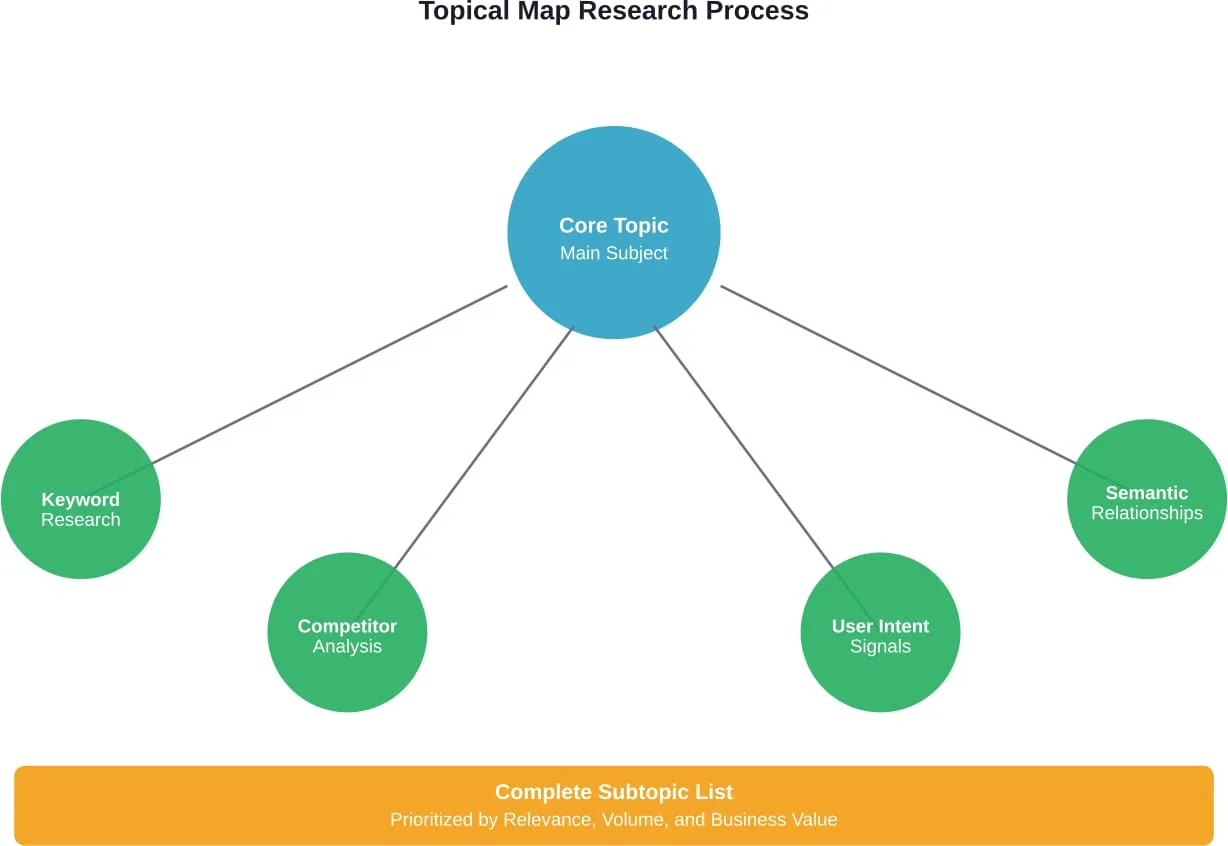
Once the core topic is locked in, the next phase involves identifying every relevant subtopic, supporting topic, and semantic variation that falls under that umbrella.
This isn’t keyword research in the traditional sense. The goal isn’t to find high-volume keywords—it’s to map the complete knowledge domain of your core topic.
Using Research Tools Effectively
Multiple tools provide insights into topic structure. Google Keyword Planner reveals search volume, competition, and related keywords for primary topics. Ahrefs and SEMrush offer competitive analysis, showing top-ranking websites and their content strategies.
But the most valuable data often comes from analyzing what already ranks. Look at the top 10 results for your core topic. What subtopics do they cover? What questions do they answer? What’s missing from their coverage?
Schema.org provides another layer of insight. The structured data model shows how entities and concepts relate within topic domains. Understanding these relationships helps build more semantically coherent topical maps.
Mining User Intent Signals
Search tools show what people search for. User intent signals show what people actually need.
Check Google’s “People Also Ask” boxes for your core topic. Each question represents a subtopic someone cares about. Scan related searches at the bottom of search results. Review forum discussions, Reddit threads, and community questions where your audience asks real questions.
This qualitative research uncovers gaps that purely quantitative keyword tools miss. Someone might search “project management software” but really need to understand “how to get team buy-in for new project management tools.” That’s a subtopic worth creating.
Step 3: Organize Topics Into Clusters
Raw subtopic lists need structure. Topic clusters provide that structure by grouping related subtopics under organizing themes.
A topic cluster consists of one pillar page covering a broad topic comprehensively, surrounded by cluster content—individual articles diving deep into specific subtopics. Each cluster article links to the pillar page and to related cluster content.
According to Moz’s guide on topic clusters, this organizational approach helps search engines understand topic relationships, improves site architecture, and makes internal linking strategic rather than arbitrary.
Creating Effective Cluster Hierarchies
Start by grouping subtopics into logical categories. If the core topic is “content marketing,” subtopics might cluster around content strategy, content creation, content distribution, content measurement, and content tools.
Each cluster should have 5-15 supporting articles. Fewer than five means the cluster might work better as sections within a single article. More than fifteen suggests the cluster might be too broad and should split into multiple clusters.
The hierarchy typically looks like this:
- Core Topic (homepage or main topic page)
- Pillar Pages (comprehensive guides for each major cluster)
- Cluster Content (specific articles answering detailed questions)
- Supporting Content (supplementary resources, examples, case studies)
Now, this is where it gets interesting. The structure isn’t rigid. Some topics naturally demand deeper hierarchies with sub-clusters. Others work better with a flatter structure. Let the content and user needs dictate the architecture, not some template.
Step 4: Assess Traffic Potential and Business Value
Not all subtopics deserve equal attention. Some drive significant traffic and conversions. Others generate clicks that go nowhere. Smart prioritization separates effective topical maps from theoretical exercises.
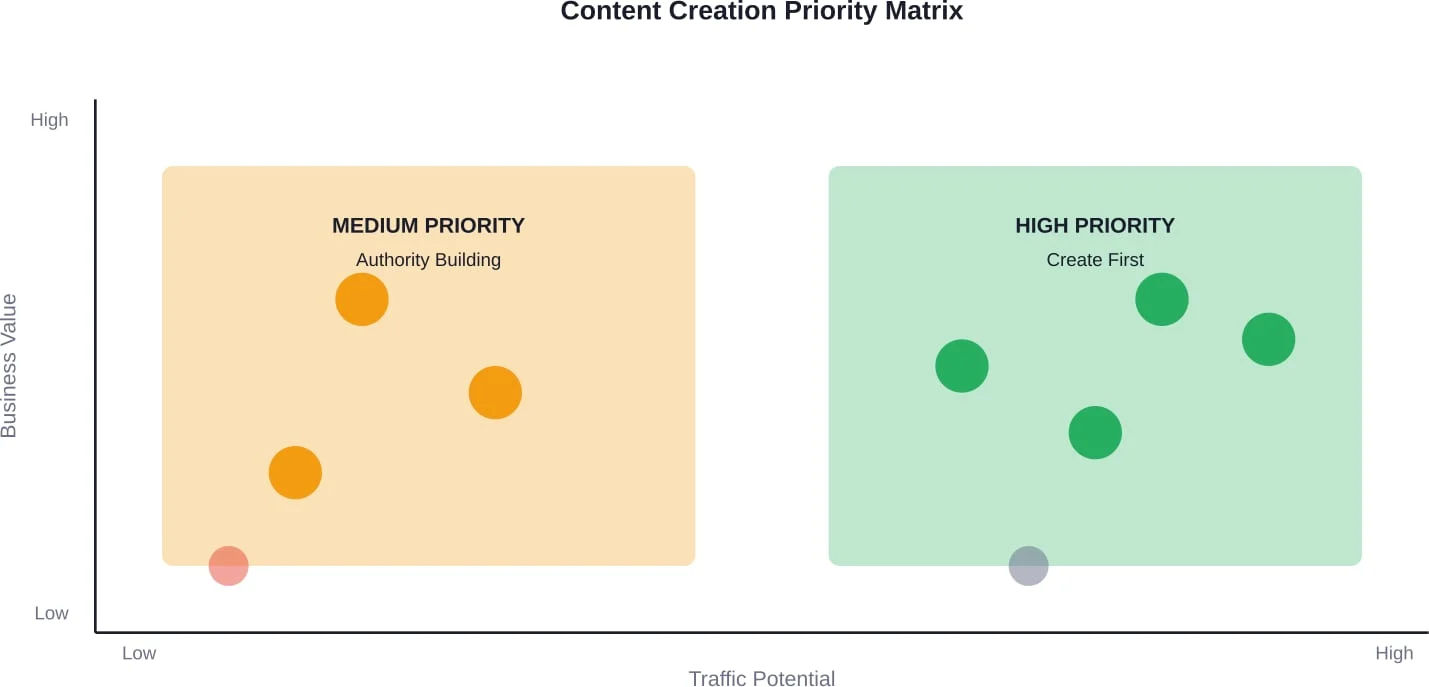
Traffic potential measures how many visitors a topic might attract. Business value measures how much those visitors matter. The sweet spot is topics with both high traffic potential and clear business value.
| Priority Level | Traffic Potential | Business Value | Action |
|---|---|---|---|
| High Priority | High volume or strategic keywords | Direct connection to products/conversions | Create first, optimize heavily |
| Medium Priority | Moderate volume | Indirect business connection | Include in content calendar |
| Low Priority | Low volume but important for completeness | Establishes authority | Create eventually for topical coverage |
| Skip | Minimal volume | No business connection | Remove from map |
Check search volume using Google Keyword Planner, Ahrefs, or SEMrush. But don’t obsess over exact numbers. A topic with 100 monthly searches from high-intent users beats 10,000 searches from tire-kickers.
Evaluate business value by asking: Does this topic attract potential customers? Does it address problems our products solve? Does it support the customer journey from awareness to decision?
Step 5: Map Existing Content and Identify Gaps
Most websites already have content—it’s just not organized strategically. This step involves auditing existing pages and mapping them to the topical structure.
Create a spreadsheet listing every published article, its current URL, its target topic, current performance metrics, and which cluster it belongs to. This reveals patterns quickly. Some clusters might be fully built out. Others have zero coverage.
Look for these common issues during content audits:
- Orphan pages—content that doesn’t link to anything or isn’t linked from anywhere
- Duplicate coverage—multiple articles targeting the same subtopic
- Thin content—pages that exist but don’t provide comprehensive information
- Misaligned content—articles that don’t match user intent for their target topic
- Missing clusters—entire topic areas with no coverage
The gap analysis comes next. Compare the ideal topical map against existing content. The gaps represent the content roadmap—topics that need new articles, existing articles that need expansion, and content that should be consolidated or retired.
Step 6: Plan Content Creation and Optimization
With gaps identified, the content plan takes shape. This isn’t just a list of articles to write—it’s a strategic roadmap prioritizing based on impact and resources.
According to Google’s official guidance on creating helpful content, automated ranking systems prioritize information created to benefit people rather than manipulate rankings. That principle should guide every content decision.
Prioritize content creation using these factors:
- Quick wins—topics where ranking is achievable and business impact is immediate
- Foundation content—pillar pages that anchor entire clusters
- Competitive gaps—topics where competitors have weak coverage
- Seasonal opportunities—topics with time-sensitive relevance
- Completeness—filling holes that prevent comprehensive topical coverage
Content Brief Development
Each content piece needs a detailed brief specifying target topic, primary and secondary keywords, search intent, target audience, required word count, content structure, internal linking targets, and external sources to reference.
The brief should answer the question: What does this content need to accomplish? Not just “rank for X keyword,” but “help users understand Y concept well enough to make decision Z.”
Content briefs also standardize quality. Whether content is created in-house, by freelancers, or with AI assistance, briefs ensure consistency and topical relevance.
Step 7: Implement Strategic Internal Linking
Internal linking transforms isolated articles into a cohesive topical map. The structure tells search engines which pages are most important, how topics relate to each other, and where expertise is concentrated.
Strategic internal linking follows specific patterns. Pillar pages link to all cluster content within their topic area. Cluster articles link back to the pillar page and to related cluster content. Hierarchical navigation reinforces the topical structure through categories and breadcrumbs.
The link architecture should be intentional. Moz’s research on topical authority emphasizes creating content in clusters and linking them together as a core strategy. Random links help less than zero—they create noise without signal.
Internal Linking Best Practices
Use descriptive anchor text that signals what the linked page is about. “Click here” tells search engines nothing. “How to conduct keyword research for topical maps” provides clear semantic context.
Link from high-authority pages to newer content that needs boosting. Pages that already rank well pass authority through internal links, helping related content gain traction faster.
Don’t overdo it. Three to five contextual links per 1,000 words is reasonable. Forty links in a 500-word article looks like spam and dilutes link equity.
Monitor internal link distribution. Tools like Screaming Frog or Ahrefs Site Audit show which pages have strong internal linking and which are orphaned. Fix imbalances systematically.
Step 8: Add Structured Data and Entity Markup
Structured data helps search engines understand content relationships at a semantic level. Schema.org provides standardized markup for entities, creative works, and their relationships.
According to Schema.org documentation, properties can have multiple types as domains, creating a flexible framework for describing how entities relate within knowledge domains.
For topical maps, several schema types prove particularly valuable. Article schema identifies content type and topic. BreadcrumbList schema reinforces topical hierarchy. FAQPage schema captures question-answer relationships. WebPage schema with about and mentions properties links content to specific entities.
Case studies on semantic SEO and entity linking show varying results, but structured data (Schema.org) significantly improves rich result eligibility, which can lead to higher click-through rates (CTR) for non-branded queries.
Implementing Entity-Based Markup
Start by identifying the main entities discussed in content. For an article about project management software, relevant entities might include specific products, methodologies like Agile or Scrum, related concepts like sprint planning, and organizational types that use the software.
Use schema markup to make these entity relationships explicit. The about property identifies the main entity. The mentions property tags related entities. This creates a semantic web that helps search engines understand topical scope and relationships.
JSON-LD is the preferred format according to Google documentation. It’s easier to implement than inline markup and doesn’t interfere with page rendering.
Step 9: Monitor Performance and Iterate
Topical maps aren’t static. Performance monitoring reveals what’s working, what needs adjustment, and where new opportunities emerge.
Track these metrics across the topical map:
- Organic traffic by cluster—which topic areas drive the most visitors
- Ranking improvements—how cluster and pillar pages move in search results
- Internal link flow—whether link architecture effectively passes authority
- Engagement metrics—time on page, pages per session, bounce rate by cluster
- Conversion patterns—which topics generate leads, sales, or other goals
Use Google Search Console to identify which queries drive traffic to each cluster. Look for patterns. Some clusters might rank for unexpected terms, revealing new subtopic opportunities. Others might underperform despite optimization, suggesting strategic issues.
| Metric | What It Reveals | Action If Underperforming |
|---|---|---|
| Organic Traffic Growth | Overall topical map effectiveness | Review targeting, content quality, technical issues |
| Cluster-Level Rankings | Topic-specific authority | Expand content, strengthen internal linking, add depth |
| Internal Link Clicks | User navigation patterns | Improve linking placement, anchor text, relevance |
| Content Engagement | Content usefulness and relevance | Rewrite for clarity, add media, improve structure |
| Conversion Rate by Cluster | Business value of topics | Add CTAs, improve user journey, reassess topic choice |
Iterative Optimization
Based on performance data, prioritize improvements. High-traffic pages ranking in positions 4-10 are prime candidates for optimization—small improvements can yield significant traffic gains.
Content gaps become apparent through search query analysis. Users search for topics within a cluster that don’t have dedicated content. Fill those gaps.
Update older content regularly. Search engines favor fresh, current information. Refresh statistics, add recent examples, expand sections that need more depth, and remove outdated information.
Common Topical Map Mistakes to Avoid
Even well-intentioned topical maps fail when certain mistakes creep in.
Starting too broad is the most common error. Trying to dominate “marketing” or “finance” as a core topic requires resources most sites don’t have. Narrow focus builds authority faster than broad coverage.
Ignoring user intent creates content that ranks poorly because it doesn’t match what searchers actually want. Someone searching “project management software” might want comparison reviews, implementation guides, or pricing information. Content that doesn’t match intent gets ignored.
Weak internal linking undermines the entire strategy. If cluster content doesn’t link to pillar pages and related articles, the topical structure exists only in a spreadsheet—search engines can’t see it.
Inconsistent content quality damages authority. Three excellent articles and seven mediocre ones in a cluster don’t establish expertise—they establish inconsistency.
Neglecting maintenance means topical maps decay. Content becomes outdated, links break, new subtopics emerge uncovered, and competitors fill gaps. Topical authority requires ongoing effort, not just initial setup.
Advanced Topical Map Strategies
Once basic topical map structure is in place, advanced strategies amplify results.
Semantic Expansion
Search Engine Journal notes that semantic similarity and topical depth matter more than specific keyword optimization. Semantic expansion involves identifying related concepts, synonyms, and co-occurring terms that strengthen topical signals.
Use tools like Natural Language Processing APIs to identify semantically related terms. Include these terms naturally throughout content to reinforce topical relevance without keyword stuffing.
Cross-Cluster Linking
While most internal links should stay within clusters, strategic cross-cluster links create a more sophisticated topical network. When two clusters naturally relate—like “content marketing” and “SEO strategy”—linking between them shows topical breadth.
But wait. These cross-cluster links need clear contextual relevance. Random links between unrelated clusters confuse rather than clarify topical relationships.
Topical Freshness Signals
For some topics, freshness matters tremendously. SEO strategies, technology reviews, regulatory information, and trending subjects all benefit from regular updates.
Build update schedules into content maintenance. High-priority pillar pages might need quarterly reviews. Cluster content might need annual refreshes. Breaking news topics might require weekly or daily updates.
Add “last updated” dates and update logs to signal freshness. These elements tell users and search engines that content remains current and actively maintained.
Tools for Building Topical Maps
Several tools streamline the topical mapping process, though none automate it completely.
Keyword research platforms like Ahrefs, SEMrush, and Google Keyword Planner provide search volume data and related keyword suggestions. These form the foundation of topic research.
Content analysis tools like Clearscope, MarketMuse, and Surfer SEO help identify semantic relationships and content gaps. They analyze top-ranking content to reveal what comprehensive coverage looks like.
Mind mapping software like MindMeister, Coggle, or even spreadsheets help visualize topic relationships. Visual maps make cluster structure clear and identify missing connections.
Project management tools like Asana, Trello, or Monday.com track content creation progress. Moving from strategy to execution requires organized workflow management.
Analytics platforms including Google Analytics and Search Console monitor performance. Without measurement, optimization is guesswork.
Real-World Topical Map Examples
Looking at how high-authority sites structure topical coverage provides practical templates.
Ahrefs structures their content around clear topic clusters. Their SEO blog has pillar content on link building, keyword research, technical SEO, and content marketing. Each pillar connects to dozens of cluster articles diving into specific aspects. The internal linking is systematic—every cluster article links back to its pillar and to related cluster content.
Moz takes a similar approach with comprehensive guides serving as pillar pages. Their topic clusters cover search engines, keyword research, link building, and local SEO. The structure makes it easy to navigate related content and demonstrates clear topical expertise in each area.
Industry-specific sites follow the same principles. A healthcare site might build clusters around specific conditions, treatments, prevention, and patient education. A finance site might cluster around investing, banking, credit, and financial planning.
The pattern is consistent: clear core topics, comprehensive coverage through organized clusters, strategic internal linking, and regular content updates.
Conclusion
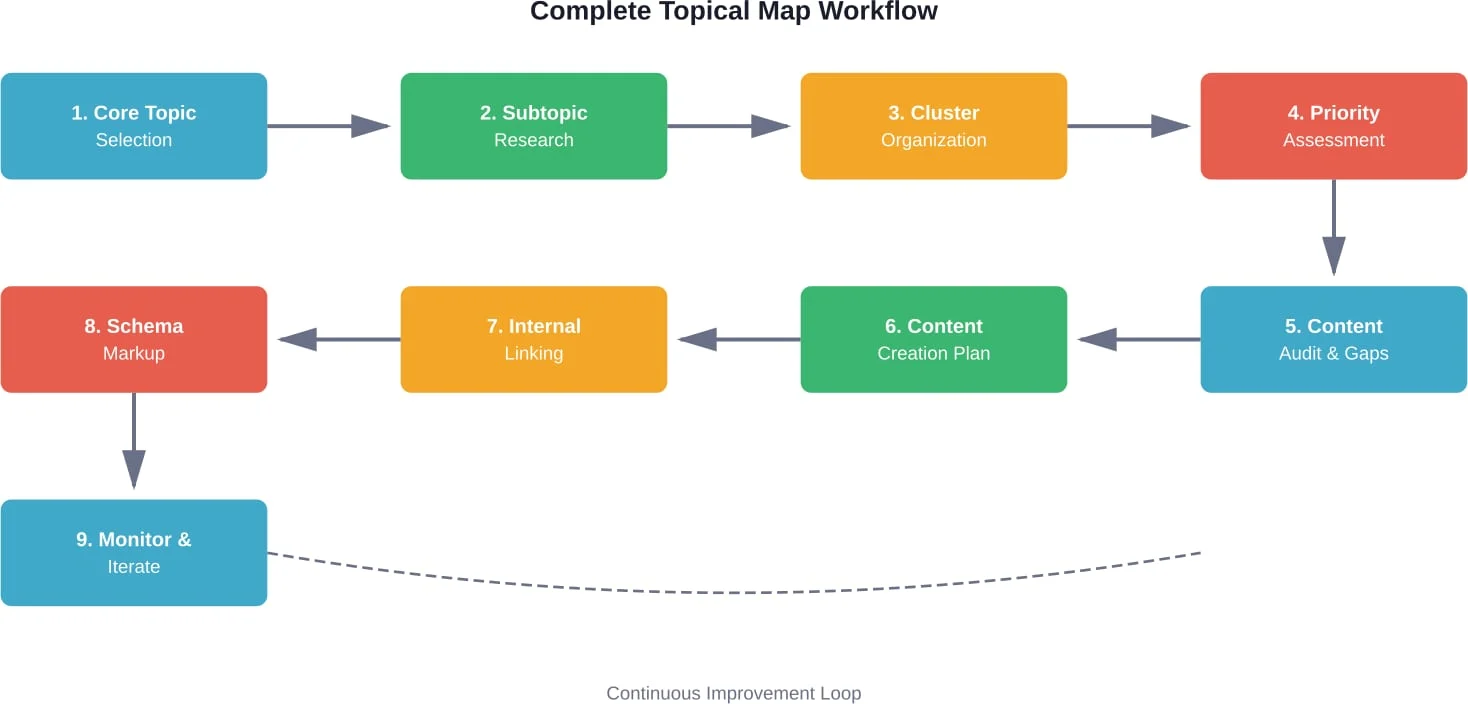
Topical maps transform random content into strategic assets. The process—identifying core topics, researching subtopics, organizing clusters, prioritizing based on value, mapping existing content, planning creation, implementing internal linking, adding structured data, and continuously optimizing—builds genuine topical authority.
Google’s ranking systems prioritize helpful, reliable information created to benefit people. A well-executed topical map does exactly that by organizing comprehensive coverage of subjects in ways that serve user needs.
The work isn’t trivial. Building comprehensive topical coverage takes time, resources, and sustained effort. But the alternative—scattered content without strategic direction—wastes those same resources with minimal return.
Start small. Pick one core topic where demonstrating expertise aligns with business goals. Research thoroughly. Build the cluster systematically. Monitor what works. Iterate based on data. Then expand to additional topics.
Search engines reward topical authority because users value comprehensive, reliable information. Creating that value through strategic topical maps isn’t just good SEO—it’s good business.
Ready to build your topical map? Choose your core topic today. The sooner you start building topical authority, the sooner you dominate search results in your niche.