


External links remain one of the most powerful ranking signals in search algorithms. But here’s the thing—building them effectively requires more than just mass outreach or buying directory listings.
According to Google’s Search Central documentation, links serve as signals for determining page relevancy and discovering new content to crawl. The challenge isn’t understanding that links matter. It’s knowing how to earn them systematically without triggering spam filters or wasting time on tactics that stopped working years ago.
This guide breaks down the strategies that actually work in 2026, from content-driven approaches to technical best practices that make link acquisition sustainable.
What Are External Links and Why Do They Matter?
External links—also called backlinks or inbound links—are hyperlinks from other websites pointing to your domain. When authoritative sites link to your content, search engines interpret this as a vote of confidence.
The logic is straightforward. If multiple reputable sources reference your content, it’s probably valuable. Search algorithms use these signals to assess trustworthiness and relevance.
Domain Authority, developed by Moz, attempts to predict how well a website will rank based partially on its link profile. The score ranges from 1 to 100, with higher scores indicating stronger ranking potential. According to Moz, Domain Authority is requested over 1 billion times per year, making it one of the most widely referenced metrics in SEO.
Research published by Moz on November 8, 2021, confirmed that links and brand authority show strong correlation with search rankings. The study analyzed the first 20 organic results for every MozCast keyword and found consistent patterns linking backlink profiles to ranking position.
The Foundation: Understanding Link Quality vs. Quantity
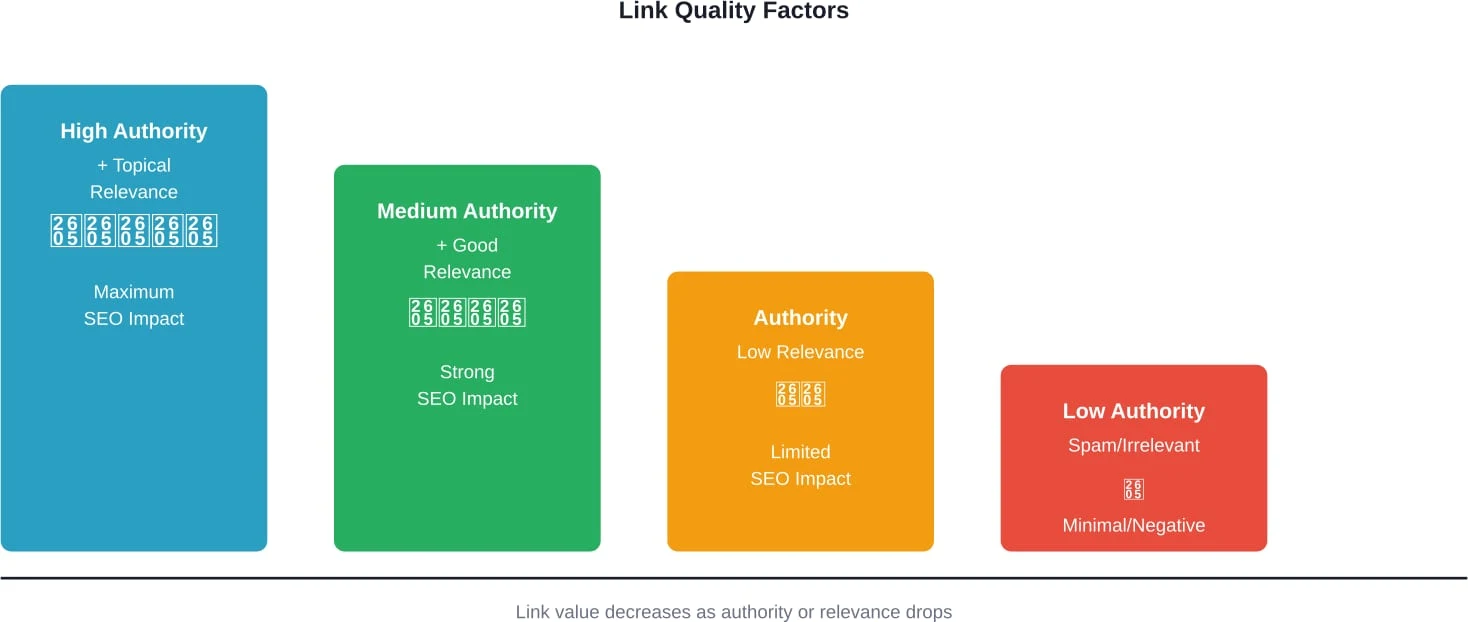
Not all links carry equal weight. A single link from a highly authoritative domain often outperforms dozens of links from low-quality directories.
Search engines evaluate several factors when assessing link value:
- Source authority: Links from established, trusted domains carry more weight
- Relevance: Links from topically related sites signal contextual authority
- Anchor text: The clickable text provides context about the linked content
- Link placement: Editorial links within content perform better than sidebar or footer links
- Follow vs. nofollow: While nofollow links don’t pass direct ranking value, they still drive traffic and brand visibility
A study published by Moz on November 9, 2022, examined which link metrics correlate most closely with organic visibility. The research emphasized topical link relevance—a score showing how relevant a keyword or topic is to the entire document text or range of pages analyzed.
Content-Driven Link Building Strategies
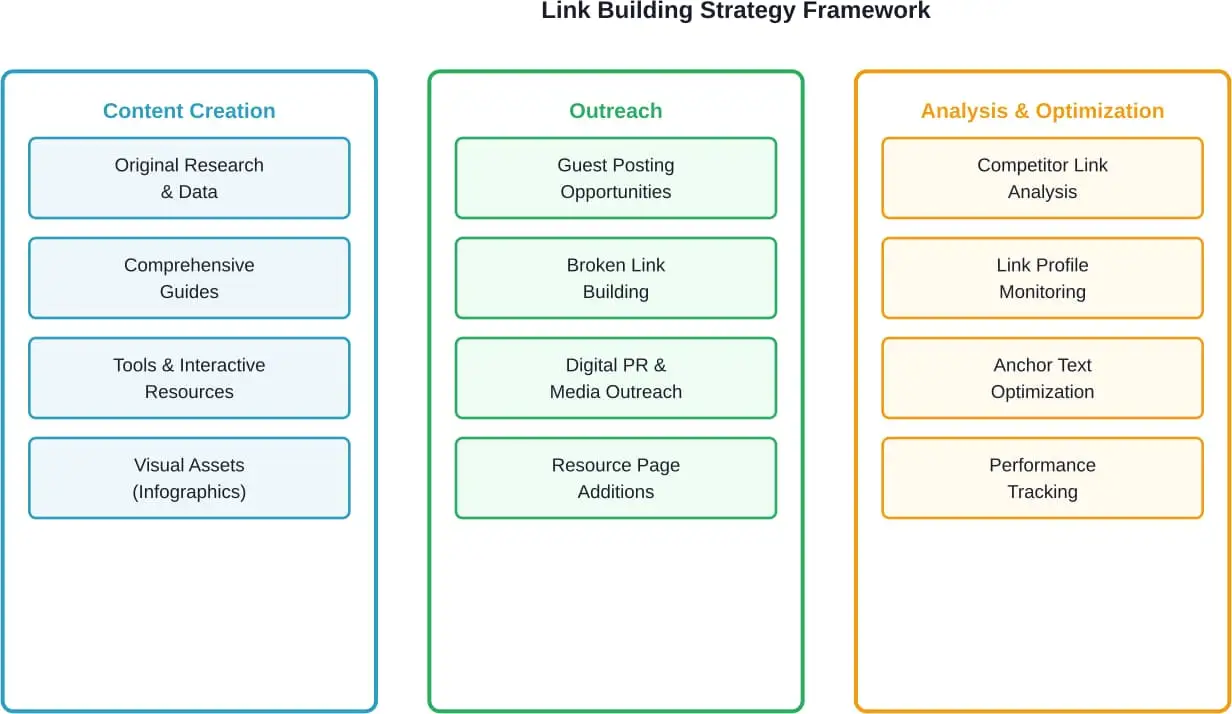
The most sustainable link building happens when you create content others naturally want to reference. These strategies focus on earning links through value rather than requesting them.
Create Link-Worthy Research and Data
Original research, industry surveys, and proprietary data attract links because they provide unique information others can’t find elsewhere.
Consider publishing:
- Industry benchmark reports with original statistics
- Survey results addressing common industry questions
- Case studies with specific results and methodologies
- Data visualizations that simplify complex information
When other sites reference this data, they typically include a backlink to the source. This approach scales because a single piece of research can generate links for months or years.
Develop Comprehensive Resource Guides
In-depth guides that thoroughly cover a topic become go-to resources for both users and other content creators. These tend to accumulate links over time as more people discover and reference them.
Effective resource guides share common characteristics:
- They address a topic comprehensively, not superficially
- They’re updated regularly to maintain accuracy
- They include original insights, not just aggregated information
- They’re structured for easy navigation and reference
Build Tools and Calculators
Interactive tools provide utility that static content can’t match. When a tool solves a specific problem, it naturally attracts links from users who want to share it with their audience.
Popular tool formats include calculators, assessment quizzes, comparison tools, and template generators. The key is solving a genuine problem rather than creating a tool for the sake of link building.
Outreach-Based Link Building Techniques
While earned links through quality content form the foundation, strategic outreach accelerates the process. These methods involve actively requesting or creating opportunities for links.
Guest Posting on Relevant Sites
Contributing content to other websites in your industry provides value to their audience while earning a contextual backlink. The effectiveness depends heavily on targeting the right publications.
Focus on sites that:
- Serve your target audience
- Have established authority in your industry
- Maintain editorial standards and publish quality content
- Allow contextual links within the content body
Avoid guest posting networks or sites that exist solely to sell links. These provide minimal value and risk manual penalties.
Broken Link Building
This technique involves finding broken links on relevant websites, then suggesting your content as a replacement. It works because you’re helping site owners fix a genuine problem.
The process follows these steps:
- Identify sites in your industry with resource pages
- Use tools to scan those pages for broken links
- Create content that matches the broken link’s topic (or identify existing content)
- Contact the site owner, noting the broken link and suggesting your resource
Success rates tend to be higher than cold outreach because you’re offering a solution rather than just requesting a link.
Digital PR and Media Outreach
Generating media coverage and mentions in online publications creates high-authority backlinks while building brand visibility. This approach works best when you have genuinely newsworthy angles.
Effective digital PR tactics include:
- Responding to journalist queries through services like HARO
- Pitching data-driven stories to relevant publications
- Creating visual assets (infographics, charts) that journalists want to use
- Commenting on industry news and trends as an expert source
Competitive Link Analysis
Analyzing competitor backlink profiles reveals opportunities they’ve already validated. If a site links to your competitor, they might be open to linking to similar content from your site.
A guide published by Moz on January 16, 2011, titled ‘Guide to Competitive Backlink Analysis,’ outlined strategies for leveraging link data for competitive insights. The analysis revealed that understanding competitor link profiles allows for more scientific SEO approaches.
Start by identifying your top-ranking competitors for target keywords.
Then examine their backlink profiles to find:
- Common linking domains across multiple competitors
- High-authority sites in your space
- Content types that attract the most links
- Guest posting opportunities they’ve used
- Resource pages that list competitor content
The research noted that analysis can reveal aggressive anchor text strategies. In some competitive niches, approximately 30% of links for ranking pages use specific anchor text targeting particular keywords.
Technical Best Practices for Link Building
According to Google’s Search Central documentation, links must be crawlable in standard HTML format for search engines to discover and evaluate them properly. Technical implementation matters as much as acquisition strategy.
Make Links Crawlable
According to Google’s official guidelines, search engines need to follow links to discover content. This means using standard HTML link elements rather than JavaScript-dependent navigation.
Best practices include:
- Using standard <a href> tags with valid URLs
- Ensuring links don’t require JavaScript execution to render
- Avoiding blocking important pages with robots.txt or noindex directives
- Creating logical site architecture that search crawlers can navigate
Optimize Anchor Text
Google’s Search Central Blog post on linking out, published on October 8, 2008, emphasized the importance of anchor text for helping users and search engines understand content.
Effective anchor text is:
- Descriptive: It clearly indicates what the linked page is about
- Concise: Usually a few words or a short phrase
- Natural: It fits seamlessly within the content flow
- Varied: Different sources should use naturally diverse anchor text
Over-optimized anchor text—where too many links use exact-match keywords—can trigger spam filters. Natural link profiles show variety in how different sites reference your content.
Use Appropriate Link Attributes
Google provides specific guidance on qualifying outbound links using rel attributes. While this primarily affects links you create, understanding these signals helps when requesting links from others.
| Attribute | Purpose | When to Use |
|---|---|---|
| rel=”sponsored” | Identifies paid links | Affiliate links, paid placements |
| rel=”ugc” | Marks user-generated content | Forum posts, comments |
| rel=”nofollow” | Indicates link shouldn’t pass authority | Untrusted content, general use |
| No attribute | Standard editorial link | Natural, editorial links |
Link Building Pitfalls to Avoid
Understanding what doesn’t work prevents wasted effort and potential penalties. Search algorithms have evolved to detect and devalue manipulative link schemes.
Low-Quality Directory Submissions
While legitimate business directories can provide value, most directory networks exist solely to sell links. These provide minimal benefit and can harm rankings if they’re part of a link scheme.
Reciprocal Link Exchanges
Systematic link exchanges—where sites agree to link to each other—are easily detected and carry little weight. Organic link networks develop naturally through relationships and content quality, not through formal exchanges.
Irrelevant Link Insertion
Links work best when they’re contextually relevant to both the source and target content. Securing links from completely unrelated sites raises red flags and provides little ranking benefit.
Over-Optimized Anchor Text
Research from competitive backlink analysis shows that while some aggressive anchor text strategies exist, balance matters. Sites that rely too heavily on exact-match anchor text risk appearing manipulative.
Measuring Link Building Success
Effective link building requires tracking the right metrics to understand what’s working and where to adjust strategy.
Key Performance Indicators
Track these metrics to gauge link building effectiveness:
| Metric | What It Measures | Why It Matters |
|---|---|---|
| Total Referring Domains | Number of unique sites linking to you | Indicates overall link diversity |
| Domain Authority Growth | Changes in overall site authority | Reflects cumulative link profile strength |
| Link Velocity | Rate of new link acquisition | Shows campaign momentum |
| Ranking Position Changes | Movement for target keywords | Measures actual SEO impact |
| Referral Traffic | Visitors from backlinks | Demonstrates real user value |
Attribution and ROI
Link building often shows results over months rather than days. Track performance using cohort analysis—grouping links by acquisition date and monitoring their cumulative impact on rankings and traffic.
Share of Voice (SOV) provides another useful metric. According to research from Moz published on November 9, 2022, Share of Voice (SOV) expresses visibility as a percentage of total available search volume for a keyword set. If SOV is 25%, you’re capturing 25% of the clicks for that keyword group.
Building a Sustainable Link Building Process
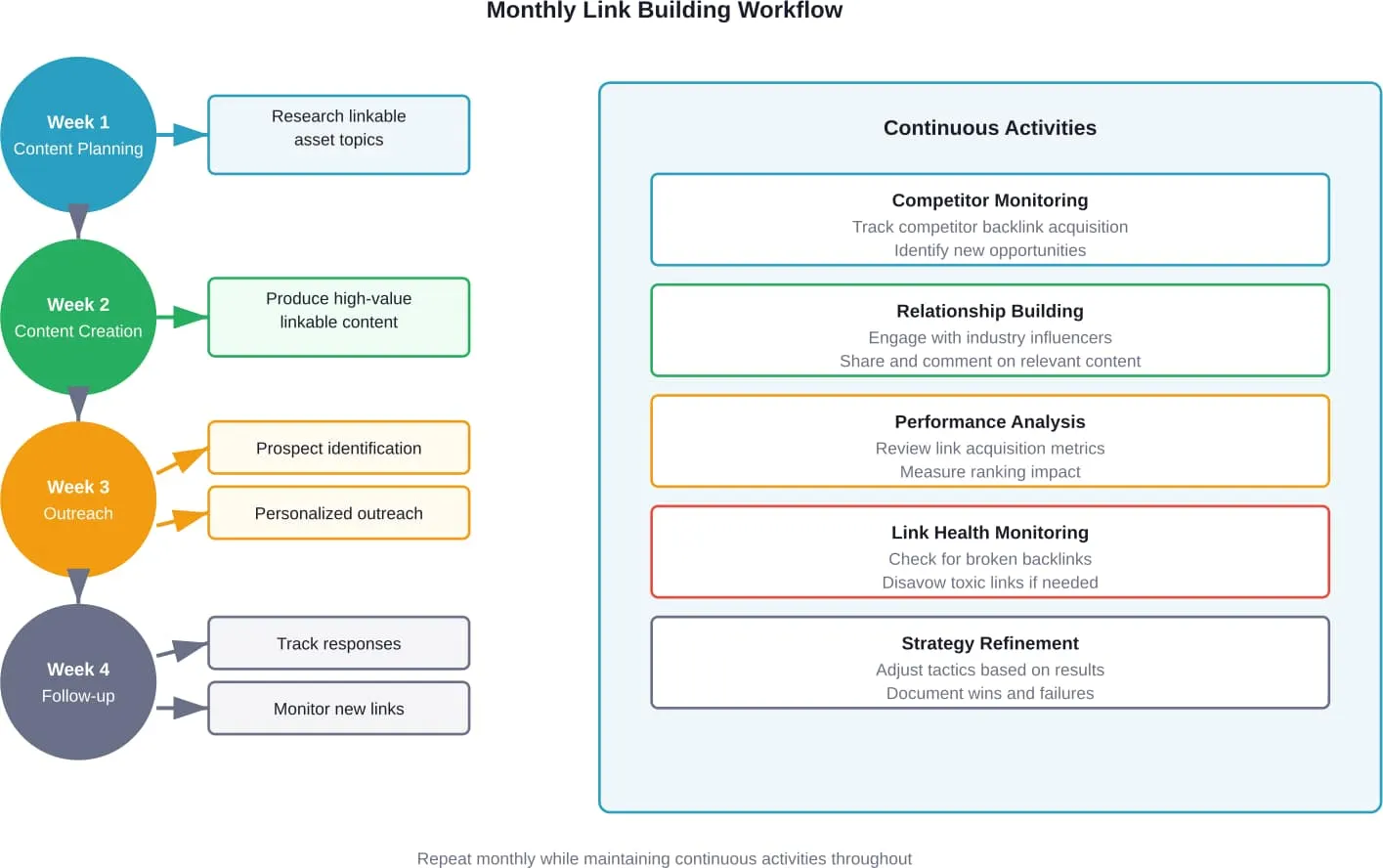
One-off campaigns generate temporary results. Sustainable link building requires systematic processes that continue generating links over time.
Content Calendar Integration
Align content creation with link building goals. Every piece of content should consider link acquisition potential during the planning phase. This might mean adding data points that make content more reference-worthy or creating formats that naturally attract links.
Relationship Development
The most effective link builders cultivate genuine relationships with industry influencers, journalists, and site owners. These relationships make future outreach significantly easier and more successful.
Focus on providing value before asking for links. Share others’ content, offer expert commentary, and establish yourself as a helpful resource within your industry.
Template and Process Documentation
Create templates for common outreach scenarios—guest post pitches, broken link notifications, resource suggestions. This consistency improves efficiency while maintaining quality.
Document successful processes so teams can replicate what works. Include templates, best practices, and lessons learned from both successes and failures.
Scalable SEO Growth with LenGreo
Building a sustainable backlink profile is a sophisticated endeavor that requires a blend of creative outreach and technical precision. At LenGreo, we move beyond generic tactics by integrating directly with your team to lead your digital marketing efforts. Our systematic approach to SEO and link building focuses on acquiring high-authority placements that align with your specific industry, ensuring every link serves as a genuine driver of domain authority and organic traffic.
We understand that in 2026, search engines prioritize relevance and transparency above all else. Whether we are executing a data-driven content strategy or managing complex white-label SEO operations, our goal is to deliver measurable ROI through qualified lead generation. By tailoring our strategies to your unique market position, we help you navigate the evolving search landscape with confidence and achieve the long-term visibility your brand deserves.
Conclusion: Building Links That Last
Effective link building combines strategic planning with consistent execution. The tactics that work in 2026 prioritize earning links through genuine value rather than manipulating algorithms through shortcuts.
Start with content that deserves links—original research, comprehensive guides, and tools that solve real problems. Then amplify reach through targeted outreach to relevant sites and publications. Monitor performance, refine approaches based on results, and maintain ethical practices that won’t trigger penalties.
The fundamentals remain consistent even as specific tactics evolve. Quality beats quantity. Relevance matters as much as authority. Natural link profiles show diversity in sources, anchor text, and acquisition patterns.
Build your link acquisition process around these principles, and results will compound over time. Ready to strengthen your backlink profile? Start by auditing your existing links, identifying your most link-worthy content, and mapping out opportunities where strategic outreach could connect your resources with relevant audiences.